The Architecture of Belief
El Arte Monumental | Catalogue: The Architecture of Belief
Catalogue Entry: Buddhism (2018) | Art Curator: Daniel Varzari
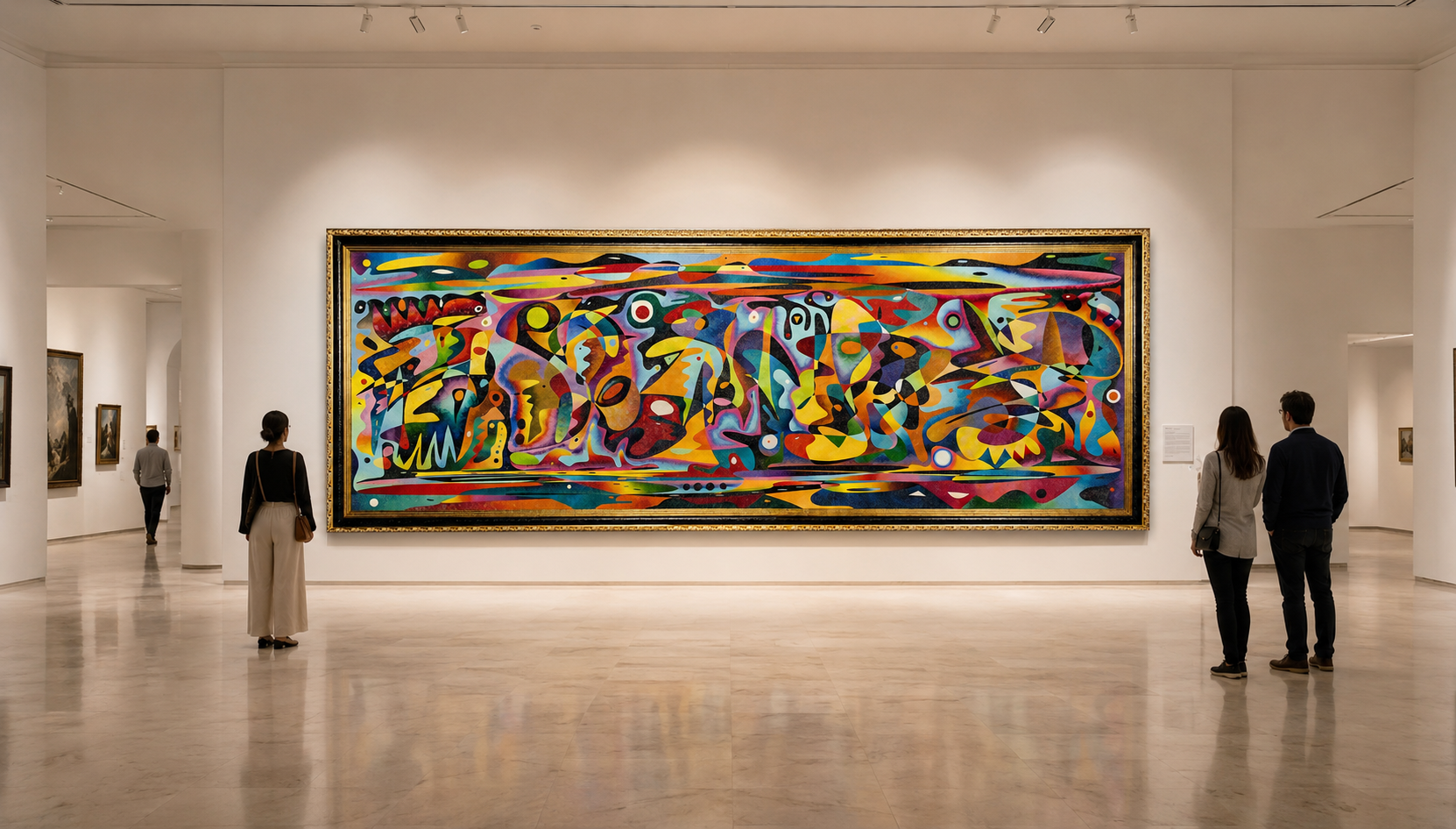
Within the broader framework of the 10 Religions series, Gheorghe Virtosu’s Buddhism occupies a pivotal position, articulating a shift from structured cosmological systems toward a more fluid, process-oriented understanding of existence. The work does not attempt to visualize doctrine through recognizable symbols; rather, it reconstructs the perceptual and ontological conditions associated with Buddhism. In doing so, Virtosu moves beyond representation, inviting the viewer into a field where meaning is not delivered but continuously produced through engagement.
What distinguishes this painting is its refusal of hierarchy and stability. Forms emerge only to dissolve, faces appear without consolidating into identity, and color operates independently of descriptive function. This compositional logic resonates with both Buddhist philosophy and key strands of post-structuralist thought, from the open-ended signification described by Roland Barthes¹ to the relational ontology articulated by Gilles Deleuze². The painting becomes a site in which perception itself is destabilized, revealing the extent to which reality is constructed through shifting relations rather than fixed structures.
In this context, Buddhism should be understood not as an image to be decoded, but as an environment to be experienced. Its panoramic scale and dense visual field position the viewer within a continuous process of recognition and loss, mirroring the principles of impermanence, interdependence, and non-self. Virtosu’s achievement lies in his ability to translate these philosophical concepts into a visual language that remains open, dynamic, and resistant to closure, ultimately foregrounding the act of perception as both the subject and the medium of the work³.
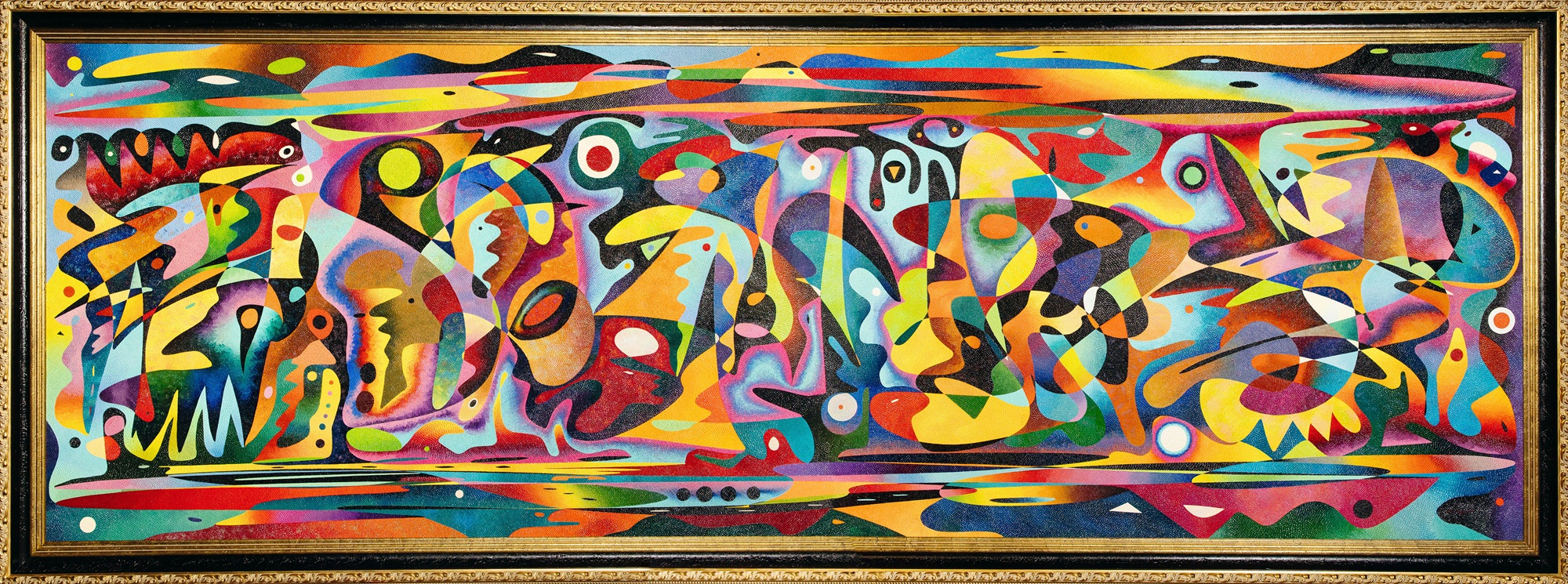
Buddhism (2016–2018) by Gheorghe Virtosu presents a large-scale panoramic composition in which abstract and biomorphic forms unfold across a continuous horizontal field. The painting resists fixed structure, instead organizing itself through a dynamic interplay of emergence, transformation, and dissolution. A central band of loosely defined faces—ranging from youthful to aged—appears and disappears within the composition, while the upper and lower zones remain largely non-figurative, suggesting conditions of formation and dispersal rather than stable environments.
Color plays a central role in shaping the visual experience. Highly saturated hues—yellows, blues, reds, and greens—move fluidly across the surface, disregarding boundaries and destabilizing form. Rather than describing objects, color operates as an active force, generating connections between disparate elements and reinforcing the sense of constant flux. Edges dissolve through gradual transitions, producing a layered field in which forms overlap and shift across multiple perceptual planes.
The composition offers no singular focal point or hierarchy. Instead, meaning emerges through the viewer’s movement across the canvas, where recognizable elements briefly cohere before dissolving back into the surrounding field. This continuous oscillation between figuration and abstraction creates an immersive environment that emphasizes transformation, interconnection, and the instability of perception.
Buddhism (2016–2018) engages with the fundamental principles of Buddhist philosophy—impermanence, non-self, interdependence—through abstract, biomorphic forms. Virtosu’s composition does not illustrate doctrinal content; instead, it enacts the structural processes that underlie Buddhist thought, translating cycles of awareness and transformation into a visual language of continuous emergence and dissolution.
Central to the painting is the proliferation of faces across the midsection, representing both the variability of human experience and the transient nature of identity. Faces arise, stabilize briefly, and then dissolve into surrounding forms, refusing static representation. This formal approach mirrors the Buddhist notion of non-self (anattā) and the interdependent origination of phenomena⁵, emphasizing that neither identity nor perception exists independently.
The upper and lower zones of the canvas, largely devoid of faces, function as abstract registers of “sky” and “land.” These areas operate as perceptual and metaphysical grounds in which forms emerge and dissipate. Their non-figurative character reinforces the painting’s central principle: impermanence is not only a philosophical abstraction but a visual and experiential condition.
Chromatic strategy is equally significant. Virtosu employs highly saturated, fluid colors that traverse forms, destabilizing edges and merging structures. Color is not descriptive; it is generative, producing relations between forms, guiding perception, and enacting impermanence at the sensory level¹. This approach resonates with Roland Barthes’ concept of the deferred signifier¹ and Deleuze’s productive notion of difference⁴, in which meaning emerges dynamically rather than existing as a fixed entity.
The painting’s non-hierarchical structure and continuous visual flow evoke Deleuze and Guattari’s notion of the rhizome². Forms, faces, and chromatic elements interact across the surface as a distributed network of intensities, where no element dominates. The viewer is implicated in this field, moving through the canvas and generating meaning in real time—a reflection of both phenomenological perception⁷ and the Buddhist principle of dependent origination⁵.
Psychoanalytic theory also illuminates the work’s conceptual framework. Recurring eye-like motifs suggest a decentralized gaze, destabilizing the subject’s position and echoing Lacan’s insight that the gaze constitutes the subject⁹. Here, perception is distributed: the observer is enmeshed within the visual field, and the act of seeing becomes inseparable from the process of being seen.
Ultimately, Buddhism embodies a metasymbolic process: it does not represent doctrine directly but enacts the relational and impermanent structures that underpin Buddhist philosophy. The painting’s fluid forms, dispersed faces, and chromatic oscillations constitute an immersive visual meditation on impermanence, interdependence, and the continuous generation of meaning, positioning the viewer as an active participant within the work’s unfolding field.
Virtosu (active 2010s–present) is an interdisciplinary painter and conceptual artist whose work interrogates the structural and symbolic underpinnings of human belief systems. Employing large-scale, immersive canvases, Virtosu synthesizes biomorphic abstraction, architectural form, and symbolic motifs to explore the interplay between consciousness, identity, and cosmology. Their practice is informed by comparative philosophy, mythology, and the study of ritualized imagery, translating complex metaphysical ideas into visual sequences that are simultaneously gestural and highly structured.
Within the 10 Religions series, Buddhism (2016–2018) exemplifies Virtosu’s approach, examining a major world tradition through abstract form. Spanning six meters horizontally, the painting integrates floating faces, biomorphic clusters, and dynamic chromatic transitions to evoke impermanence, interdependence, and the non-self. The work foregrounds the fluidity of symbols and relational perception, positioning the viewer as an active participant in the generation of meaning and the experience of a continuous field of transformation.
Exhibited internationally in both solo and group shows, Virtosu’s work has been included in collections emphasizing contemporary explorations of spirituality and abstraction. Their approach bridges philosophical inquiry and painterly innovation, creating works that challenge conventional boundaries between figuration and abstraction, narrative and process, and self and cosmos. Through sustained engagement with cross-cultural cosmologies, Virtosu’s paintings function as both visual philosophy and experiential environment, inviting reflection on the conditions of perception, identity, and interconnectedness.
Executed in oil on canvas, Buddhism measures 2 × 6 meters, creating an immersive and panoramic visual field. The scale allows viewers to experience the simultaneous emergence and dissolution of forms across multiple perceptual planes. Layered brushwork produces depth and translucency, while the interplay between fluid, organic shapes and sharply defined, angular forms reinforces the painting’s conceptual tension between continuity and fragmentation.
Virtosu’s chromatic strategy is integral to the work’s effect. Highly saturated colors flow across the surface, often crossing the boundaries of individual forms to generate relational connections and visual resonance. Gradual gradients and overlapping applications destabilize figure-ground distinctions and enact impermanence and transformation at the level of perception.
The combination of scale, layering, and chromatic variation enables a dynamic field in which perception is distributed, fluid, and participatory. The painting’s technical execution reinforces its conceptual aims, emphasizing process, interconnection, and the continuous generation of meaning rather than static representation.
Artist: Gheorghe Virtosu
Medium: Oil and acrylic on linen canvas
Dimensions: 2 × 6.0 m
The composition of Buddhism unfolds as a continuous horizontal field, structured around zones that suggest emergence, consolidation, and dispersal. The lower register carries dense, pre-figurative forms that evoke a foundational or “grounded” presence, while the central band hosts transient faces and biomorphic clusters. The upper register dissolves into expansive chromatic fields, creating a vertical rhythm that oscillates between stability and dispersion, formation and dissolution.
Virtosu balances curvilinear flow with angular interruptions, generating tension between continuity and segmentation. Smooth, organic shapes guide the viewer’s eye across the canvas, while sharper intrusions fragment the field, producing a dynamic oscillation between cohesion and rupture. This interplay aligns with the painting’s thematic focus on impermanence, interdependence, and the instability of identity.
Chromatic relationships further enhance the visual complexity. Saturated hues traverse multiple forms, dissolving boundaries and creating relational connections across the surface. Color, form, and repetition function together as emergent structures, allowing perception and meaning to arise momentarily and dissolve, positioning the viewer within a continuous field of transformation and reflexive engagement.
In Buddhism, Virtosu employs color as an autonomous element, detached from descriptive representation. Highly saturated hues—vivid blues, warm reds, deep greens, and bright yellows—traverse the canvas fluidly, blurring the boundaries between forms and producing continuous chromatic transitions. These gradients create a sense of impermanence and flux, emphasizing the painting’s central concern with transitory states and the dynamic interplay between emergence and dissolution.
Forms are equally fluid and ambiguous. Faces, biomorphic shapes, and eye-like motifs emerge in the central register, while the upper and lower zones remain largely abstract, suggesting spatial polarity without fixed referents. Curvilinear shapes generate continuity and flow, whereas intermittent angular intrusions introduce tension, segmentation, and structural articulation. This balance between smooth and striated space generates oscillation rather than stability, inviting active visual engagement.
The interaction of color and form operates relationally: no element maintains primacy. Color modulates the perception of form, and form guides the interpretation of color, producing a multisensory field in which the viewer participates in the continuous creation and dissolution of meaning. Through this dynamic, Virtosu visualizes impermanence, interdependence, and the instability of identity, aligning formal properties with philosophical and spiritual concepts.
Virtosu’s Buddhism employs faces, biomorphic forms, and ocular motifs as recurring symbolic elements, yet none are fixed or hierarchically privileged. Faces of various ages—children, adults, and elders—emerge fleetingly within the composition, reflecting impermanence and the transient nature of identity. Ocular forms suggest perception and awareness, while their dispersal across the canvas emphasizes distributed consciousness rather than a centralized self, evoking core Buddhist concepts such as non-self (Anattā) and interdependence.
The upper and lower zones of the painting, largely devoid of figurative detail, function symbolically as sky and land, respectively. These zones provide structural counterpoints to the central proliferation of faces and forms, marking the space of emergence and dispersal. The fluid interplay between abstract shapes and chromatic transitions enacts cycles of formation, stabilization, and dissolution, echoing the Buddhist notion of impermanence (Anicca) at both symbolic and perceptual levels.
Chromatic choices serve not merely decorative purposes but act as symbolic mediators between form and meaning. Saturated hues traverse and blur boundaries, generating relational dynamics among forms and reinforcing the painting’s emphasis on continuous transformation. The result is a visual environment in which symbols operate simultaneously as identity, awareness, and relational nodes, inviting the viewer to participate in a continuous negotiation of perception and meaning.
In Buddhism, Gheorghe Virtosu explores the philosophical principles of impermanence, interdependence, and non-self through abstraction and process-oriented composition. The proliferation of faces and biomorphic forms represents consciousness in motion, emphasizing the transitory nature of identity and perception. No figure retains coherence; each emerges and dissolves within a network of relationships, reflecting the Buddhist understanding that phenomena lack independent essence.
Spatially, the painting enacts a rhizomatic logic, in which formation and dissolution coexist without hierarchy or linear progression. Lower and upper zones serve as the metaphorical ground and sky, providing contrasting registers where forms condense and disperse. This structure mirrors the continuous cycles of arising and ceasing described in Buddhist cosmology, situating the viewer within an experiential field of transformation rather than a narrative scene.
Chromatically, the work reinforces these conceptual aims. Color flows across and through forms, detaching visual identity from fixed representation and producing a sense of impermanence at the level of perception. Through this combination of spatial and chromatic mobility, Virtosu enacts a visual philosophy in which meaning, consciousness, and relationality are continually generated, dissolved, and regenerated.
Buddhism 2018 evokes a contemplative and meditative emotional atmosphere. The continuous emergence and dissolution of faces and forms generates a sense of impermanence, inviting viewers to reflect on the transient nature of experience. The panoramic scale envelops the observer, encouraging an immersive engagement that mirrors the contemplative focus central to Buddhist practice.
The chromatic intensity contributes to a heightened affective experience. Vibrant, fluid colors produce a dynamic emotional flow, oscillating between warmth and coolness, stability and volatility. This constant visual flux elicits feelings of openness and attentiveness, emphasizing the delicate balance between presence and absence, form and formlessness.
By refraining from privileging any single figure or motif, the painting fosters an emotional register of interconnectedness. Viewers encounter multiple expressions simultaneously—youth, maturity, and age—creating empathy without hierarchy. The resulting affect is one of both serenity and subtle tension, capturing the paradoxical qualities of impermanence and interdependence that define the philosophical and spiritual underpinnings of the work.
- Roland Barthes, Mythologies (Paris: Seuil, 1957).
- Gilles Deleuze and Félix Guattari, A Thousand Plateaus (Minneapolis: University of Minnesota Press, 1987).
- Gilles Deleuze, Difference and Repetition (New York: Columbia University Press, 1994).
- Jacques Derrida, Of Grammatology (1967).
- Nāgārjuna, Mūlamadhyamakakārikā.
- Jay L. Garfield, The Fundamental Wisdom of the Middle Way (Oxford: Oxford University Press, 1995).
- Jacques Lacan, The Four Fundamental Concepts of Psychoanalysis (New York: Norton, 1978).
- Maurice Merleau-Ponty, Phenomenology of Perception (London: Routledge, 1962).
Selected Bibliography
- Barthes, Roland. Mythologies. Paris: Seuil, 1957.
- Derrida, Jacques. Of Grammatology. 1967.
- Deleuze, Gilles. Difference and Repetition. New York: Columbia University Press, 1994.
- Deleuze, Gilles, and Félix Guattari. A Thousand Plateaus. Minneapolis: University of Minnesota Press, 1987.
- Nāgārjuna. Mūlamadhyamakakārikā.
- Garfield, Jay L. The Fundamental Wisdom of the Middle Way. Oxford: Oxford University Press, 1995.
- Lacan, Jacques. The Four Fundamental Concepts of Psychoanalysis. New York: Norton, 1978.
- Merleau-Ponty, Maurice. Phenomenology of Perception. London: Routledge, 1962.
Curatorial Team: Daniel Varzari
Photography: El Arte Monumental
Special Thanks: Daniel Varzari, Gheorghe Virtosu
El Arte Monumental
08007 Barcelona
Phone: +34 934 439 470/ +01 312 358 8023