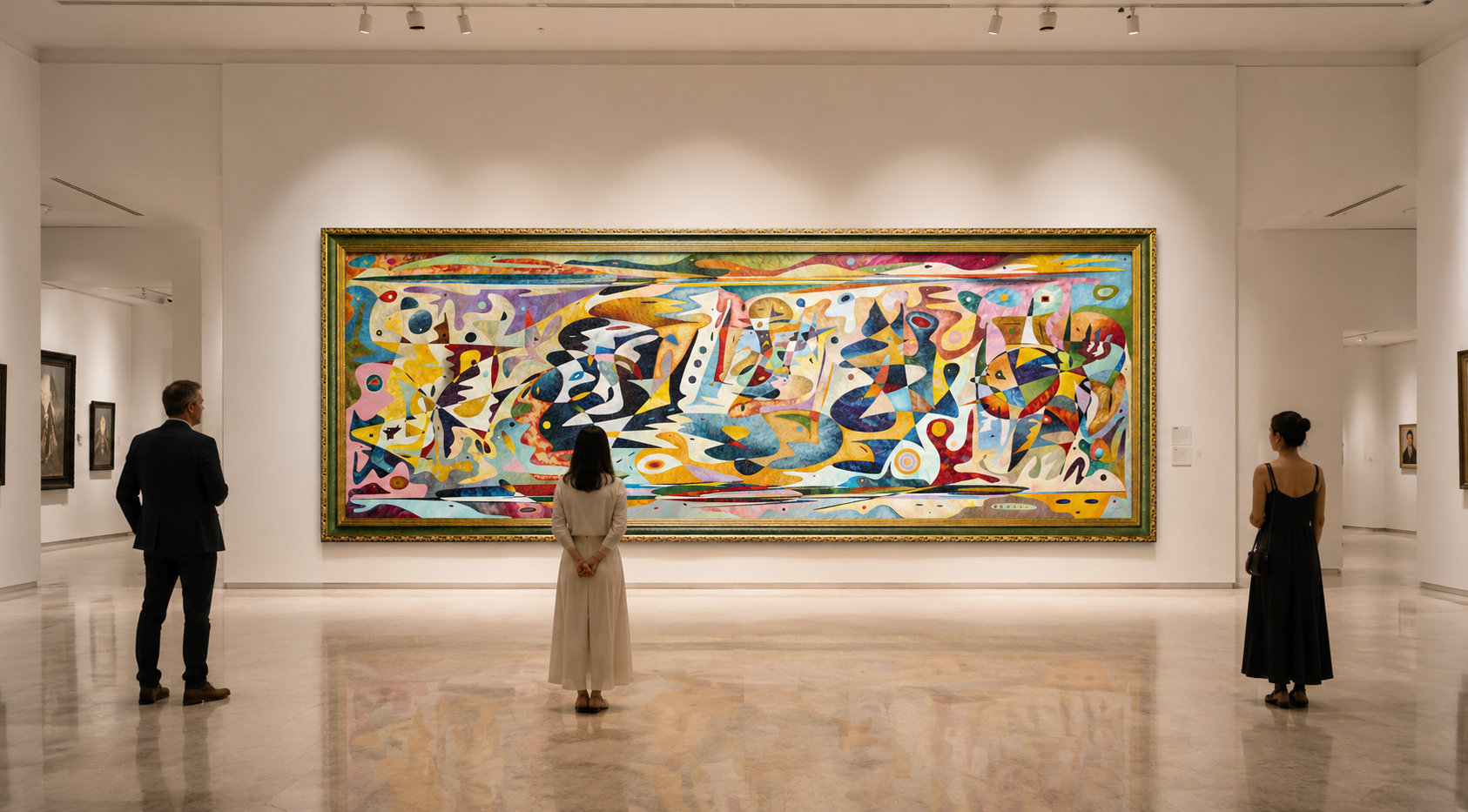
The Architecture of Belief
El Arte Monumental | Catalogue: The Architecture of Belief
Catalogue Entry: Caodaism (2021) | Art Curator: Daniel Varzari
The 10 Religions series by Gheorghe Virtosu engages with some of the most enduring and complex systems of belief, translating them into expansive visual fields that resist fixed interpretation. Rather than illustrating doctrine, Virtosu constructs environments in which symbolic, chromatic, and structural elements interact to produce meaning through perception. Each work operates as a conceptual and experiential space, inviting the viewer to navigate a network of forms that echo the philosophical and spiritual foundations of global traditions.
In Caodaism (2019–2021), this approach is articulated through a panoramic composition that reflects the syncretic nature of its subject. The painting brings together multiple visual languages—biomorphic abstraction, fragmented figuration, and geometric structuring—into a continuous yet unstable field. Subtle chromatic shifts and recurring motifs suggest processes of convergence and transformation, aligning with the unifying principles of Caodaism while maintaining a deliberate openness. The work does not prescribe meaning but instead stages the conditions under which meaning may emerge.
As a whole, the series positions painting as a site of philosophical inquiry, where visual form becomes a means of thinking through complexity, multiplicity, and connection. Virtosu’s practice challenges the boundaries between abstraction and symbolism, proposing a mode of engagement that is both reflective and participatory. In this context, Caodaism stands as a meditation on unity without reduction, offering a space in which diverse systems of thought coexist and unfold within a shared visual continuum.
Caodaism (2019–2021) by Gheorghe Virtosu is a monumental panoramic composition that translates the syncretic philosophy of Caodaism into a dynamic abstract visual field. Spanning six meters in width, the painting unfolds laterally, encouraging a left-to-right reading that suggests progression while resisting fixed narrative closure. Chromatic zones shift from luminous yellows through cooler blues to intensified reds, establishing a visual rhythm that can be interpreted as resonating with the convergence of multiple spiritual traditions. Rather than presenting explicit iconography, the work constructs meaning through relationships between color, form, and spatial distribution.
Across the surface, a dense network of biomorphic shapes, fragmented faces, and recurring eye motifs creates a sense of distributed perception. These elements emerge and dissolve within layered strata, producing a field in constant transformation. Near the center, three small circular forms and a loosely defined anthropomorphic silhouette suggest a point of convergence, evoking ideas of synthesis and balance without resolving into fixed symbolic identity. The composition’s upper and lower bands frame the image, reinforcing a sense of containment while introducing a subtle temporal quality, as if the painting unfolds across successive moments.
The work emphasizes multiplicity, interconnection, and the instability of meaning. Visual elements do not function as isolated symbols but as relational components within an open system, inviting active interpretation. Through its interplay of abstraction, repetition, and chromatic progression, Caodaism becomes a contemplative environment in which spiritual unity is not depicted as a resolved state, but experienced as an ongoing process of transformation and coexistence.
Caodaism (2019–2021) by Gheorghe Virtosu operates as a panoramic visual system that translates the syncretic philosophy of Caodaism into an abstract, spatial experience. Rather than illustrating doctrine, the work constructs a field in which meaning emerges through the interaction of color, form, and perceptual movement. The composition resists fixed hierarchy, distributing attention across a continuous horizontal axis that encourages sustained, contemplative engagement.
The painting’s left-to-right structure suggests a directional unfolding, though not a strictly linear narrative. Variations in chromatic intensity and compositional density guide the viewer’s movement, producing a sense of progression across the surface. This movement can be interpreted as a visual analogue to spiritual development, in which multiplicity gradually reorganizes into more structured, yet increasingly unstable, configurations.
A chromatic transition from yellow-dominant passages on the left, through cooler blue tonalities in the center, to red-inflected zones on the right introduces a potential symbolic framework. These color fields may be read in relation to the “Three Teachings” central to Caodaism—Buddhism, Taoism, and Confucianism—though such correspondences remain interpretive rather than fixed. The painting does not encode a rigid symbolic system but instead allows these associations to emerge through cultural resonance and spatial organization.
At the compositional center, three small circular forms and a loosely defined anthropomorphic figure establish a point of convergence. The figure, suggestive of a meditative or enlightened presence, resists precise identification and instead functions as a structural anchor within the field. The three dots may be understood as an abstract condensation of plurality into unity, reinforcing the painting’s broader engagement with synthesis and convergence.
Throughout the composition, the repetition of eyes and fragmented faces constructs a distributed field of perception. These motifs destabilize the notion of a singular viewing subject, introducing instead a multiplicity of observing positions embedded within the work itself. Perception becomes reciprocal: the viewer does not simply observe the painting but is implicated within a network of gazes that traverse the surface.
Horizontal bands along the upper and lower edges frame the composition, establishing a sense of containment while simultaneously suggesting segmentation. These bands evoke, by analogy, the structure of photographic or cinematic sequences, introducing a temporal dimension in which the image may be experienced as a succession of perceptual moments. This temporal ambiguity reinforces the painting’s resistance to singular interpretation.
Ultimately, Caodaism functions as an open system in which unity is not presented as a resolved state but as an ongoing process of negotiation. Through its interplay of chromatic progression, symbolic ambiguity, and distributed figuration, the work embodies a syncretic logic in which multiple meanings coexist without closure. The painting invites the viewer into an ակտիվ interpretive role, where perception, belief, and identity remain in continuous transformation.
Gheorghe Virtosu is a contemporary painter whose work explores the intersection of philosophy, symbolic systems, and visual abstraction. His practice is characterized by large-scale compositions that integrate biomorphic forms, geometric structures, and fragmented figuration, creating complex visual fields in which meaning emerges through transformation and relation.
Virtosu’s work engages with global belief systems, cultural frameworks, and theoretical discourse, translating them into a visual language that resists fixed interpretation. Rather than illustrating specific narratives or doctrines, his paintings investigate the underlying structures through which ideas such as identity, perception, unity, and multiplicity are formed. This approach positions his work within a broader dialogue between contemporary art and philosophical inquiry.
Central to his practice is the ongoing series 10 Religions, in which Virtosu examines major spiritual and philosophical traditions through abstraction. Each work within the series functions as a conceptual exploration rather than a representational image, emphasizing shared structural principles across different systems of thought. Through this body of work, the artist invites viewers into an active process of interpretation, where meaning is continuously constructed and redefined.
Working primarily in oil on canvas, Virtosu employs layered techniques that allow forms to emerge, overlap, and dissolve across multiple perceptual planes. His compositions often combine controlled geometric elements with fluid, organic shapes, producing a tension between order and transformation. This interplay defines his visual language and underpins his exploration of interconnectedness and the evolving nature of reality.
The work is executed in oil on canvas at a monumental scale (200 × 600 cm), designed to function as an immersive visual environment rather than a discrete pictorial object. The horizontal extension of the support establishes a panoramic field that structurally encourages lateral reading and sustained perceptual scanning.
The surface is constructed through multiple stratified layers of oil paint, applied in both translucent glazes and opaque passages. This layering produces a complex optical depth in which forms appear to emerge, overlap, and recede without reliance on traditional linear perspective. The material handling generates a continuous tension between surface flatness and illusory spatial expansion.
Biomorphic configurations are interwoven with geometric and diagrammatic elements, suggesting a deliberate negotiation between intuitive gesture and structural order. Brushwork varies between fluid, sweeping movements and more controlled articulations, reinforcing the conceptual opposition between organic proliferation and compositional containment.
Chromatic construction plays a central structural role. Rather than functioning descriptively, color operates as an organizing principle across the pictorial field. Gradations and shifts in tonal intensity guide visual movement across the surface, producing zones of concentration and dispersion that correspond to shifts in perceptual density.
The absence of fixed perspective or singular focal hierarchy is intentional, producing a non-linear spatial logic in which multiple viewpoints coexist. This results in a field-based composition in which the viewer’s movement, rather than a predetermined pictorial order, activates the work.
Overall, the technical construction supports the conceptual framework of the painting: a distributed, non-hierarchical system in which material process, spatial organization, and chromatic structure collectively generate a dynamic and continuously unfolding visual field.
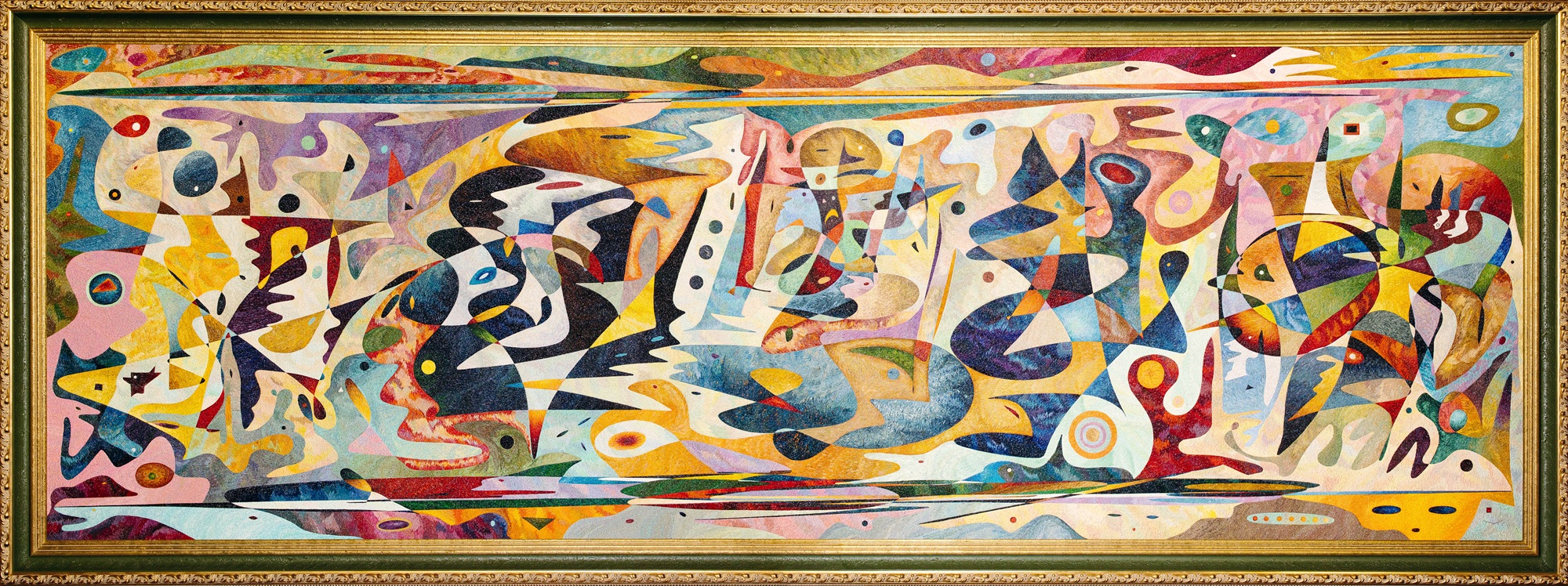
Artist: Gheorghe Virtosu
Medium: Oil and acrylic on linen canvas
Dimensions: 2 × 6.0 m
In Caodaism (2019–2021), Gheorghe Virtosu constructs a horizontally extended compositional field in which visual perception is directed through a subtle left-to-right progression. Rather than organizing space around a central focal point, the painting distributes chromatic intensity, figuration, and density across a continuous surface, producing a non-hierarchical visual system. Biomorphic structures, fragmented silhouettes, and recurrent ocular motifs circulate throughout the composition, generating a dynamic field in which perception is continuously redirected rather than resolved.
The painting’s chromatic architecture establishes a loose directional gradient, shifting from warmer yellow-based zones on the left through cooler blue tonalities toward intensified red regions on the right. This progression is reinforced by variations in structural density, where loosely articulated forms gradually give way to more condensed and interwoven configurations. Embedded within this field, three circular marks near the central axis function as compositional stabilizers, interrupting visual dispersion and introducing a moment of structural condensation within the otherwise fluid system.
Spatial organization in the work resists traditional perspectival depth, instead operating through layered simultaneity and visual overlap. Figures appear partially formed and partially dissolved, creating a continuous oscillation between emergence and disappearance. The repetition of eye-like forms across the surface introduces a distributed sense of perception, dissolving the boundary between observer and image. Overall, the composition functions as an integrated visual network in which color, form, and repetition operate as interdependent systems rather than isolated pictorial elements.
In Caodaism (2019–2021), color operates as a primary structuring principle through which the composition can be interpreted as a distributed cosmological system. A broad chromatic shift from yellow-dominant zones on the left, through cooler blue intensities in the center, to red-inflected regions on the right establishes a perceptual gradient that suggests directional movement across the pictorial field. While these transitions may be read in relation to the syncretic structure of Caodaism, particularly its incorporation of Buddhism, Taoism, and Confucianism, such associations function as interpretive frameworks rather than fixed symbolic assignments. Color thus becomes a relational device through which difference, continuity, and transition are simultaneously produced.
Formal structure is articulated through a tension between biomorphic fluidity and emergent geometric ordering. Organic, face-like formations and eye motifs proliferate across the surface, dissolving into layered spatial fields that resist stable figuration. These elements are counterbalanced by intermittent geometric structures that introduce moments of visual stabilization, producing a dynamic oscillation between indeterminacy and coherence. Rather than resolving into discrete forms, the painting sustains a condition of continuous formation, in which figure and ground remain in reciprocal instability.
The interaction between color and form generates a non-linear spatial logic in which perception unfolds as a cumulative process rather than a single unified view. The repetition of eyes and fragmented visages intensifies this effect, producing a distributed field of perception that undermines a singular viewing position. Within this structure, color does not simply describe form but actively organizes it, while form in turn redistributes chromatic intensity across the surface. The result is a pictorial system in which visual elements operate interdependently, sustaining an open field of interpretation rather than a resolved compositional hierarchy.
In Caodaism (2019–2021), symbolic meaning is constructed through a distributed field of imagery rather than through discrete, legible iconography. The painting can be read in relation to the syncretic structure of Caodaism, in which multiple religious traditions coexist within a unified metaphysical system. Within this framework, recurring ocular forms may be interpreted as an expansion of the Caodaist “Divine Eye,” not as a singular emblem but as a dispersed condition of perception. Rather than representing vision, these elements produce a field in which perception is multiplied, destabilizing the boundary between observer and observed.
Chromatic organization plays a central symbolic role, particularly in the lateral progression from yellow-dominant passages through cooler blue zones toward red-inflected regions. While these transitions may be tentatively associated with Buddhism, Taoism, and Confucianism, such correspondences should be understood as interpretive rather than fixed. The painting does not encode a strict symbolic lexicon; instead, it stages a system of chromatic relations through which cultural and philosophical associations may emerge. This instability of reference aligns with a broader logic of syncretism, in which meaning is produced through coexistence rather than hierarchy.
At the compositional center, three circular motifs and a partially defined anthropomorphic figure function as a focal point of symbolic convergence. These elements may be read as an abstract condensation of the “Three Teachings” (Tam Giáo), although their abstraction resists definitive iconographic classification. Surrounding biomorphic and geometric forms further reinforce this structure of synthesis, oscillating between dissolution and coherence. Across the surface, fragmented faces and emergent figures do not operate as individual identities but as transient configurations within a broader visual cosmology, where imagery remains in continual formation rather than fixed representation.
Gheorghe Virtosu’s Caodaism (2019–2021) can be read as a synthetic visual cosmology that translates the syncretic structure of Caodaism—a religion integrating Buddhism, Taoism, and Confucianism—into a distributed field of perception. Rather than representing doctrinal imagery directly, the painting constructs a system of relational correspondences in which meaning emerges through spatial, chromatic, and figurative interaction. The horizontal expansion of the composition suggests a non-hierarchical unfolding of belief systems, where spiritual traditions coexist as parallel rather than competing epistemologies.
The painting’s chromatic structure invites an interpretive reading in which yellow, blue, and red function as loosely associated fields rather than fixed symbolic codes. These tonal shifts may be understood as evoking Buddhism, Taoism, and Confucianism respectively, but their primary function is relational rather than representational: they organize perceptual movement across the canvas. Central motifs—particularly the triadic circular forms and the loosely defined anthropomorphic figure—operate as points of convergence, suggesting the Caodaist principle of unity through multiplicity without resolving into a singular iconographic authority.
Distributed eyes, fragmented faces, and biomorphic structures further destabilize fixed subjectivity, producing a condition of expanded or multiplied perception. In this sense, the painting does not depict a religious system but enacts one, functioning as an open visual field in which meaning is continuously generated through viewer engagement. The result is a non-linear cosmology in which synthesis is never complete but perpetually in formation, reflecting the broader Caodaist aspiration toward spiritual integration across difference.
Caodaism operates within a sustained emotional field of cognitive saturation and perceptual expansion. The viewer is not guided toward a singular affective response but instead enters a condition of heightened attentional dispersion, where recognition, uncertainty, and contemplation coexist. The dense accumulation of eyes, faces, and semi-formed figures produces an atmosphere of constant perceptual awareness, generating a subtle tension between intimacy and estrangement.
As the eye moves across the chromatic progression of the composition, affect shifts from luminous openness to increasing structural intensity. The left side’s warmer, more diffuse tonalities evoke emergence and vulnerability, while the central field introduces a more complex emotional register of ambivalence and cognitive overload. Toward the right, intensified reds and more fragmented forms generate a sense of compression and resolution-in-tension, where stability is suggested but never fully achieved.
Ultimately, the work sustains an affective condition best described as contemplative instability. Rather than resolving into a unified emotional narrative, it oscillates between expansion and containment, mirroring the syncretic logic of Caodaist thought. The viewer is left in a state of sustained attentiveness, where emotion is not delivered as conclusion but experienced as ongoing transformation.
- Umberto Eco, The Open Work (Harvard University Press, 1989), conceptualizes artworks as open systems that generate meaning through interpretive participation rather than fixed structure.
- Michel Foucault, Discipline and Punish (Pantheon Books, 1977), provides a framework for understanding the decentering of the observing subject and distributed regimes of visibility.
- Jacques Derrida, Of Grammatology (Johns Hopkins University Press, 1976), introduces the concept of différance, emphasizing the instability and deferral of meaning within sign systems.
- Gilles Deleuze and Félix Guattari, A Thousand Plateaus (University of Minnesota Press, 1987), propose the rhizome as a model of non-hierarchical, networked structures of meaning.
- Henri Bergson, Time and Free Will (1910), distinguishes between linear, spatialized time and lived duration, relevant to the painting’s continuous perceptual field.
Selected Bibliography
- Barthes, Roland. Mythologies. Paris: Seuil, 1957.
- Bergson, Henri. Time and Free Will: An Essay on the Immediate Data of Consciousness. London: Allen & Unwin, 1910.
- Deleuze, Gilles, and Félix Guattari. A Thousand Plateaus: Capitalism and Schizophrenia. Minneapolis: University of Minnesota Press, 1987.
- Derrida, Jacques. Of Grammatology. Baltimore: Johns Hopkins University Press, 1976.
- Eco, Umberto. The Open Work. Cambridge, MA: Harvard University Press, 1989.
- Foucault, Michel. Discipline and Punish: The Birth of the Prison. New York: Pantheon Books, 1977.
- Kandinsky, Wassily. Concerning the Spiritual in Art. New York: Dover Publications, 1977.
- Merleau-Ponty, Maurice. Phenomenology of Perception. London: Routledge, 1962.
Curatorial Team: Daniel Varzari
Photography: El Arte Monumental
Special Thanks: Daniel Varzari, Gheorghe Virtosu
El Arte Monumental
08007 Barcelona
Phone: +34 934 439 470/ +01 312 358 8023