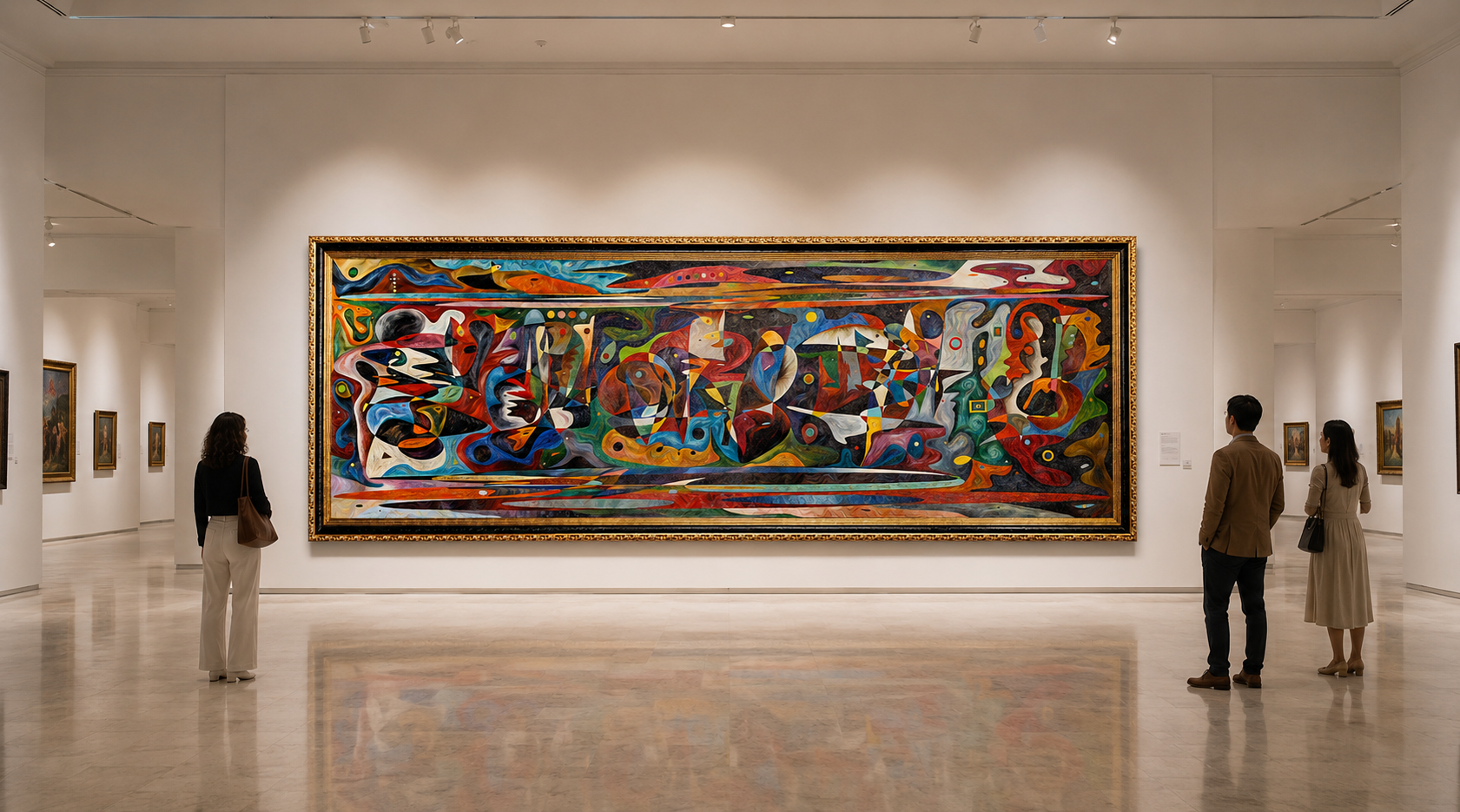
The Architecture of Belief
El Arte Monumental | Catalogue: The Architecture of Belief
Catalogue Entry: Christianity (2010) | Art Curator: Daniel Varzari
Within the 10 Religions series, Gheorghe Virtosu’s Christianity (2008–2010) marks a pivotal moment in which narrative, structure, and temporality converge into a single, expansive visual system. Unlike works that emphasize cyclical continuity or unified fields, this painting introduces a directional logic, unfolding across the canvas as a movement through sacred history. It is not a representation of doctrine or scripture, but a reconstruction of the conditions through which meaning emerges, is mediated, and ultimately transformed.
The composition establishes a trajectory from origin to estrangement, beginning with symbolic coherence on the left and progressing toward fragmentation and obscurity on the right. In doing so, Virtosu reframes theological narrative as a dynamic process rather than a fixed sequence of events. Foundational motifs—creation, fall, preservation, and sacrifice—are not illustrated in isolation but embedded within a continuous field in which their meanings shift and overlap. This approach positions the painting as both a visual and conceptual space where structure and instability coexist.
What distinguishes Christianity within the series is its engagement with irreversibility. The work does not return to origin, nor does it resolve into unity; instead, it sustains a forward movement in which identity and representation become increasingly unstable. Virtosu invites the viewer into this unfolding process, where perception is active and meaning is never fixed. The painting thus operates as an open system—one that reflects not only theological transformation but the broader conditions through which images, symbols, and beliefs persist in time.
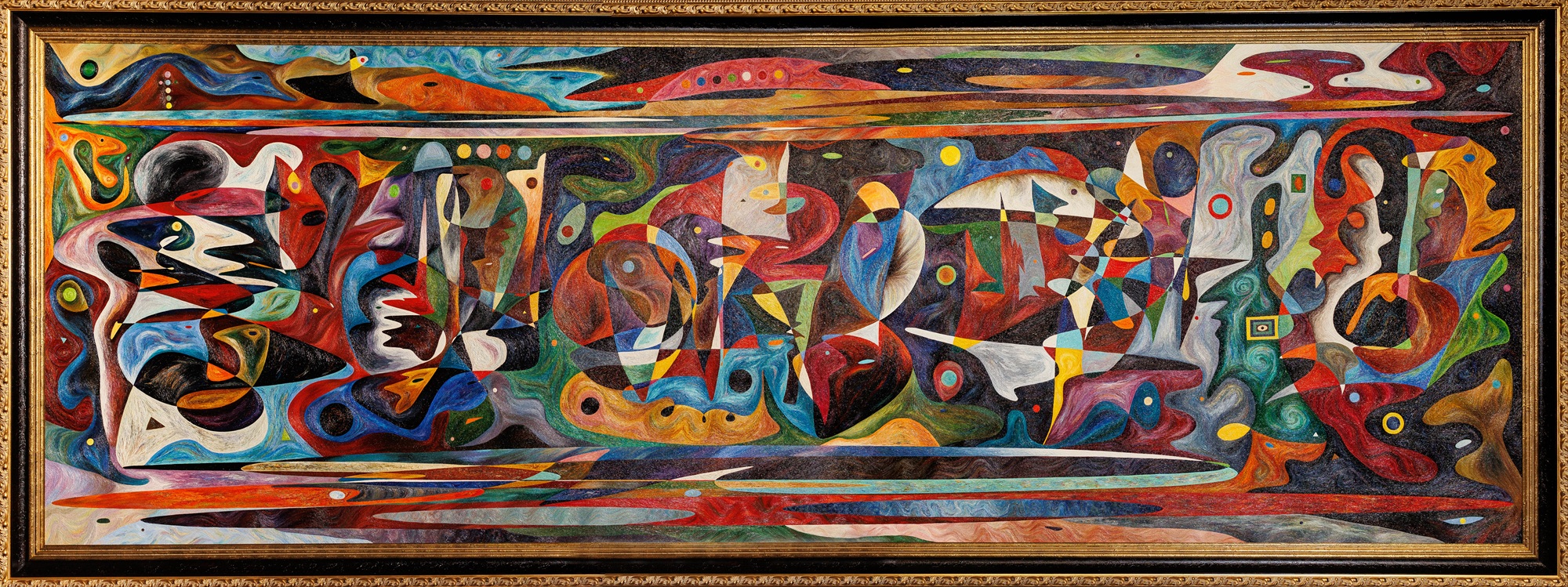
Christianity (2008–2010) is a monumental oil on canvas by Gheorghe Virtosu, measuring 2 × 6 meters, developed as part of the 10 Religions series. The composition unfolds across a panoramic format structured by a directional movement from left to right, articulating a progression from symbolic coherence toward fragmentation and obscurity. This spatial organization introduces a temporal dimension in which visual elements correspond to stages of origin, mediation, and transformation.
The left section concentrates symbolic forms associated with foundational narratives. Interwoven biomorphic figures, a serpentine structure, a vessel-like form, and recurring fish motifs appear as abstracted signs rather than literal depictions. A cross-like configuration, constructed from dispersed chromatic points, emerges within this zone, emphasizing its status as a relational structure rather than a fixed icon. This approach aligns with Roland Barthes’ theory of myth as a system of signification in which meaning is produced through layered symbolic forms¹.
The central field introduces a stratified surface that recalls systems of inscription and transmission, partially obscuring and reorganizing earlier symbolic elements. This zone functions as an interface between origin and contemporary condition, where meaning is mediated through structure. Such transformation resonates with Michel Foucault’s analysis of discursive formations, in which knowledge is shaped and conditioned by systems that govern its articulation³.
The right section is characterized by darker tonalities and increasing fragmentation. Faces dissolve into overlapping configurations, and an elongated figure in the upper right suggests a state of estrangement in which identity becomes unstable. Chromatic transitions from clarity to compression reinforce this movement, guiding the viewer across a field where meaning shifts from legibility to ambiguity. Through layered paint and interwoven forms, the work constructs an immersive visual system in which symbolic, perceptual, and structural elements continuously interact and transform².
Christianity (2008–2010) operates as a visual articulation of directional temporality, in which meaning unfolds across the pictorial field from origin to estrangement. Unlike cyclical or unified models of existence, the painting constructs a progressive structure in which forms emerge, stabilize, and ultimately destabilize. This movement is not narrative in a conventional sense but structural, embedding theological concepts within a continuous field of transformation.
The left portion of the composition establishes a condition of relative coherence. Symbolic clusters evoke foundational states of existence, where forms remain interconnected yet legible. However, this coherence is already marked by tension, as indicated by intertwined figures and serpentine motion. Origin is not presented as purity, but as a relational system in which rupture is inherent from the beginning.
As the composition advances, the introduction of mediating structures transforms the immediacy of these forms. The central register functions as an interface in which meaning is no longer directly accessible but organized through systems of inscription and transmission. This shift reflects Michel Foucault’s concept of discursive formations, where knowledge is conditioned by the structures that produce and regulate it¹.
The painting’s symbolic elements do not operate as fixed signs but as fluid constructs whose meanings shift across the field. The cross, the vessel, the serpent, and the fish are not isolated icons but relational nodes within a broader system. This condition aligns with Roland Barthes’ understanding of the sign as inherently unstable, where meaning is perpetually deferred and constructed through context².
The progression toward the right introduces increasing fragmentation and perceptual instability. Forms lose clarity, boundaries dissolve, and identity becomes dispersed across overlapping configurations. This process can be understood through Gilles Deleuze and Félix Guattari’s notion of deterritorialization, in which established structures break down and reorganize into new, unstable arrangements³.
At the culmination of this movement, the upper right region presents a figure that appears estranged from the surrounding field. This form does not represent an external entity but a transformation of the human image under conditions of instability. Identity persists only as a trace, suggesting a condition in which the coherence of the subject is no longer sustained.
Temporality within the painting is therefore both directional and simultaneous. While the composition unfolds from left to right, all stages coexist within a single field. This dual structure reflects Jacques Derrida’s concept of différance, in which meaning is constituted through temporal deferral and relational difference⁴.
The viewer is implicated within this system of transformation. Perception does not occur from a fixed external position but emerges through interaction with the field itself. The distributed presence of eye-like forms suggests that vision is not localized but shared, aligning with Maurice Merleau-Ponty’s phenomenology of perception as an embodied and relational process⁵.
Chromatic transitions reinforce the conceptual structure of the work. The movement from clearer, more saturated tones on the left toward darker and more compressed tonalities on the right functions as a visual marker of transformation. Color operates not merely as a formal element but as an indicator of shifting conditions of meaning and perception.
Ultimately, Christianity proposes a model of existence in which meaning is generated through processes of emergence, mediation, and transformation. The painting does not resolve these processes into a stable system but sustains them within an open and evolving field. Identity, perception, and symbolic structure remain contingent, continuously redefined through their position within a dynamic network of relations.
Gheorghe Virtosu is a contemporary painter whose work explores the intersection of philosophy, symbolic systems, and visual abstraction. His practice is characterized by large-scale compositions that integrate biomorphic forms, geometric structures, and fragmented figuration, creating complex visual fields in which meaning emerges through transformation and relation.
Virtosu’s work engages with global belief systems, cultural frameworks, and theoretical discourse, translating them into a visual language that resists fixed interpretation. Rather than illustrating specific narratives or doctrines, his paintings investigate the underlying structures through which ideas such as identity, perception, unity, and multiplicity are formed. This approach positions his work within a broader dialogue between contemporary art and philosophical inquiry.
Central to his practice is the ongoing series 10 Religions, in which Virtosu examines major spiritual and philosophical traditions through abstraction. Each work within the series functions as a conceptual exploration rather than a representational image, emphasizing shared structural principles across different systems of thought. Through this body of work, the artist invites viewers into an active process of interpretation, where meaning is continuously constructed and redefined.
Working primarily in oil on canvas, Virtosu employs layered techniques that allow forms to emerge, overlap, and dissolve across multiple perceptual planes. His compositions often combine controlled geometric elements with fluid, organic shapes, producing a tension between order and transformation. This interplay defines his visual language and underpins his exploration of interconnectedness and the evolving nature of reality.
Christianity (2008–2010) is executed in oil on canvas at a monumental scale of 2 × 6 meters, establishing an immersive panoramic format that supports a directional reading across the composition. The extended horizontal axis allows for the articulation of multiple symbolic zones, enabling a gradual transition from coherence to fragmentation within a single continuous field.
The painting is constructed through layered applications of oil paint, combining translucent glazes with denser, more opaque passages. This stratification produces depth and spatial complexity, allowing forms to emerge, overlap, and partially dissolve across different perceptual planes. The central register, in particular, demonstrates a heightened accumulation of layers, reinforcing its function as a zone of mediation and transformation.
Virtosu integrates biomorphic figuration with structural abstraction, creating a tension between organic and constructed forms. Fluid, curvilinear shapes dominate the left and lower areas, while more fragmented and compressed forms appear toward the right. This shift in formal handling supports the painting’s conceptual progression, with brushwork becoming increasingly disrupted and less resolved as the composition advances.
Chromatically, the work is carefully modulated to guide visual movement. The left side features greater clarity and saturation, while the right side transitions into darker, more subdued tonalities. This controlled shift reinforces the directional logic of the composition, functioning as both a spatial and conceptual indicator of transformation.
The combination of scale, layered technique, and the interplay between controlled and gestural application produces a dynamic visual environment. The surface remains active and unstable, encouraging close observation and continuous reinterpretation. Technical execution is thus inseparable from conceptual intent, with material processes directly contributing to the painting’s articulation of change, mediation, and fragmentation.
Artist: Gheorghe Virtosu
Medium: Oil and acrylic on linen canvas
Dimensions: 2 × 6.0 m
The composition of Christianity (2008–2010) is structured as a horizontally extended field organized through a directional movement from left to right. Rather than dividing the surface into clearly bounded zones, the painting establishes a continuous progression in which forms gradually transform across the canvas. This spatial arrangement introduces a temporal dimension, guiding the viewer’s perception through stages of emergence, mediation, and fragmentation.
The left section presents a relatively coherent configuration of forms, where symbolic elements are more legible and structurally integrated. Biomorphic shapes interweave with recognizable motifs, creating a dense yet ordered field. The balance between figure and ground remains stable, allowing individual forms to emerge with greater clarity while still participating in the surrounding network.
As the composition advances toward the center, the density of overlapping forms increases, producing a stratified surface that disrupts visual continuity. Layers intersect and partially obscure one another, creating a sense of depth and complexity. This central zone functions as a transitional field, where the coherence of the left begins to dissolve into more ambiguous and mediated configurations.
The right section is characterized by compression, darker tonalities, and a loss of formal definition. Figures fragment into partial and overlapping structures, and the distinction between individual forms becomes increasingly unstable. The upper area introduces a more isolated configuration, while the overall composition moves toward reduced clarity and heightened abstraction. This progression establishes a dynamic equilibrium across the canvas, in which structure, density, and fragmentation are continuously negotiated.
In Christianity (2008–2010), color and form function as interdependent systems that structure both spatial perception and conceptual progression. Unlike compositions in the 10 Religions series that emphasize chromatic unity or fluid continuity, this work employs a directional modulation of color that reinforces its movement from coherence to fragmentation. The chromatic field is not uniform but shifts across the canvas, guiding the viewer through a sequence of visual and symbolic transformations.
The left section is characterized by greater clarity and saturation, with distinct hues delineating forms while maintaining their integration within the surrounding field. Reds, blues, and lighter tonal values interact to produce a balanced yet dynamic configuration in which forms remain legible. Color here supports structural coherence, allowing biomorphic and symbolic elements to emerge with relative stability.
As the composition progresses, chromatic relationships become increasingly complex and layered. In the central field, overlapping tones and partial transparencies disrupt clear boundaries, creating a stratified surface in which forms are simultaneously revealed and obscured. Color operates as a mediating force, neither fully defining nor dissolving form, but maintaining a condition of perceptual tension.
The right section introduces a shift toward darker, more compressed tonalities. Saturation diminishes, contrasts soften, and color fields converge into more ambiguous configurations. This chromatic compression contributes to the fragmentation of form, as figures lose clarity and dissolve into the surrounding field. The gradual dominance of darker hues reinforces the painting’s directional movement toward instability and obscurity.
Form emerges through these chromatic interactions rather than through fixed outlines. On the left, forms are more cohesive and bounded, while toward the right they become increasingly open and diffuse. The relationship between color and form thus reflects the painting’s broader conceptual structure: differentiation gives way to integration, and integration to fragmentation. Together, color and form produce a dynamic system in which visual clarity and instability coexist within a continuous process of transformation.
The symbolic language of Christianity (2008–2010) is constructed through an intricate interplay of abstracted motifs and biomorphic forms. Rather than presenting fixed religious imagery, Gheorghe Virtosu embeds symbolic references within a fluid system in which meaning emerges through relation and transformation. In the left section, interwoven figures and a serpentine structure evoke foundational narratives of origin and rupture, accompanied by a vessel-like form and numerous fish motifs. These elements function as distributed signs rather than literal depictions, forming a network of associations that resists linear interpretation.
A cross-like configuration, composed of dispersed chromatic points, appears within this field as a key symbolic construct. Its fragmented structure prevents it from operating as a stable icon, instead presenting it as a relational event assembled through multiple elements. As the composition progresses toward the center, symbolic forms become increasingly layered and partially obscured, suggesting systems of inscription and mediation. Meaning is no longer directly accessible but reorganized through structural processes that transform and redistribute symbolic content.
In the right section, symbolic clarity gives way to fragmentation and ambiguity. Faces dissolve into overlapping configurations, and previously identifiable motifs lose their distinct boundaries. An elongated figure in the upper right suggests a state of estrangement, where identity and representation become unstable. Across the composition, symbolism operates as a dynamic system in which images do not convey fixed meanings but participate in an evolving network of relations, continuously generating and transforming significance.
Christianity (2008–2010) articulates a conceptual model of sacred history as a directional and irreversible process, in which meaning unfolds from origin toward fragmentation. Rather than presenting theology as a stable system of belief, the painting reconstructs it as a dynamic field of transformation, where symbolic structures emerge, are mediated, and gradually lose coherence. This progression establishes a visual logic in which temporality is embedded within spatial composition, producing a continuous movement across the canvas.
Within this system, identity is understood as relational and unstable. Figures and symbols do not exist as autonomous entities but are constituted through their position within a broader network of forms. As the composition advances, these relations become increasingly complex and fragmented, suggesting that coherence is not a fixed condition but a temporary stabilization within ongoing transformation. This reflects a broader conceptual premise in which meaning is produced through interaction rather than essence.
Ultimately, the painting proposes a model of interpretation in which theological narrative is transformed into a structural and perceptual experience. Symbolic elements such as the cross, vessel, serpent, and fish are not treated as static references but as shifting nodes within a system of relations. The viewer is therefore engaged in an active process of reading, where meaning remains open, contingent, and continuously reconfigured through perception and movement across the field.
In Christianity (2008–2010), the emotional register is not expressed through isolated figures or narrative cues, but through the gradual modulation of intensity across the pictorial field. Affect emerges as a spatial condition, distributed through shifts in density, chromatic pressure, and formal stability. The painting constructs an emotional trajectory that moves from relative coherence on the left toward increasing instability and perceptual strain on the right.
The left section carries a sense of openness and relational balance, where forms remain more legible and interconnected. This legibility produces a stabilizing affect, grounded in clarity and structural coherence, even as underlying tensions are already present within the intertwining of figures and symbolic elements. As the composition progresses toward the center, this stability begins to fracture, and emotional tone becomes more ambiguous, marked by layering, overlap, and increasing visual density.
In the right section, emotional intensity shifts toward compression and fragmentation. Darker tonalities and dissolving forms generate a sense of withdrawal and disorientation, where identity and perception lose their anchoring structures. Rather than resolving into a singular affective state, the painting sustains a field of emotional instability, in which coherence and disintegration coexist as continuous, interdependent conditions.
- Roland Barthes, Mythologies, 1957.
- Gilles Deleuze and Félix Guattari, A Thousand Plateaus, 1987.
- Jacques Derrida, Of Grammatology, 1967.
- Michel Foucault, The Archaeology of Knowledge, 1969.
Selected Bibliography
- Barthes, Roland. Mythologies. Paris: Seuil, 1957.
- Derrida, Jacques. Of Grammatology. Baltimore: Johns Hopkins University Press, 1976.
- Deleuze, Gilles, and Félix Guattari. A Thousand Plateaus. Minneapolis: University of Minnesota Press, 1987.
- Foucault, Michel. The Archaeology of Knowledge. New York: Pantheon Books, 1972.
- Agamben, Giorgio. The Time That Remains. Stanford University Press, 2005.
- Auerbach, Erich. Mimesis. Princeton University Press, 1953.
- Lacan, Jacques. The Four Fundamental Concepts of Psychoanalysis. New York: Norton, 1978.
- Merleau-Ponty, Maurice. Phenomenology of Perception. Routledge, 2012.
Curatorial Team: Daniel Varzari
Photography: El Arte Monumental
Special Thanks: Daniel Varzari, Gheorghe Virtosu
El Arte Monumental
08007 Barcelona
Phone: +34 934 439 470/ +01 312 358 8023