The Architecture of Belief
El Arte Monumental | Catalogue: The Architecture of Belief
Catalogue Entry: Hinduism (2017) | Art Curator: Daniel Varzari
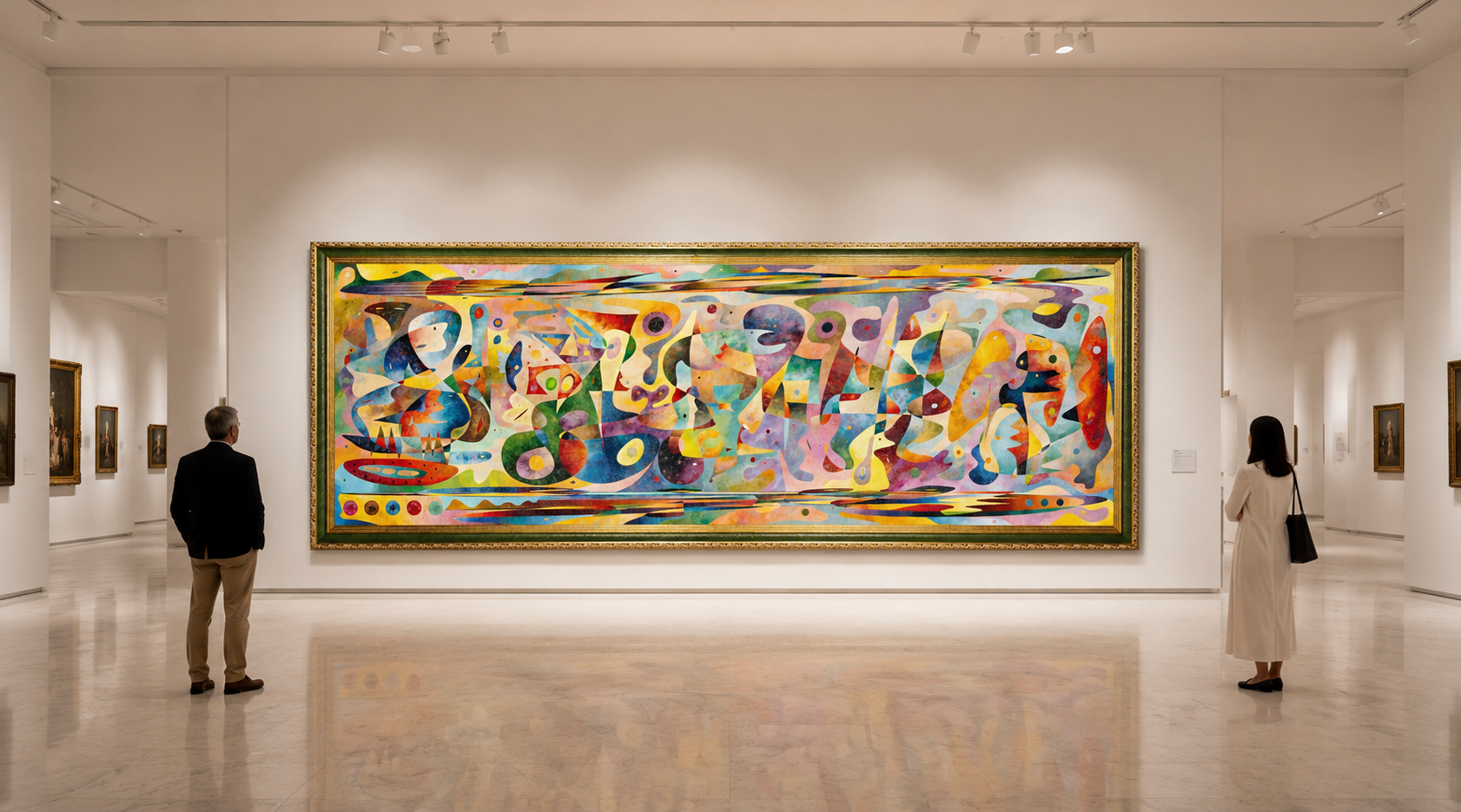
Virtosu’s Hinduism (2015–2017), part of the 10 Religions series, unfolds a visual cosmology that transcends literal representation. Spanning six meters, the work engages with the philosophical and symbolic underpinnings of Hindu thought through an abstract, biomorphic language. Forms emerge, interact, and dissolve across the canvas, evoking cycles of creation, consciousness, and transformation, while resisting static or figurative interpretation. In doing so, the painting enacts the very processes it explores: the continuous interplay of unity and multiplicity, perception and dissolution, structure and fluidity.
The composition’s densely layered motifs—including eye-like forms, radiating petal structures, and angular, disruptive shapes—operate simultaneously on multiple symbolic registers. These overlapping forms evoke awareness, identity, and spiritual emergence while also signaling disruption, transformation, and impermanence. Virtosu’s abstraction, therefore, does not depict Hinduism iconographically but visualizes its cosmological and philosophical logic, inviting the viewer to experience the interdependence of all forms and the ephemeral nature of symbolic meaning.
Hinduism challenges conventional modes of perception and interpretation, positioning the spectator within a dynamic field where consciousness, identity, and cosmological order are in constant negotiation. By collapsing figure and ground, observer and observed, the work embodies a non-dual sensibility, reflecting the philosophical principle that multiplicity and unity are inseparable. In this sense, the painting is not merely a study of religious symbols, but a meditative exploration of process, transformation, and the universal pursuit of meaning.
Part of the conceptual series 10 Religions, Hinduism investigates the cosmological and philosophical frameworks of Hindu thought through an expansive, abstract visual language. Virtosu employs biomorphic forms, flowing ribbons, and angular disruptions to evoke the cycles of creation, consciousness, and dissolution, articulating a continuum in which identity, awareness, and matter emerge, interact, and dissolve. The composition resists literal depiction, instead offering a dynamic interplay of form and symbol, in which ocular motifs, mandala-like arrangements, and lotus-inspired structures suggest consciousness, spiritual unfolding, and relational interconnection.
Across the canvas, recurring angular and triangular forms introduce tension, fragmentation, and structural differentiation, juxtaposed against curvilinear, flowing shapes that emphasize continuity, unity, and the fluidity of existence. The work enacts the philosophical principles of Atman and Brahman, Samsara, and non-dual consciousness: awareness is distributed, identity is provisional, and the boundaries between observer and observed are permeable. This simultaneity of emergence and dissolution invites contemplation on the impermanence of form and the universality of symbolic processes.
Through its monumental scale and immersive abstraction, Hinduism engages viewers in a sustained visual meditation, allowing them to navigate cycles of multiplicity and unity, creation and dissolution, while reflecting on the structural and symbolic logic underlying human attempts to understand the sacred. Virtosu’s work transcends illustration, offering a metaphysical experience that is simultaneously sensory, conceptual, and spiritual.
Virtosu’s Hinduism, part of the conceptual series 10 Religions, is an expansive meditation on consciousness, cosmology, and the formation of symbolic meaning. Spanning six meters in horizontal length, the painting eschews literal iconography in favor of a dynamic visual system in which forms emerge, interact, and dissolve. Rather than representing Hindu deities or rituals directly, Virtosu constructs a fluid symbolic continuum that mirrors philosophical principles of cyclical existence, interdependence, and non-duality.¹²
The left segment of the canvas establishes the ontological substrate of the work. Biomorphic shapes coalesce into dense, grounded masses, among which a human-like figure appears to rise above a turtle-like base. This juxtaposition evokes a cosmic foundation, echoing mythic structures of support and emergence without reducing them to literal narrative. The composition communicates that consciousness and form arise from and within the world, rather than existing apart from it.¹³
Toward the center, the painting intensifies into a field of multiplicity and reflexivity. Face-like profiles, ocular motifs, and layered radial forms proliferate, creating zones of interaction and tension. The eyes—detached from any singular figure—function as distributed awareness, reflecting the philosophical equivalence of Atman (individual self) and Brahman (universal consciousness).³⁴ Simultaneously, angular, triangular elements introduce rupture, delineation, and contrast, suggesting the interplay of differentiation and relational perception.⁴
The right section of the painting embodies dissolution and transformation. Forms elongate, fragment, and merge into continuous flows of color and pattern. Previously distinct faces and structures lose definition, signaling the impermanence of identity and perceptual centrality. This visual logic enacts the cyclical processes of Samsara¹, in which creation, preservation, and dissolution occur not sequentially but simultaneously within an ongoing field.
Symbolically, Virtosu integrates cues reminiscent of Hindu cosmology: lotus-like radiations for spiritual emergence², mandala-like clusters for universal order³, and disruptive angular forms invoking transformative energy akin to Shiva⁴. Yet these motifs are never fixed; they overlap, morph, and double as other forms. Each element may function as awareness, identity, and spiritual unfolding concurrently, emphasizing that symbolic meaning is generated through relation and transformation rather than through static representation.
Ultimately, Hinduism presents a visual philosophy of processual being. Through the interplay of form, division, and dissolution, Virtosu enacts the principles of non-duality⁵ and interconnection inherent in Hindu thought. The work positions the viewer as an active participant in the continuous generation of meaning, illustrating that consciousness, structure, and identity are not given, but emergent, transient, and inseparably intertwined.
Virtosu (active 2010s–present) is an interdisciplinary painter and conceptual artist whose work interrogates the structural and symbolic underpinnings of human belief systems. Employing large-scale, immersive canvases, Virtosu synthesizes biomorphic abstraction, architectural form, and symbolic motifs to explore the interplay between consciousness, identity, and cosmology. Their practice is informed by comparative philosophy, mythology, and the study of ritualized imagery, translating complex metaphysical ideas into visual sequences that are simultaneously gestural and highly structured.
Virtosu’s oeuvre is marked by the 10 Religions series, in which each work examines a major world tradition through the lens of abstract form, investigating the cycles, correspondences, and archetypal patterns that underpin cultural cosmologies. Hinduism (2015–2017), a six-meter horizontal oil painting, exemplifies this approach, merging flowing, eye-like forms, radial motifs, and angular interventions to visualize consciousness, samsara, and the interplay of multiplicity and unity. Across their practice, Virtosu consistently foregrounds the fluidity of symbols, positioning the viewer as an active participant in meaning-making.
Exhibited internationally in both solo and group shows, Virtosu’s work has been included in collections emphasizing contemporary explorations of spirituality and abstraction. Their approach bridges philosophical inquiry and painterly innovation, creating works that challenge conventional boundaries between figuration and abstraction, narrative and process, and self and cosmos. Through sustained engagement with cross-cultural cosmologies, Virtosu’s paintings function as both visual philosophy and experiential environment, inviting reflection on the conditions of perception, identity, and interconnectedness.
- Paint applied in overlapping, semi-transparent layers to create depth and fluidity.
- Ocular and facial motifs are subtly embedded with repeated pigment patterns to encourage perception of motion.
- Angular and jagged forms were executed with a palette knife or brush-edge technique for sharp contrast against flowing curves.
- Color is used both symbolically and structurally; warm/cool contrasts reinforce relational tension and spatial layering.
- Canvas proportions (2 m × 6 m) enable immersive, continuous reading of symbolic sequences.
Artist: Gheorghe Virtosu
Medium: Oil and acrylic on linen canvas
Dimensions: 2 × 6.0 m
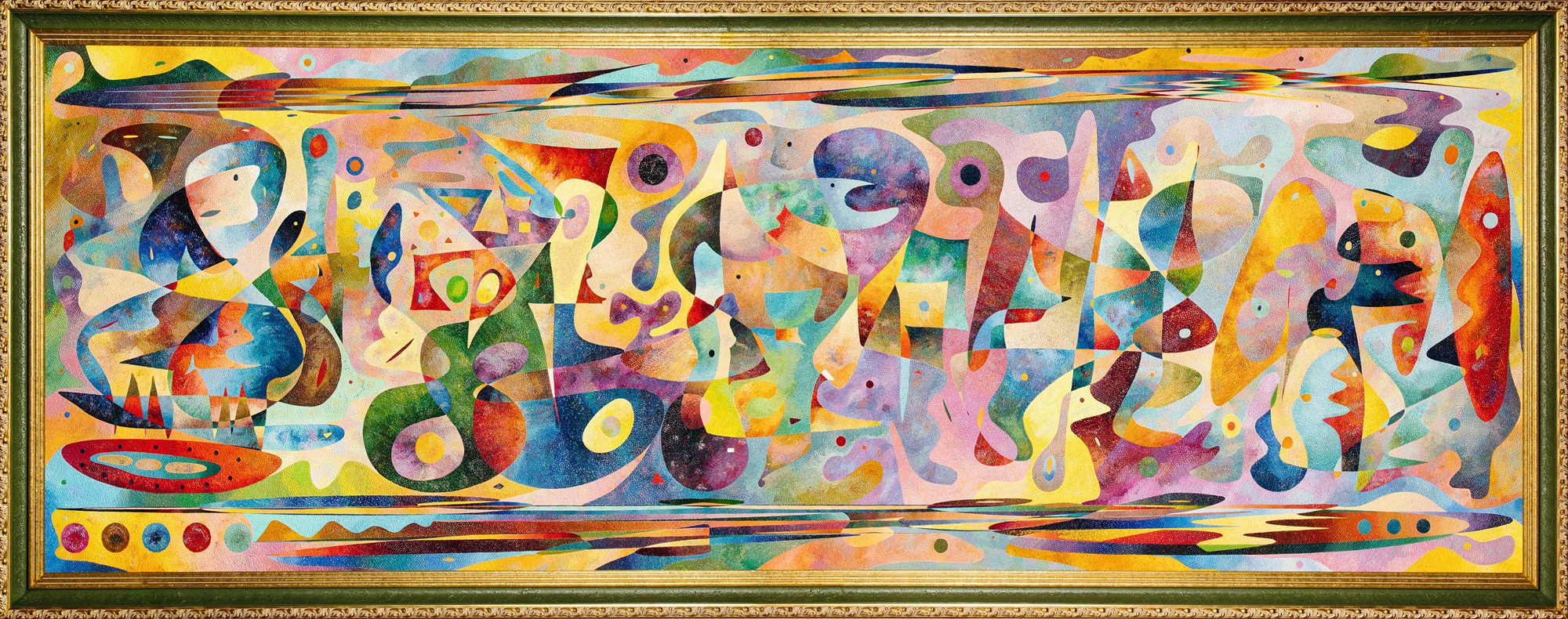
Virtosu’s Hinduism presents a six-meter horizontal tableau in which forms, colors, and motifs continuously emerge, collide, and dissolve across a single perceptual field. The composition is organized along a gradual visual arc from left to right, suggesting phases of emergence, interaction, and dissolution rather than fixed narrative or iconography.
- Left Zone: Dominated by dense, rounded biomorphic forms. Here, a human-like figure hovers above a turtle-shaped mass, visually suggesting emergence from a primal substrate. Soft curves, blended tones, and grounded forms convey stability and latent potential. This section establishes the ontological foundation for the entire composition.
- Central Zone: Characterized by relational complexity. Face-like profiles, ocular motifs, and radial clusters overlap, creating zones of visual dialogue. Angular, triangular interruptions introduce tension, marking points of conflict and structural definition. The interplay of curves and angles enacts multiplicity and reflective awareness, embodying the philosophical equivalence of individual consciousness (Atman) and universal awareness (Brahman).
- Right Zone: Forms elongate, fragment, and dissolve. Previously distinct faces and ocular motifs disintegrate into flowing ribbons and color fields, reflecting instability of form and the cyclical dissolution of identity. Angular divisions soften and merge with organic curves, emphasizing return to unity and continuity.
Virtosu’s Hinduism (2015–2017), part of the conceptual series 10 Religions, is a monumental horizontal canvas exploring the fluid dynamics of consciousness and cosmology. Through expansive biomorphic forms, layered color fields, and interweaving angular structures, the painting presents an abstracted vision of cycles—emergence, interaction, and dissolution—rather than literal religious iconography. The composition stretches across 6 meters, guiding the viewer from grounded, dense forms on the left to increasingly fragmented, elongated shapes on the right, embodying the tension between unity and multiplicity.
The artist employs recurring visual motifs—eye-like ovals, lotus-like radiations, and angular disruptions—that function simultaneously as symbols of awareness, spiritual unfolding, and transformative energy. Color is used not as representational coding but as a relational force: vibrant contrasts highlight interactions among forms, while overlapping hues create a sense of continuous movement and interconnection. These elements together suggest a visual philosophy in which identity, perception, and the structural principles of reality are not fixed, but emergent and interdependent.
In Hinduism, Virtosu translates key conceptual themes from Hindu cosmology—cycles of creation and dissolution, the interplay of Atman and Brahman, and the co-presence of order and chaos—into an abstract, experiential field. Each form functions as a metasymbol, capable of simultaneously evoking multiple layers of meaning, while the overall composition enacts the flow of consciousness itself. The work invites sustained engagement, encouraging the viewer to witness the constant formation and reformation of symbolic and perceptual structures, mirroring the philosophical notion that all reality is in continuous motion.
Virtosu’s Hinduism, part of the 10 Religions series, transcends literal representation to construct a dynamic field of symbolic interaction. Across its expansive six-meter canvas, biomorphic shapes, angular disruptions, and recurring ocular motifs create a visual rhythm in which awareness, identity, and cosmic structure emerge simultaneously. Figures suggest human, animal, and abstract forms, yet none remain fixed; instead, they interact, overlap, and dissolve, evoking cycles of creation, consciousness, and transformation central to Hindu cosmology.
The work employs abstract analogues of traditional Hindu symbols—the eye as consciousness, lotus-like forms as spiritual emergence, angular shapes as transformative force, and flowing ribbons as continuity and unity. These elements coexist within the same spatial field, allowing single forms to carry multiple symbolic meanings simultaneously. The central composition, where face-like profiles engage in mirrored or opposing relationships, dramatizes the interplay between self and other, division and unity, perception and reflection, echoing the non-dual philosophical underpinnings of Atman and Brahman.
By the right-hand edge, forms fragment, elongate, and merge back into fluid fields of color, suggesting the dissolution of boundaries and identity. Through this formal and symbolic strategy, Virtosu enacts the cyclical processes of Samsara, the continuous emergence and dissolution of form, and the transitory nature of perception itself. The painting does not illustrate Hinduism iconographically; it visualizes its philosophical logic, inviting contemplation of coexistence, transformation, and the infinite interplay of consciousness and cosmos.
Virtosu’s Hinduism transcends literal representation to construct a fluid symbolic universe, in which forms emerge, interact, and dissolve across a continuous visual field. Rounded, biomorphic shapes, interspersed with angular interruptions, evoke the interplay between unity and differentiation, consciousness and materiality. The left portion anchors the composition with dense, grounded masses—including a human-like figure above a turtle form—suggesting the foundational substrate from which existence arises. Here, the work gestures toward the ontological principle of Brahman, where all phenomena emanate from a continuous, undifferentiated source.
Progressing toward the center, face-like forms and recurring eye motifs proliferate, generating a field of distributed consciousness. Eyes appear simultaneously as awareness, identity, and cosmic principle, destabilizing the notion of a singular observer. Angular and triangular forms intersect these curvilinear motifs, introducing tension and articulation, while clusters of radial, petal-like shapes recall lotus and mandala structures. Through these dynamic interactions, Virtosu visualizes the cyclical and relational logic of Samsara, illustrating emergence, perception, and the interplay of creation, preservation, and transformation without recourse to literal iconography.
Toward the right, the forms fragment, elongate, and dissolve into flowing currents of color, reflecting the instability of identity and symbolic form. This dissolution does not signify absence but transition: the interplay of form and awareness returns to continuity, reinforcing the cyclical ontology central to Hindu philosophy. Across its six-meter span, Hinduism enacts a metasymbolic system in which meaning is not fixed but continually generated in the act of perception. Virtosu’s work invites sustained engagement, offering a contemplative exploration of consciousness, interconnection, and the impermanent, processual nature of reality.
Virtosu’s Hinduism unfolds as a monumental meditation on consciousness, transformation, and the impermanence of form. Across its six-meter expanse, biomorphic shapes, eye-like motifs, and angular interruptions pulse with energy, evoking both the emergence of identity and the fluidity of the cosmos. The left of the canvas suggests foundational life—the slow, grounded rhythm of existence—while forms gradually ascend and multiply, giving rise to awareness, reflection, and relational tension. Even as figures appear distinct, they remain permeable, dissolving into one another, inviting the viewer into a dynamic interplay between the individual and the universal.
In the central section, the painting’s intensity heightens as faces and eye motifs overlap, intersected by sharp, triangular forms that articulate boundaries and provoke visual dialogue. Here, multiplicity and duality coexist, echoing the philosophical currents of non-duality (Advaita) and the cycles of Samsara. These forms are simultaneously identity, perception, and symbolic energy—suggesting that consciousness is not contained within singular observers but arises relationally, through process and interaction. The work’s tension lies in this delicate balance: the coexistence of emergence, engagement, and the inevitable dissolution of form.
Toward the right, shapes elongate and flow into abstraction, their boundaries dissolving into color and rhythm. This final passage evokes transformation, returning the viewer to a contemplative state in which distinctions between subject, object, and symbol fade. Virtosu does not illustrate Hindu iconography literally; instead, the painting embodies the logic and emotional resonance of Hindu cosmology, rendering cycles of creation, awareness, and dissolution palpable. The result is a work of profound visual poetry, one that invites reflection on impermanence, continuity, and the ever-shifting interplay between consciousness and the cosmos.
- Doniger, Wendy. The Hindus: An Alternative History. New York: Penguin, 2009, 77–79.
- Radhakrishnan, Sarvepalli. The Principal Upanishads. London: HarperCollins, 1994, 55–60.
- Deutsch, Eliot. Advaita Vedanta: A Philosophical Reconstruction. Honolulu: University of Hawai‘i Press, 1969, 47–52.
- Zimmer, Heinrich. Philosophies of India. Princeton: Princeton University Press, 1951, 28–31.
- Flood, Gavin. An Introduction to Hinduism. Cambridge: Cambridge University Press, 1996, 86–90.
Selected Bibliography
- Deutsch, Eliot. Advaita Vedanta: A Philosophical Reconstruction. Honolulu: University of Hawai‘i Press, 1969.
- Doniger, Wendy. The Hindus: An Alternative History. New York: Penguin, 2009.
- Flood, Gavin. An Introduction to Hinduism. Cambridge: Cambridge University Press, 1996.
- Radhakrishnan, Sarvepalli. The Principal Upanishads. London: HarperCollins, 1994.
- Zimmer, Heinrich. Philosophies of India. Princeton: Princeton University Press, 1951.
Curatorial Team: Daniel Varzari
Photography: El Arte Monumental
Special Thanks: Daniel Varzari, Gheorghe Virtosu
El Arte Monumental
08007 Barcelona
Phone: +34 934 439 470/ +01 312 358 8023