The Architecture of Belief
El Arte Monumental | Catalogue: The Architecture of Belief
Catalogue Entry: Islam (2019) | Art Curator: Daniel Varzari
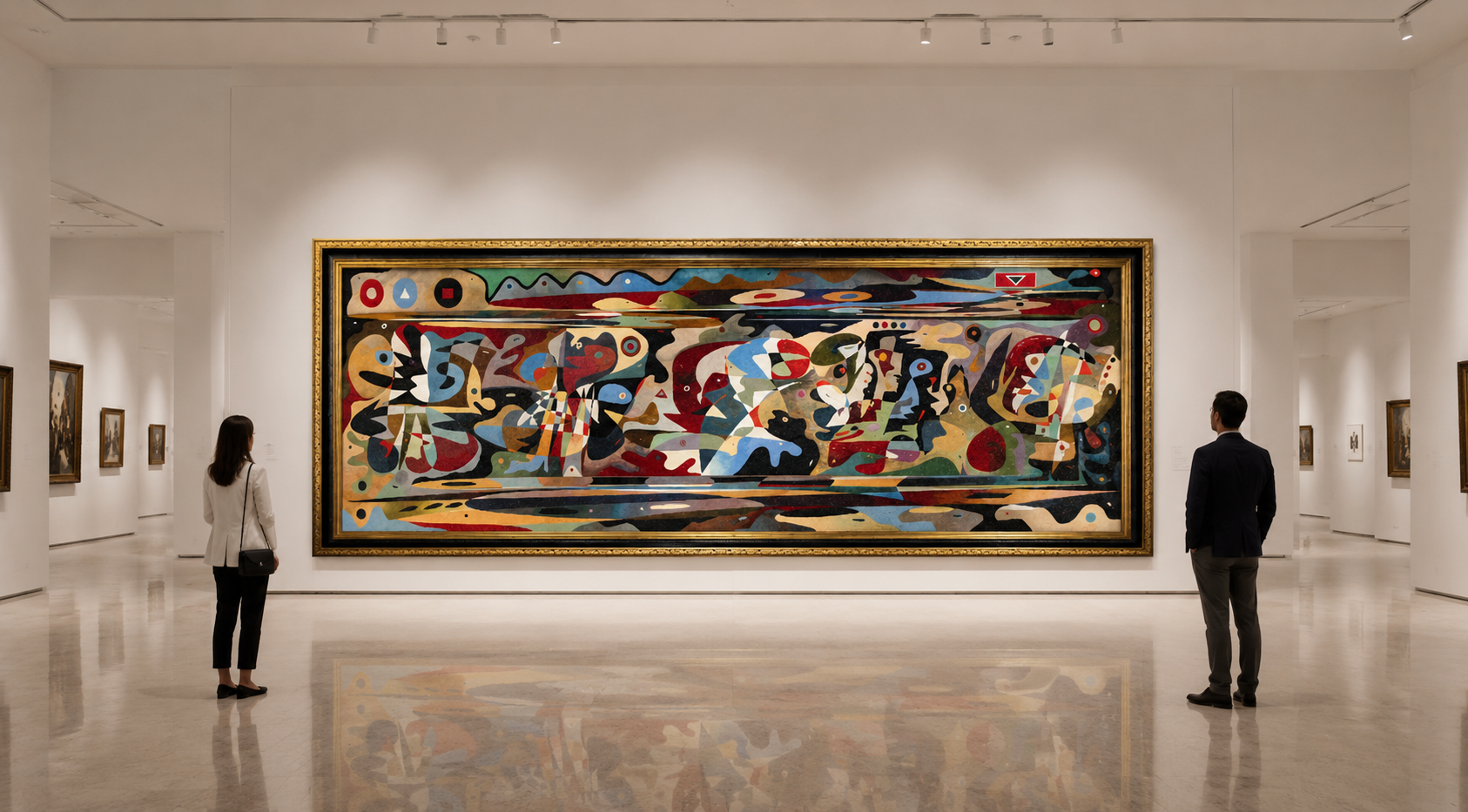
Within the 10 Religions series, Gheorghe Virtosu’s Islam (2017–2019) marks a decisive turn toward structure, order, and the articulation of unity as a governing principle. While earlier works explore expansion or dissolution, this painting consolidates a visual language in which multiplicity is neither negated nor dispersed, but held within a coherent system. Virtosu does not attempt to illustrate Islamic doctrine through recognizable imagery; instead, he reconstructs its underlying metaphysical condition, presenting unity not as an image, but as an organizing force that permeates the entire composition.
Central to this work is the tension between geometric abstraction and human presence. The upper register, defined by circles, triangles, and squares, introduces a coded visual order that evokes the structural logic of Islamic art, where geometry replaces figuration as a means of expressing the infinite. Below, a dense field of interconnected faces unfolds, suggesting a multiplicity that remains inseparable from the system that contains it. This interplay reflects a profound conceptual alignment with the principle of unity in Islam, where diversity does not oppose oneness but exists through it. The painting thus operates simultaneously as a cosmological schema and a field of lived experience.
In this context, Islam should be approached not as a symbolic representation, but as a spatial and perceptual environment. Its panoramic scale immerses the viewer within a network of relations where meaning is continuously constructed and reconfigured. Virtosu’s achievement lies in his ability to translate an abstract theological principle into a visual system that remains open, dynamic, and non-hierarchical. The result is a work that invites sustained contemplation, positioning the viewer within a unified field in which perception, identity, and structure are inseparably intertwined.
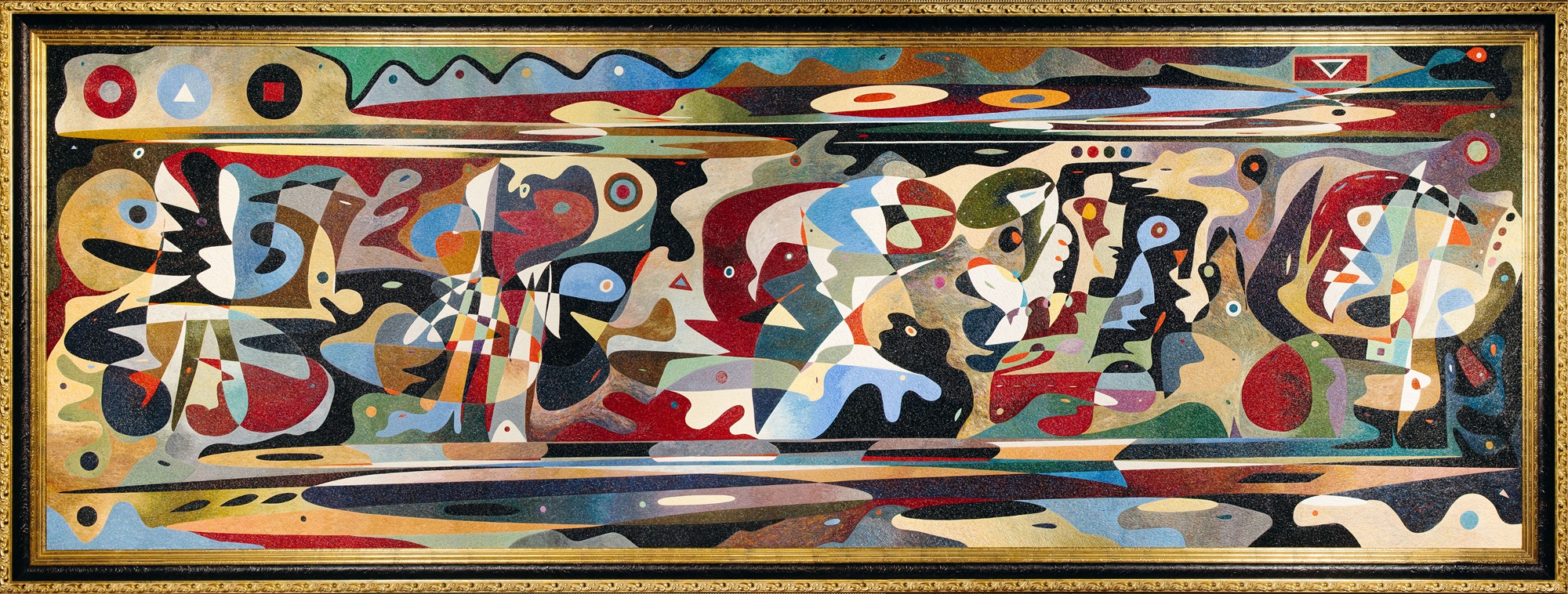
Islam (2017–2019) is a large-scale oil painting by Gheorghe Virtosu, measuring 2 × 6 meters, developed as part of the 10 Religions series¹. The composition unfolds across a panoramic format structured into three horizontal registers, each articulating a distinct yet interconnected visual logic².
The upper register is defined by geometric forms—circles, triangles, and squares—arranged with clarity and restraint³. These elements establish a system of order and abstraction, evoking the principles of geometry, repetition, and proportion associated with Islamic visual culture⁴. Rather than functioning as fixed symbols, the shapes operate as a formal language through which unity, structure, and directional movement are suggested².
The central field is densely populated with interconnected faces and fragmented human forms⁵. These figures overlap, merge, and share boundaries, forming a continuous network in which no single identity is isolated or dominant². Eye-like motifs recur throughout this zone, reinforcing the presence of distributed perception and awareness across the composition⁶.
The lower register transitions into more fluid, elongated bands of color, suggesting a reflective or horizon-like space⁷. In contrast to the density of the central field, this area is less figurative, emphasizing diffusion and continuity². The interplay between these three zones establishes a dynamic relationship between abstraction, human presence, and reflection⁵.
Executed through layered applications of oil paint, the work combines controlled geometric precision with organic, biomorphic forms⁸. The chromatic structure is carefully modulated, with distinct color zones defining forms while recurring hues create connections across the surface⁹. The result is a cohesive visual system in which geometry, figuration, and color operate together to produce a complex and immersive field of perception².
Islam (2017–2019) is conceptually grounded in the principle of unity as an underlying condition of existence¹. Rather than presenting unity as a singular or reductive state, the painting articulates it as a structure within which multiplicity is sustained and organized². The composition proposes that diversity—of forms, identities, and perceptions—does not oppose unity but emerges through it, existing only in relation to a larger, unifying framework³.
This conceptual framework is reflected in the interaction between geometry and figuration¹. The geometric forms in the upper register establish a system of order that operates independently of representation, suggesting an abstract, governing structure². In contrast, the central field introduces human presence through a network of interconnected faces³. These figures retain individuality yet remain inseparable from one another, demonstrating that identity is not autonomous but relational, shaped by its position within a broader system¹.
The painting also explores the dynamics of perception. The recurrence of eye-like forms across the surface suggests a distributed field of awareness in which seeing is not localized within a single subject¹. Instead, perception becomes a shared and circulating condition, embedded within the same structures that define form and identity². The viewer is thus drawn into a space where observation and participation are intertwined³.
The relationship between the three compositional registers further reinforces these ideas. The upper zone introduces abstraction and order, the central zone articulates multiplicity and interaction, and the lower zone suggests reflection and continuity¹. These layers do not function sequentially but simultaneously, creating a unified field in which different states of existence coexist and inform one another².
Ultimately, Islam operates as a visual investigation into the conditions through which meaning and identity are formed³. By integrating geometric abstraction, interconnected figuration, and a structured chromatic system, the painting presents a model of reality in which unity and multiplicity are inseparable¹. Interpretation remains open and relational, shaped by the viewer’s engagement with a field that is at once ordered, dynamic, and continuously evolving².
Gheorghe Virtosu is a contemporary painter whose work explores the intersection of philosophy, symbolic systems, and visual abstraction. His practice is characterized by large-scale compositions that integrate biomorphic forms, geometric structures, and fragmented figuration, creating complex visual fields in which meaning emerges through transformation and relation.
Virtosu’s work engages with global belief systems, cultural frameworks, and theoretical discourse, translating them into a visual language that resists fixed interpretation. Rather than illustrating specific narratives or doctrines, his paintings investigate the underlying structures through which ideas such as identity, perception, unity, and multiplicity are formed. This approach positions his work within a broader dialogue between contemporary art and philosophical inquiry.
Central to his practice is the ongoing series 10 Religions, in which Virtosu examines major spiritual and philosophical traditions through abstraction. Each work within the series functions as a conceptual exploration rather than a representational image, emphasizing shared structural principles across different systems of thought. Through this body of work, the artist invites viewers into an active process of interpretation, where meaning is continuously constructed and redefined.
Working primarily in oil on canvas, Virtosu employs layered techniques that allow forms to emerge, overlap, and dissolve across multiple perceptual planes. His compositions often combine controlled geometric elements with fluid, organic shapes, producing a tension between order and transformation. This interplay defines his visual language and underpins his exploration of interconnectedness and the evolving nature of reality.
Islam (2017–2019) is executed in oil on canvas at a monumental scale of 2 × 6 meters, creating an immersive panoramic format that encourages sustained visual engagement. The horizontal expansion of the composition supports the articulation of multiple registers, allowing distinct structural zones to coexist within a unified field.
The painting is constructed through layered applications of oil paint, producing depth, translucency, and a complex interplay between surface and underlying forms. Thin glazes and denser passages are combined to create variations in opacity, enabling figures and geometric elements to emerge, overlap, and partially dissolve across the canvas. This stratification contributes to the perception of multiple spatial planes operating simultaneously.
A key technical feature of the work is the integration of precise geometric forms with fluid, organic figuration. The upper register demonstrates a controlled handling of line and shape, with clearly defined edges and measured proportions. In contrast, the central and lower zones are characterized by more gestural brushwork, where forms remain open, interwoven, and dynamically resolved. This contrast reinforces the conceptual tension between order and transformation.
The chromatic structure is carefully modulated to support both differentiation and cohesion. Distinct color zones define compositional areas while recurring hues establish visual connections across the surface. The balance between saturated passages and more subdued tonal transitions contributes to the overall unity of the painting, guiding the viewer’s movement across the composition.
The scale, layering techniques, and interplay of geometric precision with painterly fluidity collectively produce a work that operates as both a structured system and a dynamic visual environment. The technical execution is integral to the painting’s conceptual framework, enabling the simultaneous presence of stability and transformation.
Artist: Gheorghe Virtosu
Medium: Oil and acrylic on linen canvas
Dimensions: 2 × 6.0 m
The composition of Islam (2017–2019) is structured as a horizontally extended field organized into three interrelated registers. The upper register is defined by geometric forms—circles, triangles, and squares—arranged along a continuous band, introducing order, clarity, and abstraction. This framework governs the composition, establishing alignment and balance while functioning as a stable structural base that contrasts with the organic complexity below.
The central register presents a dense network of overlapping faces and fragmented human forms, creating a continuous field of presence rather than discrete subjects. Shared boundaries, merging features, and the repetition of eye-like motifs generate a high degree of interconnection, emphasizing relational identity and distributed perception. The lower register transitions into fluid, horizon-like bands with softened edges, providing visual counterbalance and a sense of reflective continuity, allowing the composition to extend beyond its immediate surface.
The interplay among these registers establishes a dynamic equilibrium: geometric precision above, organic multiplicity at the center, and stabilizing fluidity below. Geometry, figuration, and color operate interdependently, producing a cohesive system in which meaning emerges through relationships, visual weight, and the continuous interaction across compositional zones. The arrangement guides the viewer’s gaze in a cyclical movement between structure, multiplicity, and reflection, creating an immersive and relational visual experience.
In Islam (2017–2019), color and form operate as interdependent systems that structure perception and organize the visual field. Unlike the fluid chromatic transitions in other works from the 10 Religions series, the palette here is controlled and compartmentalized. Distinct color zones define compositional registers, reinforcing order and coherence, while recurring hues establish connections across the surface, linking geometric and organic elements into a unified whole.
Color functions as a structural agent rather than a descriptive tool, delineating boundaries while allowing permeability. Faces in the central field emerge through layered chromatic contrasts, where subtle shifts in tone and saturation generate form without fully enclosing it. This creates figures that are simultaneously defined and integrated, maintaining balance between individuality and relational presence within the broader network of forms.
The interplay between chromatic modulation and formal structure guides visual movement and reinforces conceptual tension. In the upper register, color emphasizes geometric clarity, while in the central and lower zones, fluid transitions soften edges and allow organic forms to merge. Saturation and contrast create depth and rhythm, ensuring continuity across the painting, so that differentiation and cohesion coexist, preserving both structural integrity and a sense of continuous transformation.
The symbolic language of Islam (2017–2019) is constructed through a synthesis of geometric abstraction and fragmented figuration. Rather than employing fixed or canonical religious symbols, Gheorghe Virtosu develops a fluid system in which meaning emerges through relationships between forms. Geometric shapes in the upper register—circles, triangles, and squares—form a foundational framework, evoking cycles of emergence, manifestation, and return without resolving into fixed symbolic meanings. The circle suggests continuity and unity, the square introduces structure and orientation, and the opposing triangles imply directional movement between ascent and descent.
The central field introduces a dense network of overlapping faces and human forms, functioning as symbolic markers of presence and awareness. These figures are relational rather than autonomous, emerging through shared contours, blended features, and continuous transitions. Eye-like motifs recur throughout, suggesting a distributed perception in which awareness is not localized, and the gaze becomes a shared attribute connecting figures and viewer alike.
The lower register reduces figuration to elongated bands of color and softened forms, evoking a reflective or horizon-like space. Across the painting, symbols interact cumulatively rather than existing in isolation, creating layers of meaning that resist singular interpretation. Together, geometric structures, faces, and perceptual motifs establish an open, relational symbolic system that continuously evolves, exploring unity, multiplicity, and the conditions through which meaning is generated.
Islam (2017–2019) operates as a visual articulation of unity not as a static condition, but as an active structuring principle through which multiplicity is generated and sustained. The painting constructs a system in which all elements—geometric, figurative, and chromatic—exist only through participation in a larger, interconnected whole. Identity and presence emerge relationally: faces within the central field are individually recognizable yet inseparable from the surrounding network, demonstrating that the self is continuously constituted through interaction with others and with the structures that contain it.
The geometric register introduces a parallel level of abstraction, establishing order, direction, and balance through circles, triangles, and squares. This framework does not impose hierarchy but provides conditions under which variation occurs without collapsing into fragmentation. The interplay between geometric precision and organic complexity, coupled with the tripartite registers—abstraction above, multiplicity at the center, and reflection below—creates a temporality that is non-linear and simultaneous, inviting the viewer into a continuous present where formation, interaction, and transformation unfold together.
Meaning in Islam is contingent, relational, and emergent. It arises through the interactions of form, color, and spatial organization rather than through fixed representation. Unity and multiplicity coexist as mutually dependent conditions, producing a visual field that functions simultaneously as system, environment, and process. The painting foregrounds the continuous emergence of perception, identity, and meaning, presenting a model of reality in which order and diversity are inseparably intertwined.
The emotional register of Islam (2017–2019) is defined by a sustained tension between containment and expansiveness. The geometric upper register establishes clarity, stability, and coherence, while the dense central field of interconnected faces introduces a dynamic, relational intensity. This duality generates an atmosphere that is neither chaotic nor static, balancing control with movement and engagement with reflection.
Within the central field, overlapping human forms evoke collective affect rather than individual expression. Faces emerge without dominance, and emotions are distributed across the composition, creating a shared emotional field in which sensations of connection, proximity, and interdependence prevail. The viewer experiences relational presence, encountering affect as a continuous, flowing condition rather than discrete narratives.
The lower register extends this emotional dynamic into a more reflective and meditative zone. Reduced figuration and elongated forms create quiet continuity, allowing the intensity of the central field to dissipate. Together with the contemplative upper zone, this structure produces a cumulative and evolving emotional experience, where tension, connection, and resolution modulate across the painting in a distributed and relational manner.
- Gilles Deleuze and Félix Guattari, A Thousand Plateaus (Minneapolis: University of Minnesota Press, 1987).
- Roland Barthes, Mythologies (Paris: Seuil, 1957).
- Jacques Derrida, Of Grammatology (Baltimore: Johns Hopkins University Press, 1976).
- Jay L. Garfield, Empty Words: Buddhist Philosophy and Cross-Cultural Interpretation (New York: Oxford University Press, 2002).
- Jacques Lacan, Ecrits: A Selection (New York: W.W. Norton, 2002).
- Maurice Merleau-Ponty, Phenomenology of Perception (London: Routledge, 1962).
Selected Bibliography
- Barthes, Roland. Mythologies. Paris: Seuil, 1957.
- Deleuze, Gilles, and Félix Guattari. A Thousand Plateaus. Minneapolis: University of Minnesota Press, 1987.
- Derrida, Jacques. Of Grammatology. Baltimore: Johns Hopkins University Press, 1976.
- Garfield, Jay L. Empty Words: Buddhist Philosophy and Cross-Cultural Interpretation. New York: Oxford University Press, 2002.
- Lacan, Jacques. Ecrits: A Selection. New York: W.W. Norton, 2002.
- Merleau-Ponty, Maurice. Phenomenology of Perception. London: Routledge, 1962.
- Flood, Gavin. An Introduction to Hinduism. Cambridge: Cambridge University Press, 1996.
- Zimmer, Heinrich. Philosophies of India. Princeton: Princeton University Press, 1951.
Curatorial Team: Daniel Varzari
Photography: El Arte Monumental
Special Thanks: Daniel Varzari, Gheorghe Virtosu
El Arte Monumental
08007 Barcelona
Phone: +34 934 439 470/ +01 312 358 8023