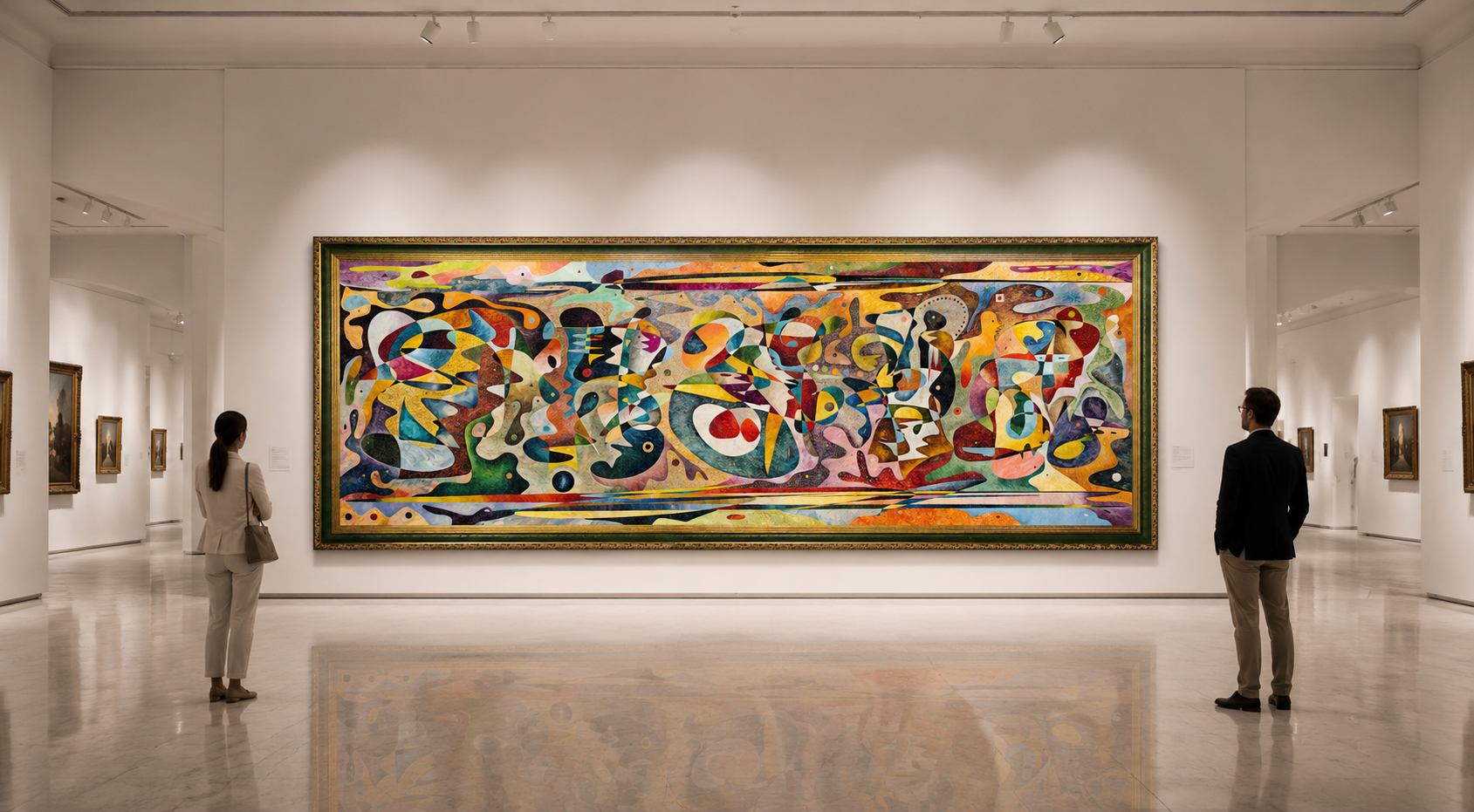
The Architecture of Belief
El Arte Monumental | Catalogue: The Architecture of Belief
Catalogue Entry: Jainism (2022) | Art Curator: Daniel Varzari
Jainism (2020–2022) by Gheorghe Virtosu occupies a distinctive position within the artist’s broader exploration of global belief systems, functioning as a rigorous visual meditation on the internal logic of Jain philosophical thought rather than its outward iconography. As part of the 10 Religions series, the work engages with systems of ethical regulation, metaphysical structure, and disciplined progression toward liberation, translating these principles into a tightly organized abstract field governed by balance, containment, and interdependence.
The composition reflects what may be understood as a visual analogue to Jain epistemology, in which knowledge and meaning are not immediately accessible but emerge through sustained attention and interpretive discipline. Repetition, numerical clustering, and the distribution of figural and symbolic elements generate a structured field in which order is implied rather than explicitly declared. Within this system, recurring dot formations and centralized configurations suggest the presence of an underlying numerical logic, while the juxtaposition of grouped elements introduces tensions between multiplicity and regulation, echoing Jainism’s emphasis on ethical precision and metaphysical balance.
Rather than functioning as a representational depiction of religious imagery, the work constructs a space in which Jain principles are operationalized through abstraction. The painting does not illustrate doctrine; it enacts a condition of disciplined perception in which meaning arises through relational structure rather than narrative clarity. In doing so, Virtosu produces a visual system that mirrors Jainism’s philosophical emphasis on restraint, interdependence, and the gradual refinement of perception as a pathway toward liberation.
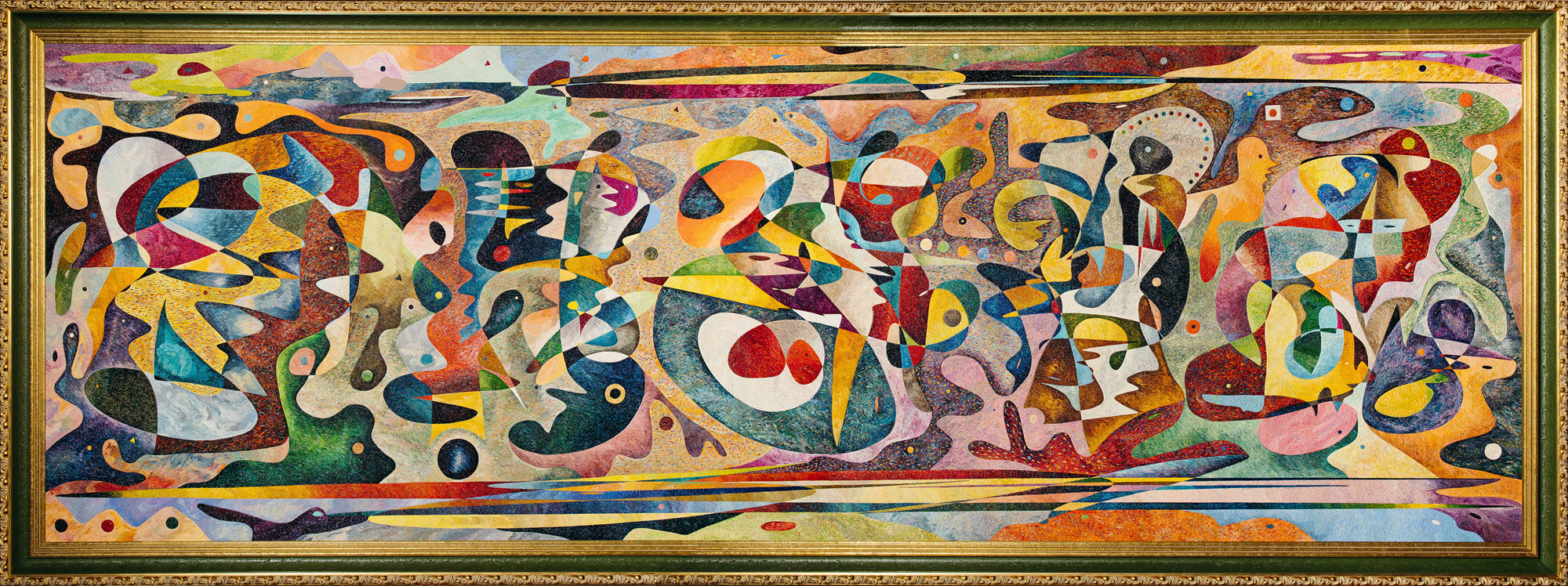
Jainism (2020–2022) by Gheorghe Virtosu presents a panoramic abstract composition structured through repetition, containment, and numerical organization. The painting unfolds as a continuous yet non-linear field in which biomorphic forms, fragmented faces, and circular motifs interweave across a horizontally extended surface. Rather than establishing a central focal point, the composition distributes visual attention across multiple zones, producing a condition of equilibrium that reflects the Jain emphasis on balance and interdependence. This spatial logic aligns with the concept of samsara, the cyclical continuity of existence shaped by karmic processes¹.
A central oval structure anchors the composition, enclosing internal forms that suggest containment and interiority. This feature may be interpreted as resonating with the Jain concept of jiva (soul), which remains bound within material conditions until liberated through ethical discipline. Surrounding this central form, a dense multiplicity of faces and living presences emerges, reflecting the Jain ontology in which all beings possess a soul and participate in a shared field of existence. The absence of hierarchical emphasis reinforces a distributed model of perception, where no single entity dominates the visual or conceptual structure².
Distinct numerical clusters—most notably groupings of eighteen and five dots—introduce a system of symbolic enumeration within the composition. These formations may be read in relation to Jain ethical frameworks, where the multiplicity of karmic impediments contrasts with the concentrated discipline of the five vows (mahavratas). The juxtaposition of dispersion and concentration visually articulates the tension between bondage and liberation, suggesting a regulated cosmology governed by ethical balance. While these correspondences remain interpretive, their structural clarity supports an understanding of the painting as a systematically encoded visual field rather than a purely formal abstraction³.
Jainism operates as a visual system in which abstraction becomes a vehicle for articulating philosophical structure. Rather than presenting identifiable iconography, the painting organizes meaning through repetition, numerical clustering, and spatial containment. This approach reflects the internal logic of Jain thought, which privileges classification, ethical precision, and the systematic ordering of existence. The composition does not narrate doctrine but constructs a field in which philosophical principles are translated into visual relations.
Central to this structure is the tension between multiplicity and regulation. The proliferation of biomorphic forms and fragmented faces suggests a densely populated universe of living entities, each participating in an interconnected system. At the same time, the controlled distribution of shapes and the absence of compositional hierarchy impose a condition of equilibrium. This duality mirrors the Jain understanding of reality as both infinitely plural and rigorously governed by karmic law.
The presence of distinct numerical groupings introduces a further level of conceptual organization. The contrast between dispersed and concentrated clusters can be interpreted as encoding ethical oppositions, particularly between the forces that bind the soul and the disciplined practices that enable its liberation. In this sense, number functions not merely as a formal device but as a structural principle through which moral and metaphysical categories are visualized.
Spatially, the painting resists directional movement in favor of cyclical continuity. Forms circulate rather than progress, reinforcing a conception of time aligned with recurrence rather than linear development. This cyclical condition is further emphasized by the enclosing bands that frame the composition, suggesting both the bounded nature of material existence and the regulated framework within which transformation occurs.
Ultimately, the work can be understood as a disciplined abstraction of Jain cosmology, in which meaning is neither fixed nor arbitrary but emerges through structured interaction. Virtosu’s painting does not resolve the tension between multiplicity and unity; instead, it sustains it as an active condition. The viewer is thus positioned within a system that demands sustained attention, mirroring the philosophical and ethical rigor that defines Jain practice.
Gheorghe Virtosu | Artist Biography
Gheorghe Virtosu is a contemporary painter whose work explores the intersection of philosophy, symbolic systems, and visual abstraction. His practice is characterized by large-scale compositions that integrate biomorphic forms, geometric structures, and fragmented figuration, producing complex visual fields in which meaning emerges through relational order, repetition, and structured balance.
Virtosu’s work engages with global belief systems and philosophical frameworks, translating them into a visual language that resists fixed interpretation while remaining structurally rigorous. Rather than illustrating specific narratives or doctrines, his paintings investigate the underlying logics through which concepts such as ethical order, multiplicity of life, containment, and transformation are visually organized. In this sense, his practice aligns particularly well with systems of thought that emphasize discipline, equilibrium, and cyclical existence.
Central to his practice is the ongoing series 10 Religions, in which Virtosu examines major spiritual and philosophical traditions through abstraction. Each work functions as a conceptual system rather than a representational image, emphasizing internal coherence, numerical structuring, and relational correspondence across symbolic elements. In works associated with Jainism, this approach becomes especially evident in the use of repetition, containment, and distributed visual units that suggest structured ethical and metaphysical organization.
Working primarily in oil on canvas, Virtosu employs layered techniques that allow forms to emerge, repeat, and interlock across multiple perceptual planes. His compositions often combine controlled geometric systems with dense biomorphic networks, producing a tension not between chaos and order, but between multiplicity and regulation. This interplay defines his visual language and underpins his exploration of interconnected existence, ethical structure, and cyclical transformation.
Jainism (2020–2022) is executed in oil on canvas at a monumental scale of 2 × 6 meters, creating an immersive horizontal field that engages the viewer’s full visual range. The panoramic format reinforces the painting’s non-hierarchical structure, allowing forms to extend laterally without privileging a single focal point. This spatial expansiveness supports the work’s conceptual emphasis on continuity, multiplicity, and relational balance.
The surface is built through successive layers of paint, producing a stratified field in which forms emerge, overlap, and partially dissolve. Virtosu employs a combination of fluid brushwork and controlled application, balancing gestural movement with structural precision. Biomorphic shapes, facial fragments, and geometric motifs are integrated through a process of accumulation, resulting in a dense yet coherent visual system.
Chromatically, the painting is organized through a calibrated interplay of warm and cool tonalities, with particular emphasis on ochres, reds, and muted blues. These color relationships function not only as compositional devices but also as structuring agents that guide perceptual movement across the surface. Repeated circular marks and dot clusters are carefully positioned, contributing to both rhythmic continuity and numerical organization within the composition.
The upper and lower bands act as formal boundaries, framing the pictorial field and reinforcing its contained structure. These elements stabilize the composition while maintaining tension between openness and enclosure. The overall technique reflects a synthesis of intuitive mark-making and deliberate construction, aligning material process with the painting’s conceptual emphasis on order, discipline, and interdependence.
Artist: Gheorghe Virtosu
Medium: Oil and acrylic on linen canvas
Dimensions: 2 × 6.0 m
The composition of Jainism is structured as a horizontally extended field in which visual elements are distributed with calculated equilibrium rather than hierarchical emphasis. The absence of a dominant focal point compels the viewer’s gaze to circulate across the surface, engaging with clusters of forms that emerge, overlap, and dissolve within a continuous spatial matrix. This lateral organization produces a sense of rhythmic containment, reinforced by the upper and lower bands that function as compositional boundaries, enclosing the pictorial field within a regulated system.
Formally, the painting negotiates a tension between biomorphic fluidity and geometric order. Organic shapes—often suggestive of faces, profiles, and living entities—are interwoven with circular motifs and structured clusters, creating a dense network of interdependence. The repetition of rounded forms, particularly the prominent central oval and surrounding dot formations, establishes a visual language grounded in recurrence and variation. These elements generate a cyclical spatial logic, in which movement is not directional but recursive, reinforcing the impression of continuous transformation within a bounded field.
The distribution of chromatic intensities further articulates the painting’s internal structure. Warmer and cooler tonal zones coexist without clear separation, producing a dynamic balance that avoids compositional dominance. The interplay between dispersed and concentrated elements—most notably in the contrast between expansive fields of interwoven forms and tightly grouped clusters—introduces a visual tension between multiplicity and control. This tension is sustained across the entire surface, resulting in a composition that is simultaneously complex and disciplined, where visual density is counterbalanced by structural coherence.
The chromatic structure of Jainism is governed by a controlled yet varied palette in which warm ochres, muted reds, and cooler blue tonalities coexist within a balanced visual field. Rather than producing sharp contrasts, color transitions are modulated and interdependent, creating a sense of equilibrium across the composition. This restraint in chromatic intensity reinforces the painting’s overall condition of regulation and balance, avoiding expressive excess in favor of measured distribution. Color operates not as a purely emotive device but as a structural agent, guiding the viewer’s movement across the surface while maintaining compositional coherence.
Formally, the painting integrates biomorphic and geometric elements into a dense, interwoven system. Organic shapes—suggestive of faces, profiles, and living entities—emerge and dissolve within a network of circular and oval configurations, producing a continuous interplay between figuration and abstraction. Repetition plays a central role, with recurring motifs such as dots, loops, and enclosed forms establishing rhythm and continuity. The absence of a dominant figure or focal point results in a distributed compositional logic, where each element contributes to the overall structure without hierarchical prioritization.
The relationship between color and form is particularly evident in the central oval structure and surrounding clusters, where tonal variation enhances the perception of containment and depth. Warmer hues tend to concentrate within enclosed forms, while cooler tones circulate around them, creating a subtle tension between interiority and expansion. This interplay reinforces the painting’s broader visual logic, in which containment and dispersion coexist as complementary forces. The result is a highly regulated pictorial system in which chromatic and formal elements function together to sustain balance, rhythm, and structural unity.
The symbolic language of Jainism is articulated through a dense interplay of abstracted forms that evoke, rather than directly depict, the philosophical structures of Jainism. Central to this system is the large oval configuration, which functions as a locus of containment and interiority. This form may be read as resonating with the concept of jiva (soul), understood within Jain thought as an entity bound within material existence yet capable of liberation through ethical discipline. The enclosure of this central structure suggests both limitation and potential, reflecting the dual condition of constraint and transcendence that defines the Jain metaphysical framework.
Surrounding this focal form, a multiplicity of faces, profiles, and biomorphic presences emerges across the pictorial field. These figures do not operate as individualized identities but as distributed markers of life, aligning with the Jain principle that all beings—regardless of scale or form—possess a soul. The repetition of ocular motifs further reinforces a condition of dispersed awareness, transforming perception into a shared, non-centralized phenomenon. This proliferation of life forms constructs an image of existence as densely populated and ethically interconnected, where no single entity holds dominance.
A defining symbolic feature of the composition lies in its numerical structuring, particularly the presence of distinct dot clusters. The grouping of eighteen dots, positioned in a controlled formation, and a nearby cluster of five introduce a system of enumeration that may be interpreted in relation to Jain ethical categories. These configurations suggest a conceptual tension between multiplicity and concentration, or between forces that bind the soul and those that guide it toward liberation. While such readings remain interpretive, the precision and repetition of these elements indicate a deliberate integration of symbolic logic, positioning the painting as a structured cosmology rather than a purely formal abstraction.
Jainism (2020–2022) can be understood as a visual system that translates philosophical structure into spatial and relational terms. Rather than representing doctrine, the painting constructs a field in which meaning is generated through balance, repetition, and containment. The absence of linear progression and the persistence of cyclical organization suggest a cosmology governed not by narrative development but by continuous processes of interaction. In this sense, the work operates analogously to Jain metaphysics, where existence is defined by the interplay of forces rather than singular events.
Central to this conceptual framework is the tension between multiplicity and regulation. The proliferation of forms—faces, eyes, and biomorphic entities—establishes a condition of ontological density, while the structured arrangement of these elements imposes a system of order upon that multiplicity. This duality reflects a fundamental aspect of Jain philosophy: the coexistence of infinite living beings within a universe governed by precise ethical and karmic laws. The painting does not resolve this tension but sustains it, allowing both dispersion and control to coexist within a single visual system.
The integration of numerical groupings further reinforces the work’s conceptual rigor, introducing the possibility of an encoded ethical structure within the composition. These elements suggest that the painting is not only spatially organized but also logically constructed, functioning as a visual analogue to systems of classification and discipline. Ultimately, the work proposes a model of existence in which liberation is not achieved through escape from structure, but through engagement with it. Meaning emerges through the recognition of underlying order, positioning the viewer within an active process of interpretation that mirrors the disciplined path central to Jain thought.
The emotional tone of Jainism is characterized by restraint, equilibrium, and sustained introspection rather than expressive intensity. Unlike compositions that privilege dramatic contrast or gestural dynamism, the painting maintains a controlled affective field in which emotion is distributed across the surface rather than concentrated in a single focal point. This produces a contemplative register that aligns with the ethical discipline central to Jainism, particularly its emphasis on self-regulation and non-attachment (aparigraha). The viewer is not confronted with emotional excess, but instead drawn into a condition of reflective attentiveness.
Despite its structural balance, the work contains subtle tensions that generate an undercurrent of unease and ambiguity. The dense interweaving of faces, forms, and numerical clusters introduces a sense of cognitive saturation, where perception must continuously negotiate between order and multiplicity. This oscillation between clarity and complexity produces a quiet intensity, not through dramatic opposition but through sustained perceptual demand. Emotion, in this sense, emerges as a slow accumulation of attention rather than immediate affective impact.
Ultimately, the painting establishes an emotional register grounded in stillness and ethical contemplation. The absence of narrative resolution or hierarchical focus reinforces a meditative state in which meaning is continually deferred and reassembled. This condition mirrors the Jain understanding of liberation as a gradual process of purification and disciplined awareness, suggesting an affective structure in which calmness is not absence of feeling, but its refined and regulated form.
- Umberto Eco, The Open Work. Cambridge, MA: Harvard University Press, 1989. Eco’s concept of the “open work” frames meaning as a structured but non-fixed field generated through interpretive engagement.
- Paul Dundas, The Jains. London: Routledge, 2002. A comprehensive overview of Jain doctrine, ethics, and metaphysical structure, including the central role of ahimsa and karmic theory.
- Padmanabh S. Jaini, The Jaina Path of Purification. Berkeley: University of California Press, 1979. Foundational study of Jain soteriology and the structure of liberation through ethical discipline.
- Gilles Deleuze and Félix Guattari, A Thousand Plateaus. Minneapolis: University of Minnesota Press, 1987. Introduces the concept of the rhizome as a non-hierarchical model of organization relevant to distributed visual systems.
Selected Bibliography
- Eco, Umberto. The Open Work. Cambridge, MA: Harvard University Press, 1989.
- Dundas, Paul. The Jains. London: Routledge, 2002.
- Jaini, Padmanabh S. The Jaina Path of Purification. Berkeley: University of California Press, 1979.
- Deleuze, Gilles, and Félix Guattari. A Thousand Plateaus: Capitalism and Schizophrenia. Minneapolis: University of Minnesota Press, 1987.
- Derrida, Jacques. Of Grammatology. Baltimore: Johns Hopkins University Press, 1976.
- Foucault, Michel. Discipline and Punish: The Birth of the Prison. New York: Pantheon Books, 1977.
- Barthes, Roland. Mythologies. Paris: Seuil, 1957.
Curatorial Team: Daniel Varzari
Photography: El Arte Monumental
Special Thanks: Daniel Varzari, Gheorghe Virtosu
El Arte Monumental
08007 Barcelona
Phone: +34 934 439 470/ +01 312 358 8023