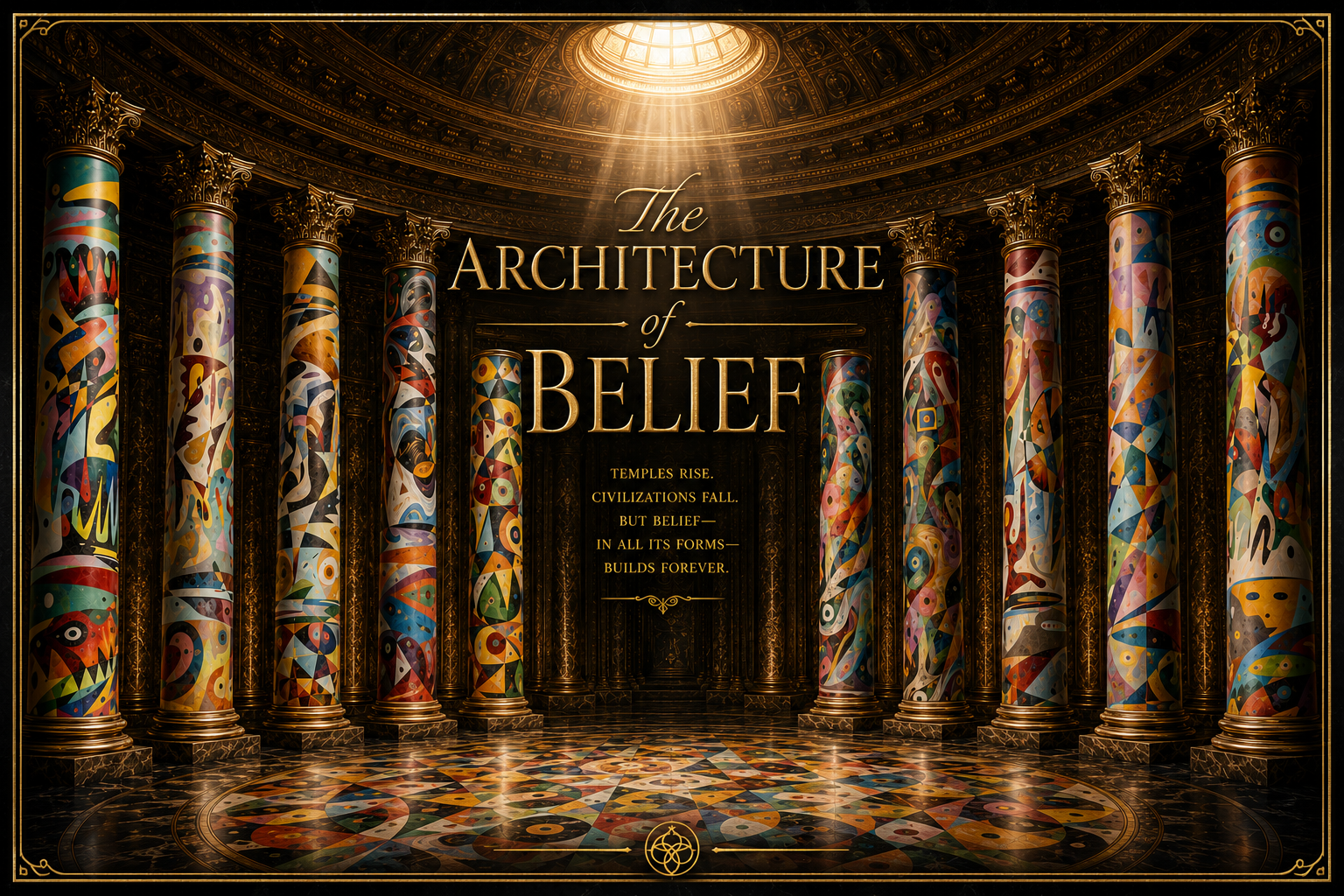
The Architecture of Belief
El Arte Monumental | Catalogue: The Architecture of Belief
Catalogue Entry: Judaism (2024) | Art Curator: Daniel Varzari
Gheorghe Virtosu’s Judaism (2022–2024) forms part of the ongoing 10 Religions series, in which systems of belief are translated into abstract visual structures. In this work, Virtosu turns toward a tradition defined not by singular imagery, but by its deep investment in text, law, and interpretation. The painting does not attempt to represent Judaism iconographically; rather, it constructs a field in which its underlying principles—continuity, debate, and structured meaning—are enacted through form.
The composition operates through fragmentation and recombination, producing a surface that resists fixed reading while maintaining internal coherence. Faces, geometric structures, and numerical elements emerge and recede within a layered environment that evokes the accumulation of textual traditions and the dialogic nature of interpretation. Here, meaning is not presented as stable or singular, but as something continually negotiated across time, structure, and relation.
What distinguishes Judaism within the series is its emphasis on continuity through transformation. The work sustains tension between disruption and order, between historical rupture and persistent identity, without resolving these into a unified image. In doing so, Virtosu offers not a depiction of belief, but a visual analogue to a living system of thought—one that endures through reinterpretation, structure, and the ongoing production of meaning.
Judaism (2022–2024) by Gheorghe Virtosu is a monumental abstract painting that translates the foundational structures of Judaism into a complex visual field. Through layered biomorphic forms, geometric interventions, and fragmented figuration, the composition constructs a system in which meaning emerges through accumulation, relation, and reinterpretation rather than fixed representation.
The work is characterized by a dynamic interplay between fluid organic shapes and rigid geometric elements, including a prominent square-within-square motif that introduces a sense of spatial order and containment. Repeated facial profiles and overlapping planes create a dialogic environment, suggesting multiplicity and exchange, while numerical groupings of dots subtly reinforce underlying structures of time, law, and continuity.
Balancing fragmentation with coherence, the painting evokes themes of historical persistence, textual tradition, and interpretive depth. Its panoramic scale and rhythmic composition invite immersive viewing, encouraging the viewer to navigate shifting zones of clarity and density, and to engage with the work as an evolving system of meaning grounded in both cultural memory and contemporary abstraction.
Judaism (2022–2024) constructs a visual system that translates the foundational principles of Judaism into an abstract language of structure, relation, and continuity. Rather than depicting specific narratives or symbols, the painting operates through a network of interdependent elements in which meaning is generated through interaction. The composition reflects a tradition grounded not in fixed imagery, but in processes of interpretation, transmission, and reinterpretation, aligning with the notion of the “open work” articulated by Umberto Eco¹.
The fragmented and layered nature of the composition suggests a model of knowledge that is cumulative rather than linear. Overlapping planes and intersecting forms evoke a stratified field in which visual elements function analogously to textual layers, recalling the interpretive depth of Torah and its commentaries. Meaning emerges through this accumulation, requiring active engagement rather than passive recognition, consistent with Jacques Derrida’s concept of différance².
Recurrent facial profiles introduce a dialogic dimension, in which multiple perspectives coexist and interact. These figures do not assert individual identity but instead contribute to a distributed field of perception, suggesting exchange, debate, and relational understanding. The painting thus reflects a system in which meaning is negotiated collectively rather than defined by a singular authority, resonating with Mikhail Bakhtin’s theory of dialogism³.
Geometric structures provide a counterpoint to the fluidity of the surrounding forms. The square-within-square motif establishes a sense of containment and spatial hierarchy, evoking ordered systems governed by structure and boundary. This tension between organic multiplicity and geometric control reflects the interplay between lived experience and the regulating frameworks of law and tradition.
Numerical groupings embedded within the composition introduce an additional layer of organization. A sequence of six elements suggests temporal structuring and progression, while a grouping of five implies containment and codification. Together, these elements may be understood as articulating a relationship between the unfolding of time and the establishment of order, reinforcing the painting’s underlying conceptual framework.
The composition also engages with the idea of continuity through fragmentation. While forms appear disrupted and reconfigured, they remain interconnected within a unified field. This dynamic reflects a condition in which identity and meaning persist not through stability, but through adaptation and transformation across time, echoing Michel Foucault’s concept of discontinuous historical systems⁴.
Ultimately, the work functions as an open system in which structure and ambiguity coexist. It invites sustained contemplation, encouraging the viewer to navigate its shifting relationships and to participate in the ongoing construction of meaning. In this way, the painting embodies a mode of thought in which interpretation is not a conclusion, but a continuous process.
Gheorghe Virtosu | Artist Biography
Gheorghe Virtosu is a contemporary painter whose work explores the intersection of philosophy, symbolic systems, and visual abstraction. His practice is characterized by large-scale compositions that integrate biomorphic forms, geometric structures, and fragmented figuration, producing complex visual fields in which meaning emerges through relation, structure, and interpretive depth.
Virtosu’s work engages with global belief systems and philosophical frameworks, translating them into a visual language that resists fixed interpretation while maintaining internal coherence. Rather than illustrating specific narratives or doctrines, his paintings investigate the underlying logics through which concepts such as law, memory, continuity, and interpretation are visually constructed. This approach aligns particularly with traditions in which meaning is shaped through textual transmission and sustained reinterpretation.
Central to his practice is the ongoing series 10 Religions, in which Virtosu examines major spiritual traditions through abstraction. Each work functions as a conceptual system rather than a representational image, emphasizing structural relationships, layered meaning, and the interaction of symbolic elements. In works associated with Judaism, this methodology becomes especially evident through the use of fragmentation, geometric containment, and dialogic figuration, reflecting systems of thought grounded in law, discourse, and historical continuity.
Working primarily in oil on canvas, Virtosu employs layered techniques that allow forms to emerge, overlap, and reconfigure across multiple perceptual planes. His compositions combine geometric order with fluid, organic structures, producing a tension between regulation and transformation. This interplay defines his visual language and underpins his exploration of meaning as an evolving, relational process shaped by structure, interpretation, and time.
Executed in oil on canvas at a monumental scale (2 × 6 meters), Judaism (2022–2024) establishes an immersive panoramic field that encourages sustained visual engagement. The horizontal format supports a continuous yet non-linear composition, allowing forms to unfold across the surface while maintaining a sense of structural cohesion.
The painting is constructed through layered applications of pigment, producing a stratified surface in which forms emerge, overlap, and partially dissolve. This process creates depth without relying on traditional perspective, instead generating multiple perceptual planes that shift as the viewer’s attention moves across the composition.
Virtosu combines fluid biomorphic shapes with sharply defined geometric elements, including rectilinear structures that introduce moments of visual stability and containment. These geometric interventions function as organizing anchors within the composition, contrasting with the surrounding organic forms and reinforcing the interplay between order and fragmentation.
Chromatically, the work is defined by a controlled yet varied palette, in which areas of luminosity are set against denser, more saturated regions. This modulation of color enhances the painting’s internal rhythm, guiding the viewer through zones of relative clarity and complexity while reinforcing the tension between legibility and opacity.
Fine linear details and repeated motifs, including dot sequences and facial fragments, contribute to the painting’s intricate surface texture. These elements operate both as compositional devices and as carriers of conceptual structure, reinforcing the work’s emphasis on repetition, variation, and relational organization across the pictorial field.
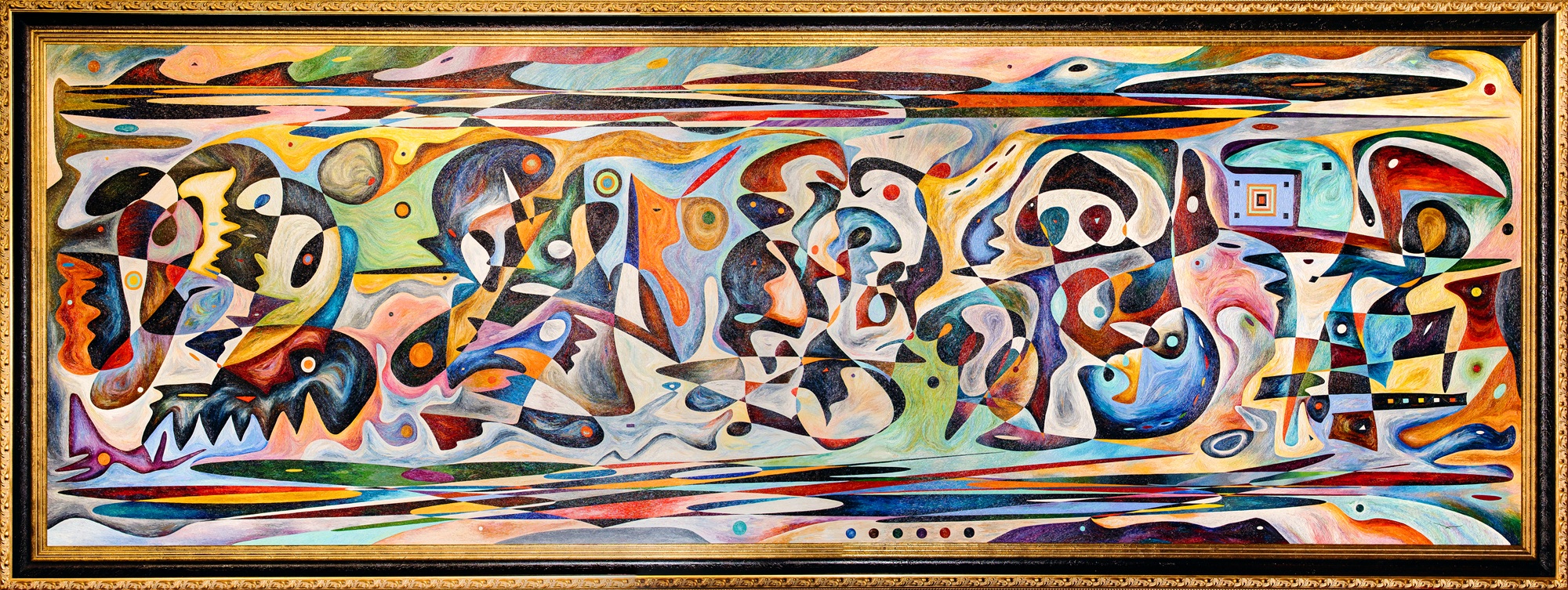
Artist: Gheorghe Virtosu
Medium: Oil and acrylic on linen canvas
Dimensions: 2 × 6.0 m
Judaism (2022–2024) is structured as a horizontally extended, stratified field in which fragmented figuration, geometric containment, and rhythmic repetition are distributed across a continuous pictorial surface. The composition avoids central hierarchy, instead establishing a system of relational balance in which visual elements gain meaning through adjacency, contrast, and recurrence rather than focal dominance.
The interplay between biomorphic forms and rectilinear structures introduces a sustained tension between fluidity and order. Recurrent facial profiles appear embedded within overlapping planes, suggesting a dialogic condition in which perception is dispersed across multiple points of reference. This distributed figuration destabilizes singular reading positions and reinforces a sense of visual multiplicity.
Geometric interventions, including square-based configurations and linear dot sequences, function as stabilizing devices within the composition. These elements introduce moments of structural clarity that contrast with the surrounding fluidity, producing a dynamic equilibrium between regulation and transformation. The result is a visual system that oscillates between openness and containment.
Chromatic modulation further reinforces the painting’s internal logic, with shifts between light and dense tonal regions guiding perceptual movement across the surface. Rather than directing a linear narrative, the composition establishes a cyclical rhythm of attention, in which meaning emerges through sustained viewing and the continuous negotiation of relationships between form, color, and spatial interval.
In Judaism (2022–2024), color operates as a structuring device that organizes perception across a fragmented yet coherent visual field. The palette shifts between muted earth tones, desaturated blues, and intermittent chromatic intensifications, producing zones of varying optical density. Rather than functioning descriptively, color establishes relational gradients that guide the viewer through alternating states of clarity, compression, and diffusion.
Form in the painting is defined by a tension between geometric containment and biomorphic fluidity. Rectilinear structures introduce moments of stability and spatial hierarchy, while organic, fragmented shapes disrupt linear reading and generate continuous visual movement. This interplay produces a dynamic system in which form is not fixed, but constantly negotiated through adjacency and overlap.
Repetition plays a central role in structuring both color and form, particularly through recurring facial fragments, dot sequences, and modular shapes. These elements function as rhythmic units that establish coherence across the composition while preventing closure. Their distribution across the pictorial surface creates a sense of distributed meaning, in which no single form dominates the visual hierarchy.
Ultimately, the relationship between color and form generates a field of controlled instability, where visual order emerges through fluctuation rather than symmetry. The painting sustains a balance between structure and dissolution, positioning perception as an active process of navigation through shifting chromatic and formal conditions.
In Judaism (2022–2024), symbolism is embedded within a densely structured visual field where meaning is articulated through relation rather than direct representation. Fragmented facial profiles, overlapping planes, and layered chromatic zones collectively construct a dialogic environment in which perception is distributed across multiple viewpoints. Rather than functioning as isolated motifs, these figures operate as interconnected units within a broader system of interpretive exchange, reflecting a model of meaning grounded in continuity and reinterpretation.
Geometric configurations play a central role in organizing the composition, most notably through a square-within-square structure that introduces a sense of spatial hierarchy and containment. This motif is counterbalanced by biomorphic forms that resist fixed boundaries, producing a tension between order and fluidity. Numerical groupings, including sequences of five and six elements, further suggest underlying structures of law, time, and textual organization, reinforcing the work’s engagement with systems of classification and meaning-making.
The interplay between fragmentation and coherence reflects a broader conceptual framework in which identity, history, and interpretation are continually negotiated. Symbolic elements do not resolve into a singular narrative but remain in a state of dynamic interaction, allowing the painting to function as an open system of meaning. In this sense, imagery operates not as illustration but as structure, where visual form becomes a site of ongoing conceptual production.
In Judaism (2022–2024), Gheorghe Virtosu constructs an abstract system that translates key structural principles of Judaism into visual form, particularly those related to textuality, law, and interpretive continuity. The composition operates not as narrative illustration but as a relational field in which meaning emerges through fragmentation, layering, and recombination. This approach reflects a mode of thought in which understanding is generated through sustained interpretation rather than fixed representation.
Fragmented figuration and dialogic spatial arrangements establish a visual analogue to interpretive traditions in which meaning is produced through exchange and commentary. Geometric interventions—most notably square-based structures—introduce systems of containment and order that contrast with the fluid biomorphic field, suggesting the structuring function of law and spatial regulation. Within this framework, numerical groupings of elements introduce additional layers of organization, evoking conceptual relationships between temporal sequence, textual structure, and codified systems of meaning.
Ultimately, the painting functions as an open system in which structure and ambiguity coexist without resolution. Its fragmented yet interconnected composition sustains a dynamic tension between continuity and disruption, reflecting a worldview in which meaning is not fixed but continually produced through interpretation. The viewer is therefore positioned not as a passive observer, but as an active participant in the ongoing construction of significance within the work.
Judaism (2022–2024) establishes an emotional register grounded in tension between clarity and fragmentation. The work avoids expressive resolution, instead sustaining a condition in which perception oscillates between recognition and uncertainty. This produces a contemplative intensity shaped less by narrative affect than by sustained cognitive engagement with structure and ambiguity.
The layering of forms and recurrent interruptions within the composition generates a sense of continual deferral, where visual meaning is always in formation but never fully stabilised. This creates an atmosphere of reflective distance rather than immediacy, inviting a mode of looking that is slow, attentive, and interpretive. Emotional experience arises through navigation of the work’s internal tensions rather than through identifiable figurative content.
At a broader level, the painting sustains a quiet intensity derived from its balance of order and dispersion. Rather than resolving into harmony or rupture, it maintains both states simultaneously, producing a restrained but persistent affective field. The result is an emotional register characterised by contemplation, structural awareness, and open-ended interpretive engagement.
- Umberto Eco, The Open Work (Cambridge, MA: Harvard University Press, 1989), theorizes artworks as “open systems” in which meaning is produced through active interpretation rather than fixed representation.
- Jacques Derrida, Of Grammatology (Baltimore: Johns Hopkins University Press, 1976), introduces différance as the continuous deferral and relational production of meaning within systems of signs.
- Mikhail Bakhtin, The Dialogic Imagination (Austin: University of Texas Press, 1981), develops the concept of dialogism, where meaning emerges through interaction between multiple voices rather than singular authority.
- Michel Foucault, The Archaeology of Knowledge (New York: Pantheon Books, 1972), examines discontinuities in historical epistemes and the non-linear transformation of knowledge systems over time.
- Gershom Scholem, Major Trends in Jewish Mysticism (New York: Schocken Books, 1995), provides foundational analysis of symbolic and interpretive structures within Jewish mystical traditions.
Selected Bibliography
- Bakhtin, Mikhail. The Dialogic Imagination. Austin: University of Texas Press, 1981.
- Derrida, Jacques. Of Grammatology. Baltimore: Johns Hopkins University Press, 1976.
- Eco, Umberto. The Open Work. Cambridge, MA: Harvard University Press, 1989.
- Foucault, Michel. The Archaeology of Knowledge. New York: Pantheon Books, 1972.
- Levinas, Emmanuel. Totality and Infinity. Pittsburgh: Duquesne University Press, 1969.
- Scholem, Gershom. Major Trends in Jewish Mysticism. New York: Schocken Books, 1995.
Curatorial Team: Daniel Varzari
Photography: El Arte Monumental
Special Thanks: Daniel Varzari, Gheorghe Virtosu
El Arte Monumental
08007 Barcelona
Phone: +34 934 439 470/ +01 312 358 8023