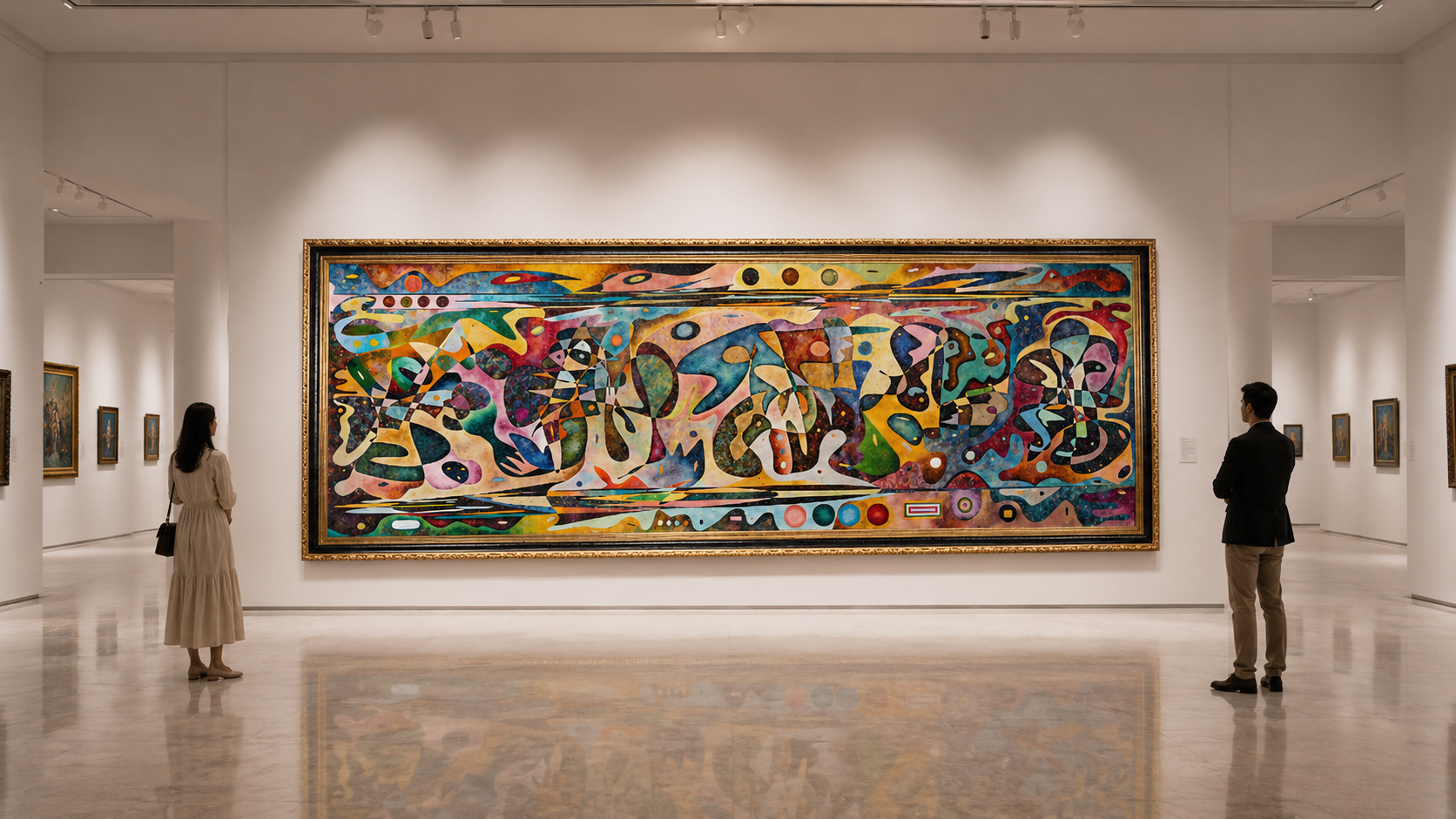
The Architecture of Belief
El Arte Monumental | Catalogue: The Architecture of Belief
Catalogue Entry: Satanism (2025) | Art Curator: Daniel Varzari
Satanism (2023–2025) occupies a critical position within Gheorghe Virtosu’s ongoing 10 Religions series, marking a decisive shift from systems grounded in harmony, continuity, or transcendence toward a framework defined by inversion, autonomy, and structural tension. Rather than engaging with sensational or iconographic representations, the work approaches Satanism as a philosophical condition—one concerned with the reconfiguration of authority, the construction of selfhood, and the negotiation of opposing forces within a shared field.
Virtosu’s approach is neither illustrative nor polemical. Instead, the painting constructs a complex visual system in which order and disruption coexist, and where meaning emerges through relational dynamics rather than fixed symbols. By embedding structured elements within a continuously shifting environment, the artist invites viewers to consider how systems of belief are formed, challenged, and transformed from within. The work thus resonates with broader contemporary concerns surrounding agency, resistance, and the instability of inherited frameworks.
Within the context of the series, Satanism functions as a counterpoint that reorients the viewer’s understanding of the whole. It does not negate the structures explored in other works, but reframes them through opposition and reinterpretation. In doing so, Virtosu expands the conceptual scope of the project, positioning belief not as a fixed system, but as an evolving process shaped by tension, inversion, and the continuous redefinition of meaning.
Satanism (2023–2025) unfolds across a monumental horizontal canvas, presenting a densely layered field of interwoven biomorphic forms, geometric structures, and shifting chromatic zones. The composition is framed by elongated upper and lower bands that function as visual thresholds, containing sequences of circular elements that introduce rhythm and structural repetition. Within this bounded field, forms emerge, overlap, and dissolve, creating a continuous flow that resists fixed orientation or stable figuration.
Throughout the central register, abstracted profiles, fragmented faces, and hybrid organic shapes appear in states of transformation. These elements are distributed across multiple spatial planes, often intersecting or confronting one another, producing a sense of internal tension and relational complexity. Geometric insertions—such as squares and framed structures—punctuate the fluid field, introducing moments of rigidity that contrast with the surrounding organic movement.
The chromatic palette ranges from deep, saturated tones to luminous, translucent passages, generating areas of intensity and diffusion across the surface. Warm and cool colors interact in shifting balances, while layered applications of paint create depth and optical vibration. The result is an immersive visual environment in which structure and fluidity coexist, encouraging the viewer to navigate the composition through continuous perceptual engagement.
The conceptual foundation of Satanism (2023–2025) rests on the principle of inversion—not as negation, but as a generative reconfiguration of established structures. The painting does not position itself in opposition to order in a purely destructive sense; rather, it constructs a system in which existing frameworks are retained, displaced, and reoriented. This logic aligns with 1Friedrich Nietzsche’s formulation of the transvaluation of values, where meaning emerges through the reordering of inherited hierarchies rather than their erasure.
Within this framework, identity is treated as a relational construct rather than a fixed entity. The fragmented and overlapping facial profiles distributed across the composition suggest multiple, coexisting states of subjectivity. These figures neither stabilize nor dissolve completely; instead, they remain suspended in a condition of continuous negotiation. Such a configuration reflects 2Michel Foucault’s understanding of the subject as produced through systems of power and resistance, rather than existing as an autonomous origin.
The dual horizontal sequences of circular forms introduce a critical structural tension between codification and reinterpretation. Their regular spacing suggests systems of enumeration or classification, yet their duplication and displacement undermine any singular authority. Positioned at the thresholds of the composition, these sequences function as boundary conditions that both contain and destabilize the central field, indicating that systems of order persist even as they are subjected to transformation.
Geometric insertions within the composition operate as localized manifestations of imposed structure. Squares, frames, and linear elements appear as attempts to fix or regulate the surrounding fluidity, yet they are consistently disrupted by intrusion and distortion. This interplay produces a condition in which structure is neither fully dominant nor entirely dissolved, but exists in a state of ongoing tension with the forces that undermine it.
The painting’s internal logic is further articulated through processes of mirroring and doubling. Repeated forms and reversed configurations establish a visual syntax of reflection that resists stable orientation. In this context, inversion functions not as a binary reversal, but as a continuous process in which distinctions between origin and reflection, authority and opposition, become increasingly indeterminate.
Chromatic relationships reinforce this conceptual structure by generating zones of optical conflict rather than harmony. Saturated hues intersect with muted tonal fields, producing a dynamic in which color destabilizes form and disrupts spatial continuity. This instability aligns with 3Jacques Derrida’s concept of différance, where meaning is perpetually deferred and constituted through relational difference rather than fixed presence.
Ultimately, the painting proposes a model of autonomy grounded not in isolation, but in relational opposition. By embedding systems of order within a field of continuous disruption, Virtosu constructs a visual philosophy in which meaning emerges through tension, inversion, and reconfiguration. The viewer is thus situated within an open system in which interpretation remains contingent, and where the act of perception itself becomes a form of participation in the ongoing production of meaning.
Gheorghe Virtosu | Artist Biography
Gheorghe Virtosu is a contemporary painter whose work explores the intersection of philosophy, symbolic systems, and visual abstraction. His practice is defined by large-scale compositions that integrate biomorphic forms, geometric structures, and fragmented figuration, producing complex visual fields in which meaning emerges through tension, inversion, and relational structure.
Virtosu’s work engages with global belief systems and philosophical frameworks, translating them into a visual language that resists fixed interpretation while maintaining internal coherence. Rather than illustrating doctrines or narratives, his paintings investigate the underlying mechanisms through which systems of authority, identity, and value are constructed, challenged, and reconfigured.
Central to his practice is the ongoing series 10 Religions, in which Virtosu examines major spiritual and philosophical traditions through abstraction. Each work operates as a conceptual system rather than a representational image, emphasizing structural relationships, symbolic density, and the instability of meaning. In works associated with Satanism, this approach becomes particularly focused on processes of inversion, opposition, and self-definition, reflecting philosophical frameworks that prioritize autonomy and the revaluation of established structures.
Working primarily in oil on canvas, Virtosu employs layered techniques that allow forms to emerge, fragment, and reconfigure across multiple perceptual planes. His compositions balance geometric constraint with fluid, organic transformation, generating dynamic environments in which order and disruption coexist. This interplay defines his visual language and underpins his exploration of meaning as a process shaped by conflict, reinterpretation, and continual transformation.
Executed in oil on canvas at a monumental scale (2 × 6 meters), Satanism (2023–2025) employs a panoramic format that establishes a continuous horizontal field, encouraging lateral movement across the composition. The surface is built through layered pigment applications, producing depth, translucency, and chromatic complexity, with forms emerging and dissolving across overlapping spatial registers.
The composition is structured through the interplay of biomorphic forms and geometric insertions, generating a dynamic tension between fluidity and constraint. Recurrent horizontal bands at the upper and lower edges introduce linear sequences of circular elements, creating a rhythmic framework that both stabilizes and subtly disrupts the pictorial field. These structural features function as visual anchors without fully containing the composition.
Chromatically, the work is defined by the juxtaposition of saturated and muted tonal zones, producing optical vibration and spatial ambiguity. Transitions between opacity and transparency allow forms to overlap and interpenetrate, reinforcing the painting’s emphasis on instability, transformation, and the continuous reconfiguration of visual relationships.
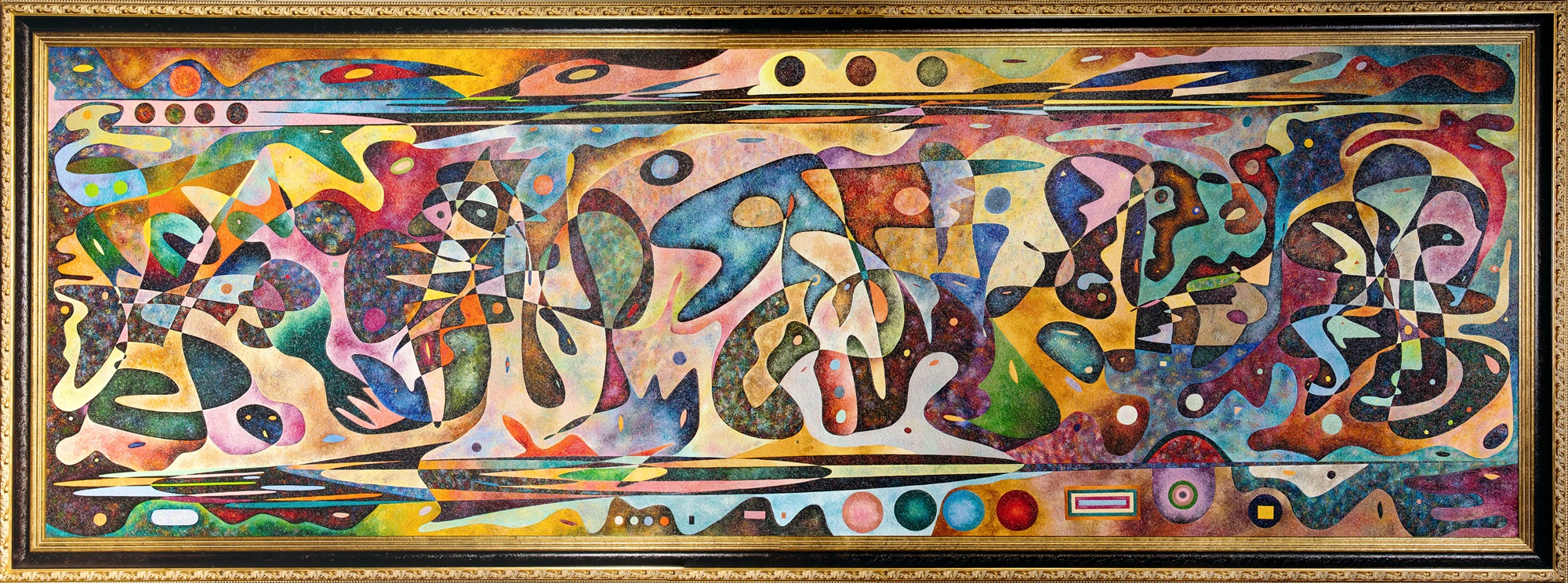
Artist: Gheorghe Virtosu
Medium: Oil and acrylic on linen canvas
Dimensions: 2 × 6.0 m
The composition of Satanism is structured as a horizontally extended field in which visual elements are distributed across a continuous yet tension-filled surface. Upper and lower bands frame the central zone, each containing sequences of circular forms that introduce a measured rhythm against the otherwise fluid and irregular interior. These linear registers function less as boundaries than as stabilizing counterpoints, establishing a latent order that contrasts with the dense, interwoven forms occupying the central field.
Within this central zone, biomorphic shapes and fragmented figuration generate a complex network of overlapping silhouettes, many of which suggest partial human profiles or confrontational pairings. These forms are neither fully resolved nor hierarchically arranged; instead, they appear in states of emergence and dissolution, producing a condition of unstable legibility. Geometric insertions—most notably angular divisions and enclosed shapes—interrupt this flow, creating moments of structural tension where organic continuity is constrained or redirected.
Chromatically, the painting operates through a dynamic interplay of saturated and muted tones, with warm and cool hues interpenetrating across the surface. Rather than organizing space through tonal hierarchy, color functions as a destabilizing force, dissolving boundaries and generating zones of optical vibration. This interplay reinforces the overall compositional logic, in which balance is not achieved through harmony, but through the sustained interaction of opposing visual forces.
The chromatic structure of Satanism is defined by heightened contrast and deliberate instability. Saturated reds, deep blues, ochres, and muted greens coexist in a field that resists tonal hierarchy, producing zones of optical tension rather than harmony. Color is not used descriptively but operates as a force that disrupts and reconfigures form, dissolving boundaries and generating shifting perceptual relationships. This dynamic reinforces the painting’s broader logic of inversion, where visual clarity is continually challenged by competing chromatic intensities.
Form emerges through a complex interplay between biomorphic fluidity and geometric constraint. Organic shapes—suggestive of faces, limbs, and hybrid entities—interweave with rigid structures such as squares, linear bands, and circular sequences. These geometric elements do not stabilize the composition; instead, they introduce moments of imposed order that are subsequently fragmented or absorbed into the surrounding field. The result is a system in which form is never fixed, but continuously negotiated between structure and dissolution.
The relationship between color and form produces a condition of visual oscillation. Contours are frequently interrupted or redefined by shifts in hue, causing forms to appear and disappear depending on the viewer’s focus. This instability generates a perceptual field in constant motion, where no single configuration achieves dominance. Through this interplay, the painting constructs a visual language in which meaning arises not from stable representation, but from the continuous interaction between chromatic energy and formal transformation.
The symbolic structure of Satanism is articulated through a system of inversion rather than fixed iconography. Recurrent circular elements arranged in linear sequences at the upper and lower registers function as markers of order, enumeration, and codified structure. Their repetition suggests systems of classification or imposed frameworks; however, their duplication and variation destabilize any singular meaning. These elements operate not as decorative motifs but as visual indices of constructed order, subsequently subjected to reinterpretation within the broader field of the painting.
Throughout the central composition, fragmented anthropomorphic profiles and hybrid biomorphic forms emerge in states of partial recognition. Faces appear in confrontation, overlap, or dissolution, suggesting identity as a relational and unstable construct rather than a fixed entity. These configurations evoke a condition of internal dialogue or opposition, where subjectivity is formed through tension rather than coherence. The absence of stable figuration reinforces the painting’s emphasis on transformation, positioning the human form as contingent and continuously redefined.
Geometric structures—most notably squares, frames, and contained shapes—punctuate the fluid field as moments of imposed stability. Yet these elements are consistently disrupted, penetrated, or absorbed by surrounding forms, indicating the fragility of rigid systems when confronted with dynamic processes. The interplay between containment and dissolution establishes a visual language in which symbolic meaning emerges through contradiction, suggesting that autonomy is achieved not by escaping structure, but by reconfiguring it from within.
In Satanism (2023–2025), Gheorghe Virtosu constructs a conceptual field in which meaning emerges through inversion rather than affirmation. The painting does not engage with Satanism as a theological or iconographic system, but as a structural condition of opposition in which identity is produced through the negation, distortion, and reconfiguration of inherited frameworks. Within this logic, forms do not stabilize into symbolic certainties; instead, they operate as shifting articulations within a field of continuous reinterpretation, where every structure is defined through its tension with another.
The composition’s repeated circular sequences and horizontal bands introduce a latent logic of ordering that is immediately destabilized by their duplication, displacement, and chromatic disruption. This oscillation between structure and dissolution generates a visual analogy to philosophical models of transvaluation, particularly those articulated by Friedrich Nietzsche¹, in which established systems of value are not abolished but inverted and re-inscribed within new relational frameworks. Similarly, the fragmentation of figuration across the central field suggests a condition of subjectivity that is no longer unified, but distributed across competing and intersecting visual forces.
Ultimately, the work articulates a model of autonomy grounded in relational tension rather than isolated sovereignty. Geometric structures, biomorphic flows, and mirrored configurations coexist without resolution, producing a field in which meaning is perpetually deferred and reconstructed. In this sense, Virtosu’s painting aligns with philosophical accounts of instability and difference, particularly those of Michel Foucault² and Georges Bataille³, in which systems of order are understood not as fixed hierarchies, but as dynamic structures continually exposed to disruption, excess, and transformation.
Satanism operates within a heightened state of perceptual and emotional tension, where stability is continuously deferred and replaced by oscillation between coherence and disruption. Rather than evoking a singular affective response, the painting generates a shifting register of unease, intensity, and reflective distance, positioning the viewer within a field that resists emotional resolution.
The presence of mirrored figures, fragmented identities, and competing structural systems produces a psychological condition of doubled perception, in which recognition is immediately complicated by distortion. This results in an affective experience that alternates between identification and disidentification, drawing the viewer into a continuous negotiation with unstable visual cues and competing interpretive pathways.
At a broader level, the work cultivates an emotional logic grounded in controlled tension rather than resolution. Moments of formal clarity are systematically interrupted by fragmentation, generating a sustained state of alert perception. In this sense, the painting does not resolve emotion but sustains it as an ongoing process of calibration between order, inversion, and perceptual uncertainty.
- Friedrich Nietzsche, On the Genealogy of Morality (Cambridge: Cambridge University Press, 1994). Nietzsche’s critique of inherited moral systems provides a framework for understanding inversion not as negation, but as revaluation of normative structures.
- Michel Foucault, Discipline and Punish: The Birth of the Prison (New York: Vintage Books, 1995). Foucault’s analysis of power as distributed and productive informs readings of subject formation as relational rather than autonomous.
- Georges Bataille, Erotism: Death and Sensuality (San Francisco: City Lights Books, 1986). Bataille’s theory of transgression frames rupture as a structural condition through which boundaries are both destabilized and revealed.
- Gilles Deleuze, Difference and Repetition (New York: Columbia University Press, 1994). Deleuze’s philosophy of difference supports interpretations of repetition as generative variation rather than duplication.
- Jacques Derrida, Of Grammatology (Baltimore: Johns Hopkins University Press, 1976). Derrida’s concept of différance underpins the work’s refusal of semantic closure and fixed symbolic identity.
Selected Bibliography
- Bataille, Georges. Erotism: Death and Sensuality. City Lights Books, 1986.
- Deleuze, Gilles. Difference and Repetition. Columbia University Press, 1994.
- Derrida, Jacques. Of Grammatology. Johns Hopkins University Press, 1976.
- Foucault, Michel. Discipline and Punish: The Birth of the Prison. Vintage Books, 1995.
- Nietzsche, Friedrich. On the Genealogy of Morality. Cambridge University Press, 1994.
- Agamben, Giorgio. The Open: Man and Animal. Stanford University Press, 2004.
- Eco, Umberto. The Open Work. Harvard University Press, 1989.
Curatorial Team: Daniel Varzari
Photography: El Arte Monumental
Special Thanks: Daniel Varzari, Gheorghe Virtosu
El Arte Monumental
08007 Barcelona
Phone: +34 934 439 470/ +01 312 358 8023