The Architecture of Belief
El Arte Monumental | Catalogue: The Architecture of Belief
Catalogue Entry: Shintoism (2023) | Art Curator: Daniel Varzari
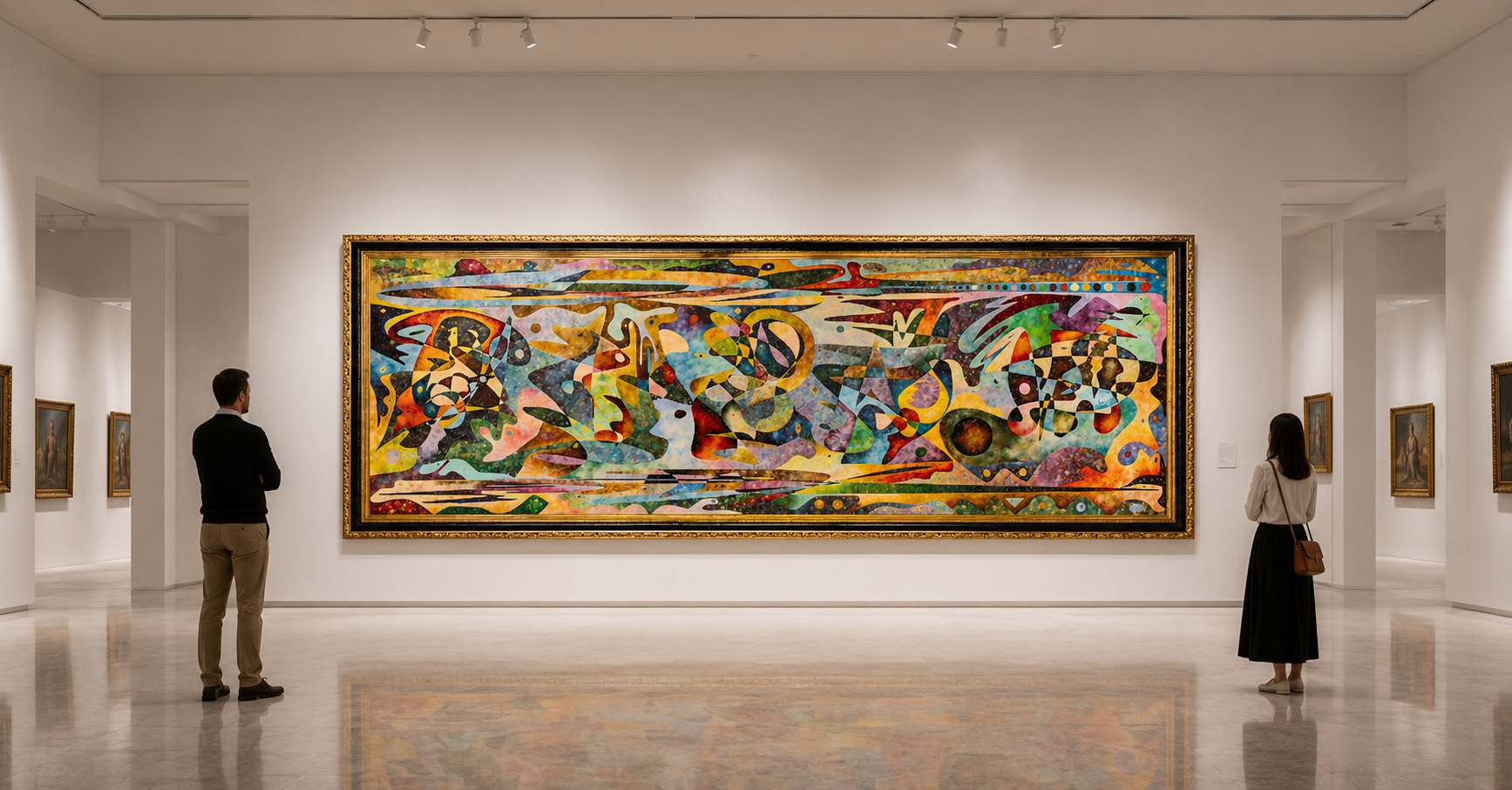
Shintoism (2021–2023) occupies a distinct position within Gheorghe Virtosu’s 10 Religions series, shifting the focus from systems of doctrine and structure toward a mode of thought grounded in presence, environment, and continuity. In contrast to works that engage with textual or ethical frameworks, this painting approaches spirituality as an immanent condition—one that unfolds through natural rhythms, spatial flow, and perceptual attunement rather than codified representation.
Virtosu constructs a field in which forms do not assert symbolic authority but emerge as transient configurations within a larger, interconnected whole. The composition resists hierarchy, emphasizing instead a condition of coexistence where boundaries between figure and ground, material and immaterial, remain fluid. This approach reflects a curatorial interest in abstraction not as reduction, but as expansion—an opening of visual language toward systems of meaning that operate beyond fixed interpretation.
As part of the broader series, Shintoism invites viewers to consider how different belief systems can be translated into contemporary visual form without reliance on literal iconography. Here, Virtosu proposes a model of engagement based on immersion and relation, encouraging a mode of viewing that is contemplative, responsive, and attuned to the subtle interplay of form, color, and space.
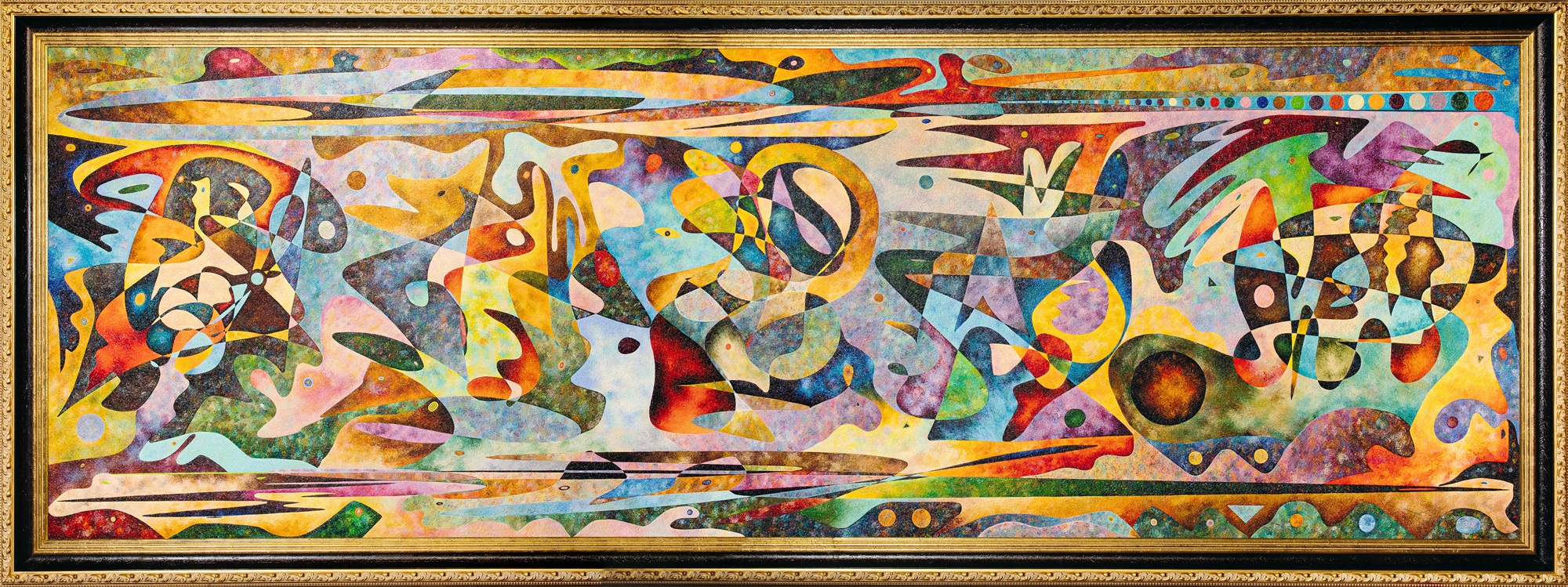
Shintoism (2021–2023) by Gheorghe Virtosu is a large-scale abstract painting that translates the principles of Shinto into a fluid and immersive visual field. Through layered biomorphic forms, subtle geometric elements, and continuous chromatic transitions, the composition evokes an environment in which natural and spiritual dimensions coexist without separation.
The work is structured through horizontal bands that suggest atmospheric, terrestrial, and reflective zones, while remaining permeable and interconnected. Organic shapes emerge and dissolve across the surface, accompanied by recurring circular motifs and rhythmic sequences of dots that introduce a sense of continuity and cyclical movement.
Emphasizing flow over fixed structure, the painting creates a dynamic interplay between color, form, and space. Its expansive format and shifting visual rhythms invite the viewer to engage with the work as an evolving environment, where perception unfolds through movement and sustained attention.
Shintoism (2021–2023) articulates a visual system grounded in continuity, presence, and environmental interrelation. Rather than organizing meaning through fixed symbols or hierarchical structures, the painting operates as a fluid field in which forms emerge, transform, and dissolve within a shared spatial continuum. This approach reflects a mode of thought in which the natural and the spiritual are not distinct domains, but mutually embedded conditions of existence.
The composition is governed by a logic of flow, where biomorphic shapes and chromatic transitions suggest movement rather than stability. Forms do not resolve into fixed identities but remain in a state of becoming, evoking currents, atmospheric shifts, and organic growth. This fluidity can be understood in relation to the Shinto conception of kami, where presence is diffuse, immanent, and inseparable from the environments it inhabits.
Horizontal stratification structures the composition into layered yet permeable zones. The upper register suggests an atmospheric or celestial field, the central area operates as a site of active transformation, and the lower register introduces grounding or reflective elements. These divisions do not produce separation but continuity, reinforcing a cosmology in which multiple realms coexist without rigid boundaries.
Recurrent nodal and circular forms function as points of concentration within the otherwise fluid field. These elements do not act as fixed symbols but as temporary condensations of energy and attention, marking moments where the diffuse structure of the painting becomes locally intensified. Their distribution establishes a rhythm that guides perception without imposing a central hierarchy.
A sequence of small, repeated marks across the upper register introduces a subtle structure of recurrence. Rather than functioning as a numerical system, this repetition suggests cyclical rhythm and continuity, evoking patterns of ritual and seasonal renewal. The painting thus incorporates a temporal dimension that is not linear but iterative, structured through repetition and return.
Chromatically, the work is defined by gradual modulation and permeability. Colors interpenetrate and transition across the surface, producing an atmospheric effect in which boundaries are continuously reconfigured. This chromatic instability reinforces the dissolution of fixed distinctions between figure and ground, emphasizing perception as an adaptive and relational process.
Ultimately, the painting functions as an open and immersive system in which meaning is generated through engagement with a continuously shifting field. It invites the viewer to move through the composition rather than decode it, experiencing form, color, and space as interconnected manifestations of a world defined by presence, transformation, and ongoing renewal.
Gheorghe Virtosu | Artist Biography
Gheorghe Virtosu is a contemporary painter whose work explores the intersection of philosophy, symbolic systems, and visual abstraction. His practice is characterized by large-scale compositions that integrate biomorphic forms, geometric structures, and fragmented figuration, producing complex visual fields in which meaning emerges through relation, structure, and interpretive depth.
Virtosu’s work engages with global belief systems and philosophical frameworks, translating them into a visual language that resists fixed interpretation while maintaining internal coherence. Rather than illustrating specific narratives or doctrines, his paintings investigate the underlying logics through which concepts such as law, memory, continuity, and interpretation are visually constructed. This approach aligns particularly with traditions in which meaning is shaped through textual transmission and sustained reinterpretation.
Central to his practice is the ongoing series 10 Religions, in which Virtosu examines major spiritual traditions through abstraction. Each work functions as a conceptual system rather than a representational image, emphasizing structural relationships, layered meaning, and the interaction of symbolic elements. In works associated with Judaism, this methodology becomes especially evident through the use of fragmentation, geometric containment, and dialogic figuration, reflecting systems of thought grounded in law, discourse, and historical continuity.
Working primarily in oil on canvas, Virtosu employs layered techniques that allow forms to emerge, overlap, and reconfigure across multiple perceptual planes. His compositions combine geometric order with fluid, organic structures, producing a tension between regulation and transformation. This interplay defines his visual language and underpins his exploration of meaning as an evolving, relational process shaped by structure, interpretation, and time.
Executed in oil on canvas at a monumental scale (2 × 6 meters), Shintoism (2021–2023) establishes a panoramic and immersive visual field. The horizontal format supports a continuous flow across the surface, allowing forms to extend, overlap, and transition without fixed boundaries, reinforcing the painting’s emphasis on spatial continuity.
The work is constructed through layered applications of pigment that produce atmospheric depth and chromatic diffusion. Forms emerge gradually from these layers rather than being sharply defined, creating a sense of movement and transformation across multiple perceptual planes. This technique enhances the fluid interplay between figure and ground, allowing visual elements to dissolve and re-form within the composition.
The composition prioritizes biomorphic structures with minimal geometric intervention, resulting in a predominantly organic visual language. Subtle variations in opacity, color saturation, and edge definition generate rhythmic modulation across the surface, guiding the viewer through shifting zones of intensity while maintaining an overall sense of cohesion and flow.
Artist: Gheorghe Virtosu
Medium: Oil and acrylic on linen canvas
Dimensions: 2 × 6.0 m
The composition of Shintoism (2021–2023) unfolds as a continuous horizontal field structured through fluid transitions rather than fixed divisions. Biomorphic forms extend across the surface in interwoven layers, creating a sense of uninterrupted movement that guides the viewer’s gaze laterally. While subtle horizontal stratification can be perceived—suggesting atmospheric, terrestrial, and reflective zones—these registers remain permeable, allowing forms and colors to circulate freely between them.
The interplay between organic shapes and minimal geometric articulation establishes a dynamic balance between coherence and dispersion. Forms emerge as transient configurations—suggestive of natural elements such as currents, vegetation, or celestial patterns—yet resist stabilization into fixed figures. Circular and nodal elements punctuate the composition, acting as points of visual concentration that momentarily anchor the otherwise fluid field, creating rhythmic intervals across the surface.
Chromatically, the painting is defined by gradual modulation and layered diffusion, with no single tonal hierarchy dominating the composition. Colors blend and transition across the surface, producing an atmospheric depth that reinforces the sense of continuous transformation. This integration of form, color, and spatial flow results in a cohesive yet dynamic visual system, where structure is maintained through rhythm and relation rather than rigid organization.
In Shintoism (2021–2023), color operates as a continuous atmospheric field rather than a system of contrast or symbolic coding. Tonal transitions unfold gradually across the surface, with greens, blues, and earth tones interweaving through subtle chromatic diffusion. This fluid modulation produces a sense of environmental immersion, where color does not define boundaries but dissolves them, reinforcing the perception of an interconnected and living continuum.
Form emerges through a network of biomorphic shapes that resist stabilization into fixed figures. Contours remain porous and adaptive, allowing elements to merge, separate, and reconfigure across the pictorial space. Occasional circular and nodal structures introduce moments of temporary coherence, yet these forms remain embedded within the broader flow, functioning as concentrations of energy rather than discrete objects.
The relationship between color and form is therefore non-hierarchical, with neither dominating the other. Instead, both operate within a shared system of transformation, where chromatic shifts generate form and form, in turn, redirects chromatic movement. This reciprocal interaction creates a rhythmic visual field that emphasizes continuity, permeability, and the constant negotiation between emergence and dissolution.
In Shintoism (2021–2023), symbolism operates not through fixed iconographic reference but through atmospheric suggestion and environmental continuity. The painting constructs a visual field in which biomorphic forms, flowing contours, and diffuse chromatic zones evoke a world animated by immanent presence rather than discrete symbolic entities. Within this framework, meaning is embedded in movement and relation, reflecting a worldview in which nature and spirit are inseparable and continuously co-constitutive.
Recurrent circular nodes and softly defined concentrations of color function as focal intensities within the broader field, suggesting moments where presence becomes perceptually concentrated. These elements do not operate as symbols in a representational sense, but as thresholds of emergence, where form temporarily stabilizes before re-entering flux. The absence of rigid geometry reinforces this condition, allowing imagery to remain open, fluid, and responsive to perceptual engagement rather than structural decoding.
The horizontal expansion of the composition reinforces a sense of continuity and circulation, evoking natural cycles such as water flow, atmospheric movement, and seasonal transformation. Subtle rhythmic repetitions across the surface suggest ritual recurrence rather than narrative progression, aligning the work with a worldview in which repetition signifies renewal. In this sense, the imagery operates as a field of continuous becoming, where symbolic meaning is inseparable from lived experience and environmental perception.
In Shintoism (2021–2023), Gheorghe Virtosu constructs a visual field grounded in continuity, permeability, and immanent presence rather than symbolic codification or narrative structure. The painting translates the ontological framework of :contentReference[oaicite:0]{index=0} into an abstract system in which natural forces—movement, growth, and atmospheric flux—are treated as carriers of spiritual agency. Rather than representing deities or fixed iconography, the composition stages a world in which meaning arises through relational conditions of environment and perception.
The pictorial structure is organized through horizontal stratification, yet these layers do not operate hierarchically. Instead, they function as permeable zones of exchange between atmospheric, terrestrial, and liminal states. Biomorphic forms emerge and dissolve within this continuum, evoking the Shinto concept of kami as immanent presences embedded within natural phenomena rather than transcendent figures. In this sense, the painting resists separation between figure and ground, instead presenting a unified field of becoming in which form is continuously negotiated rather than fixed.
Repetition, rhythmic distribution, and subtle circular motifs introduce a temporal dimension structured by recurrence rather than linear progression. These elements evoke ritual continuity and cyclical renewal, suggesting a mode of time in which presence is reactivated rather than concluded. Chromatic modulation reinforces this condition, as transitions between color fields dissolve boundaries and generate a sustained sense of atmospheric coherence. Ultimately, the work positions perception itself as an attunement to shifting relational intensities within a living and interconnected environment.
Shintoism (2021–2023) operates within an emotional register defined by openness, attunement, and perceptual quietness rather than dramatic tension or narrative resolution. The painting does not direct emotion through representational content, but through gradual shifts in chromatic temperature, spatial diffusion, and rhythmic continuity. The viewer encounters a condition of sustained attention in which perception stabilizes into a slower, more receptive mode of engagement.
The absence of rigid figuration or hierarchical structure produces an affective experience grounded in flow and permeability. Biomorphic transitions and atmospheric layering evoke sensations of movement without urgency, suggesting an emotional field closer to contemplation than interpretation. This registers as a form of attentional softness, where boundaries between figure, ground, and environment remain deliberately unresolved.
Ultimately, the emotional tone of the work aligns with states of quiet absorption and environmental attunement. Rather than eliciting affect through contrast or rupture, the painting sustains a continuous experiential field in which perception becomes participatory. The viewer is positioned not outside the image, but within its unfolding conditions, experiencing emotion as a gradual adjustment to presence itself.
- Umberto Eco, The Open Work (Cambridge, MA: Harvard University Press, 1989), frames the artwork as an open system in which meaning is activated through perceptual engagement rather than fixed representation.
- Maurice Merleau-Ponty, Phenomenology of Perception (London: Routledge, 1962), develops a theory of embodied perception in which meaning arises through situated sensory experience rather than detached cognition.
- Gilles Deleuze, Difference and Repetition (New York: Columbia University Press, 1994), articulates a philosophy of continuous variation in which repetition generates difference rather than sameness.
- Toshio Kuroda, “Shinto in the History of Japanese Religion,” reframes Shinto not as a fixed doctrine but as a historically constructed system of ritual, environment, and localised practice.
- Thomas P. Kasulis, Shinto: The Way Home (Honolulu: University of Hawai‘i Press, 2004), emphasizes Shinto as an experiential tradition grounded in intimacy, presence, and relational engagement with the natural world.
Selected Bibliography
- Eco, Umberto. The Open Work. Harvard University Press, 1989.
- Merleau-Ponty, Maurice. Phenomenology of Perception. Routledge, 1962.
- Deleuze, Gilles. Difference and Repetition. Columbia University Press, 1994.
- Kasulis, Thomas P. Shinto: The Way Home. University of Hawai‘i Press, 2004.
- Kuroda, Toshio. “Shinto in the History of Japanese Religion.” In Journal of Japanese Studies.
Curatorial Team: Daniel Varzari
Photography: El Arte Monumental
Special Thanks: Daniel Varzari, Gheorghe Virtosu
El Arte Monumental
08007 Barcelona
Phone: +34 934 439 470/ +01 312 358 8023