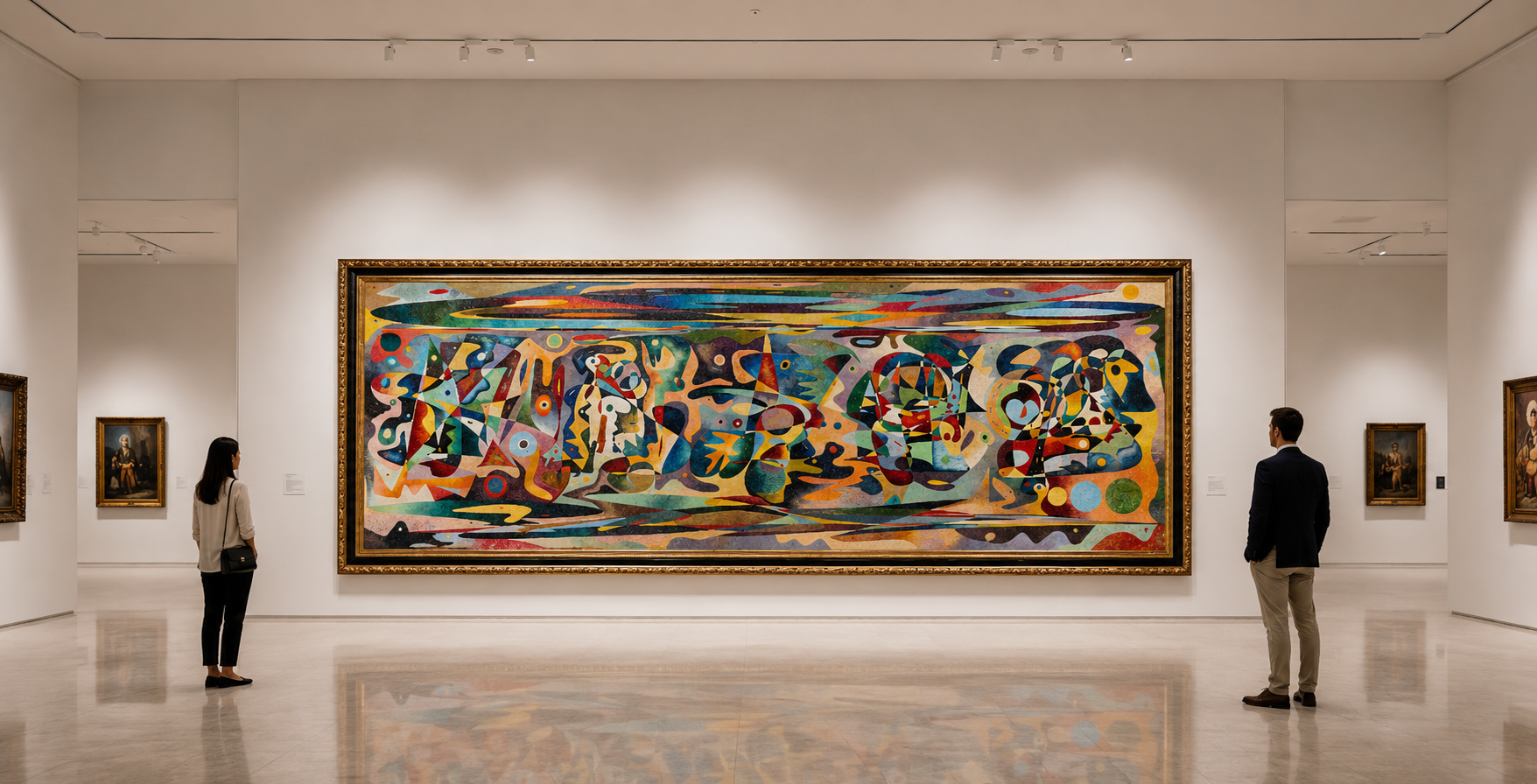
The Architecture of Belief
El Arte Monumental | Catalogue: The Architecture of Belief
Catalogue Entry: Taoism (2024) | Art Curator: Daniel Varzari
Taoism (2022–2024) by Gheorghe Virtosu forms part of the artist’s ongoing 10 Religions series, a body of work that investigates major spiritual traditions through the language of abstraction. In this painting, Virtosu moves away from systems grounded in doctrine or textual authority, instead engaging with a philosophical framework centered on process, balance, and the continuous transformation of all things. The work does not illustrate Taoism but translates its underlying principles into a visual field defined by movement, relation, and instability.
The composition invites a mode of viewing that is neither linear nor interpretively fixed. Rather than presenting stable symbols, it offers a network of shifting forms and chromatic interactions that require sustained attention and perceptual adjustment. In this sense, the painting aligns with Taoist thought not only in content but in experience, encouraging an approach grounded in observation, attunement, and non-impositional engagement.
Within the broader context of Virtosu’s practice, Taoism occupies a critical position, emphasizing relational balance over structural order and transformation over permanence. It contributes to the series by articulating a worldview in which oppositions are not resolved but continuously negotiated, and in which meaning emerges through the interplay of forces rather than through fixed systems. The painting thus offers not a representation of belief, but an environment in which philosophical ideas are encountered as lived visual experience.
Taoism (2022–2024) is a monumental oil on canvas composition measuring 2 × 6 meters, structured as an expansive horizontal field. The painting is composed of interwoven biomorphic forms, geometric elements, and layered chromatic zones that extend across the surface without a fixed focal point. Its panoramic format encourages the viewer to move visually along the composition, encountering a continuous flow of shapes that emerge, overlap, and dissolve.
The surface is characterized by a dynamic interplay of curved and angular forms, with circular and semi-circular motifs appearing throughout the composition. These elements are embedded within a network of contrasting color fields, where areas of density and openness alternate, producing a rhythmic visual structure. Subtle transitions in tone and opacity create depth, allowing multiple spatial layers to coexist and interact.
A horizontal division between upper and lower registers introduces a sense of reflection and mirroring, while scattered facial and animal-like traces remain partially obscured within the abstract field. The composition maintains a balance between fluidity and structure, inviting sustained observation as relationships between forms and colors shift across the pictorial space.
Taoism (2022–2024) articulates a visual system grounded in the principle of continuous transformation, where form, color, and spatial organization operate as interdependent forces rather than fixed elements. The composition resists stability, presenting instead a field in which all components exist in a state of relational becoming. This approach reflects the Taoist conception of the Dao as an underlying generative process that cannot be directly represented but is manifested through the movement and interaction of phenomena1.
Central to the painting is the interplay of opposing yet complementary forces. Circular and semi-circular motifs, along with shifting zones of light and darkness, suggest a system of polarity analogous to the principle of yin and yang. These oppositions do not resolve into static balance but remain in constant negotiation, producing a dynamic equilibrium in which transformation is continuous. The painting thus visualizes balance not as a fixed condition, but as an ongoing process2.
The composition’s horizontal expansion reinforces this sense of continuity. Rather than progressing toward a focal point, visual energy circulates across the surface, moving through areas of compression and release. This distributed structure reflects a non-hierarchical organization in which no single element dominates, aligning with the Taoist understanding of reality as an interconnected system without a central governing authority1.
Interlocking biomorphic forms generate fleeting impressions of faces, animals, and hybrid entities, yet these remain unstable and unresolved. Identity is treated as provisional, emerging momentarily before dissolving back into the surrounding field. This instability reflects a philosophical position in which being is not fixed but continuously transformed, resonating with broader theories of becoming and difference3.
A subtle mirroring between the upper and lower registers introduces a cyclical dimension to the composition. The lower band suggests reflection or inversion, reinforcing the idea that each state contains the potential for its opposite. This relationship evokes a process of return and renewal, in which transformation operates through continuous reversal and reconfiguration4.
Chromatically, the work is defined by modulation and interaction rather than contrast alone. Colors diffuse into one another, producing gradients and transitional zones that resist clear boundaries. This chromatic fluidity reinforces the painting’s conceptual framework, in which distinctions between elements are not fixed but remain subject to constant redefinition. Meaning, in this context, is not given but emerges through relational difference and perceptual engagement5.
Ultimately, Taoism functions as an open system in which transformation, balance, and interconnection are continuously enacted rather than represented. The viewer is invited to engage with the work as a process rather than an image, navigating a field in which meaning is generated through movement, relation, and change. In this way, the painting embodies a mode of thought in which understanding is not achieved through fixation, but through participation in an evolving continuum.
Gheorghe Virtosu | Artist Biography
Gheorghe Virtosu is a contemporary painter whose work explores the intersection of philosophy, symbolic systems, and visual abstraction. His practice is defined by large-scale compositions that integrate biomorphic forms, geometric elements, and fluid spatial structures, producing immersive visual fields in which meaning emerges through transformation, relation, and perceptual movement.
Engaging with global belief systems and philosophical traditions, Virtosu translates abstract principles into a visual language that resists fixed interpretation while maintaining internal coherence. Rather than illustrating doctrines or narratives, his work investigates underlying processes such as balance, interdependence, and continuous change, aligning closely with systems of thought that emphasize flow, equilibrium, and the instability of fixed form.
Central to his practice is the ongoing series 10 Religions, in which he examines major spiritual traditions through abstraction. Each work functions as a conceptual environment, foregrounding structural and ontological principles rather than representational imagery. In works associated with Taoism, this approach becomes particularly evident through the emphasis on polarity, transformation, and non-hierarchical organization, reflecting a worldview grounded in dynamic balance and relational process.
Working primarily in oil on canvas, Virtosu employs layered techniques that allow forms to emerge, dissolve, and reconfigure across multiple perceptual planes. His compositions balance organic fluidity with subtle structural control, creating a continuous interplay between movement and equilibrium. This visual language supports his broader exploration of reality as an evolving system defined not by fixed identities, but by ongoing processes of interaction and change.
Executed in oil on canvas at a monumental scale (2 × 6 meters), Taoism (2022–2024) establishes a panoramic visual field that supports continuous movement across the composition. The extended horizontal format encourages a non-linear mode of viewing, allowing forms to unfold gradually while maintaining a sense of overall cohesion.
The painting is constructed through layered applications of pigment, producing a surface characterized by depth, translucency, and chromatic variation. Forms emerge and dissolve across multiple spatial registers, creating an interplay between opacity and transparency that enhances the perception of fluidity and transformation.
Biomorphic shapes are interwoven with subtle geometric interventions, generating a balance between organic flow and structural articulation. Circular and semi-circular motifs recur throughout the composition, reinforcing the painting’s rhythmic organization while contributing to its overall sense of continuity and movement.
Chromatically, the work is defined by the interaction of contrasting yet harmonized tonal zones. Warm and cool colors coexist in shifting relationships, producing areas of visual tension and release. Gradual transitions between hues create a sense of atmospheric diffusion, supporting the painting’s emphasis on continuity rather than abrupt division.
A subtle horizontal division between upper and lower registers introduces a reflective dynamic within the composition. This structural feature contributes to the sense of inversion and recurrence, reinforcing the painting’s cyclical and process-oriented character while maintaining an integrated visual field.
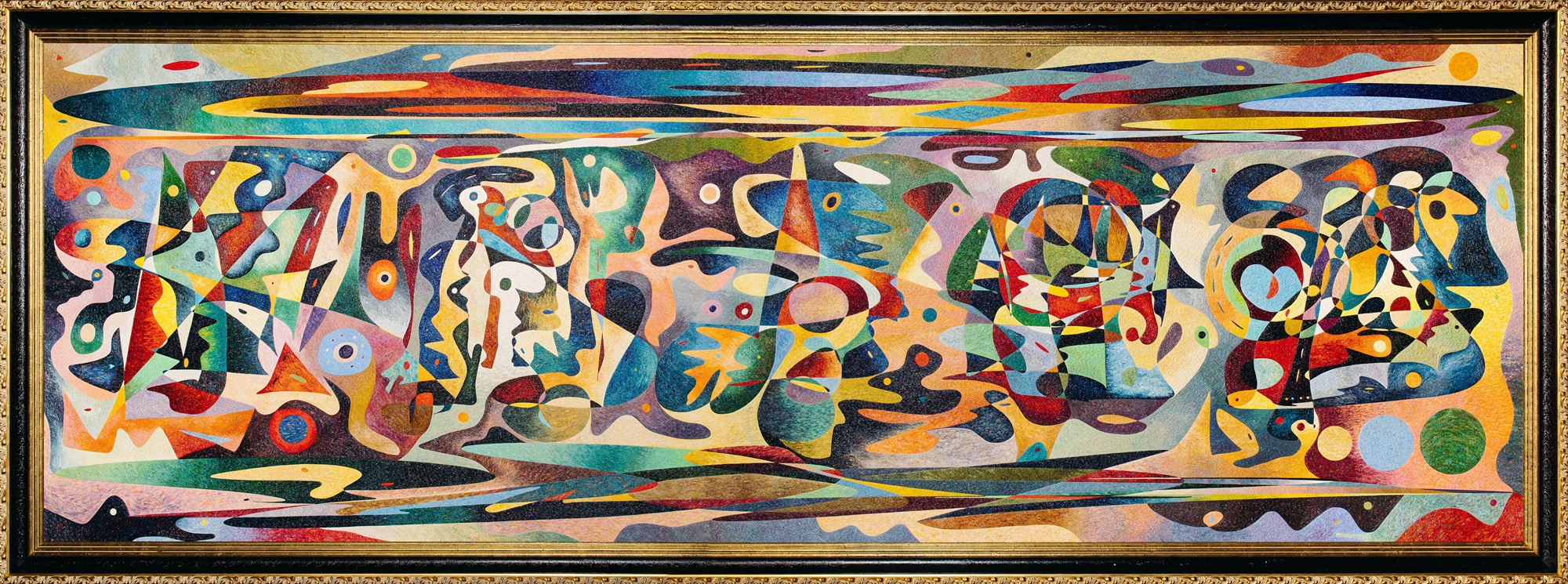
Artist: Gheorghe Virtosu
Medium: Oil and acrylic on linen canvas
Dimensions: 2 × 6.0 m
The composition of Taoism (2022–2024) is structured as an expansive horizontal field in which visual elements are distributed without a central focal point. Biomorphic forms, geometric traces, and circular motifs are interwoven across the surface, creating a network of relationships that guide the viewer’s attention through movement rather than hierarchy. The absence of a dominant axis allows the composition to function as a continuous system, where forms emerge and recede in a state of ongoing transformation.
A dynamic interplay between density and openness organizes the pictorial space. Areas of concentrated detail—where forms overlap and chromatic intensity increases—alternate with zones of relative dispersion, producing a rhythmic modulation across the canvas. Circular and semi-circular elements recur throughout, establishing visual anchors that punctuate the flow while maintaining the overall sense of continuity.
The composition is further articulated through a subtle horizontal division that introduces a reflective relationship between upper and lower registers. This mirroring effect enhances the perception of balance and inversion, reinforcing the painting’s cyclical structure. Through the interaction of form, color, and spatial layering, the work sustains a condition of equilibrium in which contrast and continuity coexist within a unified visual field.
In Taoism (2022–2024), color functions as a dynamic relational field rather than a descriptive attribute of form. Warm and cool tonal zones are distributed across the composition in shifting intervals, producing a continuous modulation of visual intensity. Instead of establishing fixed contrasts, chromatic transitions generate gradual passages in which boundaries dissolve, reinforcing the painting’s emphasis on continuity and transformation.
Form operates through a logic of emergence and dissolution, where biomorphic shapes and circular motifs arise from within layered pigment fields and subsequently reabsorb into them. These forms resist stable definition, oscillating between recognisable configurations and abstract states. The absence of rigid contouring allows form to remain porous, enabling constant interaction with surrounding chromatic and spatial conditions.
The relationship between color and form is fundamentally interdependent, with neither element functioning independently of the other. Chromatic variation activates perceptual shifts in form, while formal transitions redistribute the perception of color across the surface. This reciprocity produces a unified visual system in which meaning is generated through movement, interaction, and continuous perceptual adjustment rather than fixed representation.
In Taoism (2022–2024), imagery operates as a system of continuous transformation rather than fixed representation. Biomorphic forms, circular motifs, and fluid spatial configurations evoke natural processes such as water flow, atmospheric circulation, and organic growth, without resolving into identifiable figures. Within this logic, imagery functions not as symbol in a conventional sense, but as perceptual event—emerging and dissolving in accordance with shifting relationships across the pictorial field.
Circular and semi-circular structures play a central role in the composition, suggesting principles of polarity and cyclical return. These forms resonate with the Taoist conceptual framework of complementary forces, in which opposing elements are understood as interdependent and mutually generative rather than contradictory. The absence of fixed iconographic markers reinforces this condition, allowing meaning to arise through dynamic interaction rather than symbolic designation.
Chromatic modulation further reinforces the painting’s symbolic logic, with gradual transitions between tonal zones creating a sense of continuous flow. Light and dark regions, along with warm and cool fields, interact without hierarchical dominance, producing a balanced yet unstable visual environment. In this way, the painting constructs an imagery system grounded in process, where symbolism is inseparable from movement, relation, and transformation.
Taoism (2022–2024) constructs a visual system grounded in continuous transformation, where form, color, and spatial relations operate as interdependent processes rather than fixed entities. The composition resists hierarchical organization and instead unfolds as a distributed field of activity, reflecting the Taoist conception of the Dao as an underlying generative principle that is expressed through movement, change, and relational continuity rather than representation or doctrine.
The interplay of circular, curved, and interlocking forms suggests a dynamic logic of polarity and balance, resonating with the principle of yin and yang. Rather than presenting opposition as conflict, the work frames it as mutual constitution, where contrasting forces generate and sustain one another within a state of ongoing equilibrium. This structure is reinforced through chromatic modulation and spatial layering, which prevent visual stabilization and maintain perceptual flux across the pictorial surface.
Ultimately, the painting functions as an open system in which meaning emerges through observation, movement, and relational engagement rather than symbolic decoding. Forms appear and dissolve within a continuous field of becoming, inviting the viewer to experience the work as a process rather than an image. In this sense, Taoism does not represent philosophical ideas but enacts them as a lived visual condition shaped by transformation, balance, and interdependence.
Taoism (2022–2024) generates an emotional field defined by continuity, balance, and perceptual drift rather than fixed narrative affect. The viewer encounters a shifting environment in which forms emerge and dissolve without resolution, producing a contemplative state shaped by attentiveness rather than interpretation. This creates a sensibility aligned with openness and receptive awareness, where meaning is experienced as unfolding rather than grasped.
The interplay of flowing biomorphic structures and subtle geometric anchors produces a tension between stability and release. This oscillation generates a quiet dynamic intensity: moments of density and convergence are followed by expansion and dispersion, evoking cycles of tension, relaxation, and return. The emotional tone is therefore not expressive in a dramatic sense, but rhythmic and meditative, grounded in modulation rather than climax.
Chromatic transitions further shape the emotional register, with warm and cool fields interpenetrating without fixed dominance. This continual adjustment of perceptual balance encourages a sustained, immersive attention in which the viewer is not positioned outside the work, but gradually absorbed into its shifting field. The resulting experience is one of equilibrium in motion, where perception itself becomes part of the painting’s unfolding structure.
- Laozi, Tao Te Ching, trans. D.C. Lau (London: Penguin Classics, 1963), articulates the Dao as an unnameable, generative principle that operates through natural process rather than fixed form or representation.
- Zhuangzi, The Complete Works of Zhuangzi, trans. Burton Watson (New York: Columbia University Press, 1968), develops a philosophy of transformation in which identity, perception, and reality are understood as fluid and relational rather than stable.
- François Jullien, The Propensity of Things (New York: Zone Books, 1995), analyzes Chinese thought as a logic of emergence and tendency, emphasizing process, situational unfolding, and immanent transformation.
- Gilles Deleuze, Difference and Repetition (New York: Columbia University Press, 1994), proposes a philosophy of becoming in which repetition produces variation and identity is defined through continuous difference.
- Jacques Derrida, Of Grammatology (Baltimore: Johns Hopkins University Press, 1976), introduces the concept of différance, in which meaning is produced through deferral and relational distinction rather than fixed reference.
Selected Bibliography
- Laozi. Tao Te Ching. Translated by D.C. Lau. Penguin Classics, 1963.
- Zhuangzi. The Complete Works of Zhuangzi. Translated by Burton Watson. Columbia University Press, 1968.
- Jullien, François. The Propensity of Things. Zone Books, 1995.
- Deleuze, Gilles. Difference and Repetition. Columbia University Press, 1994.
- Derrida, Jacques. Of Grammatology. Johns Hopkins University Press, 1976.
Curatorial Team: Daniel Varzari
Photography: El Arte Monumental
Special Thanks: Daniel Varzari, Gheorghe Virtosu
El Arte Monumental
08007 Barcelona
Phone: +34 934 439 470/ +01 312 358 8023