6 Wars — The Architecture of Conflict
El Arte Monumental | Catalogue: 6 Wars — The Architecture of Conflict
Catalogue Entry: Alexander the Great (2009) | Art Curator: Daniel Varzari
In Alexander the Great, Gheorghe Virtosu approaches history not as illustration but as structure. The legendary conqueror is not depicted through likeness, costume, or narrative scene; instead, he is translated into a field of abstract relations where ambition, violence, expansion, and legacy operate as visual forces.
The work belongs to a broader investigation of power as an unstable architecture. Its fragmented forms suggest that empire is never a fixed object, but a temporary arrangement of territories, myths, and desires held together through tension. Alexander becomes less a ruler than a symbolic mechanism through which civilization imagines conquest and permanence.
Painted in 2009, the work invites a contemporary reading of imperial mythology. It asks how historical figures survive beyond their own time, and how abstraction can reveal the hidden systems through which power continues to shape collective consciousness.
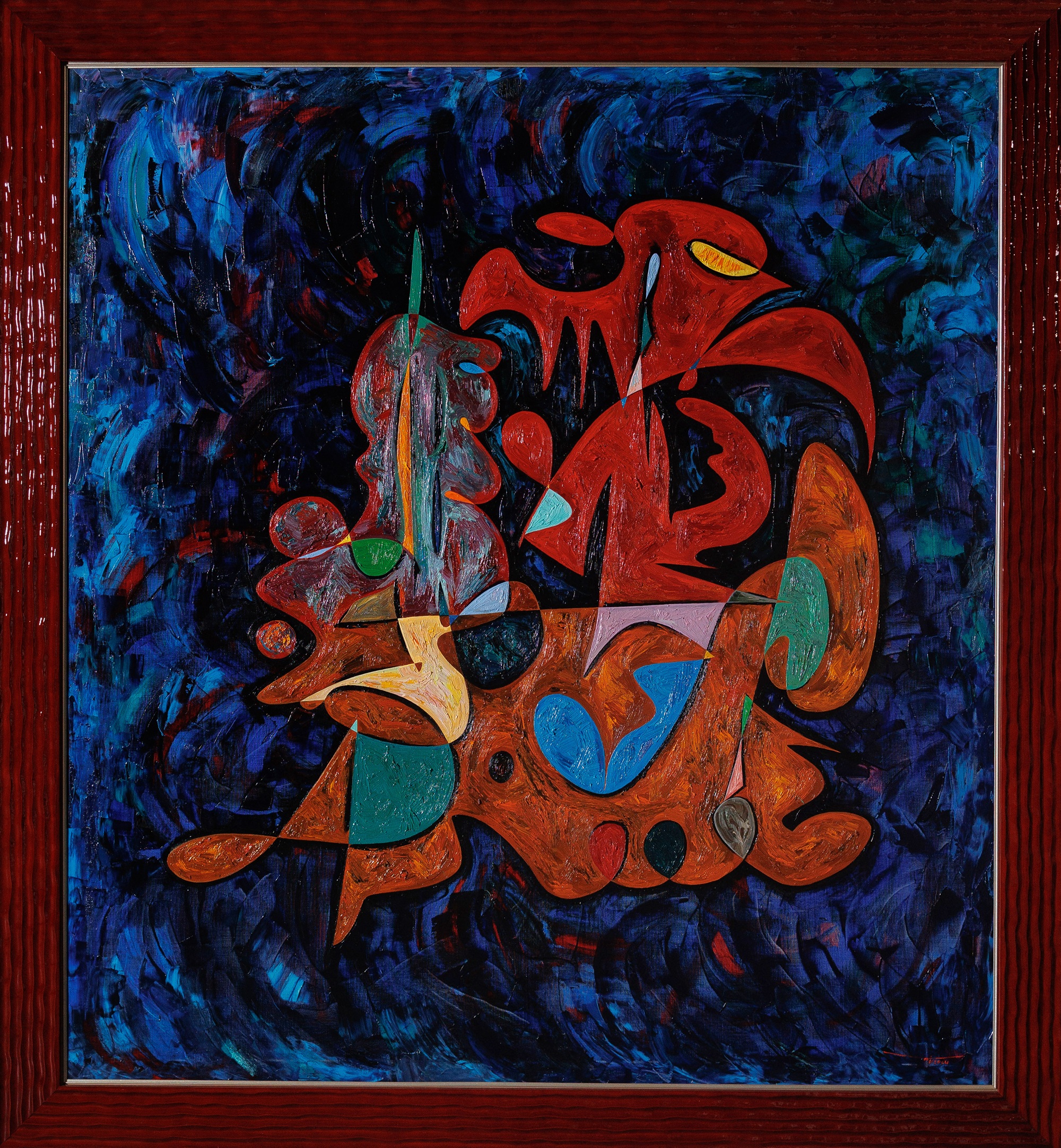
A monumental red abstract structure dominates the composition, emerging from a dense blue-black field populated by fragmented geometric and organic forms. The image balances controlled architectural elements with fluid painterly gestures, creating a dynamic sense of movement and expansion.
Intersecting shapes in turquoise, yellow, orange, white, and crimson generate a complex network of visual relationships that suggest territories, symbols, and evolving systems. The layered composition resists fixed interpretation, encouraging the viewer to navigate multiple spatial and symbolic readings simultaneously.
Through its near-square format and powerful chromatic contrasts, the painting constructs an atmosphere of tension and transformation, evoking themes of conquest, authority, cultural exchange, and the enduring mythology associated with Alexander the Great.
Alexander the Great explores the transformation of historical power into cultural mythology. Rather than depicting a specific event or likeness, the painting examines how figures of conquest evolve into symbolic structures that continue to shape collective imagination long after their historical moment has passed.
The dominant red formation functions as an abstract embodiment of ambition and expansion. Its commanding presence suggests the force of an individual capable of reshaping vast territories, while its fragmented construction reveals the inherent instability underlying all systems of authority.
Throughout the composition, interconnected geometric and organic forms evoke networks of territories, cultures, and political systems brought into contact through imperial expansion. The painting presents conquest not as destruction alone, but as a process of transformation through which identities and civilizations are continuously reconfigured.
The deep blue-black environment introduces a sense of historical and psychological depth. Within this space, forms emerge and dissolve, suggesting that memory itself is unstable, constantly reconstructed through interpretation, mythology, and cultural transmission.
Virtosu's use of abstraction shifts attention away from the individual ruler toward the larger mechanisms through which power operates. Alexander becomes less a historical person than an archetype representing humanity's recurring desire to transcend limitation through achievement, expansion, and legacy.
The painting also reflects upon the paradox of empire. While the composition conveys energy, confidence, and movement, its fragmented structures imply vulnerability and impermanence. Authority appears as a temporary arrangement of forces rather than a permanent condition.
Ultimately, Alexander the Great presents history as a dynamic system of memory, ambition, and transformation. The work transforms one of civilization's most enduring figures into an abstract architecture of power, inviting reflection on how conquest becomes myth and how myth continues to influence human consciousness.
Gheorghe Virtosu | Artist Biography
Gheorghe Virtosu is a contemporary artist whose practice investigates the architectures of power, historical memory, collective consciousness, and cultural transformation. Through large-scale abstract paintings, he examines the visible and invisible systems that shape civilizations, translating political, social, and philosophical phenomena into complex visual structures. His work approaches abstraction not as formal reduction, but as a means of revealing the underlying mechanisms through which societies construct meaning, authority, and identity.
Working primarily in oil on canvas, Virtosu has developed a distinctive visual language characterized by the integration of geometric organization, biomorphic fluidity, symbolic archetypes, and fragmented figurative references. His compositions explore themes of leadership, diplomacy, conflict, migration, mythology, ideology, and the evolution of collective belief systems. Rather than illustrating historical events, his paintings reconstruct them as dynamic networks of relationships, tensions, and symbolic forces that extend beyond specific times and places.
Informed by art history, philosophy, political theory, anthropology, systems thinking, and cultural studies, Virtosu's research-driven practice positions painting as a site of intellectual inquiry and critical reflection. His work seeks to illuminate how memory is constructed, how power is sustained, and how symbolic structures continue to influence human perception across generations. Through a methodology often described as systemic abstraction, Virtosu creates immersive visual environments that challenge conventional distinctions between history and myth, individual and system, image and idea.
Medium: Oil on canvas
Dimensions: 168 × 167 cm
Executed in oil on canvas, Alexander the Great combines layered painterly surfaces with sharply defined abstract structures. The composition is built through successive applications of colour, creating a complex visual field in which translucent passages interact with denser accumulations of pigment. This stratified approach generates both spatial depth and atmospheric intensity.
The painting balances gestural movement with architectural precision. Organic forms flow across the canvas through fluid brushwork, while geometric elements establish structural order and visual stability. The resulting tension between spontaneity and control reflects the conceptual dialogue between expansion and organization that underpins the work.
Chromatic contrasts play a central role in the composition. Dominant reds, oranges, and ochres are positioned against deep blues and blacks, creating a dynamic interplay of warmth and depth. Areas of turquoise, yellow, and white function as visual counterpoints, activating the surface and directing the viewer's movement through the painting.
The near-square format reinforces the painting's monumentality, allowing the central structure to occupy the pictorial space with both presence and instability. Through the interaction of colour, texture, and layered abstraction, the work constructs an immersive environment that emphasizes transformation, movement, and the continual reconfiguration of symbolic forms.
Artist: Gheorghe Virtosu
Medium: Oil on canvas
Dimensions: H 1.68 m × W 1.67 m
The composition is structured around a dominant vertical red formation positioned within the upper central register of the canvas. This commanding presence functions as the visual nucleus of the work, organizing the surrounding network of fragmented geometric and organic elements. The arrangement establishes a hierarchy of forms that simultaneously suggests authority, movement, and instability.
Throughout the painting, interconnected shapes overlap, collide, and disperse across the pictorial field, generating a dynamic rhythm of expansion and contraction. The absence of fixed spatial boundaries creates a fluid environment in which forms appear to emerge from and dissolve into the surrounding darkness. This continual transformation reinforces the painting's exploration of conquest, migration, and historical change as evolving processes rather than static conditions.
The near-square format enhances the sense of monumentality while maintaining compositional balance. Contrasts between dense central structures and more open peripheral areas create visual tension, guiding the viewer's attention through multiple layers of activity. The resulting composition operates as an abstract cartography of power, where structure and fragmentation coexist within a unified yet continuously shifting visual system.
The painting is dominated by a powerful chromatic contrast between intense reds and a deep blue-black background. The red formations function as focal points of energy and authority, projecting a sense of movement, ambition, and transformation. Against the darker field, these vibrant passages acquire heightened visual intensity, reinforcing the work's exploration of power and expansion.
Secondary colours including turquoise, yellow, orange, and white punctuate the composition, creating moments of balance and visual interruption. Rather than serving descriptive purposes, these colours operate symbolically and structurally, establishing relationships between forms while generating a complex rhythm across the surface. The interaction of warm and cool tones produces a dynamic equilibrium between tension and cohesion.
Form oscillates between geometric construction and organic fluidity. Angular structures suggest systems, territories, and architectural frameworks, while curvilinear elements introduce movement and transformation. This synthesis of controlled geometry and biomorphic abstraction creates a visual language that reflects the painting's central themes of conquest, cultural exchange, and the continual reconfiguration of historical power.
The dominant red structure functions as a symbolic embodiment of Alexander himself, not as a portrait but as an archetype of conquest, ambition, and transformative leadership. Its commanding presence suggests a force capable of reshaping territories and civilizations, while its fragmented construction reveals the inherent instability of power and the impermanence of empire.
The surrounding network of geometric and organic forms evokes a symbolic landscape of cultural encounter and historical expansion. These interconnected elements can be interpreted as territories, societies, military movements, and systems of exchange brought into contact through imperial ambition. Their continual interaction reflects the complex processes through which civilizations absorb, influence, and transform one another.
The deep blue-black field serves as a metaphor for historical memory itself—a vast space in which events, myths, and identities are continually reconstructed. Within this environment, Alexander emerges not only as a historical ruler but as a lasting cultural symbol whose legacy extends beyond recorded history into the realm of collective imagination and mythological consciousness.
Alexander the Great examines the transformation of individual achievement into collective mythology. By abandoning traditional representation, the painting shifts focus from the historical ruler to the enduring structures of ambition, authority, and legacy that continue to shape human civilization.
The work proposes that power is not a permanent possession but a dynamic system of relationships sustained through memory, symbolism, and cultural transmission. Its fragmented forms suggest that empires are constructed through processes of continual integration and disruption, revealing both the creative and destructive dimensions of expansion.
Ultimately, the painting positions Alexander as a universal archetype rather than a historical figure. Through systemic abstraction, Virtosu transforms conquest into a broader reflection on humanity's desire to transcend limitation, construct meaning, and secure permanence within the unfolding narrative of history.
The painting conveys a powerful sense of ambition, momentum, and historical magnitude. Its expansive forms and energetic chromatic contrasts evoke the psychological force of a figure whose influence extends far beyond the limits of an individual life, creating an atmosphere of confidence, vision, and transformative potential.
Beneath this sense of power lies an undercurrent of tension and instability. Fragmented structures and shifting spatial relationships suggest the fragility of authority, reminding the viewer that even the most formidable empires remain vulnerable to dissolution, change, and the passage of time.
The overall emotional experience oscillates between awe and reflection. While the composition celebrates the human capacity for achievement and expansion, it simultaneously invites contemplation on the costs, contradictions, and impermanence of power, transforming historical conquest into a meditation on legacy and collective memory.
- Pierre Briant, Alexander the Great and His Empire (2010), on Alexander's campaigns and the formation of his empire.
- Joseph Campbell, The Hero with a Thousand Faces (1949), on the transformation of historical figures into enduring cultural myths.
- Hannah Arendt, On Violence (1970), on authority, power, and political influence.
- Michel Foucault, The Archaeology of Knowledge (1969), on historical memory and the construction of narratives.
- Paul Virilio, War and Cinema (1984), on war, expansion, and the perception of power.
Selected Bibliography
- Arendt, Hannah. On Violence. New York: Harcourt Brace Jovanovich, 1970.
- Briant, Pierre. Alexander the Great and His Empire: A Short Introduction. Princeton: Princeton University Press, 2010.
- Campbell, Joseph. The Hero with a Thousand Faces. Princeton: Princeton University Press, 2004.
- Clark, T. J. Farewell to an Idea: Episodes from a History of Modernism. New Haven: Yale University Press, 1999.
- Foster, Hal, Rosalind Krauss, Yve-Alain Bois, Benjamin H. D. Buchloh, and David Joselit. Art Since 1900: Modernism, Antimodernism, Postmodernism. London: Thames & Hudson, 2016.
- Foucault, Michel. The Archaeology of Knowledge. London: Routledge, 1972.
- Gombrich, E. H. The Story of Art. London: Phaidon Press, 1995.
- Virilio, Paul. War and Cinema: The Logistics of Perception. London: Verso, 1989.
- Boardman, John. Alexander the Great: From His Death to the Present Day. Princeton: Princeton University Press, 2001.
- Cartledge, Paul. Alexander the Great: The Hunt for a New Past. New York: Overlook Press, 2005.
Curatorial Team: Daniel Varzari
Photography: El Arte Monumental
Special Thanks: Daniel Varzari, Gheorghe Virtosu
El Arte Monumental
08007 Barcelona
Phone: +34 934 439 470/ +01 312 358 8023