6 Wars — The Architecture of Conflict
The Art Monumental | Catalogue: 6 Wars — The Architecture of Conflict
Catalogue Entry: Babylonian Human (2008) | Art Curator: Daniel Varzari
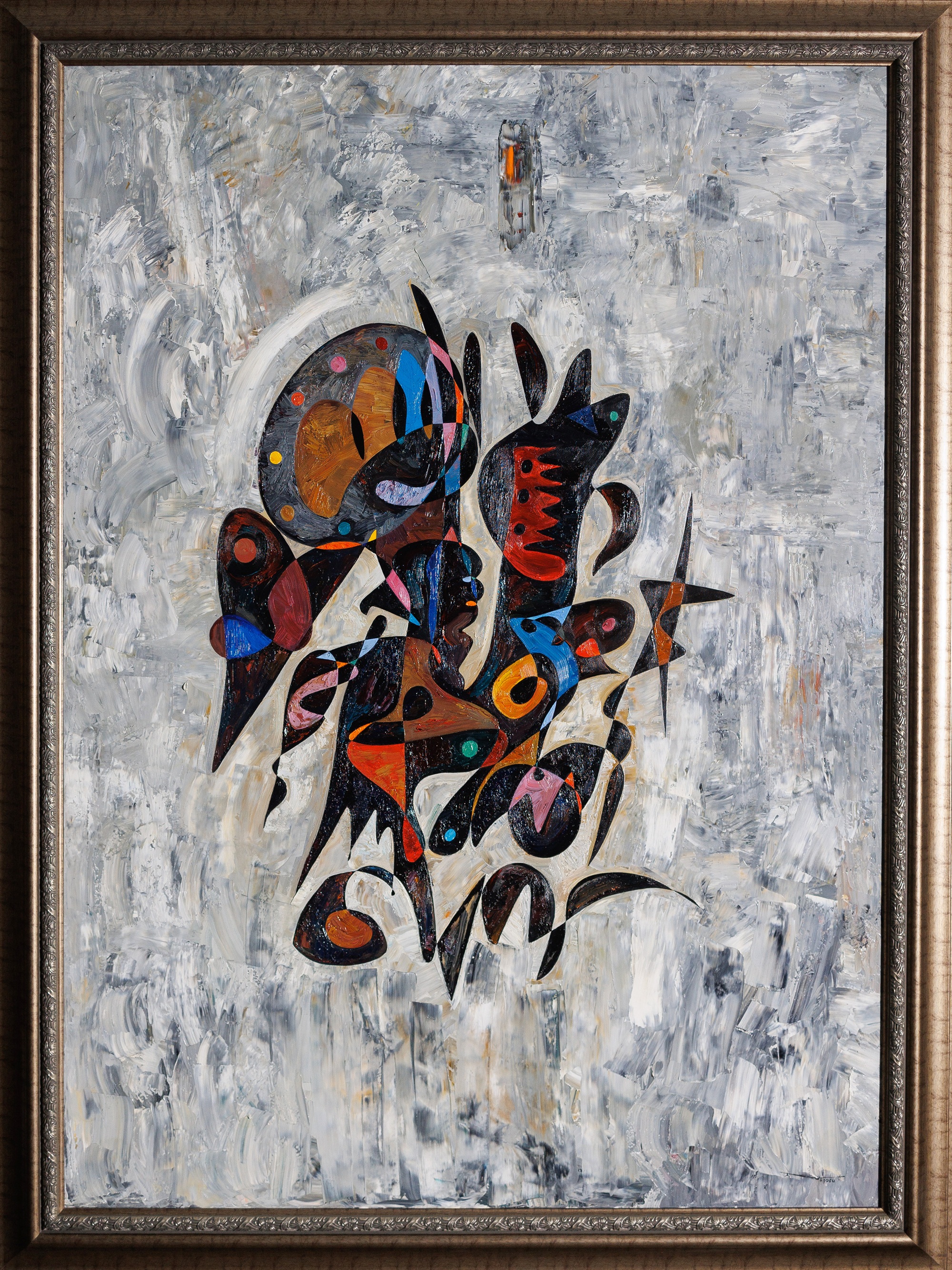
Babylonian Human (2008) occupies a pivotal position within Gheorghe Virtosu’s practice, marking an early and assured engagement with abstraction as a means of addressing historical memory and human identity. The painting’s central cluster of forms—fragmented yet cohesive—emerges from a dense, textured ground that suggests both excavation and erasure. In this interplay between figure and field, Virtosu establishes a visual language that resists fixed interpretation while remaining anchored in material experience.
The title introduces a critical framework. “Babylonian” evokes one of the earliest sites of written culture, a place historically associated with the origins of language, law, and urban complexity, while also carrying connotations of multiplicity and fragmentation1. Paired with “Human,” the term shifts the work away from representation toward a broader reflection on how identity is constructed and understood. The painting does not depict a figure in any conventional sense; instead, it presents a constellation of forms that suggest a body assembled through signs, gestures, and shifting relationships2.
Seen in this light, Babylonian Human can be understood as an exploration of how meaning is formed through looking. The viewer is invited to navigate the surface, moving between areas of intensity and restraint, clarity and ambiguity. This open-ended structure aligns the work with wider developments in postwar and contemporary painting, where the image operates less as a stable representation and more as a site of ongoing interpretation3. Virtosu’s painting offers no single resolution; instead, it sustains a productive tension between history, abstraction, and the evolving idea of the human.
Babylonian Human (2008) by Gheorghe Virtosu presents a densely constructed abstract composition in which a fragmented, figure-like structure emerges from a heavily worked grey ground. The surface is built through layered brushwork, producing a sense of erosion and accumulation that evokes archaeological processes rather than direct representation. The title situates the work within an expanded historical frame, invoking Babylon as both a cultural origin point and a symbol of fragmentation and linguistic excess1.
At the centre of the composition, interlocking geometric and biomorphic forms suggest a dispersed human figure. These elements resist anatomical coherence, instead forming a visual system of shifting signs in which body-like references appear and dissolve. Colour is used selectively—bright reds, blues, and yellows punctuate the darker structure, creating focal points that guide the viewer’s perception without stabilising meaning. The result is a composition that oscillates between figuration and abstraction.
The relationship between title and image is central to the work’s interpretive tension. While “Babylonian” suggests historical depth and the origins of written systems, “Human” implies legibility and presence. Virtosu undermines both expectations, presenting instead a fractured visual language in which identity is constructed through unstable relationships between form, surface, and sign. In doing so, the work aligns with broader concerns in contemporary abstraction regarding the limits of representation and the shifting status of the human figure2.
Babylonian Human (2008) by Gheorghe Virtosu stages a deliberate tension between abstraction and legibility. The painting resists immediate figuration, instead presenting a dense central structure that hovers between image and sign. The title introduces a dual reference—“Babylonian” and “Human”—that frames the work as both historical evocation and inquiry into the stability of identity.
The grey, heavily worked ground suggests erosion, excavation, and layered time. Rather than depicting a specific historical Babylon, the surface evokes a broader sense of cultural accumulation and loss. In this reading, “Babylonian” operates as a conceptual field rather than a literal subject, invoking early systems of writing and urban complexity as a backdrop for fragmentation1.
At the centre, the composition coalesces into a fragmented figure constructed from interlocking geometric and biomorphic forms. These elements suggest bodily fragments without resolving into a coherent anatomy. The result is a figure that appears assembled rather than depicted, shifting between organism, diagram, and visual code.
Colour plays a structural rather than descriptive role. Accents of red, blue, yellow, and pink interrupt the darker configuration, functioning as visual markers that guide perception across the surface. These chromatic interruptions intensify the sense of a system under construction, where meaning emerges through relational placement rather than narrative depiction.
The title’s invocation of “Babylon” also introduces a linguistic dimension. Babylon is historically associated with the origins of writing and with the fragmentation of unified language systems. Within this context, the painting can be read as a field of unstable signs, where meaning is continuously deferred rather than fixed2.
The term “Human” further complicates interpretation. Rather than presenting a stable subject, the painting disperses the idea of the human across multiple visual components. Identity becomes relational and provisional, constructed through fragments that resist synthesis into a single figure.
Ultimately, Babylonian Human positions itself as an inquiry into how meaning is assembled. By placing a historically charged title against an abstract visual system, Virtosu foregrounds the instability of interpretation itself. The painting does not resolve the human; instead, it presents it as an ongoing process of construction within shifting visual and historical frameworks3.
Gheorghe Virtosu | Artist Biography
Gheorghe Virtosu is a contemporary painter whose practice is grounded in the exploration of complex systems, metaphysical structures, and the visual translation of abstract processes into painterly form. Working primarily in large-scale oil on canvas, his oeuvre is distinguished by a sustained inquiry into the conditions through which meaning, form, and perception emerge within dense pictorial environments.
Rather than adhering to a linear stylistic trajectory, Virtosu’s practice is characterized by a systematic approach to composition in which biomorphic, geometric, and gestural elements are continuously reorganized within field-based structures. His paintings often function less as representations of external reality and more as self-contained epistemic spaces in which visual elements operate as interdependent variables within a dynamic system.
Central to Virtosu’s work is an engagement with philosophical models of emergence, transformation, and relational ontology. His paintings frequently evoke processes associated with biological growth, technological assembly, and cosmological formation, yet resist reduction to any single interpretive framework. Instead, they operate as speculative visual propositions in which materiality and concept are inseparable.
Technically, Virtosu employs a layered methodology that emphasizes accumulation, erosion, and reconfiguration of painted surface. This approach produces compositions in which depth is not illusionistic but structural, generated through the interaction of chromatic density, directional gesture, and compositional tension. The viewer is thus positioned not as a passive observer but as an active participant in the unfolding perceptual field.
Across his practice, Virtosu maintains a consistent focus on the relationship between order and instability, coherence and fragmentation. His work situates itself within a broader discourse on post-representational painting, contributing to ongoing debates concerning the capacity of abstraction to articulate systems of thought that extend beyond narrative or symbolic containment.
Babylonian Human (2008) is executed in oil on canvas, measuring 215 × 171 cm. The scale of the work supports its immersive visual impact, allowing the central forms to operate as a concentrated field within a broader spatial environment. The composition is structured around a central clustering of biomorphic and geometric elements, set against a heavily worked, atmospheric ground.
The painting employs layered oil application, combining dense impasto in the background with more controlled, sharply defined brushwork in the central figure. This contrast produces a tension between surface depth and graphic clarity, reinforcing the separation yet interdependence of figure and ground. The layering process suggests repeated revision, where earlier marks remain partially visible beneath subsequent applications of paint.
Colour is used selectively to articulate focal points within the composition, with saturated tones of red, blue, yellow, and pink interrupting the predominantly grey field. These chromatic accents function as structural signals rather than descriptive modelling, guiding visual movement across the surface. The material handling situates the work within contemporary abstract painting practices concerned with process, surface complexity, and perceptual instability1.
Artist: Gheorghe Virtosu
Medium: Oil on canvas
Dimensions: H 2.15 m × W 1.71 m
Babylonian Human (2008) by Gheorghe Virtosu constructs its visual impact through a strong centralisation of form against an expansive, heavily worked grey ground. The composition is vertically oriented, with a dense cluster of interlocking shapes positioned slightly above the midpoint, creating a sense of suspension. The surrounding field is built from layered, gestural brushstrokes that flatten spatial depth while simultaneously suggesting erosion or accumulation. This tension between figure and ground produces an unstable pictorial space in which forms appear both embedded within and emerging from the surface.
The central structure is composed of fragmented, biomorphic and geometric elements that resist anatomical coherence. Curved and angular segments interlock to form a quasi-figure, yet no stable bodily identity is resolved. Colour operates as a structural device rather than a descriptive one: saturated reds, blues, yellows, and blacks punctuate the composition, creating points of visual intensity that guide the viewer’s eye across the surface. This fragmentation aligns the work with broader modernist strategies of deconstruction, where the figure is broken into constituent visual units rather than presented as a unified whole1.
The title, Babylonian Human, introduces a historical and conceptual frame that contrasts with the abstraction of the image. “Babylonian” evokes early systems of writing and urban civilisation, while “Human” suggests figuration and identity. The painting resists both readings: instead, it presents the human as a dispersed visual system rather than a stable form. In this sense, meaning is produced through tension between linguistic reference and visual ambiguity, echoing theories of unstable signification in visual culture2.
In Babylonian Human (2008), Gheorghe Virtosu constructs meaning through a dynamic tension between colour and form, where neither element functions independently. The central figure is built from interlocking geometric and biomorphic shapes, producing a fragmented anatomy that resists stable reading. Colour operates not as descriptive modelling but as structural emphasis, with saturated reds, blues, yellows, and pinks punctuating a predominantly muted grey ground. This contrast establishes a visual hierarchy in which chromatic intensity directs attention across a dispersed, unstable figure, reinforcing its resistance to singular identity1.
The relationship between form and ground is equally significant. The heavily worked grey surface functions as an active field rather than passive background, its layered texture suggesting erosion, accretion, and temporal depth. Within this environment, the central forms appear both embedded and suspended, creating ambiguity between emergence and dissolution. This oscillation destabilises traditional figure-ground relationships and situates the work within broader post-war explorations of material surface and spatial ambiguity2.
Colour in the painting also performs a semiotic role, operating as a system of signs rather than expressive gesture. Bright chromatic accents function as nodes within a fragmented visual language, echoing the painting’s broader concern with broken or partial meaning. In this sense, form and colour together construct a non-linear visual syntax in which the “human” of the title is never fully resolved but continually reassembled through perceptual reading3.
In Babylonian Human (2008), Gheorghe Virtosu constructs a complex field of symbolism in which the human figure is never fully stabilised. At the centre of the composition, fragmented biomorphic forms suggest bodily presence, yet these elements resist anatomical coherence. Instead, they operate as visual signs that hover between figure and abstraction, evoking a constructed language rather than a readable body. The surrounding grey field intensifies this ambiguity, functioning as a kind of temporal or archaeological surface that frames the central form as something both emerging and dissolving.
The title plays a crucial role in shaping the painting’s imagery. “Babylonian” evokes ancient systems of writing, architecture, and cultural complexity, while also carrying associations of fragmentation and linguistic dispersion. Against this backdrop, the central cluster of shapes can be read as a kind of proto-script or symbolic code, where colour and form act as unstable signifiers rather than descriptive elements. This tension recalls theoretical accounts of meaning as fluid and deferred, particularly in relation to visual sign systems1.
Colour further contributes to the symbolic structure of the work. Bright reds, blues, and yellows punctuate the darker internal forms, creating points of visual emphasis that resist narrative resolution. These chromatic accents suggest energy, perception, or even emotional intensity, yet remain embedded within an overall structure that denies hierarchy or clarity. The result is an image in which symbolism does not resolve into fixed meaning but circulates across surface, form, and title, producing a sustained ambiguity between the human and the abstract2.
Babylonian Human (2008) by Gheorghe Virtosu constructs a deliberately unstable relationship between title and image, where meaning is generated through tension rather than resolution. The painting’s dense central formation resists figurative clarity, instead offering a fragmented structure of interlocking shapes that suggests the human form without ever completing it. The title invokes “Babylonian” as a site of historical and linguistic origin, yet this reference is not illustrative; it functions instead as a conceptual framing device that positions the work within ideas of cultural accumulation, loss, and translation1.
The surface treatment reinforces this instability. The heavily worked grey ground evokes processes of erosion and excavation, suggesting a surface that has been both built up and worn away. Within this field, the central configuration appears as both emergence and residue, as if the figure were simultaneously being uncovered and dissolved. This oscillation between presence and absence aligns the work with broader modern and post-war concerns around the breakdown of stable representation and the shifting status of the image2.
Ultimately, the painting resists a fixed reading of the “human.” Instead, it proposes the human as a constructed and contingent formation, assembled through fragments of sign, colour, and gesture. The title’s invocation of Babylon intensifies this condition, situating the work within a mythic history of fragmented language and collapsed unity. In this sense, Babylonian Human does not depict identity but stages its continual negotiation within systems of visual and historical reference3.
Babylonian Human operates within a restrained yet unsettled emotional register, balancing stillness with latent intensity. The heavily worked surface produces a muted atmosphere that feels suspended, as though the image is holding itself in a state of tension rather than resolution. Within this field, the viewer encounters not expressive narrative but a slow accumulation of visual pressure, where meaning feels continuously forming and dissolving. This produces a mood closer to contemplation than declaration, shaped by uncertainty rather than clarity1.
The central cluster of forms introduces a more charged emotional frequency. Its fragmented structure suggests proximity to the human body, yet denies coherence, generating a sense of recognition interrupted. Bright chromatic accents puncture the darker internal structure, introducing moments of intensity that feel both alert and unstable. These interruptions prevent emotional settling, creating instead a rhythm of attraction and withdrawal across the surface. The viewer is drawn in, then held at a distance, within a shifting field of partial legibility2.
This oscillation produces an affective condition best described as suspended ambiguity. The title, invoking both ancient civilisation and the figure of the “human,” amplifies this tension without resolving it. Instead, it frames the work as a space where identity, memory, and perception remain provisional. The emotional experience of the painting is therefore not cathartic but reflective—marked by a continual hesitation between reading the image as figure and encountering it as field3.
- On historical memory and surface in painting, see discussions of materiality in postwar European art.
- Roland Barthes, Image–Music–Text (1977), on the instability of meaning in visual signs.
- Michel Foucault, The Order of Things (1966), on changing systems of representation.
Selected Bibliography
- Barthes, Roland. Image–Music–Text. London: Fontana, 1977.
- Foucault, Michel. The Order of Things. New York: Pantheon, 1970.
- Foster, Hal et al. Art Since 1900. London: Thames & Hudson, 2016.
- Krauss, Rosalind. The Originality of the Avant-Garde. Cambridge, MA: MIT Press, 1985.
Curatorial Team: Daniel Varzari
Photography: The Art Monumental
Special Thanks: Daniel Varzari, Gheorghe Virtosu
The Art Monumental
08007 Barcelona
Phone: +34 934 439 470/ +01 312 358 8023