The Architecture of Conflict
El Arte Monumental | Catalogue: The Architecture of Conflict
Catalogue Entry: Battle of Gaugamela (2002) | Art Curator: Daniel Varzari
Battle of Gaugamela (2000–2002) occupies a pivotal position within Gheorghe Virtosu’s engagement with historical systems, marking a decisive shift from history painting as narrative representation toward history as a field of forces, relations, and structural dynamics. Rather than reconstructing the event associated with the Battle of Gaugamela as a figurative tableau, the work reframes it as a condition of distributed tension in which strategy, perception, and movement are translated into abstract visual logic.1
Virtosu’s approach is neither documentary nor illustrative. Instead, the painting constructs a complex spatial system in which cohesion and fragmentation operate simultaneously, and where meaning emerges through the interaction of opposing formal elements rather than through identifiable figures or events. The battlefield becomes a diagrammatic environment in which forces are not depicted but enacted, inviting the viewer to consider how historical outcomes are shaped by the interplay of structure, decision, and disruption.2
Within this context, Battle of Gaugamela functions as a reorientation of historical perception itself. It does not seek to stabilize the past into a coherent image, but to expose its internal volatility and multiplicity. In doing so, Virtosu extends his broader inquiry into systems of knowledge and power, positioning history not as a closed narrative, but as an open and continually reconfigured field of relations.3
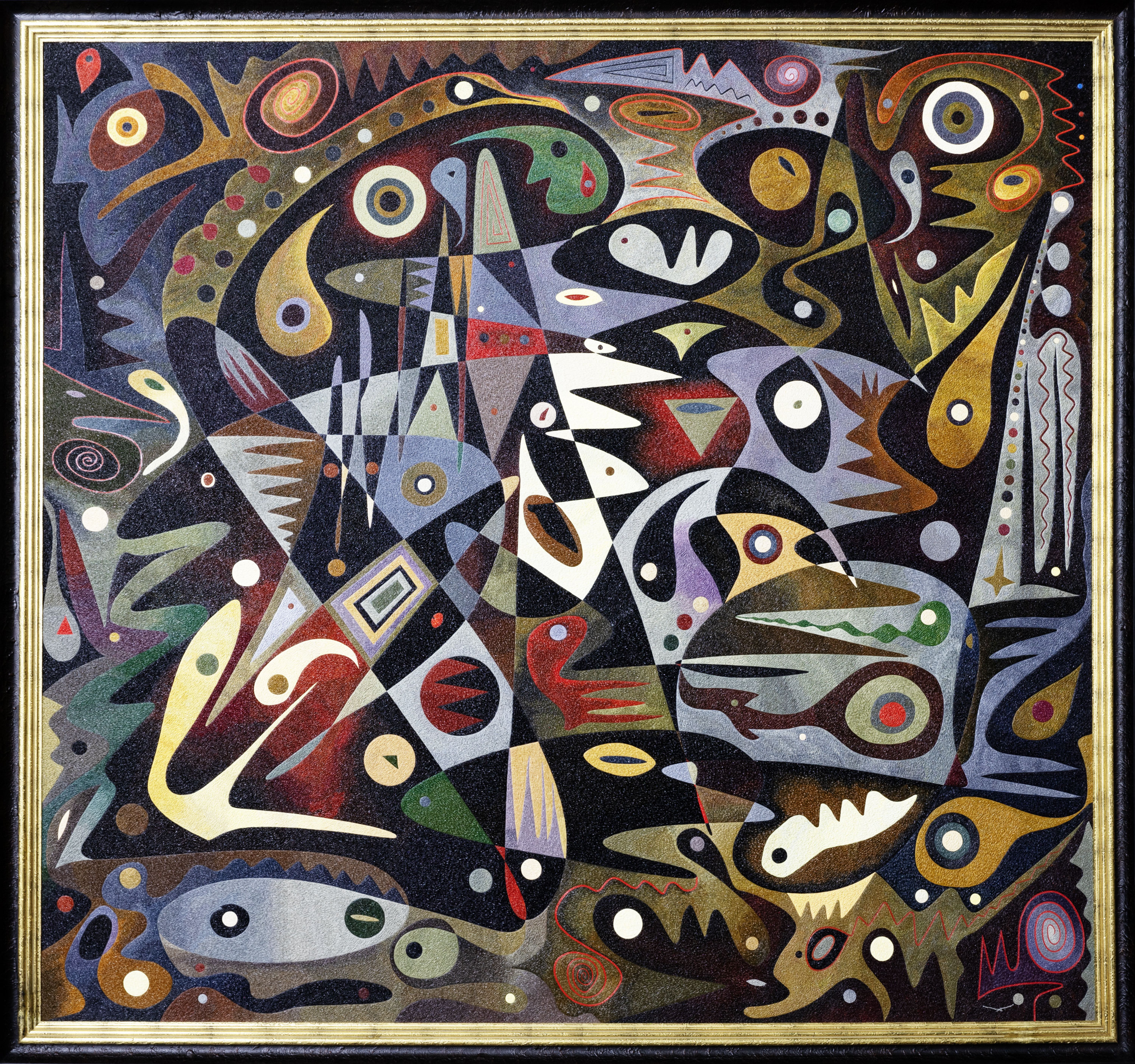
In Battle of Gaugamela (2000–2002), Gheorghe Virtosu reinterprets the Battle of Gaugamela as a non-representational field of forces rather than a historical tableau. The composition abandons figuration in favor of an expansive system of geometric, biomorphic, and linear elements that translate tactical movement, spatial pressure, and conflict dynamics into abstraction. The result is a visual environment in which history is experienced as structure, rhythm, and interaction rather than narrative depiction.
A dominant diagonal axis organizes the pictorial field, generating asymmetry and directional tension across the canvas. This structural thrust suggests the logic of maneuver associated with Alexander the Great, though it is not illustrative but operational in nature.1 Surrounding forms respond through compression, fragmentation, and reorientation, producing a dynamic system of visual forces that evokes the instability of large-scale conflict.
Across the surface, dense zones of intersection and collision contrast with more open, dispersed regions, creating a rhythm of escalation and release. Biomorphic motifs—particularly eye-like forms—introduce multiple points of perception, fragmenting any singular viewpoint.2 The painting ultimately constructs history as an immersive field of relations in which meaning emerges through movement, tension, and perceptual engagement.3
In Battle of Gaugamela (2000–2002), Gheorghe Virtosu reconfigures the Battle of Gaugamela1 not as a historical tableau but as a field of interacting forces. The painting abandons figuration in favor of structural abstraction, translating warfare into a dynamic system of spatial tensions, directional flows, and relational disruptions. What traditionally functions as a moment of historical resolution is here reconstituted as an unresolved visual condition.
Central to the conceptual logic of the work is the transformation of military strategy into compositional structure. The diagonal thrust traversing the canvas evokes the tactical maneuver associated with Alexander the Great2, yet it is not illustrative. Instead, it operates as a vector of instability, reorganizing the pictorial field through displacement, fragmentation, and asymmetry.
The opposing field may be read in relation to the forces of Darius III3, whose scale and extension introduce structural vulnerability. Rather than representing opposing armies, the painting encodes asymmetry through formal imbalance: extended sequences of forms are countered by zones of rupture and compression, producing a continuous negotiation between cohesion and breakdown.
From a conceptual perspective, the work replaces narrative time with spatialized process. The viewer does not encounter a fixed scene but navigates a system of unfolding relations. Meaning emerges sequentially through movement across the canvas, aligning perception with the logic of tactical engagement rather than detached observation.1
Biomorphic and geometric elements function as competing epistemic systems. The geometric introduces order, control, and structural legibility, while the biomorphic disrupts these systems through ambiguity, proliferation, and perceptual instability. Their interaction generates a field in which order is continuously produced and undone.2
This tension situates the painting within broader modernist inquiries into abstraction, particularly those associated with early and postwar systems-based abstraction. However, unlike purely formalist abstraction, this work remains anchored in historical reference, producing a hybrid condition in which abstraction becomes a mode of historical cognition rather than escape from it.3
Ultimately, the painting proposes that history is not a stable narrative to be represented, but a dynamic field of forces to be experienced. By dissolving figures into systems and events into structures, Virtosu reframes the Battle of Gaugamela as an epistemological problem: how to perceive complexity without reducing it to simplification.
Gheorghe Virtosu | Artist Biography
Gheorghe Virtosu is a contemporary painter whose practice investigates abstraction as a system for articulating complex structures of thought, perception, and historical consciousness. Working primarily at large scale, his compositions combine geometric order, fractured figuration, and biomorphic disruption to construct unstable visual fields in which meaning is produced through tension rather than representation.
Rather than depicting identifiable narratives, Virtosu’s work engages with the underlying architectures through which history, belief, and ideology are formed and sustained. His paintings operate as non-linear systems in which fragmentation, inversion, and recomposition replace conventional pictorial logic. In this framework, abstraction becomes a method for examining how cultural and symbolic orders are constructed, destabilized, and reconfigured.
The series 6 Wars extends this inquiry into the domain of historical conflict, treating war not as subject matter but as a recurring structural condition. Referencing events from antiquity to the present, the works refuse illustrative representation, instead translating conflict into fields of visual pressure, rupture, and imbalance. Each painting functions as a self-contained system in which historical reference is absorbed into abstraction, producing a tension between naming and erasure.
In this body of work, Virtosu’s practice moves away from symbolic narrative toward an examination of war as a persistent logic embedded within perception itself. The compositions do not resolve into images of events, but instead register the instability of representation when confronted with violence, memory, and historical repetition.
Technically grounded in layered oil painting processes, Virtosu constructs surfaces through accumulation, interruption, and reconfiguration. Forms emerge and dissolve across multiple visual strata, generating compositions in which order and disintegration coexist. This method reflects his broader concern with instability as a generative condition—one in which meaning is never fixed, but continuously produced through conflict between systems of structure and collapse.
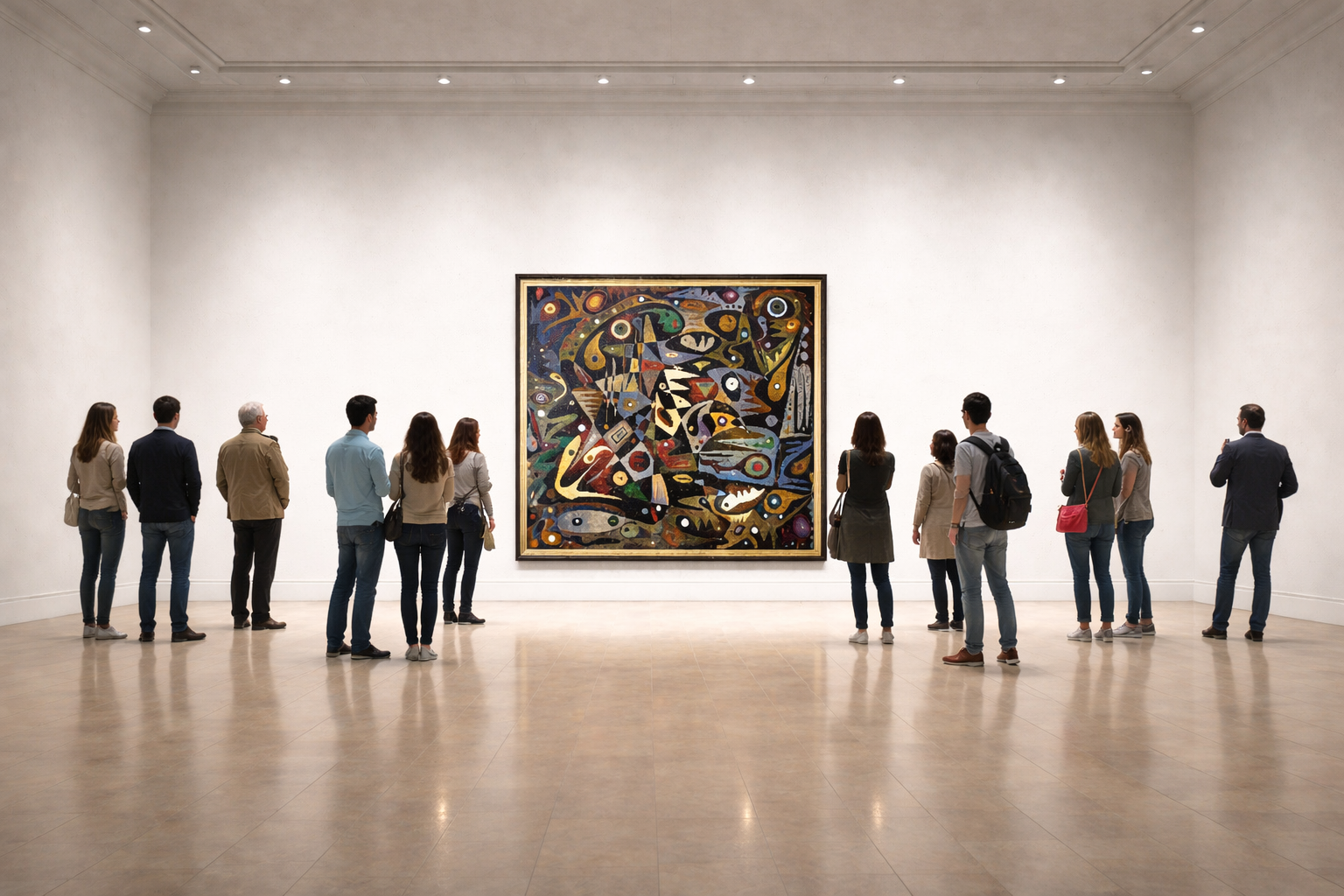
Executed in oil on canvas at a monumental scale (3.23 × 4.03 meters), the painting establishes an immersive horizontal field that necessitates bodily movement for full perception. The viewer is unable to apprehend the composition in a single glance; instead, understanding is constructed through sequential visual traversal.
The surface is built through layered applications of pigment, producing a stratified field in which forms alternately emerge, dissolve, and reassert themselves. This layering generates a controlled instability, allowing spatial depth to remain ambiguous rather than illusionistically resolved.
The interplay between biomorphic configurations and angular geometric structures produces a sustained tension between fluidity and directional force. Overlapping planes and intersecting contours create a compressed spatial environment in which interaction is prioritized over pictorial recession.
Chromatic variation functions as a structural rather than decorative element. Deep tonal zones establish fields of compression, while lighter and metallic passages introduce points of articulation and visual rupture. These contrasts guide perceptual movement across the surface and reinforce the painting’s internal logic of distributed tension.
The granular handling of paint at close range introduces a secondary perceptual regime in which the image breaks down into particulate marks. This oscillation between coherence and fragmentation is fundamental to the work’s construction, reinforcing its refusal of fixed visual hierarchy.
Artist: Gheorghe Virtosu
Medium: Oil and acrylic on linen canvas
Dimensions: 3.4 × 3.5 m
The composition of Battle of Gaugamela is structured as a non-hierarchical field in which spatial stability is continuously destabilized through intersecting geometric and biomorphic forms. Rather than organizing the image around a central focal point, the work distributes visual tension across a horizontal expanse, producing a condition of perpetual visual circulation.1 Diagonal vectors, fragmented clusters, and looping trajectories generate a sense of movement that resists resolution, echoing the dynamics of tactical dispersion and convergence associated with large-scale conflict.
Spatial depth is constructed not through linear perspective but through layering, overlap, and chromatic modulation. Forms appear to advance and recede simultaneously, creating an unstable pictorial space in which foreground and background are continuously renegotiated.2 This ambiguity intensifies the viewer’s perceptual engagement, as reading the image requires constant recalibration of spatial relationships. The result is a compositional logic grounded in flux rather than fixity, where meaning emerges through shifting alignments rather than stable structures.
Chromatically, the work operates through controlled contrasts between dark tonal fields, metallic highlights, and muted chromatic zones. These variations function not merely as descriptive elements but as structural forces that guide visual movement across the surface. Color punctuations act as nodes of emphasis, interrupting continuity and redirecting attention.3 In this way, chromatic design becomes integral to compositional order, reinforcing the painting’s broader articulation of instability, fragmentation, and distributed visual energy.
In this work, color operates not as surface decoration but as a structural agent that governs spatial tension and perceptual rhythm. Deep tonal fields—particularly blacks and muted greys—establish zones of compression, against which intermittent inflections of gold, red, and pale luminosity function as disruptive events. These chromatic punctuations do not stabilize form; instead, they intensify its instability, producing a field in which meaning emerges through contrast rather than continuity.1
Form is articulated through a dual logic of geometric segmentation and biomorphic flow. Angular structures introduce directional force and implied vectors of movement, while organic, curvilinear elements resist containment, dissolving edges and softening transitions between spatial zones. This interplay generates a constant negotiation between order and entropy, where no form remains fixed and every structural assertion is subject to deformation.2
The relationship between color and form is ultimately reciprocal: chromatic variation defines the legibility of structure, while formal disruption redistributes chromatic intensity across the surface. Rather than functioning independently, both systems operate as interdependent mechanisms that construct a dynamic perceptual environment—one in which visual coherence is perpetually produced and withdrawn in equal measure.3
In Battle of Gaugamela, symbolism operates not through iconographic representation but through the translation of historical conflict into a system of abstract forces. The diagonal thrust cutting across the composition functions as a structural metaphor for strategic disruption, recalling the maneuver of Alexander the Great during the battle.1 Rather than depicting armies or terrain, the painting encodes movement, pressure, and collision through intersecting geometries and shifting spatial tensions, transforming military action into a visual grammar of force.
Biomorphic elements—eye-like forms, fragmented organic shapes, and ambiguous anatomical traces—introduce a layer of perceptual instability. These motifs suggest distributed awareness rather than centralized vision, undermining the notion of a single commanding gaze. In relation to the historical figure of Darius III, whose forces depended on vast but diffuse coordination, these dispersed visual nodes evoke systems of perception that are fragmented and vulnerable to disruption.2 The imagery thus constructs conflict as both physical and cognitive breakdown.
The interplay between dense chromatic zones and darker structural fields reinforces a symbolic tension between order and dissolution. Gold and light-inflected accents punctuate the surface as markers of intensity, while deep tonal areas absorb and destabilize form. This oscillation produces a visual metaphor for the collapse of coherent systems under pressure, aligning with historical accounts of the Persian line’s fragmentation during the battle.3 Symbolism in the work therefore emerges not as fixed meaning, but as a dynamic condition of transformation.
In Battle of Gaugamela (2000–2002), the historical event of the Battle of Gaugamela is transformed into a non-narrative field of forces in which strategy replaces figuration and movement replaces representation. The work dismantles traditional history painting by refusing a central subject, instead dispersing agency across a network of geometric and biomorphic structures. The result is not an image of battle, but a system that behaves like battle—tension, rupture, and convergence are encoded as formal relationships rather than depicted events.
The diagonal thrust across the composition can be interpreted as a structural analogue to the maneuver executed by Alexander the Great, whose oblique advance destabilized the Persian line and created conditions for rupture1. Rather than illustrating this tactic, the painting reproduces its logic through spatial asymmetry and directional pressure, allowing compositional forces to substitute for narrative action. In parallel, the dispersed and unstable upper formations evoke the stretched and vulnerable configuration of Darius III’s forces, where numerical excess produced structural fragility rather than cohesion2.
Ultimately, the work constructs a visual epistemology in which history is no longer legible as sequence but only as relational intensity. Dense zones of collision, fragmentation, and optical instability replace heroic clarity with systemic ambiguity, situating the viewer within a perceptual field rather than outside it. The painting thus reframes historical understanding as embodied navigation through competing forces rather than detached observation of resolved events3.
The emotional register of Battle of Gaugamela is not anchored in narrative affect such as triumph, terror, or lamentation, but instead unfolds as a sustained condition of perceptual напряжение—an affective state structured by pressure, instability, and distributed intensity. Rather than directing the viewer toward empathy with figures or events, the painting generates a field of emotional ambiguity in which sensation is mediated through spatial tension, fragmentation, and visual overload. This produces a form of affect that is impersonal yet bodily, closer to physiological alertness than to identifiable feeling states, aligning emotion with structure rather than representation.
The diagonal thrust and colliding zones of density operate as vectors of emotional escalation, producing moments of heightened perceptual stress followed by partial release. These fluctuations do not resolve into catharsis; instead, they maintain the viewer in a continuous state of oscillation between coherence and disintegration. In this sense, the work echoes the logic of battlefield perception described in classical accounts of the :contentReference[oaicite:0]{index=0}, where scale and simultaneity exceed the capacity for unified emotional processing, producing fragmented attention rather than stable affective response¹.
The dispersal of biomorphic “eye” forms intensifies this condition by introducing a sense of being continuously observed without a stable locus of vision. Emotional experience is thus reframed as reciprocal exposure rather than identification: the viewer does not look at the painting so much as it distributes perceptual pressure back onto the viewer’s body. The result is an affective system in which emotion is not expressed but induced—constructed through spatial relations, structural imbalance, and sustained perceptual intensity².
- Arrian, Anabasis of Alexander.
- Plutarch, Life of Alexander.
- Robin Lane Fox, Alexander the Great. Penguin Books, 1973.
Selected Bibliography
- Arrian. Anabasis of Alexander.
- Plutarch. Life of Alexander.
- Fox, Robin Lane. Alexander the Great.
- Krauss, Rosalind. The Originality of the Avant-Garde and Other Modernist Myths.
- Deleuze, Gilles. Difference and Repetition.
Curatorial Team: Daniel Varzari
Photography: El Arte Monumental
Special Thanks: Daniel Varzari, Gheorghe Virtosu
El Arte Monumental
08007 Barcelona
Phone: +34 934 439 470/ +01 312 358 8023