The Architecture of Conflict
El Arte Monumental | Catalogue: The Architecture of Conflict
Catalogue Entry: Battle of Waterloo (2003) | Art Curator: Daniel Varzari
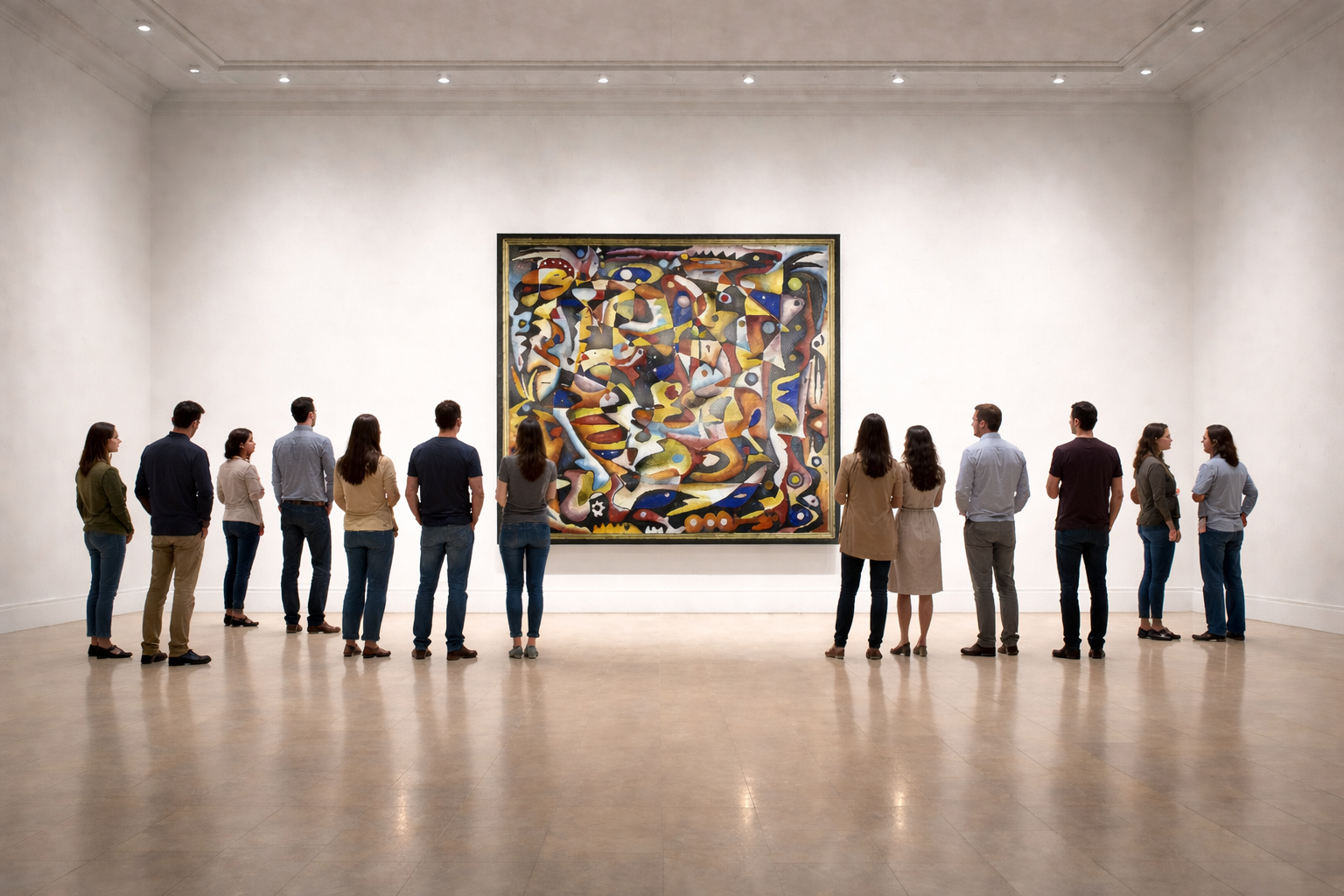
Battle of Waterloo (2003) forms a pivotal work within Gheorghe Virtosu’s exploration of historical conflict through abstraction, reconfiguring the Battle of Waterloo as a dynamic system of forces rather than a fixed narrative of defeat. At a monumental scale, the painting resists the conventions of traditional history painting—its hierarchies, its heroes, its clarity—and instead proposes a visual field in which movement, tension, and instability replace representation. The work invites the viewer not to observe history from a distance, but to enter into its complexity, navigating a space where structure and meaning remain in constant flux.
Central to this composition is the dissolution of singular perspective. Figures emerge only intermittently, assembled through the viewer’s perception and anchored by recurring eye-like forms that both guide and destabilize recognition. In this way, Virtosu displaces the authority of the individual—most notably that associated with Napoleon Bonaparte—and replaces it with a dispersed system of perception in which vision itself becomes uncertain. The painting thus reframes Waterloo not as a decisive moment governed by command, but as a condition of fragmentation in which control, identity, and direction are continuously contested.
Positioned within the broader context of contemporary abstraction, Battle of Waterloo functions as both a meditation on historical memory and a self-contained visual universe. Its interlocking forms and chromatic tensions do not resolve into a singular meaning, but instead sustain a productive instability that reflects the complexities of power, ambition, and collapse. In this catalogue, the work stands as a critical inquiry into how history is constructed, perceived, and reimagined—offering not answers, but a space in which the viewer actively participates in the unfolding of its meanings.
Battle of Waterloo (2003) by Gheorghe Virtosu reimagines the Battle of Waterloo as an abstract field of competing forces rather than a narrative scene. The composition is structured through a dense interplay of angular geometries and biomorphic forms, where diagonals, curves, and compressed planes evoke momentum, disruption, and tactical entanglement. Rather than depicting soldiers or terrain, the painting translates the dynamics of conflict into a visual system of pressure and fragmentation, reflecting the instability that characterized the battle’s unfolding.1
Across the surface, eye-like motifs and fragmented silhouettes emerge and dissolve, creating a dispersed network of perception. These elements suggest the presence of multiple viewpoints without consolidating into a single authoritative perspective, undermining the traditional focus on central command often associated with Napoleon Bonaparte. The viewer’s act of recognition becomes integral, as figures are not given but constructed through shifting visual relationships, reinforcing the painting’s emphasis on perceptual instability and the breakdown of unified control.2
Chromatically, the juxtaposition of saturated yellows, deep blues, and warm reds against darker tonal grounds generates zones of optical tension and fluctuating depth. These contrasts produce a continual oscillation between emergence and dissolution, mirroring the collapse of coordinated movement and the exhaustion of forces. The painting ultimately presents Waterloo not as a fixed historical image, but as a dynamic process of structural disintegration and transformation, where meaning arises through interaction rather than representation.3
In Battle of Waterloo (2001–2003), Gheorghe Virtosu constructs a conceptual system in which historical representation is replaced by the dynamics of perceptual instability. The painting does not function as a narrative depiction of the Battle of Waterloo, but as an abstract field in which the conditions of conflict are translated into structural and chromatic relations. Within this system, the historical event is not illustrated but reconstituted as a set of interacting forces, where meaning emerges through tension rather than depiction.
A central conceptual strategy of the work is the decentralization of figuration. Rather than presenting identifiable protagonists, the composition disperses figural potential across a network of partial silhouettes and unstable configurations. These figures are not fixed entities but perceptual constructs that emerge through the alignment of surrounding forms and eye-like motifs. The viewer’s recognition becomes an active process of assembly and dissolution, in which identity is continuously produced and withdrawn.1
The motif of the eye operates as a structural and conceptual device throughout the composition. These elements do not function as symbolic references but as triggers of perceptual organization, temporarily stabilizing surrounding fragments into coherent but unstable configurations. However, no single eye achieves dominance or totalization; instead, vision is distributed across multiple competing points of reference, producing a fractured field of awareness. This condition undermines traditional notions of a sovereign gaze, replacing it with a decentralized system of perception.2
Spatially, the painting rejects linear depth in favor of a compressed and intersecting field of forces. Angular trajectories and curved forms collide without resolution, generating a condition of perpetual tension rather than narrative progression. The absence of a dominant directional axis prevents hierarchical reading, ensuring that no single movement governs the composition. Instead, the image operates as a system of simultaneous and conflicting relations.
Chromatic structure intensifies this conceptual instability. Saturated yellows, reds, and blues are placed in direct opposition to dark tonal fields, producing optical vibration and perceptual ambiguity. Color does not stabilize form but actively destabilizes it, as luminous passages emerge and dissolve into surrounding darkness. This oscillation reinforces the painting’s central condition: the inability of any visual element to maintain fixed identity or position.3
The lower register introduces a counter-rhythm of repetition and accumulation, where rounded forms suggest inertia and containment. These elements contrast with the volatile dynamics of the upper field, establishing a structural tension between movement and stasis. Rather than resolving the composition, this opposition sustains its instability, reinforcing the painting’s refusal of closure or synthesis.
Ultimately, Battle of Waterloo articulates a conceptual model in which historical meaning is understood as a process of continuous construction rather than fixed representation. By dispersing identity, destabilizing perception, and dissolving narrative hierarchy, Virtosu reframes the battlefield not as an image of past events but as an active system of relations in which meaning remains perpetually contingent.
Gheorghe Virtosu | Artist Biography
Gheorghe Virtosu is a contemporary painter whose practice investigates abstraction as a system for articulating complex structures of thought, perception, and historical consciousness. Working primarily at large scale, his compositions combine geometric order, fractured figuration, and biomorphic disruption to construct unstable visual fields in which meaning is produced through tension rather than representation.
Rather than depicting identifiable narratives, Virtosu’s work engages with the underlying architectures through which history, belief, and ideology are formed and sustained. His paintings operate as non-linear systems in which fragmentation, inversion, and recomposition replace conventional pictorial logic. In this framework, abstraction becomes a method for examining how cultural and symbolic orders are constructed, destabilized, and reconfigured.
The series 6 Wars extends this inquiry into the domain of historical conflict, treating war not as subject matter but as a recurring structural condition. Referencing events from antiquity to the present, the works refuse illustrative representation, instead translating conflict into fields of visual pressure, rupture, and imbalance. Each painting functions as a self-contained system in which historical reference is absorbed into abstraction, producing a tension between naming and erasure.
In this body of work, Virtosu’s practice moves away from symbolic narrative toward an examination of war as a persistent logic embedded within perception itself. The compositions do not resolve into images of events, but instead register the instability of representation when confronted with violence, memory, and historical repetition.
Technically grounded in layered oil painting processes, Virtosu constructs surfaces through accumulation, interruption, and reconfiguration. Forms emerge and dissolve across multiple visual strata, generating compositions in which order and disintegration coexist. This method reflects his broader concern with instability as a generative condition—one in which meaning is never fixed, but continuously produced through conflict between systems of structure and collapse.
Executed in oil on canvas at a monumental scale (3.23 × 4.03 meters), the painting establishes an immersive horizontal field that requires bodily movement and sequential viewing for full perceptual access. The scale disrupts immediate overview, compelling the viewer to construct meaning through navigation rather than overview, reinforcing the work’s logic of distributed perception.1
The surface is built through layered applications of pigment, producing a dense chromatic and textural field in which forms alternately cohere and dissolve. Biomorphic and geometric structures are embedded within these layers, creating a shallow spatial system in which depth is continuously destabilized by overlapping visual regimes.2
Chromatic modulation plays a structural role, with high-saturation zones generating optical acceleration while darker fields introduce resistance and visual compression. These contrasts regulate movement across the surface, producing a dynamic equilibrium between dispersion and containment that aligns with the painting’s broader conceptual framework of instability and perceptual fragmentation.3
Artist: Gheorghe Virtosu
Medium: Oil and acrylic on linen canvas
Dimensions: 3.4 × 3.5 m
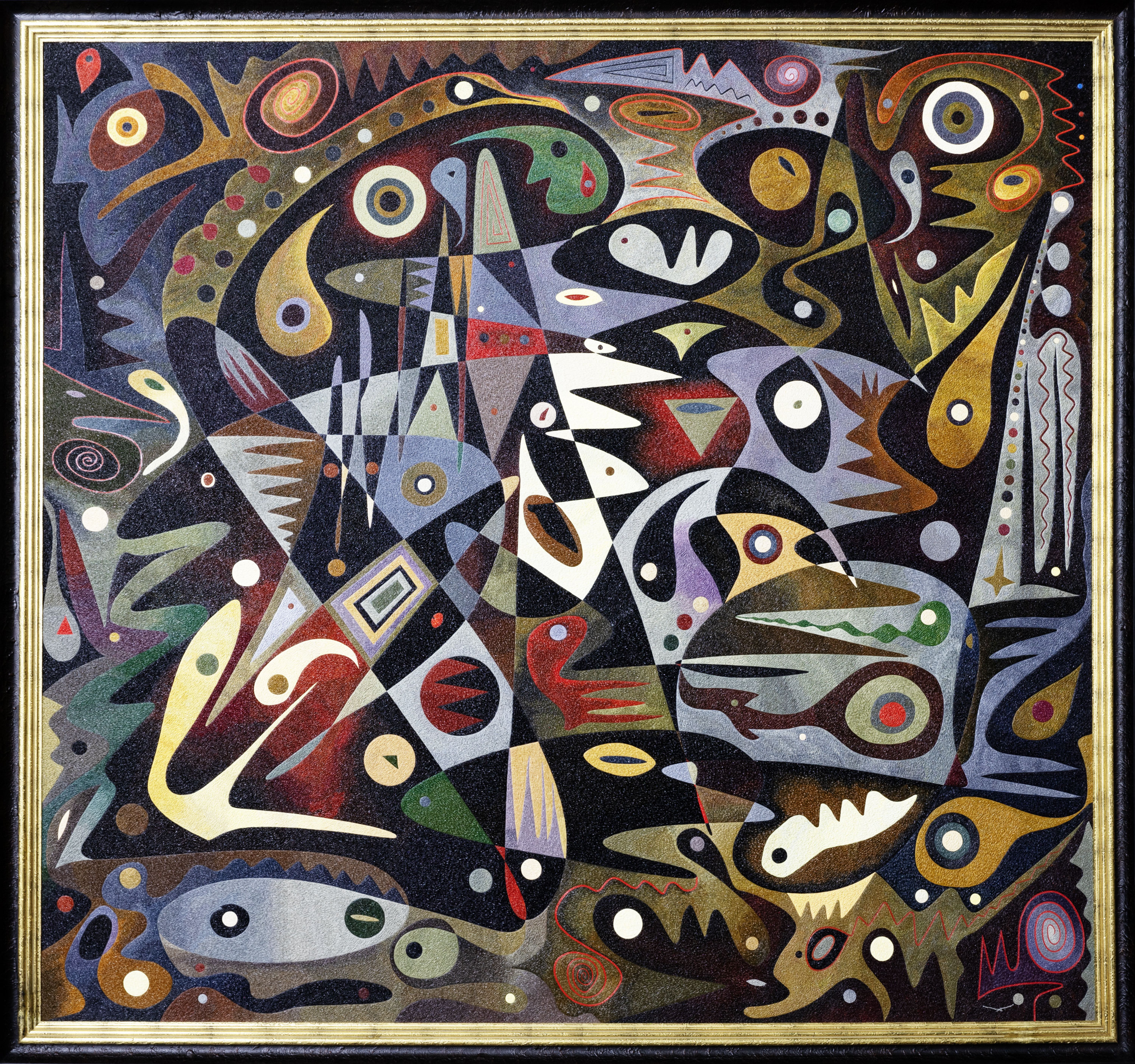
The visual composition of the work is structured as a densely layered field in which figuration, abstraction, and perceptual instability coexist without stabilizing into a single hierarchy. Rather than organizing space through linear perspective or narrative focal points, the painting distributes visual weight across intersecting geometries and biomorphic traces, producing a condition of continuous spatial negotiation. Silhouettes emerge only intermittently, often contingent on the viewer’s angle of perception, suggesting that figuration is not embedded in the image but constructed through acts of seeing.
A central structural mechanism within the composition is the use of eye-like motifs as perceptual anchors. These elements function not as symbolic decoration but as triggers of recognition, around which fragmented forms temporarily coalesce into unstable figure-structures. This strategy produces multiple, competing centers of identification, preventing any unified reading of the image and dispersing visual authority across the pictorial field.1 As a result, perception becomes recursive and unstable, with figures continuously assembling and dissolving under shifting conditions of attention.
Chromatic and spatial tensions further intensify this instability, as saturated tonal zones collide with darker compressive fields, generating optical vibration and ambiguous depth relations. Angular trajectories and curved forms intersect without resolution, producing a visual logic of interruption rather than continuity. This structure resists narrative closure, positioning the viewer within a dynamic system where meaning emerges only through movement across the surface.2
In this work, color functions not as descriptive surface treatment but as an active structural agent that modulates spatial perception and emotional intensity. Saturated chromatic zones—particularly the interplay of warm yellows, reds, and cooler blues—generate oscillations between advance and recession, destabilizing any fixed spatial hierarchy. Rather than organizing form, color disrupts it, producing a condition in which visual boundaries remain in constant flux. This chromatic instability reinforces the painting’s broader conceptual concern with systems under pressure and the breakdown of coherent visual order.1
Form operates through a logic of fragmentation and recombination, where geometric and biomorphic structures continuously intersect without resolving into stable figures. Angular vectors suggest directional force, while curved elements introduce counter-movements that resist closure. The result is a field of competing formal energies in which no single structure achieves dominance. This tension between containment and dispersal produces a visual system that mirrors conditions of instability and contested agency within the depicted historical framework.2
The relationship between color and form is therefore not hierarchical but interdependent: chromatic intensity activates structural ambiguity, while formal fragmentation intensifies optical vibration. Together, they generate a perceptual environment in which meaning emerges through instability rather than resolution. The viewer is required to navigate this shifting field actively, reconstructing provisional coherences that dissolve as quickly as they form, reinforcing the work’s emphasis on perception as a dynamic and unstable process.3
In Battle of Waterloo, symbolism emerges not as fixed iconography but as a distributed system of perceptual triggers embedded within the abstract field. The most persistent of these are eye-like motifs, which function as anchors of recognition around which transient figural forms momentarily coalesce. These forms suggest fragmented silhouettes of combatants, but they never stabilize into identifiable subjects, instead dissolving as perception shifts. In relation to the historical framework of the :contentReference[oaicite:0]{index=0}, this instability reflects the breakdown of centralized command into dispersed and competing visual logics.1
Biomorphic fragments—curved anatomical traces, partial profiles, and eye structures—operate as symbolic residues of human presence within an otherwise non-representational system. These elements do not reconstruct narrative figures such as :contentReference[oaicite:1]{index=1} but instead scatter identity across multiple perceptual nodes. The result is a condition in which subjectivity is continuously assembled and dismantled, suggesting a symbolic economy based on instability rather than representation.2
Chromatic symbolism reinforces this logic of fragmentation and tension. High-intensity yellows and reds function as zones of activation, while deep blues and blacks operate as absorptive fields that interrupt continuity. These color interactions generate optical instability, producing shifting spatial hierarchies that resist resolution. Symbolism therefore operates not through iconographic meaning but through the dynamic interaction of perceptual forces, echoing the collapse of coherent structure during the historical engagement itself.3
In Battle of Waterloo, symbolism emerges not as fixed iconography but as a distributed system of perceptual triggers embedded within the abstract field. The most persistent of these are eye-like motifs, which function as anchors of recognition around which transient figural forms momentarily coalesce. These forms suggest fragmented silhouettes of combatants, but they never stabilize into identifiable subjects, instead dissolving as perception shifts. This instability reflects the breakdown of centralized command into dispersed and competing visual logics.1
Biomorphic fragments—curved anatomical traces, partial profiles, and eye structures—operate as symbolic residues of human presence within an otherwise non-representational system. These elements do not reconstruct narrative figures such as Napoleon Bonaparte but instead scatter identity across multiple perceptual nodes. The result is a condition in which subjectivity is continuously assembled and dismantled, suggesting a symbolic economy based on instability rather than representation.2
Chromatic symbolism reinforces this logic of fragmentation and tension. High-intensity yellows and reds function as zones of activation, while deep blues and blacks operate as absorptive fields that interrupt continuity. These color interactions generate optical instability, producing shifting spatial hierarchies that resist resolution. Symbolism therefore operates not through iconographic meaning but through the dynamic interaction of perceptual forces, echoing the collapse of coherent structure during the historical engagement itself.3
In Battle of Waterloo, emotional intensity is not conveyed through figural expression but through systemic instability. The viewer encounters a field in which perceptual certainty is repeatedly undermined, producing a sustained condition of cognitive tension. Rather than eliciting empathy through narrative identification, the work generates an affective state rooted in disorientation and delayed recognition. The absence of a stable visual center produces a feeling of suspended orientation, where meaning is continuously anticipated but never fully resolved.1
This instability is heightened by the presence of fragmented silhouette structures that intermittently cohere into recognizable forms before dissolving again into abstraction. Emotional response emerges from this oscillation between recognition and loss of recognition, creating a rhythm of perceptual attachment and withdrawal. The viewer is thus positioned within a fluctuating field of partial identifications, where affect is distributed across shifting visual conditions rather than anchored in a single focal point.2
Chromatic intensity further amplifies this emotional register, as saturated tonal zones collide with deep, absorptive fields to produce a sense of pressure and instability. Rather than functioning symbolically, color operates as an affective force that acts directly on perception, generating sensations of urgency, fragmentation, and spatial uncertainty. The cumulative effect is not emotional resolution but sustained affective tension, in which historical collapse is experienced as a continuous perceptual condition rather than a concluded event.3
- Andrew Roberts, Napoleon: A Life. Penguin Books, 2014.
- David Chandler, The Campaigns of Napoleon. Scribner, 1966.
- Jeremy Black, Eighteenth-Century Europe. Palgrave Macmillan, 1990.
Selected Bibliography
- Roberts, Andrew. Napoleon: A Life.
- Chandler, David. The Campaigns of Napoleon.
- Black, Jeremy. Eighteenth-Century Europe.
- Krauss, Rosalind. The Originality of the Avant-Garde and Other Modernist Myths.
- Deleuze, Gilles. Difference and Repetition.
Curatorial Team: Daniel Varzari
Photography: El Arte Monumental
Special Thanks: Daniel Varzari, Gheorghe Virtosu
El Arte Monumental
08007 Barcelona
Phone: +34 934 439 470/ +01 312 358 8023