6 Wars — The Architecture of Conflict
The Art Monumental | Catalogue: 6 Wars — The Architecture of Conflict
Catalogue Entry: Darius III (2005) | Art Curator: Daniel Varzari
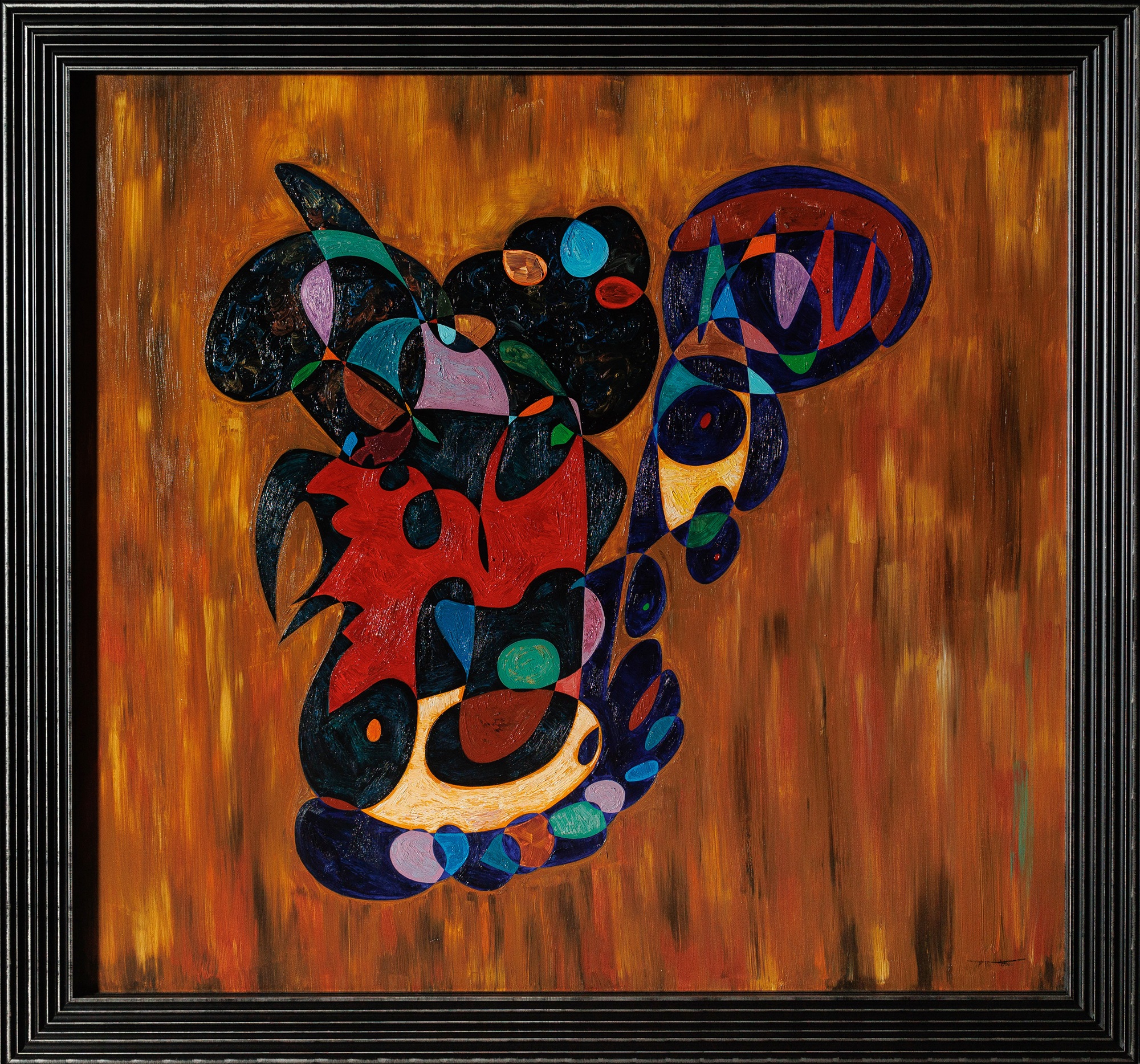
Darius III (2005) occupies a pivotal position within Gheorghe Virtosu’s Six Wars System, functioning as Codex II of the larger Battle of Gaugamela cycle. Rather than reconstructing a historical event, the work engages with its afterimage—where narrative dissolves and only fragments remain. The painting approaches history not as a fixed account but as a field of unstable traces, shaped by interpretation, memory, and loss1.
The figure of Darius III, once emblematic of imperial authority, is here dispersed into a network of interlocking forms. This fragmentation resists conventional portraiture, instead presenting power as contingent and structurally unstable. Colour and form operate as signals rather than descriptions, producing a visual language that aligns with broader questions around how meaning is constructed and disrupted within systems of representation2.
As part of a wider investigation into conflict, the work reflects on war not as spectacle but as structure. The Six Wars System proposes a mode of thinking in which historical events are encoded rather than depicted, allowing abstraction to function as a form of critical inquiry. In this context, Darius III becomes less an image of a ruler than a study of collapse—of authority, of identity, and of the frameworks through which history is understood3.
Darius III (2005) presents a fragmented, abstract figure suspended within a luminous field of ochre and rust. Rather than offering a literal depiction, the composition assembles interlocking forms that suggest bodily elements—eyes, armour, internal structures—without resolving into a stable identity. The figure appears both constructed and disintegrating, reflecting the instability of sovereignty associated with the historical figure of Darius III at the moment of imperial collapse1.
The surface of the painting is built through layered, vertical brushwork, creating a sense of heat, erosion, and atmospheric intensity. This background operates as an active field rather than a passive setting, evoking the residual conditions of conflict rather than a specific location. Within this environment, colour functions as a structural force: dense blacks anchor the composition, while vivid accents of red, blue, and green act as interruptions, directing the viewer’s attention and reinforcing the sense of fragmentation2.
As part of the Six Wars System and identified as Codex II of Battle of Gaugamela (2000–2002), the work operates as a visual archive rather than a narrative image. It encodes the aftereffects of conflict through abstraction, presenting history as a field of dispersed signs rather than a fixed account. In this context, the painting transforms the idea of power into an unstable, shifting condition, shaped by memory, perception, and the processes of representation itself3.
Darius III (2005) approaches history not through depiction but through transformation. As Codex II within the Six Wars System and linked to Battle of Gaugamela (2000–2002), the painting reframes a decisive historical moment as a field of abstraction. Rather than narrating the encounter, it isolates the condition of its aftermath, focusing on the instability of power at the point of dissolution1.
The central form suggests a figure, yet one that resists coherence. Fragmented shapes interlock without resolving into a stable body, producing a structure that appears simultaneously constructed and disintegrating. This instability reflects the historical figure of Darius III not as an individual portrait but as a condition of sovereignty under pressure, where authority is no longer unified but dispersed across competing forces1.
The surrounding field intensifies this reading. Built from layered ochre and rust tones, the surface evokes heat, residue, and erosion. It suggests an environment shaped by conflict, yet without direct reference to landscape or event. The painting thus shifts attention from representation to atmosphere, where history is registered as a material and visual condition rather than a narrative sequence.
Colour operates as a system of interruption. Dark, dense forms anchor the composition, while sharp accents of red, blue, and green disrupt visual continuity. These elements function less as descriptive devices than as signals within a fractured structure, directing attention while reinforcing the sense of internal tension. The red passages, in particular, introduce a force that appears to cut through the composition, marking moments of rupture3.
The designation “Codex II” frames the painting as part of a broader system of visual recording. However, this codex does not offer legible information. Instead, it presents a dispersed archive of forms that preserve the trace of an event without fixing its meaning. The work suggests that history, like language, is subject to fragmentation, translation, and loss, existing as a series of incomplete and shifting structures2.
Spatially, the figure appears suspended within the field, neither fully integrated nor entirely separate. This ambiguity creates a tension between emergence and dissolution, as if the form is both coming into being and breaking apart. The viewer is positioned within this instability, required to navigate a composition that resists fixed orientation or resolution.
Ultimately, Darius III presents power not as a stable condition but as a fragile construct. By dissolving the figure into a system of abstract relations, the painting redefines historical memory as something contingent and unresolved. What remains is not the image of authority, but its afterimage—fragmented, unstable, and open to interpretation2.
Gheorghe Virtosu | Artist Biography
Gheorghe Virtosu is a contemporary painter whose work explores abstraction as a means of examining complex systems, perception, and the formation of meaning. Working primarily in large-scale oil on canvas, his paintings are characterised by dense, layered compositions in which geometric and biomorphic forms interact within structured pictorial fields.
Rather than depicting external subjects, Virtosu constructs images that function as self-contained visual environments. Within these spaces, forms are continuously reorganised, suggesting processes of emergence, transformation, and instability. His work often evokes associations with biological, technological, or cosmological systems, while remaining open to interpretation.
His practice is defined by a sustained investigation into the relationship between order and fragmentation. Through a combination of controlled structure and gestural intervention, Virtosu creates compositions that resist fixed meaning and require active engagement from the viewer.
Technically, his paintings are built through layered applications of oil, balancing accumulation and erasure. This approach produces a sense of depth that is structural rather than illusionistic, with surface and form developing through tension and interaction.
Positioned within contemporary debates on abstraction, Virtosu’s work contributes to an expanded understanding of painting as a system of thought, where visual language operates beyond direct representation.
Darius III (2005) is executed in oil on canvas at a scale of 171 × 169 cm, adopting a near-square format that stabilises the composition while allowing for internal tension. The work forms part of Gheorghe Virtosu’s Six Wars System, functioning as Codex II in relation to Battle of Gaugamela (2000–2002). The format reinforces the painting’s structural logic, containing a centralised configuration within an expansive, active field1.
The surface is built through layered applications of oil paint, with the background developed using vertical, gestural strokes in ochre, rust, and gold tones. This method produces a textured field that suggests both atmospheric depth and material erosion. The accumulation of paint creates a sense of duration, where the surface reads as worked, revised, and temporally extended2.
In contrast, the central figure is constructed through more controlled, defined applications of paint. Interlocking forms are articulated with sharper edges and denser pigmentation, particularly in the use of black to anchor the composition. Colour accents—red, blue, green, and violet—are layered within this structure, functioning as visual interruptions rather than descriptive elements. This contrast between gestural ground and structured form establishes a dynamic interplay between instability and coherence3.
The painting’s material and compositional strategies emphasise tension between surface and figure, field and structure. The central form appears both embedded within and distinct from its surroundings, suggesting processes of emergence and dissolution. This duality aligns with the work’s broader engagement with fragmentation and the transformation of historical reference into a system of visual signs4.
Artist: Gheorghe Virtosu
Medium: Oil on canvas
Dimensions: H 1.71 m × W 1.69 m
The composition of Darius III (2005) is structured around a dense, central cluster of interlocking forms that suggest a figure without resolving into one. Curved and angular elements overlap and compress within a near-square format, creating a sense of internal tension and instability. The figure appears assembled from fragments—eyes, limbs, and shield-like shapes—yet remains resistant to anatomical coherence. This fragmentation transforms the figure into a constructed system rather than a fixed body, reflecting a broader condition of instability associated with authority and identity1.
The background, rendered in layered ochre, rust, and golden tones, establishes a charged atmospheric field. Vertical brushstrokes introduce a sense of downward movement, as if the surface itself were eroding or dissolving. This treatment situates the central form within an environment that is both active and unstable. Rather than functioning as a neutral backdrop, the ground interacts with the figure, suggesting emergence and potential reabsorption. The effect is one of suspended tension, where figure and field remain in constant negotiation2.
Colour operates as a structural and disruptive force within the composition. Deep black forms anchor the image, while vivid accents of red, blue, green, and violet punctuate the surface as moments of visual intensity. These colours do not describe volume or light but instead act as signals, directing attention and interrupting continuity. The sharp red passages in particular introduce a sense of rupture, reinforcing the fragmentation of the central structure. Through this interplay of colour and form, the painting constructs a visual language that resists resolution and sustains a condition of ongoing transformation3.
Colour in Darius III operates as a structural force rather than a descriptive tool. Dense black forms anchor the composition, while vivid passages of red, blue, green, and violet punctuate the surface with moments of intensity. These accents function as visual signals, directing movement across the painting and interrupting any stable reading of the figure. The dominant ochre field, layered with vertical striations, introduces a sense of heat and atmosphere, suggesting both environment and afterimage rather than a fixed setting1.
Form emerges through fragmentation. The central configuration suggests a figure, yet it resists anatomical coherence. Curved and angular elements interlock, overlap, and diverge, producing a structure that appears both assembled and unstable. Rather than representing a body, the painting constructs a system of relations in which each part gains meaning through its connection to others. This approach aligns abstraction with a language-like condition, where form operates as syntax rather than depiction2.
The interaction between colour and form reinforces the work’s conceptual tension. Bright chromatic elements disrupt the density of the darker mass, while the surrounding field presses inward, creating a dynamic balance between containment and dispersal. The result is a composition in which figure and ground remain in flux, reflecting a broader instability of identity and authority. Colour and form do not resolve the image; they sustain its openness, allowing meaning to remain provisional and shifting3.
The central form in Darius III operates as a fractured emblem of sovereignty. Rather than presenting a unified ruler, the composition disperses identity across interlocking shapes that suggest armour, eyes, and bodily fragments without resolving into a coherent figure. This instability reflects the historical figure of Darius III at the moment of imperial collapse, where authority is no longer embodied but disassembled into competing forces1.
The surrounding ochre field intensifies this reading. Its layered, striated surface evokes heat, erosion, and the residual atmosphere of conflict, transforming the background into a symbolic terrain of aftermath. Within this field, colour functions as a system of signals: sharp reds introduce rupture and tension, while cooler blues and greens suggest interruption and displacement. These elements do not describe reality but instead construct a visual language through which conflict is encoded rather than depicted2.
As Codex II of Battle of Gaugamela, the work positions itself as part of a broader system of visual inscription. The imagery can be read as a form of fragmented writing—an archive of marks that preserves the trace of historical violence without offering narrative clarity. In this sense, the painting transforms symbolism into structure: meaning emerges not from representation but from the relations between forms, colours, and surface tensions3.
Darius III (2005) reframes the historical figure not as a portrait but as a condition of unstable authority. The central form appears assembled from fragments—suggesting a body without resolving into one—where identity is constructed through tension rather than coherence. This approach shifts the focus from representation to structure, presenting sovereignty as something contingent and subject to breakdown1.
The work’s position as Codex II within Battle of Gaugamela introduces the idea of painting as a form of visual archive. Rather than narrating the battle, the composition preserves its aftereffects through dispersed signs and interrupted forms. The image operates as a system of traces, where meaning remains partial and unstable, aligning historical memory with fragmentation rather than continuity2.
Set against a charged ochre field, the figure exists within an environment that suggests both emergence and dissolution. The surrounding surface does not frame the form but actively pressures it, reinforcing a sense of collapse and transformation. In this context, the painting proposes history not as a fixed account but as an ongoing process shaped by perception, interpretation, and the limits of visual language3.
Darius III (2005) carries an atmosphere of tension held in suspension. The central form appears both forceful and unstable, as if caught between assertion and collapse. Dense black structures anchor the composition, yet sharp intrusions of red disrupt any sense of coherence. This produces an emotional field defined not by resolution, but by pressure—an image of authority under strain rather than in command1.
The surrounding ochre ground intensifies this condition. Its vertical movement and layered texture suggest heat, residue, and aftermath, evoking a space marked by conflict rather than depicting it directly. The figure does not dominate this field; instead, it appears exposed within it, its boundaries uncertain. The emotional tone shifts from dominance to vulnerability, from control to dispersal2.
Rather than presenting a singular emotional state, the painting sustains contradiction. Moments of clarity emerge through colour and structure, only to be interrupted or absorbed back into the surface. This instability aligns the work with a broader understanding of historical experience as fragmented and unresolved, where power is no longer secure but continually negotiated within shifting conditions3.
- Pierre Briant, From Cyrus to Alexander (2002), on the structure and collapse of the Achaemenid Empire.
- Michel Foucault, The Archaeology of Knowledge (1969), on archives and discontinuity.
- Paul Virilio, War and Cinema (1984), on the structuring logic of war and perception.
Selected Bibliography
- Briant, Pierre. From Cyrus to Alexander: A History of the Persian Empire. Winona Lake: Eisenbrauns, 2002.
- Foucault, Michel. The Archaeology of Knowledge. London: Routledge, 1972.
- Virilio, Paul. War and Cinema: The Logistics of Perception. London: Verso, 1989.
- Foster, Hal et al. Art Since 1900. London: Thames & Hudson, 2016.
- Clark, T. J. Farewell to an Idea. New Haven: Yale University Press, 1999.
Curatorial Team: Daniel Varzari
Photography: The Art Monumental
Special Thanks: Daniel Varzari, Gheorghe Virtosu
The Art Monumental
08007 Barcelona
Phone: +34 934 439 470/ +01 312 358 8023