The Architecture of Conflict
El Arte Monumental | Catalogue: The Architecture of Conflict
Catalogue Entry: Dreams Rider (2008) | Art Curator: Daniel Varzari
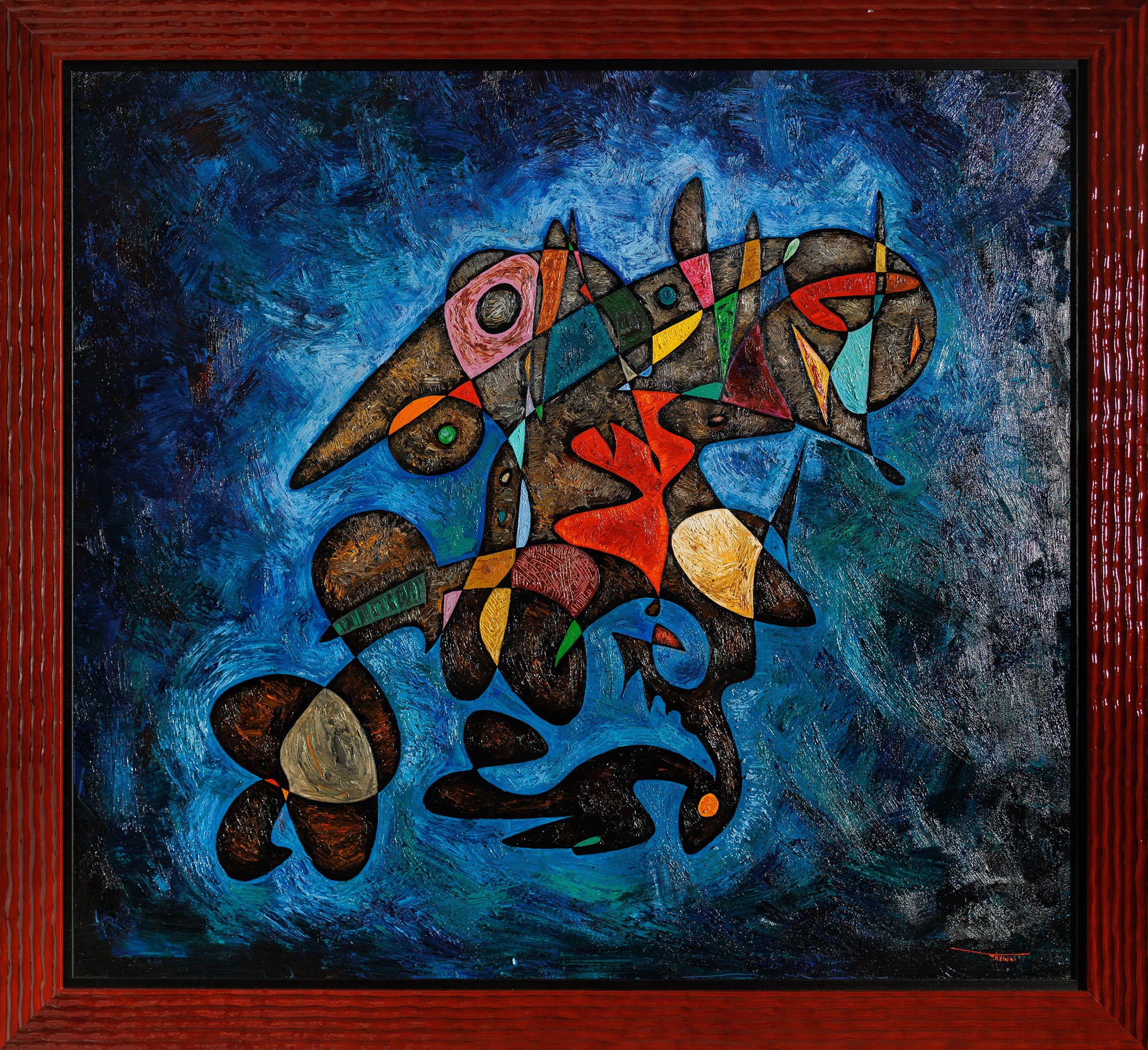
Dreams Rider (2008) occupies a significant position within Gheorghe Virtosu’s exploration of consciousness, symbolic systems, and the hidden architectures that shape human experience. Through a complex language of abstraction, the painting transforms dreaming from a private psychological phenomenon into a monumental visual structure, revealing the dynamic relationships between memory, imagination, perception, and transformation.
Rather than illustrating a dream or narrating a symbolic event, Virtosu constructs an environment in which forms continuously evolve, merge, and reorganize themselves. Suspended within an expansive field of luminous blue, the central hybrid figure appears simultaneously as rider, vessel, and archetypal presence. The work invites viewers to navigate a space where certainty dissolves and meaning emerges through movement, association, and contemplation.
Presented today, Dreams Rider reflects a broader contemporary interest in the relationship between inner experience and visual form. It demonstrates Virtosu’s ability to transform abstraction into a philosophical instrument, creating a work that speaks not only about dreaming but about humanity’s enduring search to understand the invisible structures of consciousness itself.
Dreams Rider (2008) presents a complex abstract formation suspended within an expansive field of luminous blue. Composed of interwoven geometric and organic elements, the central structure appears simultaneously as rider, creature, vessel, and symbolic construct. Its fragmented contours resist fixed interpretation, creating a visual experience that mirrors the fluid and transformative nature of dreaming.
Vibrant accents of red, yellow, green, black, and white emerge from the composition's layered architecture, generating rhythms of movement and visual tension. These chromatic interventions animate the surrounding space, suggesting the interaction of memory, imagination, and unconscious perception. The absence of a stable horizon or recognizable environment reinforces the sensation of navigating an interior psychological landscape.
Measuring 170 × 171 cm, the painting immerses the viewer within a symbolic environment where forms continuously evolve and reorganize. Through its synthesis of abstraction, colour, and spatial ambiguity, Dreams Rider transforms the dream into an architectural system of movement, transformation, and possibility.
Dreams Rider examines dreaming as an architectural condition rather than a narrative event. Gheorghe Virtosu presents the unconscious as a dynamic system in which memory, imagination, perception, and emotion interact through continuously evolving symbolic structures. The painting proposes that dreams possess their own internal logic, capable of generating realities that exist beyond conventional notions of space, time, and identity.
The central hybrid figure functions as a metaphorical navigator moving through the invisible territories of consciousness. Simultaneously rider, creature, machine, and archetype, the form resists stable classification. This ambiguity reflects the fluid nature of dream experience, where identities merge, boundaries dissolve, and symbolic meanings remain in constant transformation.
The expansive blue environment surrounding the figure suggests a realm of infinite psychological depth. Neither landscape nor atmosphere, this space operates as a visual manifestation of the unconscious itself. The absence of fixed spatial coordinates allows the composition to exist between memory and imagination, creating a sense of perpetual movement through unknown dimensions of perception.
Fragmented geometric and organic forms interact across the composition like interconnected nodes within a larger cognitive network. These structures evoke the associative processes through which dreams construct meaning, linking disparate memories, emotions, and symbolic fragments into temporary configurations. The painting visualizes consciousness as a system of relationships rather than a singular point of awareness.
Colour functions as an emotional and psychological language throughout the work. Deep blues establish an atmosphere of introspection and mystery, while accents of red, yellow, green, and white introduce moments of revelation, energy, and transformation. These chromatic tensions mirror the shifting emotional states that characterize the dream experience.
Within Virtosu's broader theory of Systemic Abstraction, the painting explores how meaning emerges through interaction rather than representation. Forms are not illustrations of specific objects or events but active participants within a symbolic architecture. Dreaming becomes a process through which the mind continuously reorganizes experience, generating new possibilities of understanding and self-perception.
Ultimately, Dreams Rider presents the dream as a journey of transformation. The rider becomes an archetype of human consciousness navigating uncertainty, imagination, and becoming. Through abstraction, the work reveals dreaming as one of humanity's most profound mechanisms for exploring the hidden architectures of reality and the self.
Gheorghe Virtosu | Artist Biography
Gheorghe Virtosu is a contemporary artist whose practice investigates the architectures of power, historical memory, collective consciousness, and cultural transformation. Through large-scale abstract paintings, he examines the visible and invisible systems that shape civilizations, translating political, social, philosophical, and psychological phenomena into complex visual structures. His work approaches abstraction not as formal reduction, but as a means of revealing the underlying mechanisms through which societies and individuals construct meaning, authority, identity, and perception.
Working primarily in oil on canvas, Virtosu has developed a distinctive visual language characterized by the integration of geometric organization, biomorphic fluidity, symbolic archetypes, and fragmented figurative references. His compositions explore themes of leadership, diplomacy, conflict, migration, mythology, ideology, consciousness, imagination, and the evolution of collective belief systems. Rather than illustrating historical events or psychological narratives directly, his paintings reconstruct them as dynamic networks of relationships, tensions, and symbolic forces that extend beyond specific times and places.
Informed by art history, philosophy, political theory, anthropology, systems thinking, psychology, and cultural studies, Virtosu's research-driven practice positions painting as a site of intellectual inquiry and critical reflection. His work seeks to illuminate how memory is constructed, how power is sustained, how consciousness organizes experience, and how symbolic structures continue to influence human perception across generations. Through a methodology often described as Systemic Abstraction, Virtosu creates immersive visual environments that challenge conventional distinctions between history and myth, individual and system, dream and reality, image and idea.
Medium: Oil on canvas
Dimensions: 170 × 171 cm
The painting combines layered applications of oil paint with a complex arrangement of geometric and biomorphic structures. Broad atmospheric passages of blue establish depth and spatial immersion, while concentrated areas of contrasting colour articulate the central form. The interaction between controlled structural organization and expressive painterly gestures creates a dynamic visual environment characterized by movement, transformation, and psychological resonance.
Variations in texture, pigment density, and chromatic intensity generate multiple spatial relationships across the surface. Fragmented contours, intersecting planes, and fluid transitions between forms contribute to the sensation of continual evolution, reinforcing the work's exploration of dreaming as an active process of perception and reconstruction.
The near-square format enhances the composition's immersive quality, allowing the symbolic architecture to unfold without a fixed directional hierarchy. Through the integration of layered colour fields, structural abstraction, and atmospheric depth, the painting transforms the canvas into a visual system that simultaneously evokes consciousness, imagination, and the fluid dynamics of the unconscious.
Artist: Gheorghe Virtosu
Medium: Oil on canvas
Dimensions: H 1.70 m × W 1.71 m
The composition is organized around a centralized hybrid structure that anchors the painting while simultaneously generating movement throughout the surrounding field. Intersecting geometric planes, circular motifs, and organic contours converge into a complex symbolic formation that appears suspended within an expansive blue environment. This balance between concentration and openness creates a dynamic visual tension between stability and transformation.
Virtosu employs a sophisticated interplay of directional vectors, fragmented forms, and chromatic contrasts to guide the viewer’s gaze across the surface. Rather than establishing a singular focal point, the composition encourages continuous visual exploration, allowing forms to emerge, dissolve, and reconfigure themselves through shifting relationships. The resulting structure mirrors the associative logic of dreams, where perception unfolds through fluid connections rather than linear narratives.
The expansive blue field functions as an active compositional element rather than a passive background. It provides spatial depth while amplifying the sensation of suspension and psychological immersion. Through the interaction of architectural organization and painterly spontaneity, the composition achieves a delicate equilibrium between order and ambiguity, transforming the canvas into a visual architecture of consciousness, imagination, and continual becoming.
Colour functions as both an atmospheric and structural force within Dreams Rider. Dominated by expansive passages of cobalt, ultramarine, and turquoise, the composition establishes a visual environment associated with depth, introspection, and limitless possibility. Accents of red, yellow, green, black, and white punctuate the surface with moments of energy and contrast, creating a dynamic dialogue between calm immersion and psychological intensity.
The formal language of the painting is characterized by the interaction of geometric precision and organic fluidity. Angular planes intersect with curved contours, while fragmented structures merge into evolving configurations that resist fixed interpretation. This synthesis of opposing formal qualities reinforces the painting’s exploration of transformation, ambiguity, and the fluid nature of dream experience.
Rather than describing recognizable objects, colour and form operate as interconnected symbolic systems. Chromatic relationships guide movement through the composition, while the hybrid architecture of forms suggests continuous processes of emergence and becoming. Together, they transform the canvas into a visual field where consciousness, imagination, and memory are expressed through abstraction rather than representation.
The central figure functions as a symbolic rider navigating the shifting territories of the unconscious. Simultaneously creature, vessel, machine, and archetype, the form resists singular interpretation, reflecting the fluid nature of dream imagery where identities merge, transform, and re-emerge. The rider becomes a metaphor for consciousness itself, moving through landscapes of memory, imagination, and psychological discovery.
The expansive blue environment symbolizes depth, mystery, and the boundless dimensions of inner experience. Neither sky, ocean, nor cosmic space, it occupies an ambiguous realm that evokes the infinite nature of dreaming. Within this atmosphere, fragmented geometric and organic structures appear as symbolic traces of memories, emotions, desires, and archetypal forms that continually reorganize themselves into new configurations of meaning.
The painting’s imagery operates through suggestion rather than description. Circular motifs, intersecting planes, and evolving hybrid forms create a symbolic architecture in which transformation becomes the dominant theme. Rather than depicting a specific dream, Dreams Rider visualizes the processes through which the unconscious constructs reality, revealing dreaming as an active space of exploration, renewal, and becoming.
Dreams Rider proposes dreaming as a fundamental mechanism through which consciousness explores realities beyond the limits of rational perception. Gheorghe Virtosu presents the dream not as escapism, but as an active cognitive and symbolic process capable of reorganizing memory, identity, and experience into new structures of understanding. The painting transforms the unconscious into an architectural system where meaning is continuously constructed and reconfigured.
The rider functions as an archetype of human awareness navigating uncertainty and transformation. Rather than controlling the dream landscape, the figure exists in a state of dialogue with it, suggesting that knowledge emerges through participation rather than mastery. This relationship reflects the broader human condition, in which identity remains fluid and continuously shaped by imagination, memory, and perception.
Through abstraction, the work dissolves conventional distinctions between inner and outer reality, presenting consciousness as a dynamic network of interconnected symbolic forces. Dreams Rider ultimately suggests that dreaming is not separate from reality but one of the essential processes through which reality is interpreted, transformed, and understood.
Dreams Rider evokes a profound sense of wonder, curiosity, and introspection. The expansive blue atmosphere and fluid symbolic forms create an experience that feels simultaneously familiar and unknowable, inviting viewers into a space where certainty dissolves and imagination becomes a mode of exploration. The painting balances serenity with mystery, generating an emotional landscape that encourages contemplation rather than resolution.
Beneath its visual complexity lies a subtle tension between movement and stillness, guidance and uncertainty. The rider appears suspended between discovery and transformation, embodying the emotional conditions often associated with dreaming: anticipation, vulnerability, freedom, and possibility. This ambiguity allows the work to resonate on both personal and collective levels, reflecting the universal experience of navigating the unknown dimensions of consciousness.
Ultimately, the painting conveys a sense of openness and continual becoming. Rather than presenting a fixed emotional narrative, it creates a psychological environment in which reflection, imagination, and transformation coexist. The resulting atmosphere is one of quiet transcendence, suggesting that dreams are not escapes from reality but pathways toward deeper forms of awareness and self-understanding.
- Sigmund Freud, The Interpretation of Dreams (1900), on dreams as symbolic expressions of unconscious processes and memory.
- Carl Gustav Jung, Man and His Symbols (1964), on archetypes, symbolic imagery, and the collective unconscious.
- Gaston Bachelard, The Poetics of Space (1958), on imagination, interiority, and psychological space.
- James Hillman, The Dream and the Underworld (1979), on dreams as autonomous symbolic realities beyond rational interpretation.
- Maurice Merleau-Ponty, Phenomenology of Perception (1945), on perception as an active process through which reality is continually constructed.
Selected Bibliography
- Bachelard, Gaston. The Poetics of Space. Boston: Beacon Press, 1994.
- Freud, Sigmund. The Interpretation of Dreams. London: George Allen & Unwin, 1913.
- Hillman, James. The Dream and the Underworld. New York: Harper & Row, 1979.
- Jung, C. G. The Archetypes and the Collective Unconscious. Princeton: Princeton University Press, 1981.
- Kandinsky, Wassily. Concerning the Spiritual in Art. New York: Dover Publications, 1977.
- Merleau-Ponty, Maurice. Phenomenology of Perception. London: Routledge, 2012.
- Clark, T. J. Farewell to an Idea: Episodes from a History of Modernism. New Haven: Yale University Press, 1999.
- Foster, Hal, Rosalind Krauss, Yve-Alain Bois, Benjamin H. D. Buchloh, and David Joselit. Art Since 1900: Modernism, Antimodernism, Postmodernism. London: Thames & Hudson, 2016.
- Gombrich, E. H. The Story of Art. London: Phaidon Press, 1995.
- Arnheim, Rudolf. Art and Visual Perception: A Psychology of the Creative Eye. Berkeley: University of California Press, 1974.
Curatorial Team: Daniel Varzari
Photography: El Arte Monumental
Special Thanks: Daniel Varzari, Gheorghe Virtosu
El Arte Monumental
08007 Barcelona
Phone: +34 934 439 470/ +01 312 358 8023