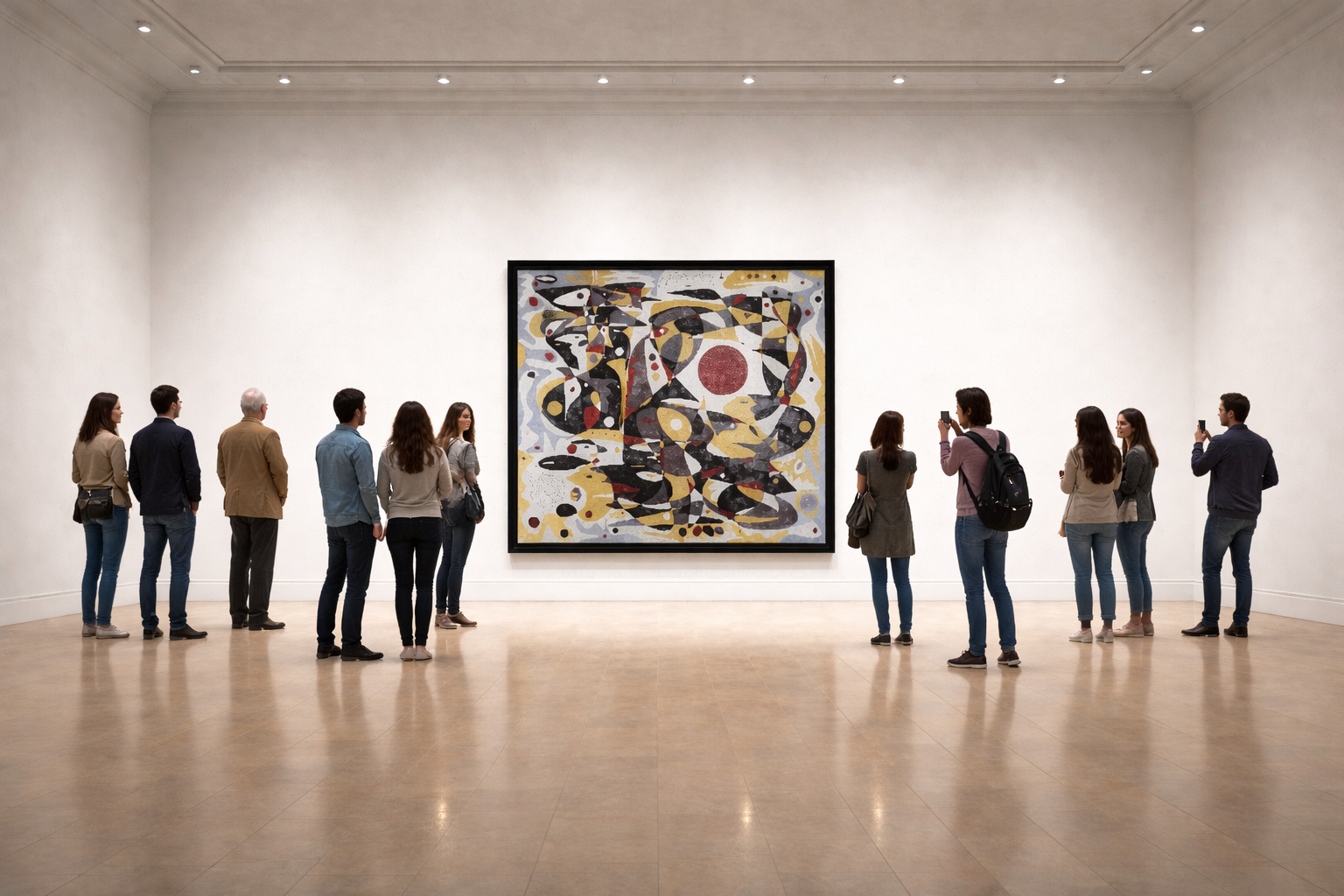
The Architecture of Conflict
El Arte Monumental | Catalogue: The Architecture of Conflict
Catalogue Entry: Hawai Sakusen (2004) | Art Curator: Daniel Varzari
Gheorghe Virtosu’s Hawai Sakusen (2004) proposes a radical rethinking of how history can be visualized, shifting the focus from representation to structure. Engaging with the Attack on Pearl Harbor, the work does not attempt to reconstruct events, but instead translates their underlying logic into a field of abstract relations. Through a carefully orchestrated interplay of geometric precision and biomorphic instability, Virtosu constructs a visual system in which coordination, timing, and transformation become the primary agents of meaning.1
What distinguishes this painting is its refusal of singular perspective or centralized authority. Figures emerge only provisionally, activated through the viewer’s perception and anchored by dispersed eye-like motifs that both stabilize and destabilize recognition. In this way, the work displaces the traditional heroic subject, replacing it with a network of contingent roles and shifting positions. The viewer is not positioned as an external observer but becomes implicated in the act of constructing coherence within a system that resists fixed interpretation.2
Presented within this exhibition, Hawai Sakusen operates as both a meditation on historical process and a broader reflection on the conditions of perception itself. By compressing phases of planning, execution, and aftermath into a single, simultaneous field, Virtosu invites us to reconsider history not as a linear narrative, but as a complex and interdependent system. The painting ultimately challenges us to navigate this system actively, revealing that meaning—like history—is never given, but continuously produced through engagement.3
Hawai Sakusen (2002–2004) by Gheorghe Virtosu presents a monumental abstract composition that reinterprets the Attack on Pearl Harbor as a system of coordinated forces rather than a representational scene. Set against a predominantly light ground, the painting unfolds as an expansive field of interlocking geometric and biomorphic forms, where sharp angular structures intersect with fluid, organic shapes. These elements generate a dynamic visual rhythm that suggests movement, alignment, and controlled tension, translating the logic of military planning and execution into an abstract pictorial language.1
Throughout the composition, eye-like motifs and fragmented silhouettes emerge and dissolve, offering fleeting moments of figuration that remain contingent upon the viewer’s perception. These forms do not stabilize into fixed identities but instead function as shifting points of recognition within a broader network of relations. A prominent red circular form on the right side of the canvas anchors the composition, acting as a focal point toward which surrounding elements appear to orient. Chromatic contrasts between saturated reds, yellows, blacks, and softer neutral tones intensify the sense of spatial interaction, guiding the viewer’s movement across the surface.2
The painting is structured across multiple registers that suggest a progression from coordination to execution and eventual dissipation. Linear and symbolic elements in the upper zone evoke systems of communication and timing, while the central field concentrates energy through dense interactions of form. Toward the lower register, shapes elongate and lose definition, indicating a transition into dispersion and residual motion. Through this layered organization, Hawai Sakusen invites viewers to engage with history as a complex, dynamic system in which meaning emerges through interaction rather than fixed representation.3
In Hawai Sakusen (2002–2004), Gheorghe Virtosu articulates a conceptual framework in which history is no longer approached as narrative reconstruction but as a system of interdependent forces. Engaging with the Attack on Pearl Harbor, the painting translates a historically specific event into an abstract field governed by coordination, timing, and structural interaction. Rather than depicting identifiable actors or sequences, the composition encodes relationships—between movement and stasis, control and contingency—allowing meaning to emerge through the viewer’s navigation of the pictorial system.1
Central to the work is the notion of abstraction as a method of epistemological inquiry. By removing descriptive detail, Virtosu foregrounds the underlying logic of the event, emphasizing how systems operate rather than how they appear. This aligns with broader theoretical approaches to history that privilege structure over anecdote, suggesting that events are best understood through the dynamics that produce them rather than through their surface manifestations.2 The painting thus functions not as representation, but as a model of historical intelligibility.
The interplay between geometric precision and biomorphic fluidity establishes a tension between order and adaptability. Angular forms introduce directional force and intentionality, while organic shapes imply responsiveness and transformation. Their continuous interaction generates a field in which no element remains fixed, reflecting the adaptive nature of coordinated action. This duality reinforces the idea that structured systems depend on both rigidity and flexibility to operate effectively.
Figuration emerges as a contingent phenomenon within this system. Eye-like motifs act as perceptual anchors, enabling the temporary formation of silhouettes that suggest human presence. However, these figures are never fully stabilized; they dissolve as quickly as they appear, indicating that identity within the work is not intrinsic but relational. This strategy displaces the primacy of the individual subject, proposing instead a distributed model of agency in which roles are defined by position and function rather than by fixed identity.3
The painting’s spatial organization may be interpreted as a compression of temporal phases, in which planning, execution, and aftermath coexist within a single visual field. Upper registers suggest abstract systems of communication and coordination, while central zones articulate convergence and action. Areas of increased stability correspond to moments of focused intent, whereas more diffuse regions indicate transition and dissipation. Through this structure, time is not depicted sequentially but experienced as a simultaneous and interwoven condition.
Chromatic relationships further intensify the conceptual framework. The contrast between luminous ground and saturated forms produces zones of visual emphasis and interruption, guiding perception while resisting closure. The prominent circular form operates as a point of convergence, introducing a rare moment of stability within an otherwise fluid system. Its presence underscores the tension between fixed objectives and the shifting conditions required to achieve them.
Ultimately, Hawai Sakusen advances a conception of history as a dynamic and relational construct. By embedding meaning within processes of emergence, interaction, and dissolution, Virtosu challenges the conventions of historical representation and invites a reconsideration of how events are understood. The work proposes that history is not a static record but an active system—one that must be continuously interpreted, navigated, and reconstructed through perception.1
Gheorghe Virtosu | Artist Biography
Gheorghe Virtosu is a contemporary painter whose work examines abstraction as a system for articulating complex structures of thought, perception, and historical consciousness. Working primarily at large scale, he constructs compositions that merge geometric order, fragmented figuration, and biomorphic disruption, producing unstable visual fields in which meaning emerges through tension rather than direct representation.
Rather than depicting identifiable narratives, Virtosu engages with the underlying frameworks through which history, belief, and ideology are formed and sustained. His paintings function as non-linear systems, where fragmentation, inversion, and recomposition replace conventional pictorial logic. Within this approach, abstraction becomes a critical method for examining how cultural and symbolic structures are constructed, destabilized, and continuously reconfigured.
The series 6 Wars extends this investigation into the domain of historical conflict, approaching war not as subject matter but as a recurring structural condition. Drawing on references from antiquity to the present, the works resist illustrative depiction, instead translating conflict into fields of visual pressure, rupture, and imbalance. Each painting operates as a self-contained system in which historical reference is absorbed into abstraction, creating a sustained tension between naming and erasure.
In this body of work, Virtosu moves further away from symbolic narrative toward an examination of war as a persistent logic embedded within perception itself. The compositions do not resolve into stable images of events, but instead foreground the instability of representation when confronted with violence, memory, and historical recurrence.
Technically grounded in layered oil painting processes, Virtosu builds surfaces through accumulation, interruption, and reconfiguration. Forms emerge and dissolve across multiple strata, generating compositions in which order and disintegration coexist. This method reflects his broader concern with instability as a generative condition—one in which meaning is never fixed, but continuously produced through the tension between structure and collapse.
Executed in oil on canvas at a monumental scale (3.23 × 4.05 meters), Hawai Sakusen establishes an expansive horizontal field designed to support lateral visual navigation and sustained bodily engagement. The painting’s surface is built through layered applications of pigment that preserve both clarity and instability, allowing forms to remain distinct while continuously interacting across shallow spatial registers. This structural openness aligns with historical accounts of the operation’s coordinated precision, where distributed units functioned through synchronized timing rather than centralized visibility.1
The compositional system is defined by the interaction between sharply articulated geometric structures and fluid biomorphic formations. These elements are arranged without reliance on classical perspectival hierarchy, instead producing depth through overlap, interruption, and relational tension. Eye-like motifs embedded throughout the surface act as perceptual anchors, temporarily stabilizing surrounding forms into recognizable configurations before releasing them back into ambiguity. This oscillation between coherence and dissolution is central to the painting’s technical construction and reinforces its logic of contingent perception.2
Chromatically, the work employs a controlled contrast between luminous ground fields and saturated inflections of red, black, and gold. These tonal modulations function not as descriptive coloration but as structural agents that guide visual flow and establish zones of intensity and pause. The large circular red form operates as a compositional fulcrum, concentrating visual energy while resisting full integration into surrounding systems. Across the surface, these chromatic dynamics articulate a technical equivalence between spatial organization and operational coordination, reinforcing the painting’s conceptual engagement with structured action and temporal sequencing.3
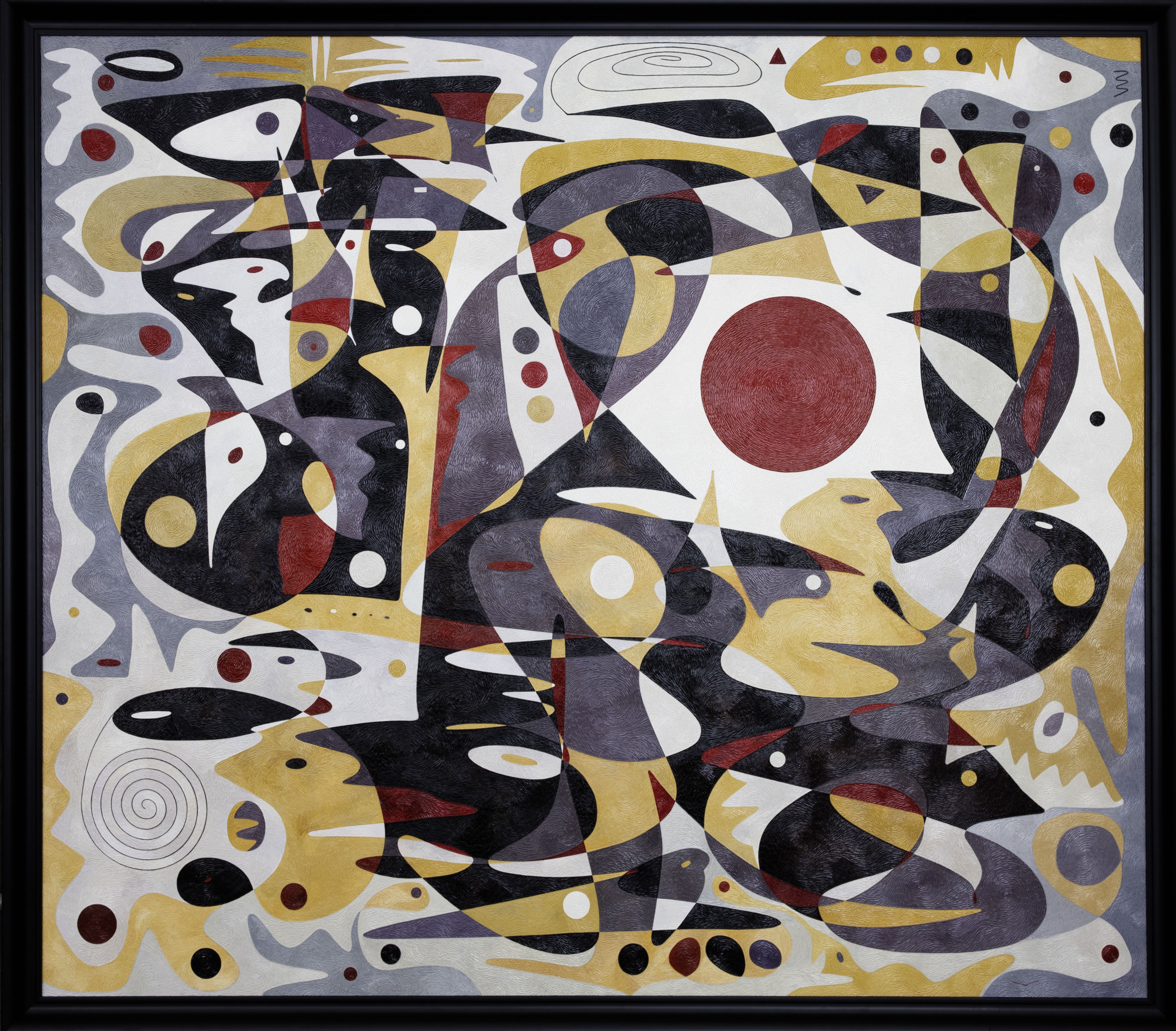
Artist: Gheorghe Virtosu
Medium: Oil and acrylic on linen canvas
Dimensions: 3.4 × 3.5 m
In Hawai Sakusen (2004), visual composition is organized as a distributed field of forces rather than a stable pictorial structure. The canvas establishes a tension between openness and directed movement, where geometric trajectories and biomorphic interruptions continuously reconfigure spatial reading. Instead of foregrounding a singular focal hierarchy, the composition disperses attention across interdependent zones, recalling the logic of coordinated systems described in accounts of the :contentReference[oaicite:0]{index=0}.1
Central to the compositional structure is the use of anchoring motifs—particularly eye-like forms—that intermittently stabilize surrounding abstraction into provisional silhouettes. These perceptual nodes generate momentary figuration, allowing forms to be read as human presences before dissolving back into abstraction. This oscillation between recognition and collapse produces a dynamic viewing condition in which identity is not depicted but continually constructed through relational positioning within the pictorial field.2
Chromatic organization further intensifies this structural logic. Contrasts between luminous ground planes and saturated tonal interventions create zones of acceleration and resistance, guiding the viewer’s movement across the surface. The large circular red form operates as a stabilizing counterpoint within this flux, functioning as both visual anchor and conceptual point of convergence. Across the composition, spatial, chromatic, and figural systems converge to construct a unified yet non-hierarchical structure of visual interaction.3
In Hawai Sakusen (2002–2004), color operates as a structuring agent that organizes perception without stabilizing it into hierarchy. The light ground establishes a field of visual openness, against which saturated reds, deep blacks, and muted yellows assert intermittent zones of intensity. Rather than functioning descriptively, color behaves relationally: it produces tension, directs movement, and interrupts continuity, generating a system in which chromatic contrast becomes the primary vehicle of spatial logic.1
Form emerges through controlled interaction between geometric precision and biomorphic instability. Angular structures establish directional force, while curved, organic shapes introduce deviation and permeability. These elements do not resolve into stable figures but instead operate as overlapping vectors of perception, producing temporary coherences that dissolve as the eye shifts. The recurring eye-like motifs act as catalytic points of recognition, allowing fragmented forms to coalesce into provisional silhouettes before dispersing again into abstraction.2
The relationship between color and form ultimately produces a dynamic system rather than a fixed composition. Chromatic intensity anchors zones of activity, while formal ambiguity prevents closure, ensuring that perception remains in continuous negotiation. In this sense, the painting constructs meaning not through depiction but through sustained interaction between visual forces, where color activates form and form, in turn, destabilizes color. The result is a field in which visual understanding is always partial, contingent, and in motion.3
In Hawai Sakusen (2002–2004), symbolism operates as a system of relational cues rather than fixed iconography, translating the :contentReference[oaicite:0]{index=0} into a field of abstract visual logic. Rather than depicting identifiable figures or environments, the painting constructs meaning through recurring structural motifs—circles, diagonals, and biomorphic traces—that function as carriers of strategic and perceptual information. These elements do not illustrate events but encode conditions of coordination, timing, and directional force.1
Imagery in the work is deliberately unstable, emerging through the viewer’s perceptual engagement rather than through fixed representation. Eye-like forms act as catalytic points of recognition, allowing fragmented shapes to momentarily cohere into silhouettes or suggestive figures. These figures, however, remain provisional, dissolving as attention shifts and reconfiguring elsewhere within the pictorial field. This instability transforms imagery into a dynamic process rather than a descriptive outcome, where perception actively constructs and deconstructs meaning.2
Across the composition, symbolic and imagistic systems converge to articulate a distributed model of historical experience. The red circular form operates as a focal anchor, while linear and curved elements suggest trajectories of movement and decision. Together, these components generate a layered structure in which symbolism is inseparable from spatial organization. The painting ultimately proposes that imagery is not a surface of representation, but a field in which historical and perceptual forces continuously interact.3
In Hawai Sakusen, Virtosu constructs history not as a sequence of events but as a distributed system of relations in which agency is dispersed across overlapping visual structures. The reference to the Attack on Pearl Harbor operates less as subject matter than as an epistemic framework: a historical moment translated into a logic of coordination, rupture, and systemic alignment.1 Within this configuration, meaning emerges not from narrative clarity but from the interaction between spatial forces, where geometric precision and biomorphic instability continuously renegotiate perceptual order.
The painting’s conceptual structure resists the classical hierarchy of history painting by eliminating a singular vantage point and replacing it with a field of competing perceptual anchors. Eye-like motifs function as unstable nodes of recognition, temporarily organizing surrounding forms into coherent figures before dissolving them again. This oscillation between legibility and fragmentation produces a condition in which identity is not represented but constructed in real time by the act of viewing itself, aligning perception with the logic of distributed systems rather than fixed subjectivity.2
Ultimately, the work proposes a model of history as simultaneity rather than sequence, compressing planning, execution, and aftermath into a single perceptual environment. Temporal order is replaced by spatial coexistence, where strategic intent, action, and consequence are experienced as overlapping intensities rather than discrete stages. In this sense, Hawai Sakusen operates as a conceptual diagram of historical cognition itself, revealing history not as a record of what happened, but as a field in which meaning is continuously produced, reorganized, and destabilized through interpretation.3
Hawai Sakusen (2004) operates within an emotional register of controlled intensity, where affect is not expressed through narrative drama but through structural tension. The composition generates a persistent sense of anticipation, as if the image is held in a state of suspended coordination. This affective condition corresponds to the logic of the :contentReference[oaicite:0]{index=0}, in which precision and timing compress emotional experience into moments of irreversible consequence.1
Rather than presenting emotion as individualized expression, the painting disperses it across systems of relation. The emergence of partial silhouettes and eye-like forms produces fleeting instances of recognition, yet these are immediately destabilized by shifting alignments of shape and color. Emotional response is therefore routed through perception itself, where the act of seeing becomes inseparable from uncertainty and recalibration.2
At its most sustained level, the work holds the viewer in a condition of heightened attentiveness rather than resolution. Chromatic contrasts and spatial tensions create a rhythm of attraction and withdrawal, preventing emotional closure while sustaining engagement. In this sense, the painting frames history not as resolved affect but as an ongoing field of pressure, where meaning and feeling are continuously produced through interaction.3
- Gordon W. Prange, At Dawn We Slept: The Untold Story of Pearl Harbor. Penguin Books, 1981.
- Jonathan Parshall and Anthony Tully, Shattered Sword. Potomac Books, 2005.
- Marc Bloch, The Historian’s Craft. Vintage Books, 1953.
Selected Bibliography
- Prange, Gordon W. At Dawn We Slept: The Untold Story of Pearl Harbor. Penguin Books, 1981.
- Parshall, Jonathan, and Anthony Tully. Shattered Sword. Potomac Books, 2005.
- Bloch, Marc. The Historian’s Craft. Vintage Books, 1953.
- Krauss, Rosalind. The Originality of the Avant-Garde and Other Modernist Myths. MIT Press.
- Deleuze, Gilles. Difference and Repetition. Columbia University Press.
Curatorial Team: Daniel Varzari
Photography: El Arte Monumental
Special Thanks: Daniel Varzari, Gheorghe Virtosu
El Arte Monumental
08007 Barcelona
Phone: +34 934 439 470/ +01 312 358 8023