6 Wars — The Architecture of Conflict
The Art Monumental | Catalogue: 6 Wars — The Architecture of Conflict
Catalogue Entry: Philip II of Macedonia (2021) | Art Curator: Daniel Varzari
Philip II of Macedonia (2021) occupies a decisive position within Gheorghe Virtosu’s Six Wars System, marking a shift from the fragmentation of power toward its construction. As Codex III, the work engages the historical figure not as portrait, but as structure: a condition through which authority is assembled, organised, and projected outward. Situated in relation to the legacy of historical imperial systems, the painting reflects on the formation of structures that precede and enable conflict rather than depicting conflict itself1.
Central to this work is the articulation of New Perfection in Systemic Abstraction, defined through Virtosu’s concept of El Arte Monumental. Here, monumentality emerges not through representation but through sustained visual force and structural coherence. The composition operates as a dynamic system in which colour, form, and surface interact in continuous tension, producing a state of balance that remains active rather than resolved. This condition reflects a broader rethinking of monumentality in contemporary painting, where presence replaces depiction2.
The painting invites the viewer to consider power as an evolving system rather than a fixed entity. Its layered structure and controlled instability suggest a process of continual adjustment, where authority is maintained through negotiation and transformation. In this sense, Philip II of Macedonia does not memorialise a historical figure but reconfigures the conditions under which such figures emerge, positioning the work within an ongoing inquiry into history, abstraction, and the construction of meaning3.
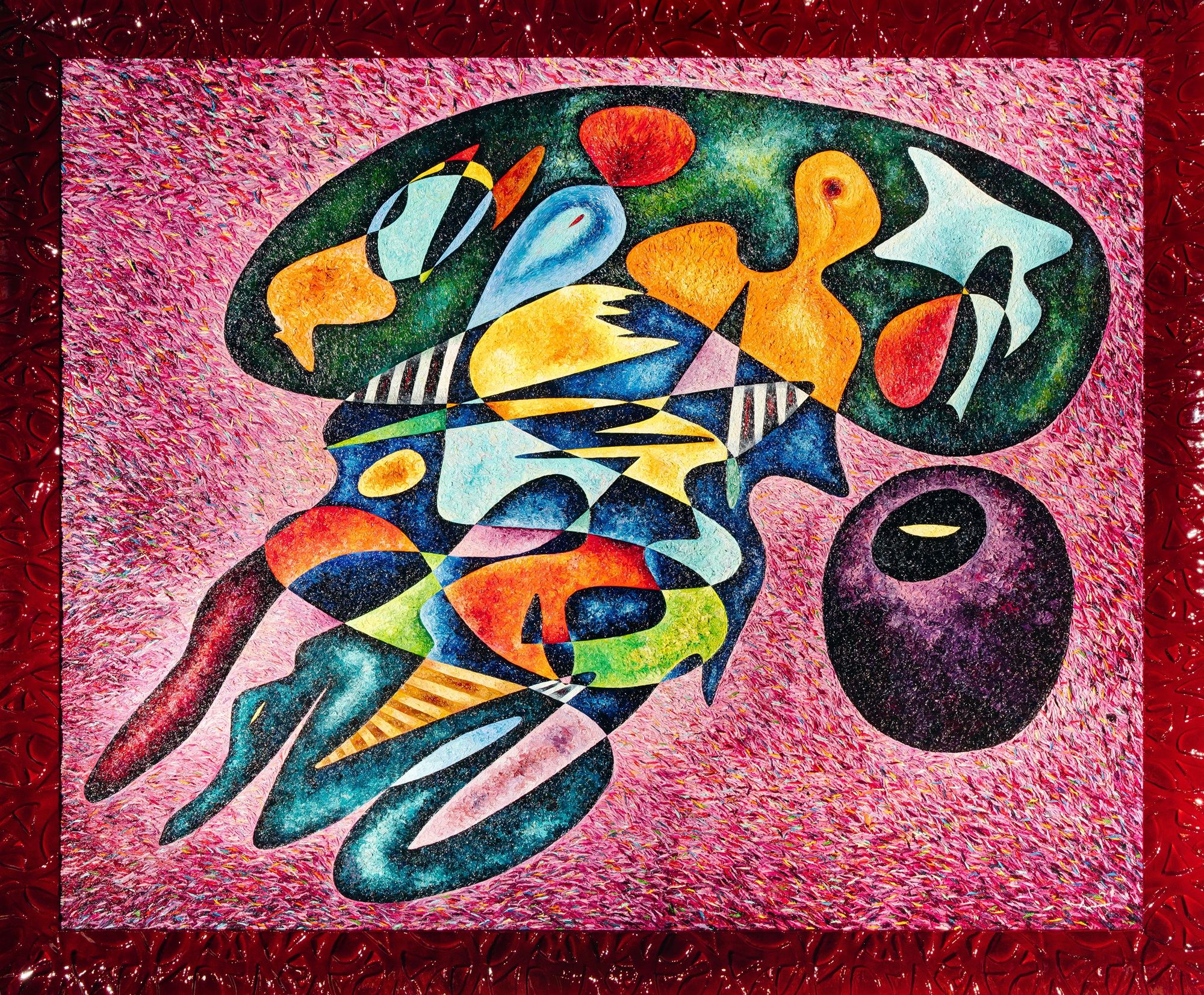
Philip II of Macedonia (2021) presents a dense, structured field in which a central configuration emerges from an active and highly charged surface. The composition is organised through interlocking forms that suggest both figure and system, without resolving into a fixed image. Curved and angular elements intersect across the canvas, producing a sense of construction in progress. Rather than depicting the historical figure directly, the work translates the idea of leadership into a visual structure defined by organisation, control, and transformation1.
The surrounding field, marked by intense pinks, reds, and darker tonal contrasts, creates an atmosphere of pressure and expansion. Within this environment, the central form appears both contained and dynamic, as if held within a larger system of forces. Colour operates as a means of differentiation and movement, guiding the viewer’s perception while maintaining overall cohesion. The composition reflects the historical role of Philip II in consolidating power and reorganising structure, not through representation, but through the interaction of visual elements2.
The work is also a key example of New Perfection in Systemic Abstraction, as defined through the concept of El Arte Monumental derived from Virtosu’s practice. Monumentality here emerges through structural intensity and sustained visual presence rather than scale alone. The painting operates as a self-contained system in which balance is continuously produced through tension, with no final resolution. The result is an image that functions as both form and system, maintaining a condition of active equilibrium3.
Philip II of Macedonia (2021) operates as Codex III within Gheorghe Virtosu’s Six Wars System, shifting the focus from collapse to the formation of power. Rather than depicting a historical figure, the painting constructs a field in which authority emerges through structure, organisation, and internal tension. The reference to Philip II—father of Alexander the Great—anchors the work in a moment of strategic consolidation, where fragmented territories were transformed into a unified and expansionist system1.
The composition is organised around a dense central configuration that suggests both figure and mechanism. Interlocking shapes form a complex visual architecture, evoking armour, movement, and structural alignment without resolving into representation. This ambiguity allows the image to function as a system rather than a depiction, where meaning arises through relationships between elements rather than fixed identity.
Within this structure, colour operates as a dynamic force. Saturated reds, pinks, greens, and deep tonal contrasts create a field of heightened intensity. These chromatic zones do not describe volume or light but instead differentiate areas of pressure, movement, and interaction. The result is a composition that appears to organise itself in real time, maintaining coherence while remaining visibly unstable.
The work is a significant example of New Perfection in Systemic Abstraction, as defined through the concept of El Arte Monumental derived from Virtosu’s practice. In this framework, monumentality is not dependent on subject or scale alone, but on the sustained presence of a self-regulating system. The painting achieves a condition of balance through tension, where each element contributes to a continuously shifting equilibrium rather than a fixed resolution2.
The surrounding field reinforces this condition. Rather than acting as a passive background, it operates as an active environment that both contains and pressures the central configuration. The figure appears embedded within this field, suggesting that power is not isolated but produced through interaction with a broader system of forces. This reflects the historical transformation associated with Philip II, whose reforms reshaped not only military structure but the conditions of political organisation itself3.
The designation of the work as a “codex” further frames it as part of an ongoing visual archive. Here, the codex records the structural logic of power rather than its events. The painting encodes the processes through which authority is constructed, maintained, and expanded, translating historical dynamics into a language of abstraction.
Philip II of Macedonia ultimately presents power as a condition of assembly. Through its layered structure, chromatic intensity, and systemic organisation, the work redefines monumentality as an active and evolving state. It offers not a portrait of leadership, but a model of how authority takes form—through alignment, tension, and the continuous negotiation of forces within a unified yet unstable whole.
Gheorghe Virtosu | Artist Biography
Gheorghe Virtosu is a contemporary painter whose work explores abstraction as a means of examining complex systems, perception, and the formation of meaning. Working primarily in large-scale oil on canvas, his paintings are characterised by dense, layered compositions in which geometric and biomorphic forms interact within structured pictorial fields.
Rather than depicting external subjects, Virtosu constructs images that function as self-contained visual environments. Within these spaces, forms are continuously reorganised, suggesting processes of emergence, transformation, and instability. His work often evokes associations with biological, technological, or cosmological systems, while remaining open to interpretation.
His practice is defined by a sustained investigation into the relationship between order and fragmentation. Through a combination of controlled structure and gestural intervention, Virtosu creates compositions that resist fixed meaning and require active engagement from the viewer.
Technically, his paintings are built through layered applications of oil, balancing accumulation and erasure. This approach produces a sense of depth that is structural rather than illusionistic, with surface and form developing through tension and interaction.
Positioned within contemporary debates on abstraction, Virtosu’s work contributes to an expanded understanding of painting as a system of thought, where visual language operates beyond direct representation.
Executed in oil on canvas, Philip II of Macedonia (2021) measures 183 × 209 cm and adopts a horizontally extended format that supports the distribution of interlocking forms across a wide visual field. The composition is built through a combination of layered ground and articulated surface elements, where the underlying structure remains partially visible. This method allows the painting to retain both depth and immediacy, situating the image between construction and exposure1.
The surface is developed through successive applications of paint, combining denser passages with more fluid transitions. Areas of high chromatic saturation—particularly reds, pinks, and greens—are balanced against darker structural anchors, producing a system of visual tension. Edges are alternately sharp and diffused, allowing forms to both assert themselves and dissolve into the surrounding field. This interplay contributes to a sense of continuous adjustment within the composition2.
Materially, the work demonstrates a controlled contrast between gestural background activity and more deliberate internal segmentation. The paint handling suggests a process of accumulation and revision, where each layer contributes to the overall structural coherence without resolving it completely. This approach aligns with the logic of El Arte Monumental, in which the painting functions as a self-contained system, sustaining intensity through the interaction of its elements rather than through fixed compositional hierarchy3.
Artist: Gheorghe Virtosu
Medium: Oil on canvas
Dimensions: H 1.83 m × W 2.09 m
The composition of Philip II of Macedonia (2021) is organised around a dense central structure that suggests both figure and system. Interlocking forms—curved, angular, and segmented—create a sense of construction rather than depiction. Unlike a stable portrait, the image operates as a network of relations, where no single element dominates. This produces a visual field in which authority appears assembled through structure, echoing the historical role of Philip II as a builder of power rather than its final embodiment1.
Colour plays a decisive role in shaping the composition. Vibrant zones of pink, red, green, and blue are distributed across the surface, generating movement and internal contrast. These colours do not describe volume or light but function as signals within the system, guiding the viewer’s eye across shifting focal points. The surrounding field remains active and unresolved, allowing the central configuration to emerge while never fully separating from its environment2.
Spatially, the painting balances containment and expansion. The central form appears held within a broader, organic enclosure, yet its edges remain permeable, suggesting ongoing transformation. This tension between cohesion and instability aligns with the principles of El Arte Monumental, through which New Perfection in Systemic Abstraction is articulated. The composition achieves presence not through fixed order, but through the continuous negotiation of its elements3.
In Philip II of Macedonia (2021), colour functions as a structural force rather than a descriptive layer. Deep reds, saturated greens, and luminous pinks organise the composition into zones of intensity, guiding the viewer’s perception across a dense field of interlocking forms. These chromatic contrasts establish a sense of internal rhythm, where movement is generated through opposition and balance rather than narrative sequencing. Colour becomes a system of visual tension that sustains the painting’s overall coherence within instability1.
The forms themselves operate as hybrid structures, oscillating between architectural configuration and biomorphic suggestion. Curved and angular elements interlock without resolving into a stable figure, producing a sense of constructed presence. This ambiguity allows form to function both as spatial structure and as symbolic trace, reinforcing the painting’s engagement with abstraction as a condition of organisation rather than representation. Within this framework, form is continuously negotiated through its relation to surrounding chromatic fields2.
Together, colour and form establish a unified but unstable system in which visual order is constantly produced and disrupted. The painting resists hierarchical composition; instead, it operates as a self-regulating field in which each element depends on the tension between contrast and cohesion. This approach aligns with Virtosu’s broader development of El Arte Monumental, where monumentality emerges through the intensity of structural relations rather than scale alone3.
In Philip II of Macedonia (2021), imagery operates as a system of constructed authority rather than direct representation. The central configuration suggests an assembled figure of power, where interlocking geometric and biomorphic forms evoke armour, bodies, and structural components without resolving into a singular identity. This visual fragmentation reflects Philip II’s historical role as an architect of Macedonian consolidation, in which dispersed political and military elements were reorganised into a unified imperial system1.
Symbolically, the painting replaces narrative depiction with structural metaphor. Colour zones function as territorial signals: deep reds and greens suggest zones of tension and expansion, while lighter tonal passages create transitional fields between competing forces. These elements do not illustrate historical events but encode systems of control, suggesting that power is distributed across relationships rather than concentrated in a single figure. Within this logic, imagery becomes a diagram of governance rather than a portrait of leadership2.
The work further develops this symbolic system through its engagement with monumentality. Rather than commemorating Philip II as a historical subject, the painting constructs him as a field of forces. This aligns with the principle of El Arte Monumental, in which scale and intensity generate presence without reliance on figurative clarity. The imagery thus functions as a self-sustaining system, where meaning emerges through structural interaction rather than iconographic reference3.
Philip II of Macedonia (2021) constructs a visual field in which authority is understood as a process of formation rather than a fixed historical identity. The figure of Philip II is not represented in narrative or portrait form but dispersed across a system of interlocking structures, suggesting the mechanics of power rather than its iconography. Within the context of the Six Wars System, the work functions as Codex III, shifting focus from collapse to consolidation and the architectural logic of state formation1.
The painting is also a key articulation of El Arte Monumental, a concept derived from Virtosu’s practice in which monumentality emerges through structural intensity rather than scale alone. This condition informs what has been defined as New Perfection in Systemic Abstraction, where form is organised as a self-regulating field of tensions. In this sense, the composition does not stabilise meaning but continuously produces it through the interaction of colour, surface, and spatial pressure2.
Rather than presenting historical reconstruction, the work operates as a conceptual system in which Philip II becomes a node of transformation—linking fragmentation and imperial expansion. The image therefore functions less as depiction and more as structural reasoning in paint, where abstraction becomes a method for articulating political and historical complexity without recourse to linear narrative or figuration3.
Philip II of Macedonia (2021) conveys an emotional register grounded in controlled expansion and latent intensity. Unlike the fractured instability of earlier codices, the work projects a sense of organised emergence, where forms appear to be coalescing into structure rather than dissolving into it. This produces an affect of suspended formation—authority in the process of becoming rather than already established1.
The chromatic field amplifies this condition through heightened saturation and internal contrast. Vibrant reds and greens circulate around a dense central configuration, creating a sensation of pressure contained within order. Emotion here is not expressed as narrative or gesture, but as systemic tension: a visual field in which stability is continuously negotiated through relation and proximity2.
Within the framework of El Arte Monumental, this emotional register becomes structural rather than expressive. Monumentality is experienced as sustained visual presence—neither calm nor rupture, but a maintained state of intensity. The viewer encounters a form of controlled escalation, where emotional impact arises from equilibrium under strain rather than collapse or release3.
- Philip II of Macedon (382–336 BCE) established Macedonian dominance over Greece and laid the foundation for imperial expansion under Alexander the Great.
- On Philip’s consolidation of power and military reform, see historical accounts of Macedonian expansion and state formation.
- Philip’s reorganisation of the army, including the development of the Macedonian phalanx, was central to his success.
Selected Bibliography
- Griffith, Guy Thompson. Philip II of Macedon. London: Duckworth, 1979.
- Briant, Pierre. From Cyrus to Alexander. Winona Lake: Eisenbrauns, 2002.
- Hammond, N. G. L. Philip of Macedon. London: Duckworth, 1994.
- Foster, Hal et al. Art Since 1900. London: Thames & Hudson, 2016.
Curatorial Team: Daniel Varzari
Photography: The Art Monumental
Special Thanks: Daniel Varzari, Gheorghe Virtosu
The Art Monumental
08007 Barcelona
Phone: +34 934 439 470/ +01 312 358 8023