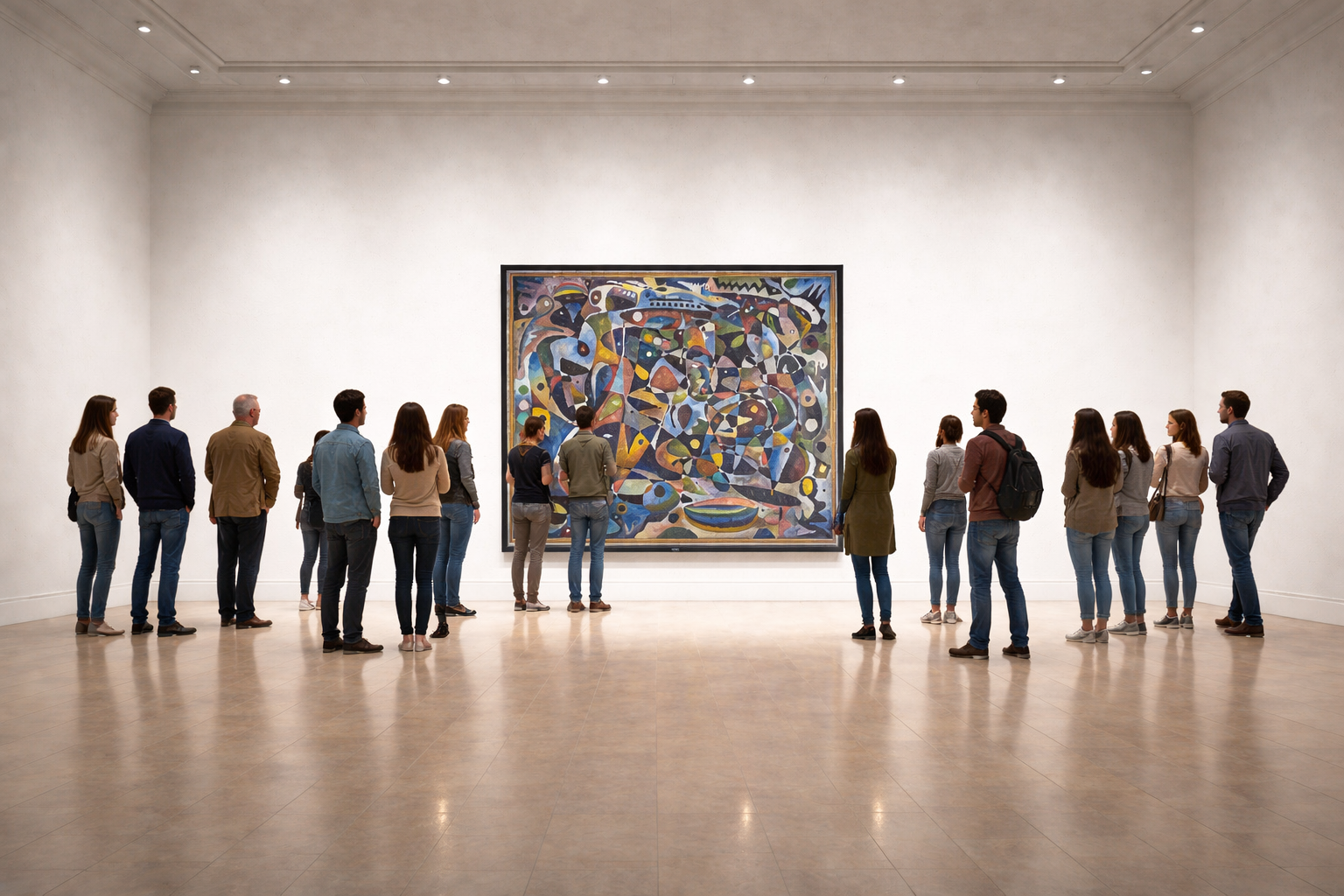
The Architecture of Conflict
El Arte Monumental | Catalogue: The Architecture of Conflict
Catalogue Entry: Ukraine War (2025) | Art Curator: Daniel Varzari
Gheorghe Virtosu’s Ukraine War (2022–2025) proposes a rigorous rethinking of how contemporary conflict may be visualized, shifting the emphasis from representation to systemic structure. Engaging with the ongoing Russian invasion of Ukraine, the painting does not reconstruct events or depict identifiable actors, but instead translates the conditions of instability, incursion, and resistance into a dense abstract field. Through the interplay of geometric scaffolding and biomorphic disruption, Virtosu constructs a visual system in which tension, fragmentation, and transformation operate as primary agents of meaning.1
What distinguishes this work is its insistence on distributed perception. The composition resists singular perspective or compositional hierarchy, compelling the viewer to navigate a surface in which forms intersect, dissolve, and reconfigure continuously. Figural traces—eyes, profiles, and bodily fragments—emerge only provisionally, embedded within a larger network of relations that both sustains and destabilizes them. In this way, the painting displaces the authority of the individual subject, replacing it with a condition in which meaning is contingent, relational, and actively constructed through engagement.2
Presented within this exhibition, Ukraine War operates as both a meditation on the structures of modern warfare and a broader reflection on perception under conditions of ongoing crisis. By compressing phases of anticipation, conflict, and aftermath into a single, simultaneous field, Virtosu redefines history as a non-linear and interdependent system. The work ultimately invites sustained attention, revealing that understanding—like history itself—is not fixed or given, but continuously negotiated within a dynamic field of forces.3
Ukraine War (2022–2025) presents a monumental abstract composition in which interlocking geometric structures and fluid biomorphic forms create a dense, dynamic visual field. The painting is organized through a subtle grid-like framework that suggests order and segmentation, yet this structure is continuously disrupted by angular intrusions, curvilinear movements, and layered forms that intersect across the surface. The result is a complex spatial environment where balance and instability coexist, reflecting a condition of constant tension and transformation.
Color plays a central role in shaping the visual experience. A palette of blues and yellows, interwoven with darker tones and punctuated by saturated reds, establishes zones of intensity and contrast. These chromatic relationships guide the viewer’s movement across the composition while simultaneously fragmenting it, creating moments of clarity that are quickly unsettled by adjacent disruptions. The surface appears active and continuously shifting, with no fixed focal point, encouraging sustained visual engagement.
Throughout the painting, fragmented suggestions of faces, eyes, and bodily forms emerge and dissolve within the surrounding structure. These elements introduce a human dimension without resolving into stable figures, reinforcing the sense of a system in flux rather than a narrative scene. The composition as a whole operates as a symbolic landscape of movement, disruption, and persistence, inviting the viewer to experience the work as an immersive field of interacting forces rather than a depiction of specific events.
Ukraine War (2022–2025) advances a conception of conflict not as an isolated event but as a continuous structural condition embedded within geopolitical, perceptual, and symbolic systems. The painting translates the ongoing dynamics of the Russian invasion of Ukraine into an abstract field in which instability, pressure, and transformation are not represented but enacted. Rather than offering an image of war, it constructs a visual environment in which conflict is experienced as a network of interdependent forces operating simultaneously across multiple registers.
Central to this work is the tension between order and disruption. The underlying grid-like organization suggests frameworks of control—territorial, political, and ideological—while the persistent fragmentation of this structure reveals their vulnerability. Lines that imply borders or divisions are repeatedly traversed, broken, or reconfigured, indicating that systems designed to stabilize reality are themselves subject to continuous destabilization. In this sense, the painting reflects a world in which structure persists, but only under conditions of strain.
The dispersed presence of figural elements introduces a critical dimension of human experience. Eyes, profiles, and partial forms emerge from within the abstract field, not as autonomous subjects but as embedded participants within a larger system. These figures do not command attention through clarity or scale; instead, they require active perceptual engagement to be recognized. Their instability reflects the condition of individuals within conflict—visible yet fragmented, present yet continually redefined by external forces.
Color operates as a symbolic and structural agent, mediating between identity and abstraction. The recurrence of blue and yellow suggests national specificity, yet these colors are not isolated or fixed; they are absorbed into the broader chromatic system, where they interact with contrasting tones of red, black, and neutral fields. This integration resists reductive symbolism, proposing instead that identity itself is dynamic, negotiated within conditions of tension and transformation.
Temporality within the painting is non-linear and condensed. Phases commonly understood as sequential—anticipation, conflict, and aftermath—are compressed into a single, simultaneous field. This collapse of temporal order challenges conventional historical narratives, suggesting that the experience of war cannot be fully contained within linear progression. Instead, time is presented as layered and recursive, with past, present, and potential futures coexisting within the same perceptual space.
The viewer’s role is integral to the realization of the work’s meaning. Without a fixed focal point or stable hierarchy, perception becomes an active process of navigation and interpretation. The eye is drawn across the surface, forming provisional connections that are continually disrupted and reconfigured. In this way, the painting implicates the viewer within its system, transforming observation into participation and reinforcing the idea that meaning is not given but constructed.
Ultimately, Ukraine War proposes that contemporary conflict must be understood as a condition that extends beyond physical confrontation into the realms of perception, structure, and cognition. By dissolving representation into a field of relational forces, the work articulates war as a persistent and evolving system—one that resists closure and demands ongoing engagement. The painting thus operates not only as a reflection on a specific geopolitical event, but as a broader inquiry into the nature of instability and the limits of representation itself.
Gheorghe Virtosu | Artist Biography
Gheorghe Virtosu is a contemporary painter whose work examines abstraction as a system for articulating complex structures of thought, perception, and historical consciousness. Working primarily at large scale, he constructs compositions that merge geometric order, fragmented figuration, and biomorphic disruption, producing unstable visual fields in which meaning emerges through tension rather than direct representation.
Rather than depicting identifiable narratives, Virtosu engages with the underlying frameworks through which history, belief, and ideology are formed and sustained. His paintings function as non-linear systems in which fragmentation, inversion, and recomposition replace conventional pictorial logic. Within this approach, abstraction becomes a critical method for examining how cultural and symbolic structures are constructed, destabilized, and continuously reconfigured.
The series 6 Wars extends this investigation into the domain of historical conflict, approaching war not as subject matter but as a recurring structural condition. Drawing on references from antiquity to the present, the works resist illustrative depiction, instead translating conflict into fields of visual pressure, rupture, and imbalance. Each painting operates as a self-contained system in which historical reference is absorbed into abstraction, sustaining a tension between naming and erasure.
Across this body of work, Virtosu moves further away from symbolic narration toward an examination of war as a persistent logic embedded within perception itself. The compositions do not resolve into stable images of events, but instead foreground the instability of representation when confronted with violence, memory, and historical recurrence.
Technically grounded in layered oil painting processes, Virtosu builds surfaces through accumulation, interruption, and reconfiguration. Forms emerge and dissolve across multiple strata, generating compositions in which order and disintegration coexist. This method reflects his broader concern with instability as a generative condition—one in which meaning is never fixed, but continuously produced through the tension between structure and collapse.
Executed in oil on canvas at a monumental scale (3.23 × 3.4 meters), Ukraine War adopts a near-square format that intensifies compositional compression while maintaining spatial equilibrium. The surface is structured through an underlying grid-like framework that organizes the pictorial field into interrelated zones, establishing an initial sense of order. This structural base is progressively disrupted by intersecting angular vectors and curvilinear forms, producing a dynamic tension between geometric precision and organic movement.
The painting is developed through layered applications of pigment, allowing forms to emerge, dissolve, and reconfigure across multiple strata. Rather than relying on traditional linear perspective, depth is constructed through overlapping planes, tonal variation, and the modulation of edge definition. This approach reinforces the primacy of surface interaction, where spatial relationships are perceived through adjacency and interference rather than illusionistic recession.
Chromatically, the work employs a system of controlled contrasts, balancing muted fields with concentrated zones of saturation. Blues, yellows, and reds are distributed across the surface as both structural anchors and points of visual intensity, while darker passages compress and redirect movement within the composition. The integration of color and form produces a cohesive yet unstable visual field, in which chromatic relationships actively shape the viewer’s perceptual navigation.
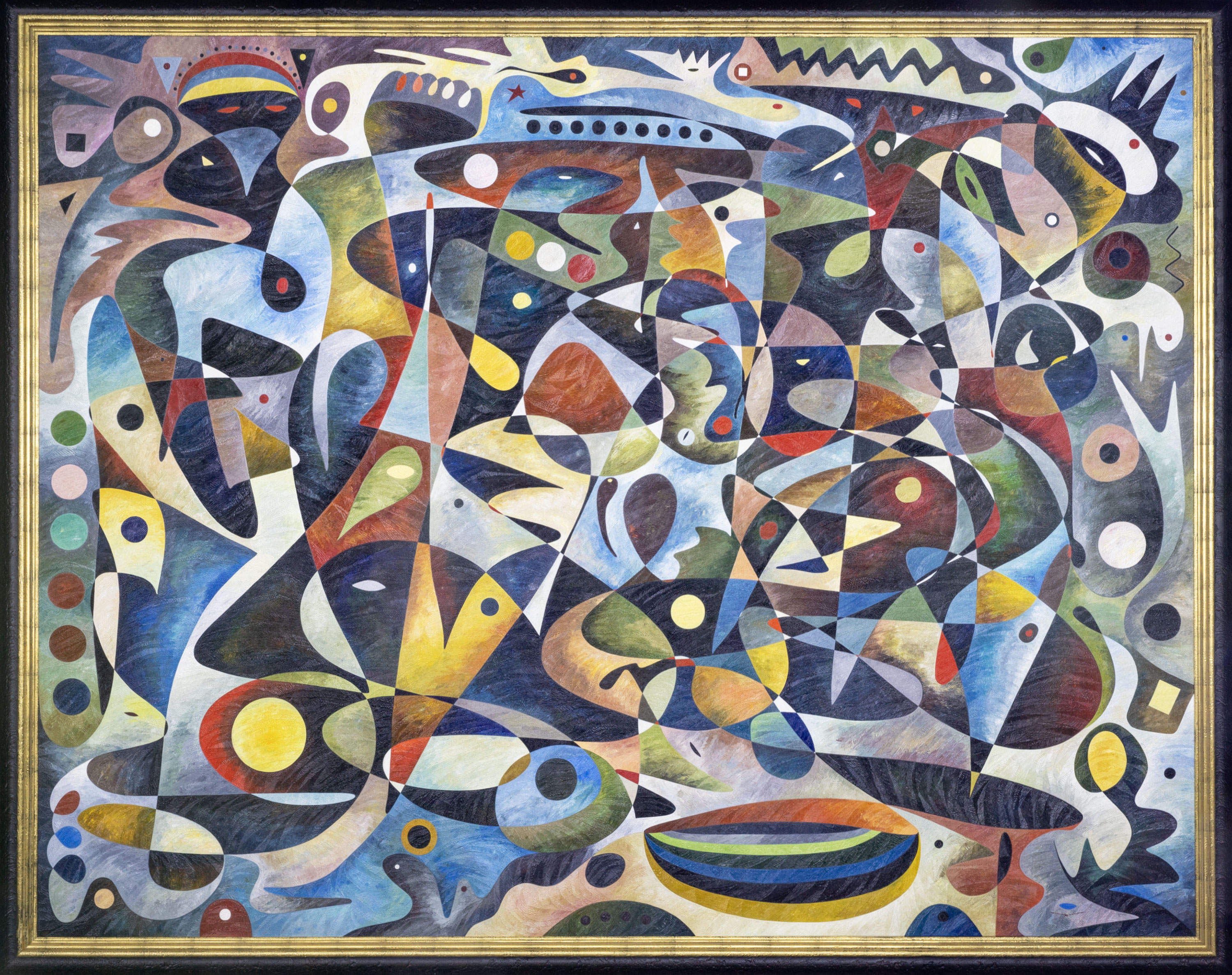
Artist: Gheorghe Virtosu
Medium: Oil and acrylic on linen canvas
Dimensions: 3.4 × 3.5 m
The composition of Ukraine War is structured around a dense, grid-like framework that organizes the pictorial field into interconnected zones while resisting complete stability. Vertical and horizontal divisions establish an initial sense of order, yet this structure is persistently disrupted by diagonal vectors and curvilinear forms that traverse and fracture the surface. The resulting tension between geometric precision and organic fluidity generates a dynamic visual system in which alignment and dislocation coexist, preventing the viewer from settling into a fixed spatial reading.
Figuration appears intermittently through embedded motifs—eyes, profiles, and fragmented bodily forms—that emerge from within the abstract field. These elements function as perceptual anchors, briefly stabilizing localized areas before dissolving back into the surrounding complexity. Their distribution across the composition eliminates hierarchical focus, instead creating a dispersed network of visual attention in which the human presence is integrated into, rather than separated from, the structural logic of the painting.
Chromatically, the work employs a system of high contrast and rhythmic variation to articulate movement and intensity. Blues and yellows recur as structuring elements, interacting with saturated reds and darker tonal concentrations that punctuate the surface as sites of pressure and rupture. The compressed spatial field, combined with the absence of a singular focal point, compels continuous visual navigation, transforming the act of viewing into an active process of negotiation between form, color, and spatial tension.
Color in Ukraine War (2022–2025) operates as both a structuring and destabilizing force, organizing the visual field while simultaneously disrupting its coherence. A dominant interplay of blues and yellows establishes a chromatic foundation that resonates with national identity, yet these tones are not isolated; they are interwoven with darker passages and punctuated by saturated reds. This distribution prevents color from functioning symbolically in a fixed manner, instead allowing it to shift between reference and abstraction. Lighter tonal zones open areas of perceptual clarity, while darker concentrations compress and intensify the field, producing a dynamic oscillation between visibility and obscurity.
Form is articulated through a sustained tension between geometric precision and biomorphic fluidity. Underlying linear divisions suggest a grid-like structure, introducing a provisional order that organizes spatial relations across the surface. This order is continuously disrupted by angular intrusions, curved contours, and interlocking shapes that traverse and fracture the compositional framework. Diagonal vectors generate directional force and momentum, while circular and oval forms act as nodes of concentration within the broader system. The resulting interplay produces a visual language in which stability is never fully achieved, but constantly negotiated.
The interaction of color and form establishes a field of continuous movement and perceptual engagement. Chromatic contrasts reinforce structural tensions, guiding the viewer’s eye across zones of alignment and disruption, while formal fragmentation resists the consolidation of a singular focal point. Together, these elements create a surface in which order and disintegration coexist, generating a visual environment that remains open, unstable, and responsive to the viewer’s shifting perception.
The symbolic language of Ukraine War is constructed through a synthesis of geometric rigidity and biomorphic fragmentation, producing a visual system in which structure and disruption coexist. Angular forms—triangles, shards, and directional vectors—suggest forces of incursion, pressure, and territorial assertion, while curved, fluid shapes introduce counter-movements of adaptation and resilience. The underlying grid-like divisions evoke borders, infrastructures, and imposed systems of order, yet these are repeatedly fractured and overlaid, indicating the instability of such constructs under conditions of sustained conflict.
Figural elements emerge intermittently within this abstract field, most notably through recurring eye motifs and fragmented profiles. These forms function as sites of perception and awareness, suggesting surveillance, witnessing, and the persistence of human presence within systemic violence. However, their incomplete and shifting nature resists fixed identity, positioning the human figure not as a central subject but as a dispersed and contingent element within a broader network of forces. This instability of figuration reinforces the tension between visibility and erasure that characterizes experiences of war.
Color operates as both symbolic marker and structural device. The recurrence of blue and yellow evokes national identity while remaining integrated within a wider chromatic field that includes saturated reds, deep blacks, and neutral tones. Red accents punctuate the composition as nodes of intensity, signifying rupture, impact, and concentrated energy, while darker zones compress space and introduce areas of uncertainty. Lighter passages provide moments of visual openness, yet these are never fully stable, contributing to an overall system in which color continuously negotiates between coherence and disruption.
Ukraine War (2022–2025) reconceives contemporary conflict as a continuous structural condition rather than a discrete historical event. The painting translates the dynamics of the Russian invasion of Ukraine into an abstract system in which pressure, fragmentation, and transformation are enacted across a dense visual field. By abandoning representation, Virtosu shifts the focus from depiction to process, constructing a network of interdependent forces that operate simultaneously rather than sequentially.
The work is grounded in a persistent tension between order and disruption. An underlying grid-like structure suggests frameworks of control—territorial, political, and ideological—while its repeated fragmentation reveals their instability. Figural traces—eyes, profiles, and partial bodies—emerge only provisionally, embedded within the system rather than distinct from it. This displacement of the individual subject reflects a condition in which human experience is inseparable from the larger mechanisms of conflict, and identity is continuously negotiated within shifting structural constraints.
Temporality is condensed into a single, simultaneous field where anticipation, conflict, and aftermath coexist. Color operates as both symbolic and structural agent, with recurring blues and yellows suggesting national identity while remaining integrated within a broader chromatic system of tension and contrast. The painting ultimately proposes that contemporary war exceeds the limits of linear narrative and fixed imagery, demanding instead an active engagement with complexity in which meaning is continuously constructed rather than given.
Ukraine War (2022–2025) operates within an emotional register defined not by singular intensity, but by sustained tension and instability. Rather than presenting overt expressions of anguish or violence, the painting generates a continuous field of pressure, where forms press against one another and visual equilibrium remains perpetually unsettled. This condition produces a quiet but persistent sense of unease, in which emotion is not localized but diffused across the entire surface.
Moments of heightened intensity emerge through chromatic contrast and concentrated formal collisions. Saturated reds and darker tonal compressions function as points of emotional weight, while fragmented figural traces—eyes, partial faces, and distorted profiles—introduce a subtle yet insistent human presence. These elements do not resolve into explicit narratives of suffering; instead, they evoke a condition of psychological strain, where recognition is fleeting and stability remains out of reach.
The overall emotional effect is one of endurance rather than resolution. Despite the pervasive fragmentation, the painting does not collapse into chaos; instead, it sustains a fragile coherence that suggests persistence under pressure. This balance between disruption and continuity produces a nuanced emotional field—one that reflects not only the tension of conflict, but also the resilience required to inhabit and withstand its ongoing presence.
- Mary Kaldor, New and Old Wars: Organised Violence in a Global Era. Stanford University Press, 2012.
- Serhii Plokhy, The Russo-Ukrainian War: The Return of History. W. W. Norton & Company, 2023.
- Paul Virilio, War and Cinema: The Logistics of Perception. Verso Books, 1989.
Selected Bibliography
- Kaldor, Mary. New and Old Wars: Organised Violence in a Global Era.
- Plokhy, Serhii. The Russo-Ukrainian War: The Return of History.
- Virilio, Paul. War and Cinema: The Logistics of Perception.
- Benjamin, Walter. Illuminations.
- Deleuze, Gilles. Difference and Repetition.
- Krauss, Rosalind. The Originality of the Avant-Garde and Other Modernist Myths.
- Deleuze, Gilles. Difference and Repetition.
Curatorial Team: Daniel Varzari
Photography: El Arte Monumental
Special Thanks: Daniel Varzari, Gheorghe Virtosu
El Arte Monumental
08007 Barcelona
Phone: +34 934 439 470/ +01 312 358 8023