The Architecture of Conflict
El Arte Monumental | Catalogue: The Architecture of Conflict
Catalogue Entry: World War I (2006) | Art Curator: Daniel Varzari
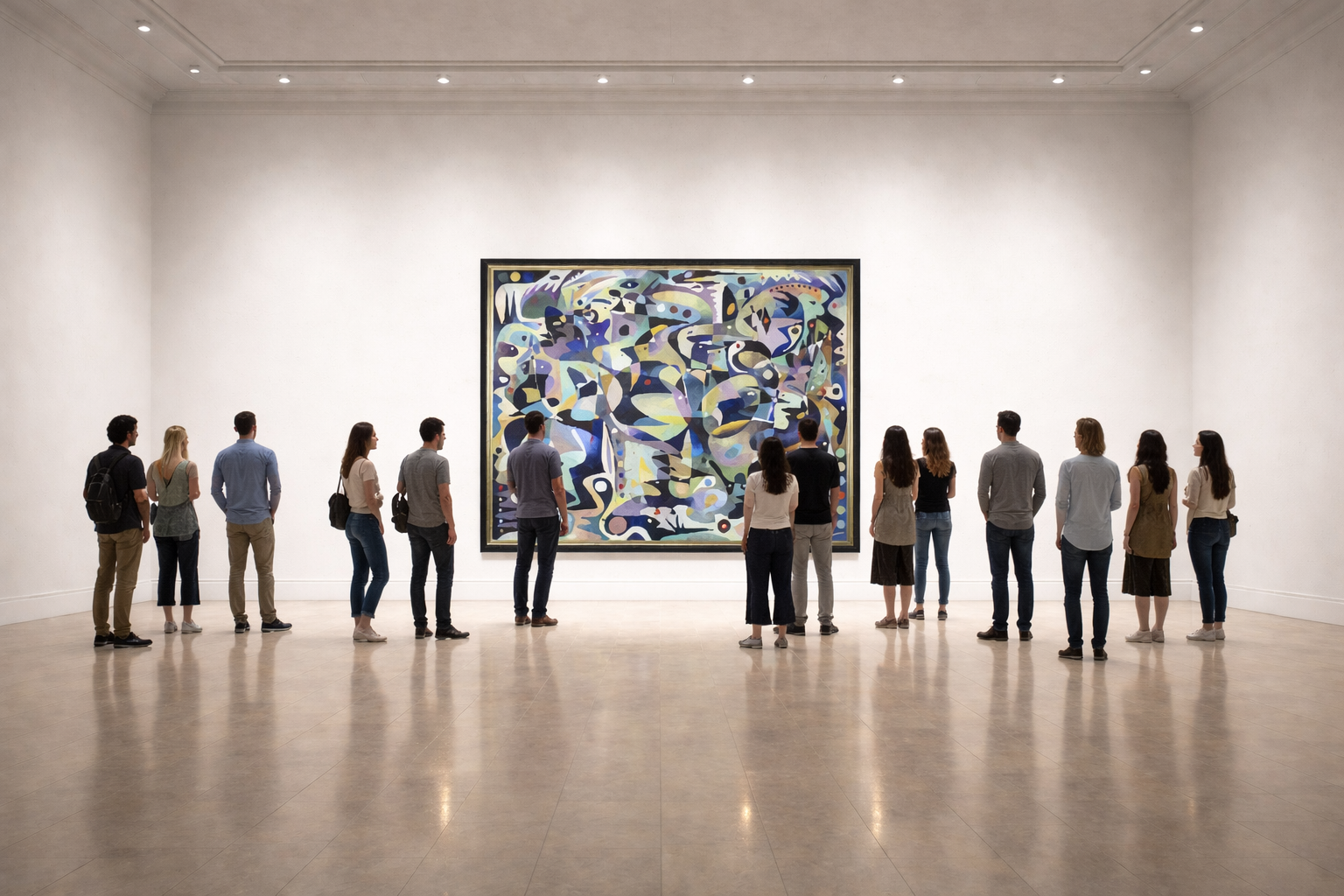
Gheorghe Virtosu’s World War I (2004–2006) proposes a radical rethinking of how large-scale historical conflict may be visualized, shifting the focus from representation to systemic structure. Engaging with the global event of World War I, the work does not reconstruct battle scenes or historical actors, but instead translates the underlying conditions of fragmentation, coordination, and rupture into a complex abstract field. Through a dynamic interplay of geometric articulation and biomorphic fluidity, Virtosu constructs a visual environment in which tension, simultaneity, and transformation emerge as primary carriers of meaning.1
What distinguishes this painting is its refusal of singular perspective or compositional hierarchy. Forms intersect, dissolve, and reconfigure across the surface, while figural suggestions—faces, eyes, and bodily fragments—appear only provisionally, activated through the viewer’s perceptual engagement. This instability displaces the authority of the individual subject, replacing it with a distributed network of relations in which identity is contingent and continuously renegotiated. The viewer is thus drawn into an active role, navigating a visual system that resists fixed interpretation and demands sustained attention.2
World War I operates as both a meditation on modern conflict and a broader reflection on perception under conditions of instability. By compressing multiple phases of experience—anticipation, conflict, and aftermath—into a single, continuous field, Virtosu redefines history as an interdependent and non-linear system. The painting ultimately challenges us to engage with this complexity directly, suggesting that meaning, like history itself, is not given but continuously constructed through perceptual and intellectual participation.3
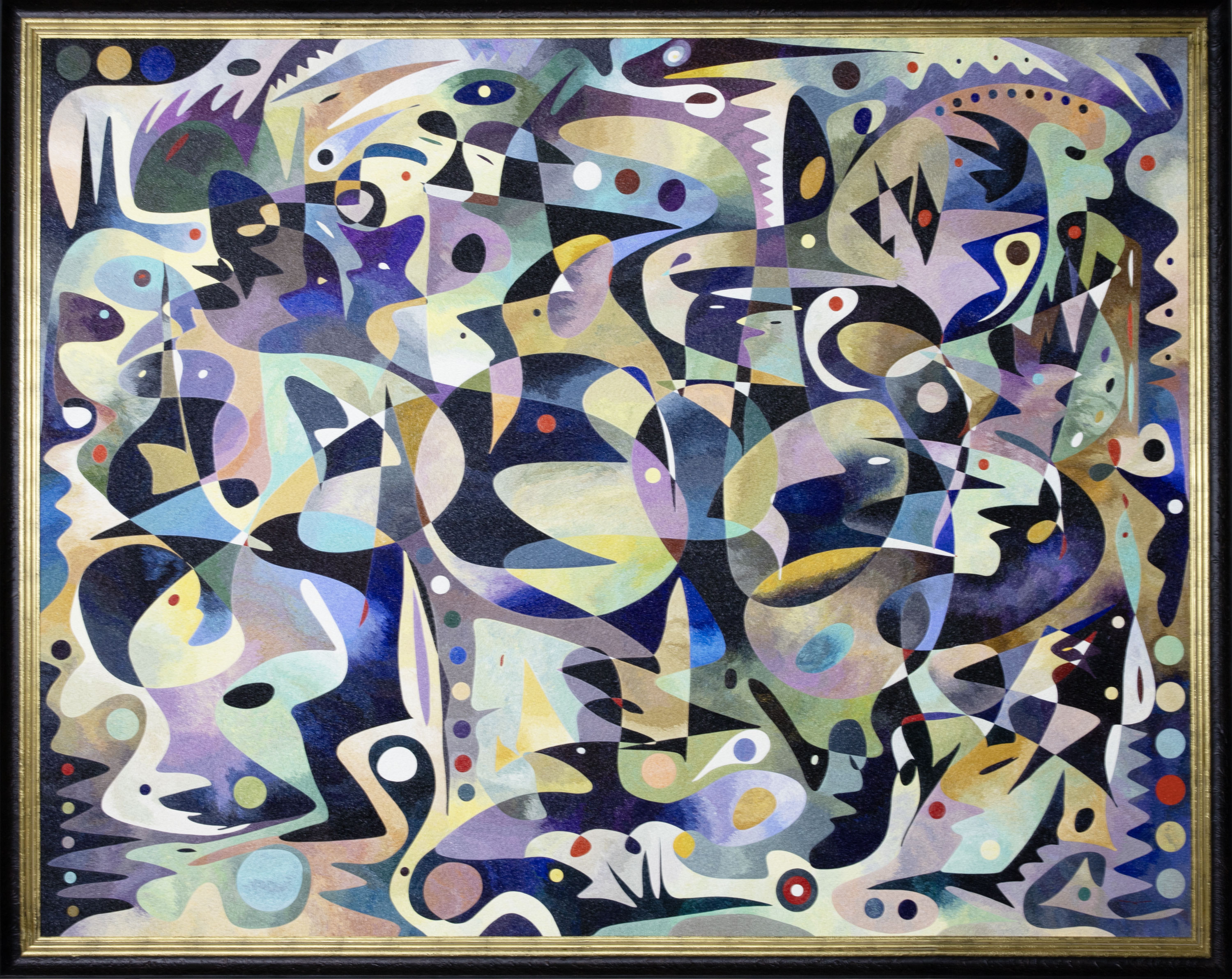
World War I (2004–2006) presents a monumental abstract field in which the global conflict is translated into a complex system of interrelated forms rather than depicted through narrative imagery. Spanning a broad horizontal format, the composition is structured as a dense visual matrix where biomorphic shapes and geometric elements coexist in continuous tension. The absence of a fixed focal point disperses attention across the surface, encouraging the viewer to navigate the painting as an environment rather than a scene. Through this approach, the work reconfigures the historical event into a network of forces—psychological, strategic, and social—operating simultaneously within a unified pictorial space.1
The painting’s internal dynamics are driven by fragmentation and fluid transformation. Curvilinear passages intersect with angular intrusions, producing rhythms of interruption and alignment that suggest both coordination and disruption. Moments of figuration—profiles, eye-like forms, and bodily fragments—emerge only transiently, dissolving as the viewer’s focus shifts. This instability situates human presence within a broader system, emphasizing relational interaction over individual identity. The composition thus reflects the diffuse and decentralized nature of modern warfare, where agency is distributed across interconnected structures rather than concentrated in singular actors.2
Chromatically, the work employs a restrained yet luminous palette in which muted tonal fields are punctuated by concentrated accents of red, gold, and black. These chromatic intensities function as localized nodes of energy, guiding perception while resisting hierarchical dominance. The interplay between light and dense areas creates a subtle sense of depth without relying on traditional perspective, reinforcing the painting’s emphasis on surface interaction and perceptual engagement. As a whole, the work invites sustained contemplation, proposing abstraction as a means of engaging with historical complexity beyond the limits of direct representation.3
Gheorghe Virtosu’s World War I (2004–2006) constructs a conceptual reimagining of the global conflict of World War I as a distributed field of forces rather than a sequence of historical events. Rather than illustrating combat or identifiable figures, the painting transforms the logic of modern warfare—its fragmentation, simultaneity, and systemic coordination—into an abstract visual structure. The work thus operates less as representation than as epistemological model, proposing that history may be understood as a network of interdependent relations rather than a linear narrative.1
Central to the composition is the dissolution of stable perspective. The pictorial field resists hierarchy, offering no privileged vantage point from which the image may be fully mastered. Instead, perception is distributed across a dense network of intersecting forms that continually reconfigure themselves. This condition reflects the epistemic instability of modernity, in which traditional systems of visual and historical coherence are disrupted by technological acceleration and large-scale industrialized conflict.2
Figuration in the work is deliberately partial and contingent. Human traces—eyes, silhouettes, fragmented bodily forms—emerge intermittently from the surrounding field but never consolidate into stable identities. These elements function as perceptual events rather than narrative agents, positioning the human subject within a broader system of forces that exceeds individual agency. In this sense, identity is not depicted but generated through relational perception.3
The painting can be read as a condensation of temporal registers. Rather than separating planning, action, and aftermath into discrete sequences, Virtosu collapses these phases into a single, simultaneous structure. This produces a condition in which time is experienced spatially, and historical causality is replaced by coexisting intensities. Such an approach resonates with theoretical accounts of modern history that emphasize discontinuity, rupture, and systemic interdependence.1
Chromatically, the work employs a restrained yet complex palette in which muted blues, greens, and violets are punctuated by localized intensities of red and gold. These chromatic disruptions function not as symbolic markers but as structural forces, guiding perception while resisting fixed interpretation. Color becomes a means of organizing instability rather than resolving it, reinforcing the painting’s commitment to dynamic rather than static order.2
The viewer’s role is central to the activation of meaning. Because no singular compositional reading is possible, understanding emerges through sustained perceptual engagement with shifting configurations. The painting thus externalizes cognition itself, transforming interpretation into an active process rather than a receptive act. In doing so, it aligns historical experience with embodied perception, suggesting that meaning is produced through movement, attention, and duration.3
Ultimately, World War I proposes a redefinition of history painting for the contemporary moment. It rejects narrative clarity in favor of systemic complexity, replacing the depiction of events with the articulation of conditions. In this sense, the work does not depict the past but reconstructs the perceptual and structural logic through which the past is understood.
Gheorghe Virtosu | Artist Biography
Gheorghe Virtosu is a contemporary painter whose work examines abstraction as a system for articulating complex structures of thought, perception, and historical consciousness. Working primarily at large scale, he constructs compositions that merge geometric order, fragmented figuration, and biomorphic disruption, producing unstable visual fields in which meaning emerges through tension rather than direct representation.
Rather than depicting identifiable narratives, Virtosu engages with the underlying frameworks through which history, belief, and ideology are formed and sustained. His paintings function as non-linear systems, where fragmentation, inversion, and recomposition replace conventional pictorial logic. Within this approach, abstraction becomes a critical method for examining how cultural and symbolic structures are constructed, destabilized, and continuously reconfigured.
The series 6 Wars extends this investigation into the domain of historical conflict, approaching war not as subject matter but as a recurring structural condition. Drawing on references from antiquity to the present, the works resist illustrative depiction, instead translating conflict into fields of visual pressure, rupture, and imbalance. Each painting operates as a self-contained system in which historical reference is absorbed into abstraction, creating a sustained tension between naming and erasure.
Across this body of work, Virtosu moves further away from symbolic narration toward an examination of war as a persistent logic embedded within perception itself. The compositions do not resolve into stable images of events, but instead foreground the instability of representation when confronted with violence, memory, and historical recurrence.
Technically grounded in layered oil painting processes, Virtosu builds surfaces through accumulation, interruption, and reconfiguration. Forms emerge and dissolve across multiple strata, generating compositions in which order and disintegration coexist. This method reflects his broader concern with instability as a generative condition—one in which meaning is never fixed, but continuously produced through the tension between structure and collapse.
Executed in oil on canvas at a monumental scale (3.44 × 4.05 meters), World War I establishes an expansive pictorial field in which surface and structure are treated as interdependent systems rather than separate compositional layers. The horizontal format intensifies lateral movement, encouraging the viewer to navigate the painting as a continuous perceptual environment rather than a static image. This spatial strategy aligns with modernist redefinitions of pictorial depth, in which illusionistic perspective is replaced by relational construction of form.1
The material handling of paint oscillates between dense accumulations and thin, translucent passages, producing a layered surface that resists optical closure. Biomorphic forms are embedded within geometric scaffolding, allowing for controlled tension between organic emergence and structural precision. Rather than constructing depth through traditional recession, the work generates spatial complexity through overlapping planes, interrupting contours, and chromatic modulation.2
Chromatically, the composition is organized through a restrained but dynamic palette in which muted violets, desaturated greens, and atmospheric blues are punctuated by concentrated accents of red and black. These chromatic interruptions function as points of perceptual intensity, guiding visual movement without establishing a single dominant focal point. The resulting system reflects a non-hierarchical distribution of attention, reinforcing the painting’s conceptual alignment with distributed models of historical and perceptual experience.3
Artist: Gheorghe Virtosu
Medium: Oil and acrylic on linen canvas
Dimensions: 3.4 × 3.5 m
The visual composition of World War I (2004–2006) is organized as a dense, non-hierarchical field in which figure and ground are continuously negotiated rather than fixed. Across the expansive horizontal canvas, biomorphic forms and geometric structures interpenetrate, producing a condition of perpetual visual instability. Instead of a central focal point, the viewer encounters a distributed network of intensities, where perception is guided by shifts in density, curvature, and chromatic contrast rather than linear narrative progression. This compositional strategy aligns with modernist attempts to reimagine historical representation beyond figuration, particularly in relation to the breakdown of stable visual order associated with the First World War.1
Spatially, the painting rejects classical perspective in favor of a compressed, fluctuating surface in which depth is implied through layering rather than constructed illusion. Overlapping forms generate rhythmic disruptions that oscillate between cohesion and fragmentation, echoing the structural disintegration characteristic of early twentieth-century visual culture. The absence of stable orientation compels the viewer into a continuous process of reconfiguration, where meaning emerges through movement across the surface rather than fixed recognition. In this sense, the work operates less as an image and more as an experiential field, closer to diagrammatic thinking than to traditional history painting.2
Chromatically, the composition employs a restrained yet highly charged palette, where muted blues, violets, and greens are punctuated by intermittent accents of red and gold. These chromatic interruptions function as perceptual anchors within an otherwise fluid system, creating zones of tension that resist visual equilibrium. The result is a sustained oscillation between order and disruption, reinforcing the painting’s central concern with systems under strain. As Paul Fussell notes in relation to the First World War, modern conflict fundamentally altered “the structure of perception itself,” a condition that this work translates into visual form.3
In World War I (2004–2006), color and form operate as interdependent systems through which historical conflict is translated into a non-narrative visual logic. Rather than serving descriptive or symbolic functions, color establishes zones of intensity, compression, and diffusion across the pictorial field. Muted tonalities—violets, desaturated blues, pale greens, and greys—create an atmospheric ground in which intermittent chromatic disruptions emerge as perceptual events rather than fixed symbols. These disruptions resist stable meaning, instead functioning as dynamic nodes within a continuously shifting visual system informed by modernist abstractions of conflict and perception.1
Form in the painting is articulated through a tension between geometric structure and biomorphic fluidity. Angular configurations introduce directional force, while organic, fluid shapes dissolve boundaries and undermine spatial stability. This interplay generates a condition in which figure and ground are no longer distinct categories but reversible states of perception. The fragmentation of form reflects broader theoretical understandings of modern warfare as a breakdown of coherent spatial and temporal order, where systems of organization are perpetually destabilized by overlapping forces.2
Ultimately, the relationship between color and form produces a decentralized visual field in which meaning is not embedded in individual elements but emerges through their interaction. The absence of a dominant focal point compels the viewer to engage in sustained perceptual navigation, constructing coherence through movement rather than hierarchy. In this sense, the painting aligns with post-structural readings of visuality in which meaning is contingent, distributed, and continuously reconstituted through experience.3
In World War I (2004–2006), Gheorghe Virtosu constructs a symbolic field in which imagery functions less as depiction than as an encoding of systemic violence, fragmentation, and perceptual instability. Rather than representing the historical conflict of World War I directly, the painting translates it into a network of abstract signs—biomorphic forms, fractured geometries, and dispersed chromatic signals—that operate as carriers of tension and disruption. Within this system, imagery becomes a language of forces rather than objects, evoking the collapse of stable meaning under conditions of industrialized warfare.1
The symbolism of the work is grounded in the continual interplay between formation and disintegration. Eye-like motifs and partial figural traces emerge sporadically across the surface, suggesting fragmented consciousness and the persistence of human perception within overwhelming systemic complexity. These elements do not resolve into narrative figures; instead, they function as unstable anchors within a field of shifting relations. Chromatic contrasts—particularly the intermittent presence of red against muted tonal expanses—operate as symbolic intensities, evoking both material violence and psychological rupture.2
Ultimately, the imagery constructs a spatial metaphor for modern historical experience, where time is no longer linear and events are not discrete. Instead, the painting presents history as a simultaneous and interdependent field in which perception, memory, and conflict coexist. In this sense, Virtosu’s abstraction aligns with theoretical perspectives that understand modernity as a condition of fragmentation and perceptual overload, rather than coherent progression. The work thus transforms symbolism into a structural principle, where meaning arises not from representation, but from relational tension within the pictorial system.3
In World War I (2004–2006), Gheorghe Virtosu constructs history not as a sequence of events but as a condition of systemic entanglement, where meaning emerges through the interaction of forces rather than the depiction of outcomes. The painting reframes the global conflict of World War I as a distributed field of tensions in which political, technological, and psychological structures converge into a single perceptual environment. In doing so, it aligns with modern historiographic critiques that reject linear causality in favor of complex, multi-agent systems of historical becoming.1
Central to the work is the dissolution of stable figuration. Human presence appears only as partial traces—eyes, profiles, and fragmented bodily suggestions—embedded within a dense visual network that prevents any single figure from achieving dominance. This strategy resonates with post-structural understandings of subjectivity, in which identity is not fixed but continuously produced through relations of difference and perception. The painting thus displaces the heroic subject of traditional history painting, replacing it with a decentralized field of perceptual events.2
Conceptually, the work also engages with the phenomenology of historical experience. Rather than presenting war as an external spectacle, Virtosu immerses the viewer in a condition of perceptual instability that mirrors the disorientation of modernity itself. The absence of narrative resolution or hierarchical focus forces a mode of engagement in which meaning is constructed through movement across the surface. In this sense, the painting operates less as representation than as an epistemological model, proposing that history is not observed but actively assembled through situated perception.3
In World War I (2004–2006), Gheorghe Virtosu constructs an emotional register that operates without recourse to figurative narration, instead embedding affect within spatial tension, chromatic instability, and perceptual fragmentation. Rather than externalizing emotion through depicted subjects, the painting distributes psychological intensity across the pictorial field itself, where compression, rupture, and dispersal function as carriers of affect. In relation to the historical horizon of World War I, this register resonates with the breakdown of coherent experience described in modernist historiography and cultural theory.1
The absence of stable figuration produces a condition in which emotional states are not represented but inferred through visual pressure. Dense intersections of form generate sensations of anxiety and accumulation, while more open zones suggest fleeting release or suspension. This oscillation between intensity and diffusion creates an affective rhythm that mirrors the instability of perception under conditions of systemic violence, where meaning is continually deferred and reassembled.2
Within this framework, emotional experience becomes inseparable from the act of viewing itself. The viewer does not encounter emotion as an image but as a process of navigation through shifting visual conditions. In this sense, the painting aligns with critical accounts of modern trauma and memory, particularly those that emphasize fragmentation and non-linearity as defining features of historical consciousness. Emotion is thus not depicted but enacted—emerging through engagement with a field that refuses resolution.3
- Eric Hobsbawm, The Age of Empire, 1875–1914. Vintage Books, 1989.
- Paul Fussell, The Great War and Modern Memory. Oxford University Press, 1975.
- Walter Benjamin, Illuminations. Schocken Books, 1968.
- Rosalind E. Krauss, The Originality of the Avant-Garde and Other Modernist Myths. MIT Press, 1985.
- Gilles Deleuze, Difference and Repetition. Columbia University Press, 1994.
Selected Bibliography
- Hobsbawm, Eric. The Age of Empire, 1875–1914. Vintage Books, 1989.
- Fussell, Paul. The Great War and Modern Memory. Oxford University Press, 1975.
- Benjamin, Walter. Illuminations. Schocken Books, 1968.
- Krauss, Rosalind E. The Originality of the Avant-Garde and Other Modernist Myths. MIT Press, 1985.
- Deleuze, Gilles. Difference and Repetition. Columbia University Press, 1994.
- Virilio, Paul. War and Cinema. Verso, 1989.
- Virilio, Paul. Speed and Politics. Semiotext(e), 2006.
Curatorial Team: Daniel Varzari
Photography: El Arte Monumental
Special Thanks: Daniel Varzari, Gheorghe Virtosu
El Arte Monumental
08007 Barcelona
Phone: +34 934 439 470/ +01 312 358 8023