The Architecture of Conflict
El Arte Monumental | Catalogue: The Architecture of Conflict
Catalogue Entry: World War II (2008) | Art Curator: Daniel Varzari
Gheorghe Virtosu’s World War II (2006–2008) enters the discourse of history painting by refusing its foundational premise: that complex events can be stabilized through narrative, figure, and composition. Instead, the work proposes a radically different model—one in which history is encountered as a field of simultaneous forces, without a privileged vantage point. Referencing the global scale of World War II, the painting disperses agency across a dense visual matrix, where no single figure, structure, or zone can fully contain the event it evokes.1
What emerges is not an image of war, but a system in which perception itself becomes unstable. Silhouettes surface and dissolve, roles shift between civilian, soldier, state, and machine, and spatial divisions collapse into overlapping conditions. Virtosu situates the viewer within this instability, requiring movement, distance, and sustained attention in order to construct provisional meaning. The painting thus transforms spectatorship into participation, aligning bodily experience with the disorientation and simultaneity that define modern conflict.2
Positioned within the broader trajectory of Virtosu’s practice, World War II marks a critical expansion in scale and conceptual ambition. Here, abstraction is not a departure from history but a method for engaging its complexity at a level beyond representation. By dissolving the coherence of image and subject, the work proposes that historical understanding emerges not through clarity or resolution, but through sustained engagement with fragmentation, multiplicity, and structural tension.3
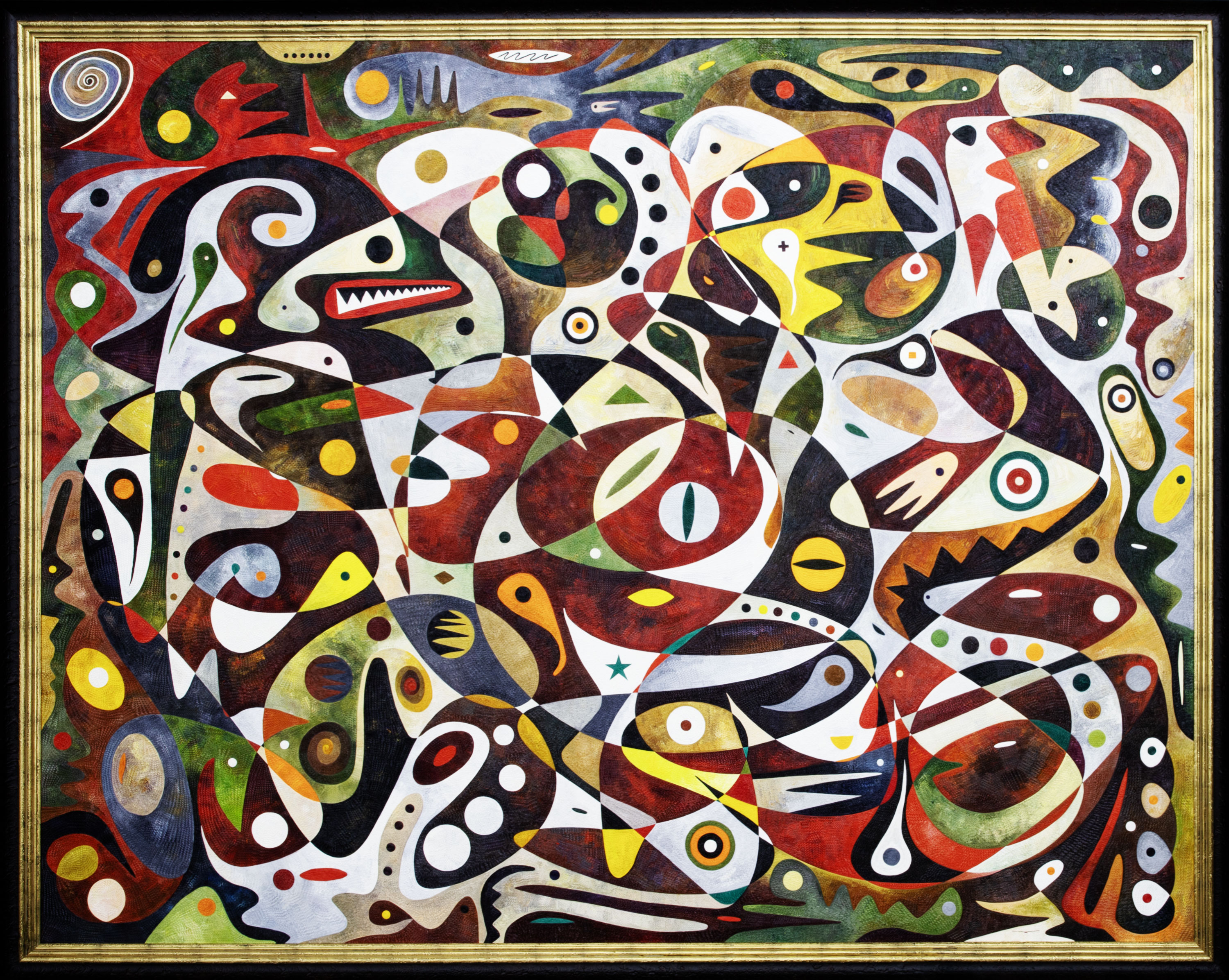
World War II (2006–2008) by Gheorghe Virtosu presents a monumental abstract composition in which the global conflict is translated into a dense field of interlocking forms, chromatic intensity, and rhythmic disruption. Rather than depicting identifiable figures, locations, or events associated with World War II, the painting constructs a visual environment where geometric fragmentation and biomorphic elements interact continuously. The surface is fully activated, offering no singular focal point, and instead invites the viewer to navigate a system defined by simultaneity, pressure, and unresolved tension.1
Across the composition, silhouettes emerge transiently through clusters of eye-like motifs and contour fragments, suggesting human presence without stabilizing identity. These forms overlap, dissolve, and recombine, reflecting the instability of roles within the conflict—where distinctions between civilian, soldier, and mechanized systems become increasingly blurred. Spatial zones shift from compressed density to relative openness, evoking the coexistence of multiple theaters of war, from concentrated territorial conflict to expansive, technologically mediated engagement.2
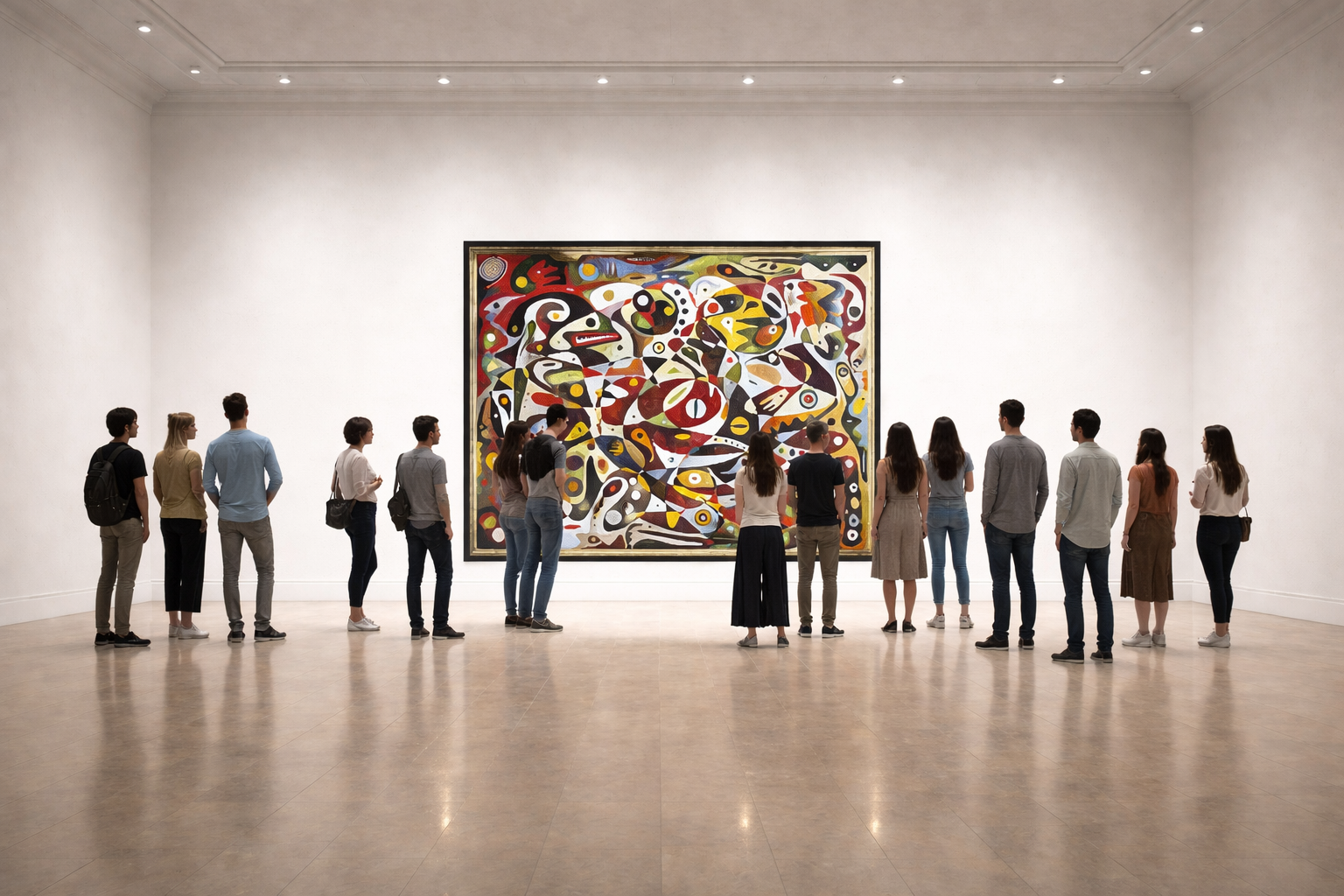
Chromatically, the dominance of saturated reds, punctuated by contrasting greens, yellows, and pale tonal interruptions, generates a sense of visual heat and kinetic energy. The layered application of oil paint produces a textured surface in which forms appear and dissolve across multiple registers, reinforcing the painting’s dynamic instability. At its monumental scale, the work demands bodily movement, compelling the viewer to engage with the composition as an immersive field in which meaning is constructed through perception rather than representation.3
In World War II (2006–2008), Gheorghe Virtosu constructs abstraction as a method for rethinking historical cognition rather than illustrating historical content. The painting does not function as a narrative image of the conflict, but as a structural field in which the conditions of global warfare are reorganized into relations of force, pressure, and simultaneity. The reference to the global conflict of World War II operates not iconographically but systemically, as an unstable totality distributed across the pictorial surface.1
The composition rejects linear temporality in favor of layered simultaneity. Instead of a sequence of events, the viewer encounters overlapping zones of activity in which multiple “theaters” of operation coexist without clear separation. This structural condition reflects the historical reality of a global conflict defined by distributed fronts, asynchronous escalation, and fragmented command structures.2
Within this field, figuration persists only as a conditional phenomenon. Silhouettes emerge through the alignment of eye-like forms and fragmented contours, briefly stabilizing into readable structures before dissolving back into abstraction. These unstable figures do not represent individuals but temporary configurations of perception, suggesting that identity within the painting is produced relationally rather than fixed in advance.3
Virtosu’s characteristic instability of roles—civilian, soldier, state, machine—becomes a core interpretive structure here. Rather than assigning these categories to distinct visual entities, the painting distributes them across overlapping zones of transformation. A single form may shift between states depending on perceptual emphasis, undermining any stable distinction between agency and system.1
The central field operates as a zone of structural overload. Dense chromatic accumulation and internal fragmentation prevent any stabilizing reading, instead producing a condition in which coherence is continuously deferred. This instability reflects the epistemological challenge of representing total war, where no singular viewpoint can account for the simultaneity of global operations.2
Peripheral zones extend this logic into differentiated but interconnected conditions. Some areas suggest industrial repetition and mechanical standardization, while others imply dissolution, displacement, or residual movement. These variations do not establish separate narratives but function as interdependent expressions of a single systemic field.3
Ultimately, the painting proposes abstraction as a model for understanding historical complexity beyond representation. By dismantling hierarchy, stabilizing no figure, and distributing meaning across a continuous field of tension, Virtosu reframes historical interpretation as an active process of navigation rather than recognition. The viewer does not observe World War II as an image; they traverse it as a system of forces that remains perpetually unresolved.1
Gheorghe Virtosu | Artist Biography
Gheorghe Virtosu is a contemporary painter whose work examines abstraction as a system for articulating complex structures of thought, perception, and historical consciousness. Working primarily at large scale, he constructs compositions that merge geometric order, fragmented figuration, and biomorphic disruption, producing unstable visual fields in which meaning emerges through tension rather than direct representation.
Rather than depicting identifiable narratives, Virtosu engages with the underlying frameworks through which history, belief, and ideology are formed and sustained. His paintings function as non-linear systems, where fragmentation, inversion, and recomposition replace conventional pictorial logic. Within this approach, abstraction becomes a critical method for examining how cultural and symbolic structures are constructed, destabilized, and continuously reconfigured.
The series 6 Wars extends this investigation into the domain of historical conflict, approaching war not as subject matter but as a recurring structural condition. Drawing on references from antiquity to the present, the works resist illustrative depiction, instead translating conflict into fields of visual pressure, rupture, and imbalance. Each painting operates as a self-contained system in which historical reference is absorbed into abstraction, creating a sustained tension between naming and erasure.
Across this body of work, Virtosu moves further away from symbolic narration toward an examination of war as a persistent logic embedded within perception itself. The compositions do not resolve into stable images of events, but instead foreground the instability of representation when confronted with violence, memory, and historical recurrence.
Technically grounded in layered oil painting processes, Virtosu builds surfaces through accumulation, interruption, and reconfiguration. Forms emerge and dissolve across multiple strata, generating compositions in which order and disintegration coexist. This method reflects his broader concern with instability as a generative condition—one in which meaning is never fixed, but continuously produced through the tension between structure and collapse.
Executed in oil on canvas at a monumental scale (3.23 × 3.4 meters), World War II constructs a continuous pictorial field in which no single compositional center is permitted to stabilize perception. The surface is built through layered applications of pigment, producing zones of density and erosion that shift according to viewing distance. This oscillation between cohesion and fragmentation requires the viewer to continually recalibrate spatial reading, echoing the simultaneity and distributive logic of global warfare.1
The painting’s internal structure is governed by the interaction between geometric articulation and biomorphic disruption. Hard-edged linear elements establish temporary directional pathways, while organic, eye-like forms interrupt and redirect these trajectories, preventing any stable reading of hierarchy or sequence. Rather than constructing depth through linear perspective, the work generates spatiality through collision, overlap, and compression of visual events.2
Chromatically, the work relies on high-intensity contrasts—particularly saturated reds, deep blacks, and destabilizing inflections of green and yellow—to generate perceptual vibration across the surface. These chromatic fields function not as descriptive color zones but as activating forces, continuously reorganizing figure–ground relations. The result is a surface that behaves less as a static image than as an energetic system in which structure and disintegration operate simultaneously.3
Artist: Gheorghe Virtosu
Medium: Oil and acrylic on linen canvas
Dimensions: 3.4 × 3.5 m
In World War II, the visual field is organized as a non-hierarchical system in which no single axis governs perception. Instead, the composition operates through distributed density: clusters of biomorphic and geometric forms accumulate across the surface, producing zones of varying intensity rather than a unified focal structure. This fragmentation resists traditional pictorial reading, replacing narrative progression with simultaneous activation across the canvas. The result is a field in which visual information must be assembled through movement rather than immediate comprehension.1
Silhouettes emerge intermittently within this structure but never stabilize into fully resolved figures. They are constructed through partial contours, eye-like nodes, and overlapping chromatic interruptions, which momentarily suggest human presence before dissolving back into abstraction. These unstable configurations shift between roles—civilian, soldier, state, machine—without settling into fixed identity. The painting thus produces a condition in which figuration is continuously generated and dismantled within the same perceptual moment.2
Chromatically, the composition intensifies its structural instability through high-contrast interactions between saturated reds, muted greens, and fragmented zones of black and white. Color does not function descriptively but operates as a force of spatial disruption, producing optical pressure that guides movement across the surface. At the scale of 3.23 × 3.4 meters, these effects become bodily rather than purely visual, requiring the viewer to navigate the painting physically in order to construct temporary coherence. The work thus transforms perception into an active process of negotiation with instability.3
In World War II (2006–2008), color operates not as descriptive surface but as an autonomous system of structural intensity. Saturated reds dominate the composition, functioning as zones of heightened pressure and visual acceleration, while intervening fields of green, yellow, and white interrupt continuity and destabilize perceptual cohesion. Rather than organizing space through tonal harmony, Virtosu constructs chromatic conflict, where color behaves as a force that drives movement across the pictorial field. This strategy aligns the painting with the expanded scale and simultaneity of global warfare, in which multiple theaters of action unfold without a singular organizing center.1
Form in the painting is similarly destabilized, existing as a condition of emergence and dissolution rather than fixed structure. Geometric fragments and biomorphic traces overlap without stabilizing into complete figures, producing silhouettes that appear only momentarily before breaking apart into adjacent configurations. These partial forms suggest bodies, machines, and systems of coordination, yet none achieve permanence. Instead, form operates as a transitional state, reflecting the instability of roles—civilian, soldier, state, and machine—within a continuously shifting visual environment.2
The interaction between color and form produces a field of reciprocal tension in which neither element stabilizes the other. Chromatic intensity disrupts figural clarity, while fragmentary forms redirect and modulate color perception across the surface. This interdependence generates a perceptual condition in which meaning arises through fluctuation rather than resolution. Virtosu thus redefines the relationship between color and form as a dynamic system of negotiation, in which visual structure remains perpetually contingent and unresolved.3
In World War II, symbolism does not operate through iconographic substitution but through systemic analogy. Rather than assigning fixed meaning to discrete motifs, Virtosu constructs a field in which form itself becomes a proxy for historical pressure. Dense clusters of overlapping shapes evoke conditions of entanglement and saturation associated with the global scale of World War II, where multiple fronts, actors, and temporalities operate simultaneously.1 The absence of stable figuration shifts symbolic meaning away from representation and toward relational intensity.
Imagery in the work is anchored by recurring eye-like forms and fragmented silhouettes that intermittently suggest human presence. These elements function less as identifiable figures and more as unstable perceptual nodes, momentarily organizing surrounding chaos into provisional coherence. However, any such coherence is immediately destabilized by intersecting geometries and chromatic interference. The result is a symbolic economy in which identity, perception, and agency are continuously constructed and dismantled rather than presented as fixed states.2
Color further intensifies this symbolic instability. Saturated reds operate as zones of heightened tension and convergence, while contrasting greens, yellows, and dark fields fracture spatial continuity. These chromatic displacements resist narrative reading and instead produce a field of visual conflict, where meaning emerges through oscillation rather than resolution. Within this system, imagery becomes a condition of instability itself, reflecting the irreducible complexity of modern total war.3
In World War II, Virtosu reframes historical conflict not as a sequence of events but as a distributed system of pressures in which meaning is produced through interaction rather than representation. The painting refuses the stabilizing function of traditional history painting, where figures, actions, and outcomes are ordered into legible narrative structures. Instead, it constructs a field in which global conflict is experienced as simultaneity—an accumulation of forces that resist consolidation into a single interpretive frame. Within this logic, the reference to the global conflict of World War II is not illustrative but structural, functioning as a condition of multiplicity rather than a subject to be depicted.1
Central to this conceptual framework is the instability of identity. The recurring silhouette structures—formed through fragmented contours and eye-like articulations—do not resolve into coherent figures but remain suspended between recognition and dissolution. Civilian, soldier, state, and machine operate less as fixed categories than as shifting modalities within a continuous system of transformation. This instability undermines the classical hierarchy of subject and object, replacing it with a logic in which agency is distributed across the entire pictorial field rather than anchored in individual forms.2
The painting further proposes that historical understanding emerges through perceptual participation rather than detached observation. The viewer must actively navigate a dense, non-hierarchical surface in which no single perspective is sufficient to stabilize meaning. Scale becomes critical here: the monumental format produces oscillation between coherence and fragmentation, forcing the body into movement as a condition of interpretation. In this sense, the work aligns conceptual abstraction with embodied cognition, suggesting that history is not viewed but reconstructed through engagement with unstable systems of relation.3
In World War II, emotional intensity is not localized in individual figures but distributed across the entire pictorial field, producing a condition of collective affect rather than personal expression. The viewer does not encounter identifiable subjects of suffering or agency; instead, emotion is encoded as pressure, saturation, and instability within the structure itself. This shift displaces empathy from representation toward perception, where emotional response arises from navigating an unstable system rather than identifying with a figure.1
The painting sustains a persistent tension between coherence and disintegration, generating a state of perceptual unease that parallels the historical conditions of total war. As forms emerge and dissolve without resolution, the viewer is placed in a continuous cycle of recognition and loss, echoing the instability of meaning under large-scale systemic conflict. Emotional experience here is not cathartic but recursive, defined by repeated attempts to stabilize what refuses fixation.2
Ultimately, the work constructs an emotional register grounded in exhaustion, overload, and simultaneity. Rather than offering narrative resolution or symbolic closure, it sustains a field in which affect is produced through duration and attention. In this sense, emotional experience becomes inseparable from structural perception: to feel the work is to move within its instability, where meaning and emotion continuously reconfigure one another.3
- Antony Beevor, The Second World War. Little, Brown, 2012.
- John Keegan, The Second World War. Penguin Books, 1989.
- Richard Overy, Why the Allies Won. W. W. Norton, 1995.
Selected Bibliography
- Beevor, Antony. The Second World War.
- Keegan, John. The Second World War.
- Overy, Richard. Why the Allies Won.
- Krauss, Rosalind. The Originality of the Avant-Garde and Other Modernist Myths.
- Deleuze, Gilles. Difference and Repetition.
Curatorial Team: Daniel Varzari
Photography: El Arte Monumental
Special Thanks: Daniel Varzari, Gheorghe Virtosu
El Arte Monumental
08007 Barcelona
Phone: +34 934 439 470/ +01 312 358 8023