The Architecture of Identity
El Arte Monumental | Catalogue: The Architecture of Identity
Catalogue Entry: Divine DNA (2016) | Art Curator: Daniel Varzari
Divine DNA stands as a rare example of a work in which conceptual clarity and material execution are held in exact alignment. Developed over a decade—from initial conception in 2006 to completion in 2016—the painting reflects an unusually sustained commitment to a single, comprehensive idea: the visualization of global human structure as a unified system.
Comprising 249 distinct and non-repeating abstract forms, each corresponding to a nation, the work operates through precision rather than improvisation. Its internal organization, based on cultural and ethnographic relationships, resists conventional modes of representation while proposing an alternative model of interconnectedness. The result is neither map nor abstraction in the traditional sense, but a constructed visual language that encodes difference within a continuous field.
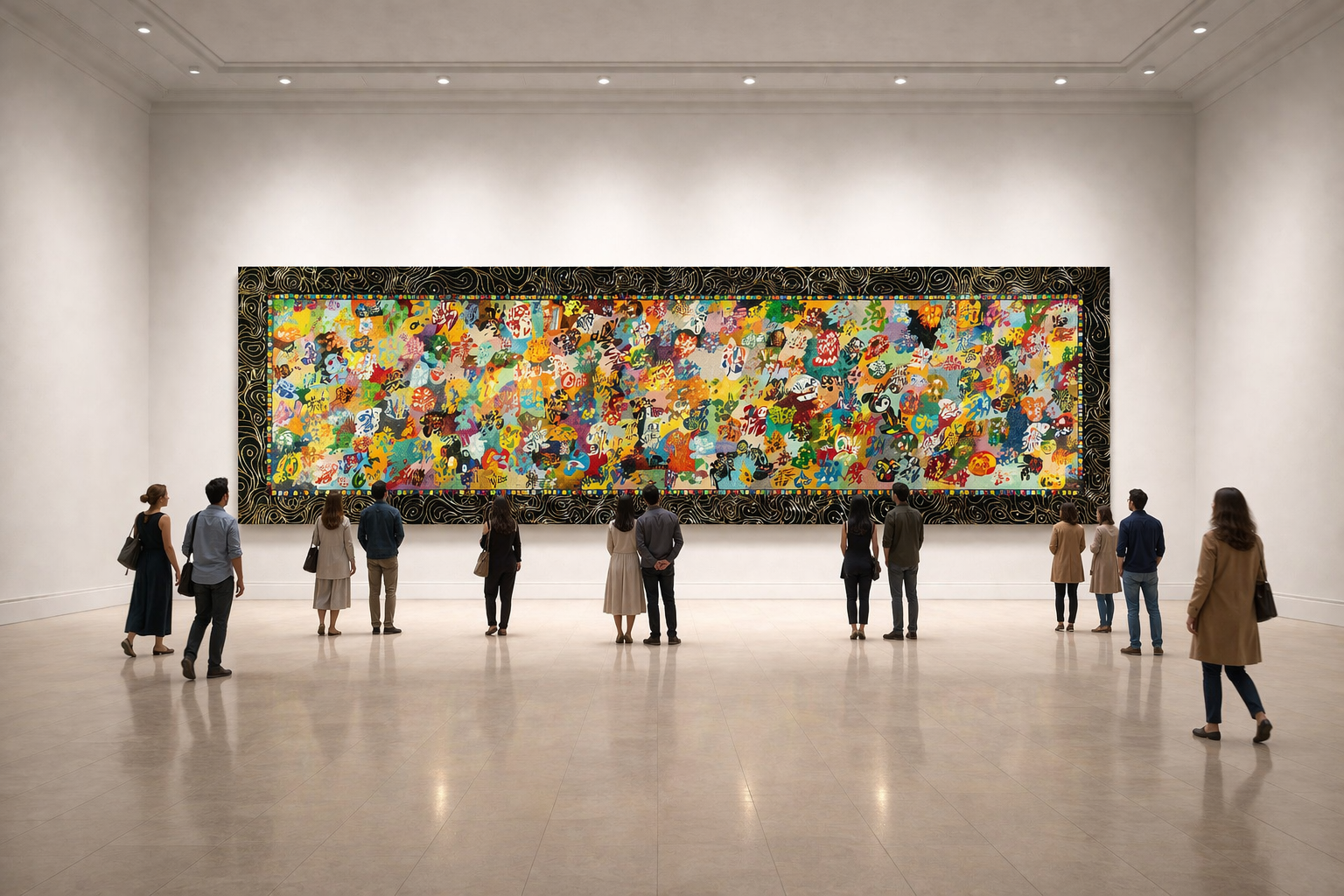
At over twelve meters in length, the scale of Divine DNA reinforces its ambition. Yet its impact lies equally in its detail—in the sustained attention required to engage with its density and structure. The painting does not prescribe interpretation; instead, it invites examination, offering itself as a complete system whose meaning emerges through encounter.
This catalogue presents Divine DNA not only as an individual work, but as a singular proposition: that the diversity of the world may be conceived as structured, unified, and indivisible, without loss of specificity.
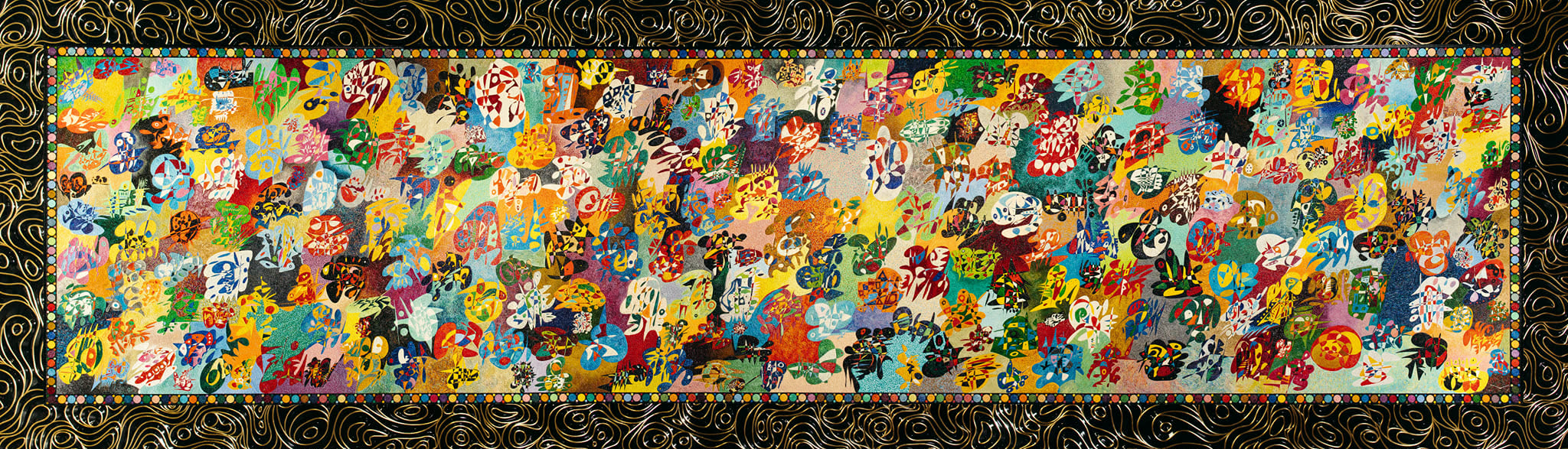
Divine DNA (2010–2016) is a monumental oil painting measuring 300 × 1240 cm, composed as a continuous panoramic field. The work consists of 249 distinct abstract icons, each representing a specific nation. Every form is unique and non-repeating, with its morphology and color structure determined to encode the defining characteristics and identity of the country it corresponds to.
The composition is organized according to a deliberate spatial system in which nations are positioned in relation to ethnographic and cultural proximities. These relationships form interconnected groupings across the surface, unified by an active background that integrates all elements into a continuous visual field.
An enclosing border frames the composition, functioning as both boundary and unifying structure. Developed as an integral component of the work, it reinforces the cohesion of the system while maintaining its internal complexity.
Entirely predetermined in conception, the painting operates as a closed system in which all elements are fixed and interdependent. Through its scale, density, and structural logic, Divine DNA presents a comprehensive visual encoding of global human diversity within a unified framework.
Divine DNA is conceived as a complete visual system in which global human diversity is translated into a structured and unified form. The work operates through a fixed set of 249 abstract icons, each representing a nation and encoding its identity through distinct morphology and color. This approach positions the painting as a form of visual language, where differentiation functions as meaning and each element contributes to a broader system of signification.¹
The conceptual foundation of the work lies in the analogy to a genetic code. Like DNA, which organizes complex biological diversity through a finite set of structures, Divine DNA proposes a model in which nations exist as discrete yet interdependent units within a larger order. This framing shifts the understanding of global identity from fragmentation toward structural coexistence, suggesting that difference operates within, rather than against, unity.²
The spatial organization of the composition reinforces this premise. Nations are arranged according to ethnographic and cultural relationships, forming clusters that reflect proximity without reliance on geographic mapping. In this sense, the work departs from conventional cartographic representation and instead constructs an alternative system of global visualization—one that emphasizes relational structure over territorial division.³
At the level of interpretation, Divine DNA engages with broader questions of classification, order, and knowledge. The painting can be understood as an attempt to construct a total system in which all elements are accounted for and positioned within a coherent framework. Such an approach recalls theoretical models in which systems of thought are defined not only by their contents, but by the relationships that organize them.⁴
The work also foregrounds the relationship between idea and form. Conceived in its entirety prior to execution, the painting embodies a translation from mental structure to material object. This process situates Divine DNA within a conceptual lineage in which the primacy of the idea defines the work, and the act of making becomes a realization of a predetermined system.⁵
Perceptually, the painting operates through a dual experience. From a distance, it presents a unified visual field; at close range, it reveals a dense multiplicity of distinct elements. This oscillation between totality and detail reflects the central conceptual tension of the work: that unity is not the reduction of difference, but its simultaneous presence within a single structure.⁶
The enclosing border further reinforces this interpretation. Functioning as both boundary and connective field, it defines the limits of the system while maintaining its internal cohesion. As such, it can be understood as a structural analogue to the concept of unity itself—an element that contains without dividing.
Ultimately, Divine DNA does not prescribe a singular meaning. Instead, it presents a complete and internally consistent system through which viewers may consider the relationships between identity, structure, and coexistence. Its interpretation unfolds through engagement, as the viewer navigates the encoded complexity of the work and reflects on the model of the world it proposes.
Gheorghe Virtosu is a contemporary artist whose work is grounded in the construction of complex visual systems that examine identity, structure, and global interconnectedness. Working primarily in painting, his practice is defined by the integration of abstraction and symbolic encoding, resulting in compositions that function as both images and structured conceptual frameworks.
Virtosu’s work is characterized by high-density compositions, non-repetitive formal elements, and a precise approach to color and morphology. Rather than relying on improvisation, his process is rooted in predetermined systems developed over extended periods of conceptual refinement. This methodology positions his paintings as closed structures in which each element is fixed and interdependent.
A central concern in Virtosu’s practice is the translation of complex cultural and geopolitical realities into unified visual forms. His works often operate at the intersection of abstraction and representation, where symbolic elements encode specific meanings while contributing to an overarching structural logic.
Developed in relative isolation and without direct reliance on established artistic lineages, Virtosu’s practice reflects a singular and internally consistent approach to image-making. His paintings invite sustained engagement, requiring viewers to navigate layered systems of meaning and consider the relationships embedded within them.
Divine DNA is executed in oil on canvas at a monumental scale (300 × 1240 cm). The work’s extended horizontal format required a modular and sequential approach to production, while maintaining strict adherence to a predetermined compositional system.
The surface is characterized by:
- High-density micro-compositional structuring, with each icon individually delineated
- Layered paint application, allowing for precise color calibration and edge definition
- Controlled brushwork, balancing clarity of form with overall visual cohesion
Given the absence of repetition across 249 distinct elements, the execution demanded sustained precision over an extended period. The consistency of scale, spacing, and chromatic intensity across the composition indicates a methodical working process aligned with the original conceptual schema.
The border, integral to the work, demonstrates a separate but related technical treatment. Its continuous, rhythmic patterning suggests iterative development while maintaining uniform visual tension across the entire perimeter.
The painting’s material stability is supported by the inherent durability of oil on canvas; however, due to its size, considerations for display, transport, and storage require specialized handling and structural support.
Artist: Gheorghe Virtosu
Medium: Oil and acrylic on linen canvas
Dimensions: 3 × 12.4 m
Divine DNA unfolds as a continuous panoramic field structured through a dense arrangement of 249 non-repeating abstract icons. The composition resists a central focal point, instead operating through distributed attention, encouraging the viewer to engage with the work through sustained visual navigation.
Each form is distinct in color and morphology, contributing to a complex yet cohesive system in which variation is balanced by overall structural unity. The spatial organization reflects relational groupings, creating zones of visual association without disrupting the continuity of the pictorial field.
The enclosing border establishes a rhythmic perimeter that both contains and integrates the composition, reinforcing its unity while maintaining internal complexity. The interplay between micro-level detail and macro-level structure defines the visual experience, oscillating between multiplicity and coherence.
Divine DNA employs a complex interplay of color and form to encode meaning at both individual and systemic levels. Each of the 249 icons uses distinct chromatic and morphological characteristics to represent a specific nation, ensuring visual differentiation within the unified field. The background integrates these elements, creating continuity while highlighting relational groupings based on cultural and ethnographic proximity.
The painting’s border functions as both a frame and connective structure, providing visual cohesion and reinforcing the overall composition. Through this careful orchestration of color, form, and placement, the work achieves a balance between individuality and totality, inviting viewers to explore both detailed elements and the global structure simultaneously.
Divine DNA encodes global identity through 249 distinct abstract icons, each representing a nation with unique colors and forms. The composition’s arrangement reflects ethnographic and cultural relationships, creating a continuous visual system in which diversity exists within unity. The enclosing border functions as both a boundary and a connective framework, reinforcing cohesion across the expansive surface.
The work’s symbolism operates on multiple levels: as a conceptual map of human diversity, as a visual language, and as an analogue to a genetic code, where each element is discrete yet interdependent. The dense layering of forms invites close observation, rewarding the viewer with a dynamic interplay of detail and totality.¹
Divine DNA presents a comprehensive visual system in which 249 unique icons encode the identity of individual nations. Each element is fixed, non-repeating, and positioned according to cultural and ethnographic relationships, forming a unified yet differentiated structure.¹
The work operates conceptually like a genetic code, translating global diversity into a single, interdependent framework.² Its enclosing border functions as a unifying element, reinforcing cohesion while maintaining internal complexity. The painting challenges conventional cartography, proposing a relational model of global identity through abstraction.³
Viewers encounter both totality and detail: from afar, the composition reads as a continuous field; up close, its multiplicity emerges.⁴ In this way, Divine DNA embodies a closed, internally coherent system, inviting reflection on the coexistence of difference and unity.
Divine DNA engages viewers on both an intellectual and perceptual level. Its monumental scale and dense composition evoke a sense of awe and contemplation, while the intricate, non-repetitive icons invite close observation. The oscillation between totality and detail produces a dynamic viewing experience, reflecting the coexistence of unity and diversity.
The painting’s rhythmic border and continuous background foster a subtle sense of cohesion and balance, grounding the viewer in the structured complexity of the work. Emotional responses emerge through the interaction of color, form, and relational positioning, encouraging reflection on global interconnectedness and the simultaneous individuality of nations.
- The number of icons (249) corresponds to the total number of nations conceived by the artist at the time of the work’s development, forming a complete and finite system.
- The conceptual framework of Divine DNA was formulated in 2006 and developed mentally over a four-year period prior to execution (2010–2016).
- Each icon is unique and non-repeating, with its form and color encoding specific attributes associated with an individual nation.
- The spatial arrangement reflects ethnographic and cultural relationships rather than geographic cartography.
- The border functions as a unifying structural element and was developed through prolonged iterative refinement.
- The work is defined as a closed system; all elements are predetermined and fixed prior to execution.
- Foucault, Michel. The Order of Things: An Archaeology of the Human Sciences. New York: Pantheon Books, 1970.
- Gombrich, E. H. Art and Illusion: A Study in the Psychology of Pictorial Representation. Princeton: Princeton University Press, 1960.
- Manovich, Lev. The Language of New Media. Cambridge, MA: MIT Press, 2001.
- Benjamin, Walter. The Work of Art in the Age of Mechanical Reproduction. 1936.
- Barthes, Roland. Image Music Text. New York: Hill and Wang, 1977.
- Wood, Denis. The Power of Maps. New York: Guilford Press, 1992.
Curatorial Team: Daniel Varzari
Photography: El Arte Monumental
Special Thanks: Daniel Varzari, Gheorghe Virtosu
El Arte Monumental
08007 Barcelona
Phone: +34 934 439 470/ +01 312 358 8023