The Architecture of Identity
El Arte Monumental | Catalogue: The Architecture of Identity
Catalogue Entry: The couple of the universe (2016) | Art Curator: Daniel Varzari
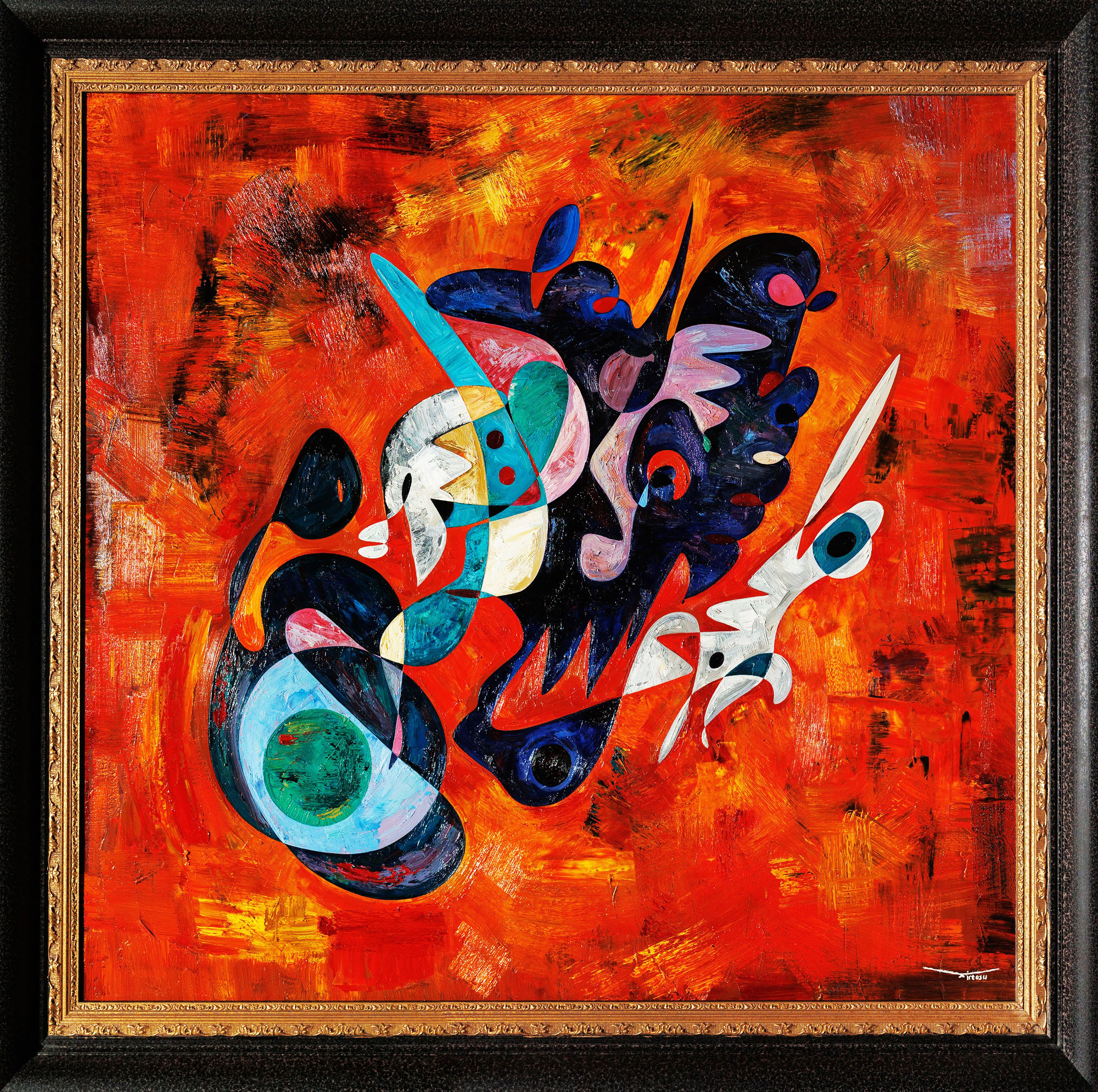
Gheorghe Virtosu’s The Couple of the Universe (2006) advances a cosmological dimension within his broader investigation of abstraction as a system of relations rather than representation. The work departs from any figurative or allegorical reading of “the couple,” proposing instead a field in which duality operates as a generative principle. Through an intense chromatic environment and a dense configuration of interlocking forms, Virtosu constructs a pictorial space where interaction, opposition, and mutual dependency supersede stable identity. The painting thus reframes unity not as synthesis, but as a dynamic equilibrium of forces held in continuous tension.1
What unfolds across the surface is a condition of perceptual flux, in which forms emerge, fragment, and recombine without settling into fixed hierarchies. The viewer encounters a network of shifting correspondences—suggestions of faces, bodies, and gestures that appear only to dissolve into the surrounding field. This instability situates perception itself as an active process, requiring sustained engagement to navigate the painting’s internal logic. Virtosu thereby transforms the act of viewing into a participatory negotiation, where meaning is not given but continuously produced through relational movement across the canvas.2
Within the trajectory of Virtosu’s practice, The Couple of the Universe marks a pivotal articulation of abstraction as a philosophical framework. Here, the painting becomes a model of interconnected becoming, where difference and interdependence coexist without resolution. By dissolving the boundaries between figure and ground, subject and environment, the work proposes a vision of reality structured through interaction rather than isolation. In doing so, it extends the language of abstraction into a speculative domain, where the pictorial field operates as both image and system.3
The Couple of the Universe (2006) is a large-scale oil on canvas composition structured around a near-square format (1.69 × 1.66 meters). The painting is dominated by an intense, luminous red ground, built through layered applications of pigment that create a textured and visually active surface. Across this field, a dense constellation of biomorphic and geometric forms coalesces at the center, extending outward in multiple directions. These forms—rendered in deep blues, turquoise, white, black, and accents of pink—interlock and overlap, generating a composition that resists a single focal point while maintaining a strong internal cohesion.
The central configuration suggests fragmented figural elements: profiles, eyes, and gestural contours briefly emerge within the abstract structure. On the left, curved shapes and circular forms evoke a sense of rotation or containment, while on the right, sharper, elongated elements introduce directional movement and tension. Darker masses anchor the composition, contrasting with lighter, more fluid passages that appear to hover or dissolve into the surrounding red field. The interplay between these elements produces a rhythmic oscillation between density and openness, guiding the viewer’s gaze across the surface without settling.
The surface handling alternates between broad, expressive brushwork in the background and more controlled, defined applications in the central forms. Edges shift between crisp delineation and soft diffusion, allowing forms to merge and separate in a continuous visual flow. The absence of perspectival depth and the distribution of visual weight across the canvas create an all-over composition, encouraging sustained visual exploration. As a result, the painting functions as both a cohesive whole and a field of evolving relationships, where form, color, and gesture remain in constant interaction.
The Couple of the Universe (2006) articulates a conception of duality that is neither relational in the conventional figurative sense nor symbolic in a traditional allegorical register. Instead, Gheorghe Virtosu constructs a cosmological field in which “couplehood” operates as a structural principle of interaction between forces. The painting replaces representation of subjects with the staging of relational dynamics, positioning existence itself as contingent upon continuous negotiation between opposing yet interdependent systems. In this sense, the work shifts interpretation away from narrative content toward ontological process.1
The intense red ground functions as more than chromatic backdrop; it operates as a totalizing energetic field within which all formal articulation occurs. Rather than receding, the background asserts itself as an active condition of visibility, producing a sense of environmental saturation. Within this field, forms appear not as objects placed in space but as emergent events generated by internal tensions. The result is a pictorial logic in which figure and environment are no longer separable categories.2
The painting’s compositional structure is governed by oscillation rather than hierarchy. Curvilinear and angular elements intersect without stabilizing into fixed configurations, generating a condition of perpetual recombination. This instability produces a visual system in which meaning is deferred, as each perceived structure is immediately recontextualized by adjacent forms. The viewer is thus confronted with a field of constant becoming rather than resolved composition.3
Fragmented figural traces—eyes, profiles, and partial anatomies—surface intermittently within the abstract matrix, suggesting the persistence of subjectivity without allowing it to consolidate. These elements function as perceptual residues rather than identifiable characters, embedded within a broader system that resists individuation. In this respect, the “couple” is not a pair of figures but a distributed condition of mutual emergence. Identity becomes relational, contingent upon proximity, interference, and dissolution.1
Chromatic contrast plays a structural role in articulating the painting’s conceptual framework. The dominance of red is punctuated by cooler tones—blue, white, and deep black—which act as vectors of interruption and differentiation. These color tensions establish a rhythm of expansion and contraction across the surface, reinforcing the sense of a system governed by dynamic equilibrium rather than compositional stability. Color operates here as both emotional intensity and structural logic.2
From a conceptual standpoint, the work can be read as a visual hypothesis regarding the nature of relational existence. It proposes that entities do not precede interaction but are constituted through it, and that unity is always provisional, maintained through ongoing tension rather than synthesis. The painting thus resists closure, offering instead a model of reality defined by continuous transformation. Interpretation is therefore not directed toward resolution, but toward sustained engagement with instability as a generative condition.3
Ultimately, The Couple of the Universe situates abstraction as a method for thinking relational systems beyond representation. It does not depict a universe containing a couple, but rather proposes coupling as a universal principle of structure and becoming. In doing so, Virtosu extends painting into a speculative domain in which visual form becomes a site for examining the conditions through which relation itself is produced.
Gheorghe Virtosu | Artist Biography
Gheorghe Virtosu is a contemporary painter whose practice is grounded in the investigation of abstraction as a structural and philosophical system rather than a purely visual language. Working primarily in large-scale oil on canvas, he develops complex pictorial environments in which biomorphic and geometric forms coexist within densely layered fields of tension and transformation. His works resist narrative closure, instead proposing dynamic systems in which meaning emerges through relational interaction rather than representation.1
Across his practice, Virtosu consistently engages with themes of fragmentation, multiplicity, and the instability of perceptual and conceptual boundaries. His paintings frequently evoke conditions of simultaneity, where opposing forces—order and entropy, coherence and dissolution—are held in productive suspension. Rather than illustrating external events or figures, he constructs autonomous visual systems that function as analogues for broader philosophical inquiries into identity, structure, and becoming.2
Virtosu’s work positions the viewer as an active participant within the pictorial field, requiring sustained perceptual negotiation rather than passive observation. Through this immersive engagement, his practice aligns painting with systems thinking, phenomenology, and contemporary theories of relational ontology. In doing so, he expands the possibilities of abstraction as a mode of inquiry into how reality itself may be understood as a continuously evolving network of interdependent forces.3
Executed in oil on canvas (H 1.69 m × W 1.66 m), The Couple of the Universe is constructed through a layered painting process in which dense pigment application alternates with more open, gestural passages. The surface is built up through successive strata, allowing chromatic intensity to accumulate while preserving a sense of underlying volatility. Rather than producing a unified optical field, Virtosu maintains visible traces of process—brushwork, scraping, and overpainting—that reinforce the painting’s structural instability.1
The composition is organized without linear perspective or fixed focal hierarchy. Instead, spatial coherence is generated through adjacency, overlap, and chromatic contrast. Biomorphic and geometric elements are interwoven across the surface, their edges alternately sharp and dissolved, producing a rhythmic oscillation between definition and dispersion. The saturated red ground functions as an active structural field rather than passive background, continuously modulating the interaction of forms.2
Materially, the work relies on controlled tension between opacity and translucency. Dense passages of paint establish zones of visual gravity, while thinner applications allow underlying layers to remain partially visible, creating a sense of depth without illusionistic recession. This interplay produces a dynamic surface in which perception is constantly recalibrated, reinforcing the painting’s conceptual emphasis on relational instability and continuous transformation.3
Artist: Gheorghe Virtosu
Medium: Oil on canvas
Dimensions: H 1.69 m × W 1.66 m
The visual composition of The Couple of the Universe is organized as a tightly interwoven field in which no single axis or focal point governs perception. Instead, the painting unfolds as a centrifugal structure, where biomorphic and geometric forms cluster, collide, and disperse across a saturated red ground. This chromatic field functions as an active spatial agent rather than a passive background, intensifying the sense of visual pressure and continuous motion. Forms appear suspended in a state of dynamic equilibrium, where stability is perpetually deferred in favor of transformation and reconfiguration.1
The internal logic of the composition is defined by oscillation between containment and expansion. Curvilinear elements suggest organic growth and fluidity, while angular interventions introduce disruption and directional force, producing a rhythm of interruption across the pictorial surface. These contrasting formal languages are not resolved but held in productive tension, generating a structure in which perception is continuously redirected. The absence of hierarchical ordering compels the viewer to construct relational pathways across the canvas, assembling meaning through movement rather than fixed reading.2
Figurative residues emerge intermittently within the abstraction—suggestions of eyes, profiles, and bodily fragments—yet these never coalesce into stable identities. Instead, they function as transient perceptual nodes within a broader system of visual interaction. The composition thus resists closure, operating as a field of potential relations rather than determinate forms. In this sense, the artwork can be understood as a model of visual complexity, where composition itself becomes a process of continual differentiation and reconfiguration.3
In The Couple of the Universe, color operates as the primary structural agent rather than a descriptive attribute. The dominant field of saturated red establishes an atmospheric totality in which all forms are embedded, eliminating the distinction between background and figure. Within this chromatic intensity, cooler accents of blue, white, turquoise, and black emerge as counter-forces, introducing zones of visual resistance and modulation. Rather than functioning as localised highlights, these tonal interruptions act as structural tensions that organize perception across the entire surface.
Form in the painting is defined through instability and transformation rather than fixed contour. Biomorphic and geometric elements interlock in shifting configurations, producing a continuous negotiation between coherence and dissolution. Edges are deliberately ambiguous: some forms assert themselves with sharp articulation, while others dissolve into the chromatic field, creating a visual rhythm of emergence and withdrawal. This oscillation prevents any single structure from achieving dominance, ensuring that form remains contingent upon its relational context.
The interaction between color and form generates a unified but non-hierarchical pictorial system. Color does not fill form, nor does form contain color; instead, both operate as interdependent forces that co-produce spatial and perceptual effects. The result is a surface that resists static reading, compelling the viewer to navigate continuously between chromatic intensity and structural fragmentation. In this dynamic equilibrium, Virtosu constructs a visual field in which meaning arises not from representation, but from the tension and reciprocity between its constitutive elements.
In The Couple of the Universe, symbolism emerges not through iconographic stability but through a system of recurrent visual tensions in which form itself becomes referential. The painting’s central cluster of interlocking shapes can be read as a field of relational symbols, where circular and angular structures coexist as opposing yet interdependent principles. The circular forms suggest cycles, continuity, and cosmological totality, while the fractured angular elements introduce disruption, separation, and kinetic interruption. Rather than resolving into a unified allegory, these symbolic registers remain in productive contradiction, generating meaning through their ongoing interaction rather than through fixed representation.1
Imagery within the work operates at the threshold between recognition and dissolution. Fragmented suggestions of eyes, profiles, and bodily contours intermittently surface within the compositional density, invoking the presence of sentient life without allowing it to stabilise into identifiable figures. These partial visual cues function as perceptual triggers rather than narrative devices, activating the viewer’s interpretative faculties while resisting closure. The imagery is therefore neither purely abstract nor figurative, but oscillates between states of legibility and erosion, reflecting a visual logic grounded in transformation rather than depiction.2
The overarching symbolic structure of the painting can be understood as cosmological rather than anthropomorphic. The intense red field functions as a universal substrate, a spatial equivalent of primordial energy within which all forms emerge and dissolve. Against this charged ground, contrasting chromatic zones articulate zones of differentiation, suggesting gravitational fields, energetic poles, or elemental forces in dynamic equilibrium. In this sense, imagery and symbolism converge into a single system: a visual cosmology in which meaning arises not from representation of the world, but from the articulation of its underlying relational principles.3
The Couple of the Universe (2006) can be understood as a speculative model of relational ontology translated into pictorial form. Rather than presenting a couple as a representational motif, Virtosu constructs “coupling” as a structural condition in which identity only becomes legible through interaction. The composition refuses stable figure-ground hierarchies, instead distributing visual agency across a network of interdependent forms. In this sense, the work does not depict relationships; it enacts them as a continuous process of emergence and dissolution within a saturated chromatic field.1
The painting’s conceptual force lies in its refusal of closure. Fragmented biomorphic and geometric elements operate as provisional nodes of recognition—suggesting bodies, eyes, or gestures—yet none achieve autonomy. These partial formations are continuously absorbed back into the surrounding field, producing a system in which perception oscillates between recognition and disintegration. The viewer is positioned not as external observer but as an active participant in the construction of meaning, compelled to assemble and reassemble relational constellations that remain fundamentally unstable.2
Read within Virtosu’s broader practice, the work articulates abstraction as a philosophical method rather than a stylistic choice. The intense red ground functions as an ontological substrate: a condition of intensity from which differentiation arises. Against this field, contrasting chromatic and formal structures generate a dynamic equilibrium of forces that resists narrative resolution. The “couple” thus expands beyond human relationality into a universal principle of co-constitution, where being is defined not by separation, but by continual entanglement within a unified yet heterogeneous system.3
The Couple of the Universe (2006) operates within an emotional register defined less by narrative sentiment than by affective intensity distributed across a destabilized field. The painting does not articulate emotion through identifiable expression or figural psychology; instead, it generates feeling as a systemic condition embedded in color, movement, and compositional pressure. The saturated red ground functions as an atmospheric catalyst, producing an immediate sense of urgency and heightened perception, while the interlocking forms introduce moments of tension, proximity, and rupture that never fully resolve into calm or closure. Emotion here is not represented—it is activated through visual encounter.1
Within this unstable environment, affect emerges as oscillation rather than state. The viewer encounters shifting impressions of attraction and resistance, coherence and disintegration, intimacy and estrangement. Fragmented visual suggestions—eyes, contours, partial bodies—trigger fleeting empathic recognition, only to withdraw into abstraction moments later. This rhythm of emergence and disappearance produces a psychological condition akin to suspended interpretation, where emotional response is continuously initiated but never stabilized. The painting thus stages affect as a process of continual modulation rather than resolution.2
Ultimately, the work constructs an emotional field that mirrors its conceptual structure: relational, unstable, and perpetually in formation. Rather than guiding the viewer toward a singular emotional reading, Virtosu disperses affect across multiple registers of intensity, compelling sustained engagement and perceptual recalibration. In this sense, emotional experience becomes inseparable from spatial and chromatic dynamics, positioning the viewer within a condition where feeling is produced through movement across the pictorial system itself. The result is an affective environment that resists containment, unfolding as an ongoing negotiation between perception and sensation.3
- Gilles Deleuze and Félix Guattari, A Thousand Plateaus: Capitalism and Schizophrenia. University of Minnesota Press, 1987. The notion of assemblage informs readings of relational structures in contemporary abstraction.
- Maurice Merleau-Ponty, Phenomenology of Perception. Routledge, 1962. The concept of embodied perception underpins the viewer’s active construction of meaning in unstable visual fields.
- Gilbert Simondon, Individuation in Light of Notions of Form and Information. University of Minnesota Press, 2020. The theory of individuation provides a framework for understanding identity as process rather than fixed state.
Selected Bibliography
- Deleuze, Gilles, and Félix Guattari. A Thousand Plateaus.
- Buber, Martin. I and Thou.
- Merleau-Ponty, Maurice. Phenomenology of Perception.
- Simondon, Gilbert. Individuation in Light of Notions of Form and Information.
- Krauss, Rosalind. The Originality of the Avant-Garde and Other Modernist Myths.
Curatorial Team: Daniel Varzari
Photography: El Arte Monumental
Special Thanks: Daniel Varzari, Gheorghe Virtosu
El Arte Monumental
08007 Barcelona
Phone: +34 934 439 470/ +01 312 358 8023