The Architecture of Identity
El Arte Monumental | Catalogue: The Architecture of Identity
Catalogue Entry: The Protector of Humanity (2017) | Art Curator: Daniel Varzari
Gheorghe Virtosu’s The Protector of Humanity (2017) advances a critical position within contemporary abstraction by reframing protection not as an iconographic motif, but as a systemic condition. Rather than presenting a singular guardian figure, the painting distributes agency across a complex visual field, where interlocking forms and chromatic sequences operate as a network of interdependent relations. In doing so, Virtosu displaces the traditional logic of representation and proposes a model in which meaning emerges through interaction, tension, and continuous recalibration.1
The work situates the viewer within an environment of perceptual flux. Forms suggest fleeting anthropomorphic traces—profiles, eyes, gestures—yet these dissolve into the surrounding structure before stabilizing into identity. Vertical chromatic bands introduce an underlying order, but this order is persistently disrupted by overlapping geometries and biomorphic intrusions. The result is a field in which perception must remain active, navigating a shifting balance between coherence and fragmentation, presence and dispersion.2
Within the broader trajectory of Virtosu’s practice, The Protector of Humanity can be understood as a foundational articulation of New Perfectionism. Here, abstraction becomes a method for modeling complex systems in which stability is never fixed but continually negotiated. The painting does not resolve into a final image; instead, it sustains a condition of dynamic equilibrium, suggesting that protection—like humanity itself—emerges from the ongoing interplay of forces rather than from any singular, stable form.3
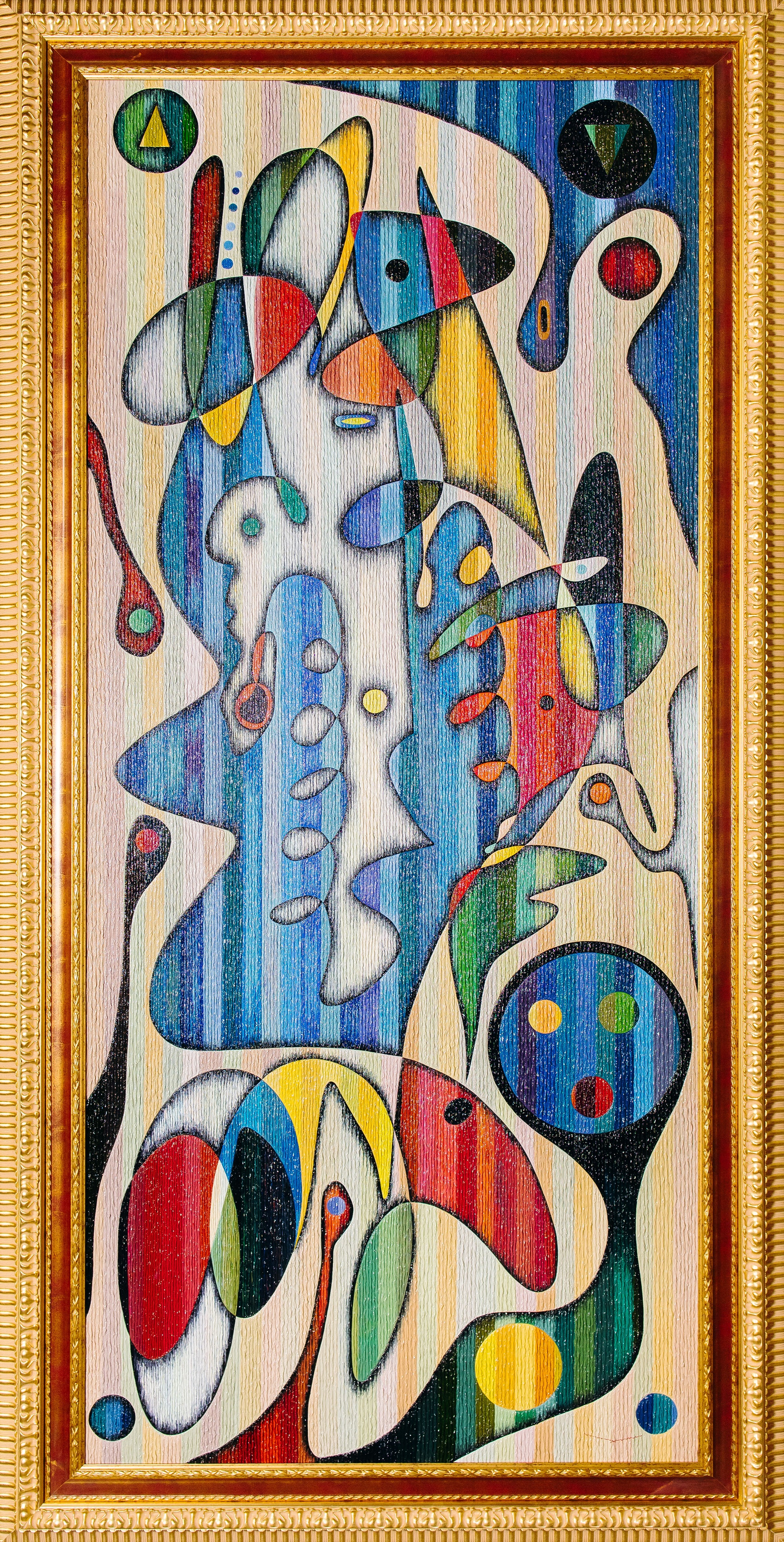
The Protector of Humanity (2017) by Gheorghe Virtosu presents a vertically oriented abstract composition in which a dense constellation of biomorphic and geometric forms unfolds across a field structured by fine chromatic striations. The surface is animated by elongated vertical bands that establish a continuous visual rhythm, over which elliptical shapes, angular fragments, and fluid contours intersect and overlap. These elements are distributed without a central focal point, creating a decentralized system in which the viewer’s gaze is guided through shifting alignments rather than fixed hierarchies.1
The composition suggests intermittent traces of figuration—profiles, eyes, and anatomical fragments—embedded within the abstract field. These forms remain unstable, oscillating between recognition and dissolution as they merge into surrounding structures. Spatial organization is articulated through layered zones: an upper region of sharper contrasts and concentrated forms, a densely interwoven central field of interaction, and a lower register where shapes expand and disperse. This stratification introduces a sense of simultaneous processes rather than linear progression, reinforcing the painting’s systemic character.2
Chromatically, the work is defined by a vivid interplay of primary and secondary colors—reds, blues, yellows, and greens—punctuated by black contours and lighter ground areas. High-saturation color regions function as visual anchors, while tonal transitions sustain continuity across the surface. The contrast between controlled linear striations and fluid, overlapping forms generates a tension between order and disruption, producing a dynamic equilibrium that defines the painting’s overall visual structure.3
The Protector of Humanity (2017) articulates a conceptual shift from representational symbolism toward systemic ontology, positioning protection as an emergent property of relational complexity rather than a fixed attribute embodied in a singular figure. Within the framework of New Perfectionism, the painting proposes that meaning arises through the interaction of distributed elements, each contributing to a dynamic equilibrium that resists closure. The absence of a central protagonist is not a negation of subjectivity, but a reconfiguration of it into a networked condition, where agency is dispersed and continuously negotiated across the pictorial field.1
The vertical stratification that organizes the composition may be interpreted as a temporal and energetic continuum, evoking processes of flow, transmission, and persistence. These chromatic bands establish a latent order analogous to a systemic infrastructure; however, their continuity is disrupted by superimposed forms that traverse, intersect, and recalibrate the field. This tension between continuity and interruption reflects a key principle in systems theory: that stability is not a static condition but the outcome of ongoing adaptive processes within complex environments.2
The interplay between biomorphic and geometric forms introduces a dialectic between organic variability and structural constraint. Curvilinear shapes suggest processes of growth, mutation, and fluid adaptation, while angular and elliptical configurations impose moments of alignment and control. Rather than resolving this opposition, the painting sustains it, producing a condition in which form is continuously negotiated. This aligns with Gilles Deleuze’s concept of difference as productive multiplicity, where identity emerges not from sameness but from the continuous variation of relational forces.3
Perceptually, the work operates within the logic of the open work, as theorized by Umberto Eco, in which meaning is not predetermined but constructed through active engagement. The viewer encounters shifting configurations that suggest anthropomorphic fragments—faces, eyes, and bodily contours—yet these elements remain unstable, dissolving into abstraction as perception moves across the surface. This oscillation between recognition and indeterminacy transforms the act of viewing into a participatory process in which interpretation is continually formed and reformed.4
Chromatically, the painting deploys primary colors as nodes of intensity within a broader field of modulation. Red, blue, and yellow function not as symbolic codes within a fixed semiotic system, but as dynamic signals that organize attention, mark transitions, and generate points of tension within the composition. The juxtaposition of saturated and muted regions produces a rhythmic alternation between compression and expansion, reinforcing the painting’s systemic logic of balance and disruption.5
The notion of “protection” in this work can be interpreted through the lens of distributed systems and network resilience. Rather than depicting defense as a boundary or barrier, the painting models it as an emergent condition arising from the density and interconnectivity of its elements. Protection becomes synonymous with adaptability: the capacity of the system to absorb, redistribute, and transform external pressures without collapsing into disorder. In this sense, the painting operates as a visual analogue to contemporary theories of resilience in ecological and technological systems.2
Ultimately, The Protector of Humanity challenges the epistemological assumptions of traditional image-making by proposing that abstraction can function as a mode of systemic knowledge. Within New Perfectionism, the work exemplifies a shift from representation to enactment: it does not depict a condition of protection, but performs it through the continuous negotiation of its internal relations. The painting thus becomes a site in which perception, structure, and meaning converge, offering a model of humanity as an adaptive, interconnected system rather than a fixed or unified entity.1
Gheorghe Virtosu | Artist Biography
Gheorghe Virtosu is a contemporary painter whose work investigates abstraction as a systemic and philosophical structure. His practice centers on the translation of complex relational networks into visual form, where geometric and biomorphic elements interact within highly organized yet fluid compositions. Working primarily in oil on canvas, he develops layered surfaces that emphasize process, emergence, and the continuous reconfiguration of form.
Central to Virtosu’s approach is the conceptual framework of New Perfectionism, which defines abstraction as a condition of structured complexity rather than formal reduction. Within this framework, his paintings function as dynamic systems in which coherence arises through interaction, tension, and adaptation. His works often engage with philosophical, historical, and systemic themes, reframing them through non-representational visual languages that resist fixed interpretation.
Operating at a monumental scale, Virtosu constructs immersive pictorial environments that require active perceptual engagement. His compositions do not present singular narratives or focal points; instead, they unfold as fields of distributed agency in which meaning is continuously negotiated. Through this approach, his work positions painting as both a conceptual model and an experiential space for understanding complexity in contemporary visual culture.
Executed in oil on canvas (239 × 134 cm), The Protector of Humanity adopts a vertically elongated format that reinforces its stratified compositional logic. The surface is structured through a sequence of fine vertical chromatic striations, likely achieved through layered glazing and controlled brushwork, which establish an initial visual scaffold. This underlying order is subsequently disrupted by superimposed abstract forms, creating a tension between linear continuity and compositional interruption that defines the painting’s systemic character.
The interaction between sharply defined contours and fluid, biomorphic shapes suggests a hybrid technique combining precise delineation with more fluid, gestural application of paint. Pigment appears to be built up in successive layers, allowing forms to emerge gradually while maintaining surface cohesion. The absence of traditional perspectival depth shifts emphasis toward planar relationships, where spatial complexity is generated through overlap, edge articulation, and chromatic contrast rather than illusionistic recession.
Chromatic organization functions as both a structural and dynamic element within the composition. High-saturation primary colors are strategically distributed as points of visual intensity, while intermediary tones mediate transitions and sustain continuity across the surface. Dark linear accents compress and define form boundaries, whereas lighter regions open zones of perceptual relief. This calibrated interplay of color and line produces a balanced yet unstable equilibrium, reinforcing the painting’s operation as a self-regulating visual system.
Artist: Gheorghe Virtosu
Medium: Oil and acrylic on linen canvas
Dimensions: H 2.39 m × W 1.34 m
The visual composition of The Protector of Humanity (2017) is structured as a vertically oriented systemic field in which chromatic layering functions as both scaffolding and circulation. Rather than organizing the canvas around a central focal point, Virtosu distributes visual intensity across interconnected zones, producing a condition of sustained perceptual mobility. Vertical striations establish an underlying rhythm of order, yet this structure is repeatedly interrupted by overlapping biomorphic and geometric forms that destabilize linear reading and reconfigure spatial hierarchy.1
Within this system, form operates less as representation than as event. Curvilinear shapes expand and contract across the surface, suggesting organic growth patterns, while sharper elliptical and angular elements introduce moments of compression and directional force. The interaction between these formal registers generates a continuous oscillation between stability and disruption, producing what can be understood as a visual ecology in which no element exists independently of its relational context. Depth is constructed through layering rather than perspective, reinforcing the painting’s rejection of classical spatial illusion in favor of a flat yet dynamic field of interactions.2
Chromatically, the work is organized around a triadic logic of red, blue, and yellow, interwoven with neutral tonal fields that mediate transitions and maintain systemic cohesion. Color does not function descriptively but structurally, acting as a regulatory mechanism that modulates tension, directs attention, and delineates zones of intensity. The result is a composition that behaves less like a static image and more like a self-regulating system, in which visual elements continuously negotiate balance through contrast, repetition, and displacement. In this sense, the painting exemplifies a procedural model of abstraction, where composition is understood as an ongoing process rather than a fixed arrangement.3
In The Protector of Humanity (2017), color operates as a primary structural agent rather than a descriptive layer, functioning as a system of modulation that organizes perception across the pictorial field. The vertical chromatic bands establish a foundational rhythm of continuity, evoking a latent grid that stabilizes the composition while simultaneously remaining porous to disruption. Within this framework, saturated hues—particularly reds, blues, and yellows—emerge as intensity nodes, generating localized pressure zones that guide visual movement and prevent the field from settling into optical equilibrium. Color is therefore not applied to form; rather, it produces form through differential relations of contrast, adjacency, and recurrence.1
The formal language of the painting is defined by a sustained negotiation between biomorphic fluidity and geometric constraint. Curvilinear shapes expand and contract across the surface like adaptive organisms, while elliptical and angular structures introduce moments of compression and directional force. This interplay generates a condition of controlled instability in which no single formal system dominates; instead, forms co-emerge through continuous interaction. The absence of a hierarchical compositional center reinforces this logic, dispersing visual weight across multiple interdependent zones and aligning the work with systemic models of distributed organization.2
The relationship between color and form ultimately produces a unified field of perceptual tension, where neither element can be isolated without loss of structural meaning. Chromatic variation shapes spatial perception, while formal articulation regulates chromatic flow, creating a recursive feedback loop between visual components. This reciprocity reflects a broader principle in New Perfectionism: that aesthetic coherence arises not from resolution, but from sustained interaction among heterogeneous elements. The painting thus operates as a self-regulating system in which color and form are co-dependent variables within an evolving perceptual structure.3
In The Protector of Humanity (2017), symbolism is no longer deployed as a stable code of reference but as a dynamic field of relational emergence. The composition resists iconographic fixation, instead distributing potential symbolic charge across biomorphic and geometric formations that intermittently suggest figures, organs, or protective structures without resolving into any definitive imagery. Within this system, “humanity” is not depicted but inferred as a dispersed presence, embedded within the interplay of overlapping shapes and chromatic tensions, where meaning is continuously deferred and reconstructed through perception.1
The imagery operates through a logic of partial recognition and controlled ambiguity. Curvilinear forms evoke bodily fragments—torsos, faces, or limbs—yet these remain abstracted through fragmentation and recontextualization within a broader structural field. Circular motifs may be read as nodes of containment or surveillance, while intersecting linear elements suggest thresholds, barriers, or connective pathways. Rather than functioning as fixed symbols, these elements operate as mutable signs whose meaning shifts according to spatial proximity, chromatic intensity, and viewer engagement.2
Chromatic symbolism plays a central role in structuring interpretive possibility. Warm saturated tones—reds and yellows—introduce zones of intensity, pressure, and energetic concentration, while cooler blues and greens establish regions of stabilization and continuity. Black contouring functions as both delimiter and absorber, compressing form while simultaneously enhancing its perceptual volatility. In this interplay, color becomes an operative system rather than a descriptive layer, constructing a symbolic environment in which protection, vulnerability, and coherence are experienced as shifting relational states rather than fixed meanings.3
The Protector of Humanity (2017) operates as a systemic redefinition of figuration in which “protection” is no longer treated as a narrative theme or allegorical function, but as an emergent structural condition. Within the framework of New Perfectionism, the painting replaces the idea of a central protective субъект with a distributed field of interdependent forms, where stability arises from continuous interaction rather than from fixed hierarchy. The visual system is therefore not descriptive but operational: it performs the very condition it conceptually proposes.1
The composition constructs meaning through controlled instability. Vertical chromatic organization suggests order and continuity, yet this structure is persistently disrupted by biomorphic and geometric intrusions that traverse the surface without resolution. Any suggestion of figuration remains partial and transient, producing a perceptual condition in which recognition is constantly deferred. In this sense, the viewer does not “read” the image but navigates it, participating in a shifting equilibrium between coherence and disintegration.2
Conceptually, the work aligns protection with systemic resilience rather than physical defense or symbolic guardianship. The painting models a condition in which multiple forces—chromatic, spatial, and formal—continuously negotiate balance, allowing the system to absorb and redistribute tension without collapse. This reframing situates humanity not as a represented subject but as a relational outcome of interconnected processes, reinforcing Virtosu’s broader proposition that abstraction can function as a form of structural knowledge rather than visual representation.3
The emotional register of The Protector of Humanity is structured less around affective narration than around sustained perceptual intensity. Rather than eliciting a singular emotional response, the work generates a fluctuating condition of attentional pressure, where recognition and disorientation operate simultaneously. The viewer is drawn into a state of interpretive instability in which emotional meaning is not delivered but continuously recalibrated through shifting visual relations. This produces a form of engagement that is closer to cognitive tension than to empathy in the conventional sense.1
Chromatic contrast plays a central role in this affective economy. Saturated reds introduce moments of urgency and rupture, while blues and greens establish zones of relative containment and continuity. These transitions do not resolve into emotional clarity; instead, they maintain a controlled oscillation between intensity and equilibrium. The result is an emotional field that resists catharsis, sustaining a condition of unresolved affect that mirrors the structural logic of the composition itself.2
Ultimately, the emotional experience of the work is systemic rather than expressive. Affect emerges from the viewer’s navigation of complexity, not from symbolic content or figurative cues. In this sense, emotionality is redistributed across the pictorial structure: it is embedded in rhythm, fragmentation, and relational tension. The painting does not represent feeling; it constructs the conditions under which feeling becomes an emergent property of perception itself.3
- Gilles Deleuze, Difference and Repetition (New York: Columbia University Press, 1994), develops a philosophy of difference as productive repetition, in which identity emerges through variation rather than stability.
- Ludwig von Bertalanffy, General System Theory (New York: George Braziller, 1968), establishes the foundational principles of systems theory, emphasizing interaction, feedback, and emergent stability in complex systems.
- Gilles Deleuze and Félix Guattari, A Thousand Plateaus (Minneapolis: University of Minnesota Press, 1987), introduce the concept of multiplicity and rhizomatic structures as alternatives to hierarchical organization.
- Umberto Eco, The Open Work (Cambridge, MA: Harvard University Press, 1989), theorizes artworks as open systems in which meaning is produced through active interpretation rather than fixed representation.
- Rudolf Arnheim, Art and Visual Perception (Berkeley: University of California Press, 1974), examines the psychological dynamics of visual balance, tension, and compositional structure in relation to color and form.
Selected Bibliography
- Arnheim, Rudolf. Art and Visual Perception. University of California Press.
- Bertalanffy, Ludwig von. General System Theory. George Braziller.
- Deleuze, Gilles. Difference and Repetition. Columbia University Press.
- Deleuze, Gilles & Guattari, Félix. A Thousand Plateaus. University of Minnesota Press.
- Eco, Umberto. The Open Work. Harvard University Press.
- Krauss, Rosalind. The Originality of the Avant-Garde and Other Modernist Myths. MIT Press.
- Virilio, Paul. War and Cinema. Verso Books.
Curatorial Team: Daniel Varzari
Photography: El Arte Monumental
Special Thanks: Daniel Varzari, Gheorghe Virtosu
El Arte Monumental
08007 Barcelona
Phone: +34 934 439 470/ +01 312 358 8023