The Architecture of Identity
El Arte Monumental | Catalogue: The Architecture of Identity
Catalogue Entry: The Protector of the Souls (2015) | Art Curator: Daniel Varzari
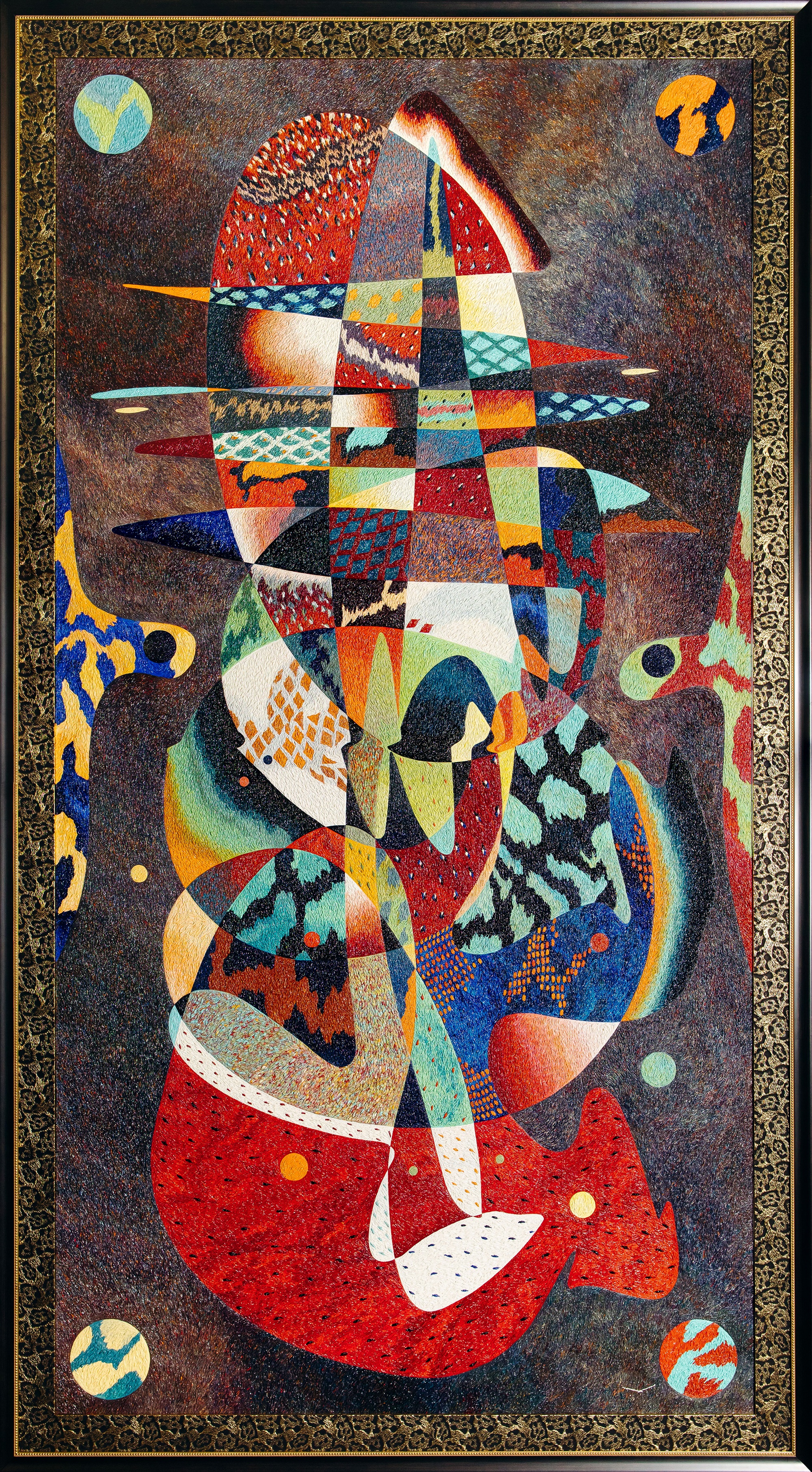
Gheorghe Virtosu’s The Protector of the Souls (2015) marks a critical moment in the evolution of his abstract language, where the notion of protection is no longer confined to symbolic representation but is instead reimagined as a condition of systemic interaction. The painting rejects the idea of the soul as a singular, stable entity, instead dispersing it across a dense and shifting field of forms. Through this redistribution, Virtosu proposes a vision of humanity in which interior experience is inseparable from the structures that contain and transform it.1
What confronts the viewer is a composition suspended between order and instability. A central vertical axis suggests symmetry and coherence, yet this structure is continuously unsettled by intersecting grids, biomorphic expansions, and chromatic intensities. Fragments of possible figuration surface only to dissolve back into abstraction, requiring the viewer to actively navigate the painting’s layered complexity. Perception becomes a process of negotiation, mirroring the fragile balance through which identity and consciousness are sustained.2
Within the broader trajectory of Virtosu’s practice, The Protector of the Souls can be understood as a foundational work leading toward the articulation of New Perfectionism. Here, abstraction emerges not as aesthetic reduction, but as a method for engaging the multiplicity of human experience. The painting does not resolve its tensions; instead, it sustains them, suggesting that protection—of the soul, of the self—is not achieved through stability, but through the continuous capacity to adapt, absorb, and transform.3
The Protector of the Souls (2015) presents a vertically oriented composition structured around a central axial division, where a dense aggregation of geometric and biomorphic forms coalesces into a unified yet internally fragmented figure. The surface is organized through a complex interplay of grid-like segmentation in the upper register and fluid, curvilinear expansion below, creating a layered visual field that oscillates between order and organic transformation. Patterned textures, chromatic blocks, and interlocking shapes generate a sense of compression at the core, while lateral extensions introduce movement and directional tension across the canvas, aligning with systemic models of distributed structure and adaptive organization.1
Color operates as a primary organizing force, with saturated reds, blues, yellows, and greens distributed across the composition in both concentrated and diffused zones. The lower register is dominated by a large red crescent-like form that anchors the painting, while cooler tonal passages and textured areas mediate transitions throughout the central field. The background, rendered through finely modulated speckled pigment, creates a continuous atmospheric ground that envelops the forms, enhancing both depth and surface unity, consistent with perceptual theories of visual balance and chromatic tension.2
Scattered circular motifs and patterned segments punctuate the composition, suggesting points of concentration within the broader field. The absence of a fixed focal point encourages the viewer’s gaze to move across the surface, navigating shifts in scale, density, and chromatic intensity. The painting maintains a balance between structural coherence and visual complexity, presenting an image that is simultaneously contained and expansive, stable and in flux, reflecting the logic of open systems in which meaning is continuously constructed through interaction.3
The Protector of the Souls (2015) can be understood as a complex meditation on interior multiplicity, where the “soul” is not treated as a unified metaphysical entity but as a stratified and dynamic system of perceptual, emotional, and structural relations. Within the emerging logic of New Perfectionism, the painting reframes interiority as a distributed field, in which identity is produced through interaction rather than contained within a stable core. The composition thus resists symbolic reduction, proposing instead that the human condition is inherently plural, unstable, and continuously reconfigured.1
The central vertical axis operates as both divider and mediator, evoking the classical notion of dualism while simultaneously undermining it. Rather than clearly separating opposing domains such as body and soul, or conscious and unconscious, the axis becomes a site of negotiation, where forms intersect, overlap, and destabilize binary distinctions. This produces a condition in which difference is not oppositional but relational, aligning with philosophical models that privilege interaction over fixed hierarchy.2
The grid-like structure in the upper register introduces a provisional system of order that suggests rationalization, classification, or cognitive mapping. Yet this structure is permeable and continuously disrupted by the intrusion of curved and irregular forms, indicating that no system of organization can fully contain the complexity of lived experience. The grid thus functions less as a controlling framework than as a temporary scaffold, subject to transformation by the very forces it seeks to regulate.3
Across the central and lower regions, biomorphic forms expand into a fluid topology that evokes processes of growth, mutation, and internal flux. These shapes resist anatomical clarity, instead operating as ambiguous signs of embodiment—simultaneously organic and abstract. The body, in this sense, is not represented as a fixed structure but as a site of ongoing negotiation, where internal states manifest through shifting configurations of form and color, aligning with philosophical models of becoming and continuous transformation.1
Chromatically, the painting intensifies its conceptual framework through the strategic deployment of saturation and contrast. The dominance of red in the lower register suggests accumulation, intensity, and affective weight, while cooler tones introduce zones of modulation and separation. These chromatic transitions generate a rhythmic oscillation between compression and release, reinforcing the idea that emotional and perceptual states are not static but fluctuate within a dynamic system of visual tension and balance.2
The notion of “protection” emerges not as enclosure but as resilience within complexity. Rather than shielding the “soul” from external forces, the painting proposes that protection arises through the capacity to sustain multiplicity without collapse. The interdependence of forms—each influencing and being influenced by others—creates a network of relations that stabilizes the system through continuous adaptation, reflecting principles found in systemic and ecological models of resilience.3
Ultimately, The Protector of the Souls anticipates the full articulation of New Perfectionism by foregrounding the processes through which systems form, destabilize, and reconstitute themselves. The painting does not resolve its internal tensions but sustains them as generative conditions, suggesting that meaning, identity, and stability emerge only through ongoing interaction. It is precisely this refusal of closure that positions the work as a critical exploration of abstraction—not as a departure from reality, but as a means of engaging its deepest structural and experiential complexities.1
Gheorghe Virtosu | Artist Biography
Gheorghe Virtosu is a contemporary painter whose practice is grounded in the exploration of complex systems, metaphysical structures, and the visual translation of abstract processes into painterly form. Working primarily in large-scale oil on canvas, his oeuvre is distinguished by a sustained inquiry into the conditions through which meaning, form, and perception emerge within dense pictorial environments.
Rather than adhering to a linear stylistic trajectory, Virtosu’s practice is characterized by a systematic approach to composition in which biomorphic, geometric, and gestural elements are continuously reorganized within field-based structures. His paintings often function less as representations of external reality and more as self-contained epistemic spaces in which visual elements operate as interdependent variables within a dynamic system.
Central to Virtosu’s work is an engagement with philosophical models of emergence, transformation, and relational ontology. His paintings frequently evoke processes associated with biological growth, technological assembly, and cosmological formation, yet resist reduction to any single interpretive framework. Instead, they operate as speculative visual propositions in which materiality and concept are inseparable.
Technically, Virtosu employs a layered methodology that emphasizes accumulation, erosion, and reconfiguration of painted surface. This approach produces compositions in which depth is not illusionistic but structural, generated through the interaction of chromatic density, directional gesture, and compositional tension. The viewer is thus positioned not as a passive observer but as an active participant in the unfolding perceptual field.
Across his practice, Virtosu maintains a consistent focus on the relationship between order and instability, coherence and fragmentation. His work situates itself within a broader discourse on post-representational painting, contributing to ongoing debates concerning the capacity of abstraction to articulate systems of thought that extend beyond narrative or symbolic containment.
The Protector of the Souls (2015) is executed in oil on canvas at a monumental scale (317 × 191 cm), a format that reinforces its architectural presence and intensifies the viewer’s bodily engagement with the pictorial field. The vertical orientation establishes a dominant axial structure that organizes compositional flow while simultaneously exposing it to destabilization through lateral expansion and internal segmentation. The support is prepared to sustain extensive layering, allowing for both dense chromatic accumulation and fine-grained modulation across the surface.
The painting is constructed through a multi-phase layering process in which underpainting, chromatic blocking, and surface articulation operate as interdependent stages rather than linear sequences. Oil medium is employed for its extended drying time and capacity for optical depth, enabling successive interventions that remain partially visible beneath subsequent applications. This results in a stratified pictorial field where earlier gestures persist as structural residues, contributing to the work’s sense of temporal accumulation and systemic density.
Surface articulation is achieved through a controlled interplay between geometric segmentation and biomorphic modulation. Hard-edged divisions are often softened through overpainting and blending, while organic forms are delineated with varying degrees of contour pressure, producing shifts between precision and dissolution. Chromatic application is used not merely for descriptive effect but as a structural device, with color fields functioning as vectors of spatial tension that organize perception across the canvas without resolving into a singular focal hierarchy.
Artist: Gheorghe Virtosu
Medium: Oil on canvas
Dimensions: H 3.17 m × W 1.91 m
The composition of The Protector of the Souls (2015) is organized around a dominant vertical axis that bisects the canvas while simultaneously generating a field of asymmetrical balance. This central alignment establishes a structural spine from which forms radiate outward in layered expansion, creating a dynamic interplay between centralization and dispersion. The upper register introduces a fragmented grid of chromatic units, whose rigid segmentation contrasts with the fluid, curvilinear expansions that define the central and lower regions. This juxtaposition produces a visual tension between order and mutation, reinforcing the painting’s systemic logic of instability within coherence and aligning with principles of structural differentiation in complex systems.1
The central mass is constructed through interlocking geometric and biomorphic forms that overlap and penetrate one another, forming a density of visual information. Horizontal elements extend laterally from the core, momentarily disrupting the vertical flow and introducing vectors of directional force. These protrusions create a rhythmic oscillation across the surface, guiding the viewer’s gaze through alternating zones of compression and openness. The lower register expands into broader, more fluid shapes, where curvature dominates and the composition appears to loosen, suggesting a movement from structural constraint toward organic release, consistent with theories of perceptual dynamics and visual balance.2
Chromatically, the painting achieves equilibrium through a complex distribution of saturated hues against a densely textured ground. The background operates as an atmospheric field, its subtle tonal variation absorbing and amplifying the intensity of the foreground forms. High-saturation reds anchor the lower region, while cooler blues and greens modulate the central zones, creating a layered depth without reliance on linear perspective. The integration of patterned textures within the grid-like sections further enhances the painting’s tactile complexity, producing a surface in which visual perception becomes a continuous negotiation between detail and totality, resonating with the concept of the open work as a field of active interpretation.3
Color in The Protector of the Souls (2015) operates as a primary structural agent rather than a descriptive attribute. The composition is anchored by zones of saturated red concentrated in the lower register, generating a sense of weight, density, and emotional intensity that stabilizes the otherwise volatile field. These red masses are counterbalanced by cooler blues and greens distributed across the central and upper regions, which introduce modulation, spatial depth, and rhythmic variation. Yellow accents function as points of high energy, punctuating the surface and directing perceptual movement across the composition. The background’s finely grained, dark tonal field creates a pressure-like atmosphere, amplifying the luminosity of the foreground and reinforcing the painting’s systemic depth, consistent with theories of chromatic tension and perceptual balance.1
Form is articulated through a complex interplay between geometric segmentation and biomorphic continuity. The upper grid introduces a modular logic, fragmenting the pictorial space into discrete yet permeable units that suggest coded or informational structures. This segmentation is continuously disrupted by elongated horizontal elements and curvilinear expansions that cut across the grid, dissolving its rigidity. In the central and lower zones, forms become increasingly organic, folding into one another in a manner that evokes internal bodily processes without resolving into fixed figuration. The tension between angular precision and fluid transformation generates a condition in which form is not stable but continuously negotiated, aligning with concepts of multiplicity and non-hierarchical structure.2
The interaction of color and form produces a dynamic system in which perception is guided yet never fixed. Chromatic intensities reinforce formal boundaries in some regions while dissolving them in others, creating oscillations between clarity and ambiguity. This interplay establishes a non-hierarchical visual field, where no single element dominates and meaning emerges through relational balance. Within the framework of New Perfectionism, such integration of color and form exemplifies a systemic logic in which visual coherence is achieved not through uniformity, but through the sustained interaction of differentiated elements in a state of controlled instability, resonating with the notion of the open work as a field of active interpretation.3
In The Protector of the Souls (2015), symbolism operates through a deliberate refusal of fixed iconography, instead emerging from the interaction between geometric segmentation and biomorphic continuity. The central vertical axis evokes a symbolic spine or conduit, suggesting a channel through which psychic or spiritual energies circulate. Surrounding this axis, the grid-like matrix in the upper register introduces a coded visual language, where patterned units function as fragments of memory, identity, or informational residue. These elements do not cohere into narrative symbols but remain suspended within a system of signs, requiring interpretation through relational proximity rather than direct representation, consistent with semiotic models of deferred meaning.1
Biomorphic forms dominate the lower and central zones, where expansive, curved shapes suggest corporeal and internal imagery—organs, embryonic structures, or fluid anatomical states. The recurring use of red in these regions intensifies associations with vitality, vulnerability, and accumulation, positioning the lower field as a zone of embodied experience. In contrast, cooler chromatic passages and patterned areas introduce moments of distance and abstraction, creating a symbolic oscillation between the visceral and the systemic. The imagery thus operates as a continuum between body and structure, where neither domain achieves autonomy, aligning with philosophical conceptions of becoming and material flux.2
The notion of “protection” is encoded not through defensive barriers but through the density and interconnectivity of forms. The interlocking shapes suggest a networked shell in which each element contributes to the stability of the whole, implying that protection arises from relational density rather than isolation. The “soul,” in this context, is not depicted as a singular essence but as a distributed condition embedded within the system. Symbolism is therefore not representational but operational: it emerges through the painting’s capacity to sustain multiplicity, tension, and continuity within a unified yet unstable field, reflecting principles of systemic resilience and open-ended interpretation.3
The Protector of the Souls (2015) can be understood as a complex articulation of pre-systemic abstraction, in which the notion of the “soul” is reconfigured from a metaphysical essence into a distributed field of perceptual and affective intensities. The painting rejects symbolic figuration in favor of a layered visual matrix where identity is neither fixed nor localized, but emerges through interaction between chromatic zones, structural divisions, and morphing contours. Within this framework, protection is not an act performed by a figure but a condition generated by the system’s capacity to sustain multiplicity and internal contradiction without collapse, aligning with theories of difference and non-identical repetition.1
The central axis introduces a provisional order that suggests symmetry and coherence, yet this order is continuously destabilized by lateral expansions and the grid-like segmentation of the upper register. This tension between axial control and horizontal dispersion produces a dynamic field in which forms appear to oscillate between containment and release. The coexistence of geometric fragmentation and biomorphic continuity reflects a deeper dialectic between rational structuring and organic transformation, positioning the painting as a site where systemic organization and experiential flux intersect, consistent with models of open systems and adaptive structures.2
Ultimately, the work operates as an experiential model of psychic and systemic resilience. The dense chromatic layering, coupled with the absence of a singular focal point, compels the viewer into active perceptual engagement, navigating a field that resists resolution. In this sense, The Protector of the Souls anticipates the principles of New Perfectionism by proposing that coherence is not pre-given but continuously produced through relational interaction. The “soul” becomes a dynamic configuration within an evolving system, and protection emerges as the system’s capacity to adapt, absorb, and transform internal and external forces, resonating with the concept of the open work as a field of participatory meaning.3
The Protector of the Souls (2015) operates within an emotional register defined by intensity, compression, and unresolved tension. The painting’s dense chromatic field—particularly the dominance of saturated reds in the lower register—generates a sense of internal pressure, as though affect is accumulating rather than dispersing. This is not an expression of singular emotion, but a layered condition in which anxiety, resilience, and latent force coexist. The viewer encounters an atmosphere that is simultaneously charged and contained, suggesting a system that absorbs emotional force without fully releasing it, consistent with theories of affect as distributed intensity rather than fixed state.1
Across the central and upper zones, the emotional field becomes more oscillatory and unstable. Fragmented geometries and patterned segments introduce moments of rupture and interruption, while cooler chromatic passages create brief intervals of detachment and distance. These shifts produce a rhythm of contraction and expansion, in which the painting alternates between states of intensity and provisional clarity. The emotional experience is therefore not linear but cyclical, unfolding through repeated transitions between cohesion and fragmentation, aligning with perceptual models of visual and psychological balance.2
Crucially, the work resists catharsis. Rather than resolving its tensions, it sustains them as a structural condition, aligning emotion with systemic persistence rather than release. The notion of “protection” emerges here as an affective equilibrium: not the elimination of distress, but the capacity to contain and reorganize it within a complex field. The painting thus constructs an emotional register in which vulnerability and stability are not opposites, but interdependent states within a continuous process of transformation, resonating with the concept of the open work as an ongoing field of engagement.3
- Alina Livneva, “Great Energy, Colors, and Motion – Gheorghe Virtosu’s Abstract Art,” 2018, discusses the artist’s use of interwoven tensions and dynamic abstraction.
- Virtosu Art Gallery, artist descriptions and works (2015–2016), outlining the compositional strength and symbolic use of color and structure in his abstract paintings.
- Robert McIntosh, “Finding Light in the Darkness,” 2018, interprets Virtosu’s work as a channel for human experience and emotional transformation.
Selected Bibliography
- Livneva, Alina. “Great Energy, Colors, and Motion – Gheorghe Virtosu’s Abstract Art.”
- McIntosh, Robert. “Finding Light in the Darkness.”
- Virtosu Art Gallery. Collected Works and Descriptions.
- Deleuze, Gilles. Difference and Repetition.
- Eco, Umberto. The Open Work.
- Bertalanffy, Ludwig von. General System Theory.
Curatorial Team: Daniel Varzari
Photography: El Arte Monumental
Special Thanks: Daniel Varzari, Gheorghe Virtosu
El Arte Monumental
08007 Barcelona
Phone: +34 934 439 470/ +01 312 358 8023