Divine DNA — The Architecture of Identity
El Arte Monumental | Catalogue: Divine DNA — The Architecture of Identity
Catalogue Entry: The source of life (2007) | Art Curator: Daniel Varzari
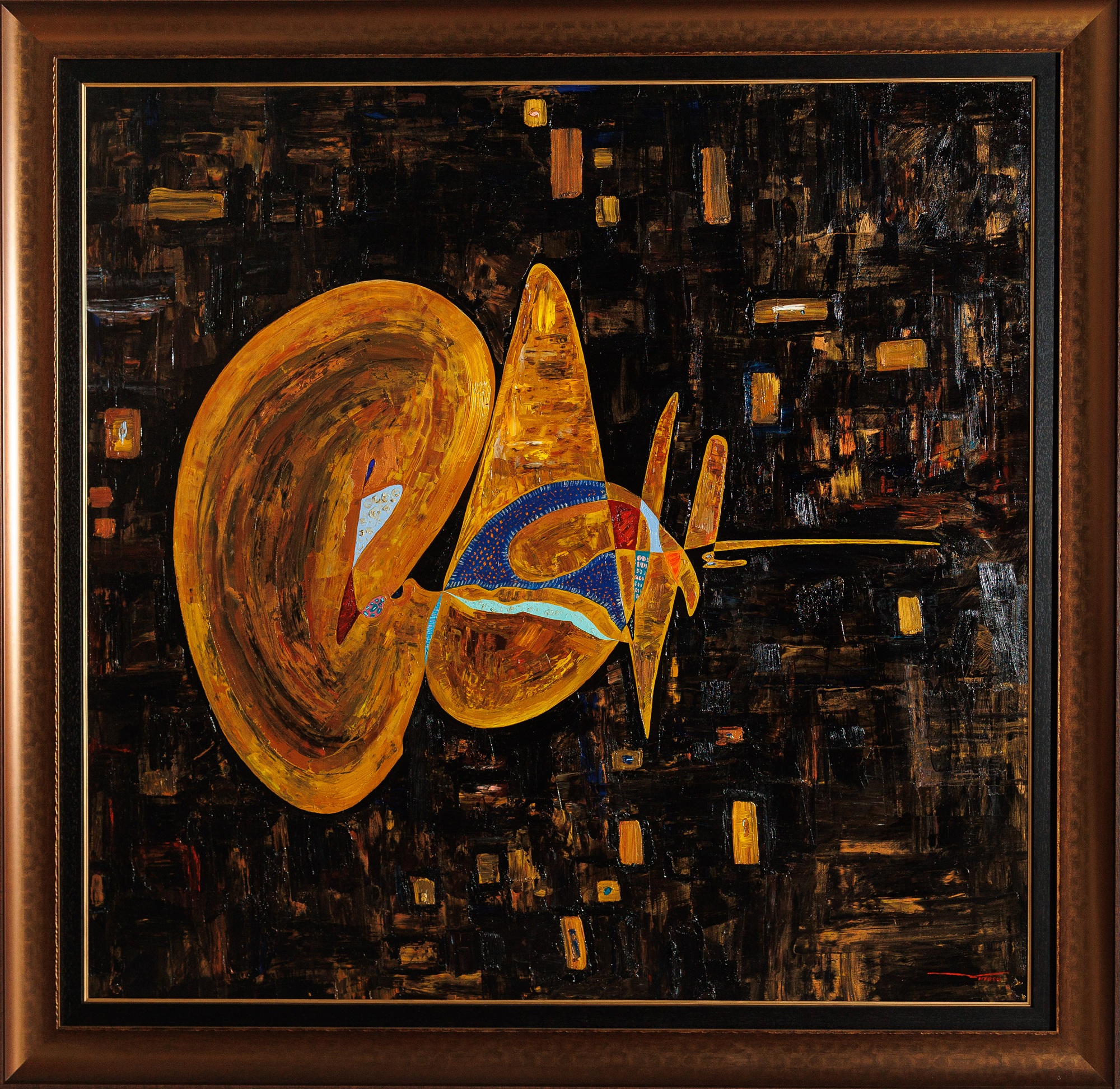
Gheorghe Virtosu’s The Source of Life (2007) occupies a pivotal position within his broader inquiry into systems of origin, transformation, and perceptual instability. Rather than approaching genesis as a fixed point of departure, the work reframes it as an ongoing condition—an emergent field in which matter, energy, and form are perpetually negotiated. The painting resists both figurative resolution and pure abstraction, instead staging a hybrid visual logic in which biomorphic and cosmological registers converge. In doing so, it aligns with late modern and post-structuralist critiques of origin as a stable category, suggesting instead that beginnings are always distributed across relational processes rather than anchored in singular causality.1
Within the composition, Virtosu constructs a tension between density and emergence, opacity and luminosity, that can be read as a pictorial analogue to systems thinking in contemporary philosophy and science. The darkened field that surrounds the central form is not passive background but an active condition of formation, echoing conceptions of the void as generative rather than absent. The central structure—simultaneously organic, mechanical, and embryonic—functions as a threshold entity, refusing stable classification while continuously reorganizing itself within the viewer’s perceptual field. This instability resonates with theories of emergence in which complex forms arise from nonlinear interactions among simpler elements, without predetermined hierarchy or final state.2
As a curatorial object, The Source of Life demands an encounter that is both spatial and temporal. Its surface does not yield immediate comprehension but unfolds through sustained attention, compelling the viewer to participate in the construction of meaning. The painting thus operates less as an image of life than as a model of its conditions: contingent, relational, and perpetually in formation. In this sense, Virtosu’s work extends beyond representation into the domain of epistemic inquiry, situating painting as a site where philosophical questions about origin, matter, and becoming are materially enacted.3
In The Source of Life (2007), Gheorghe Virtosu articulates a speculative cosmology in which life emerges as a continuous field of energetic formation rather than a discrete biological event. The composition is structured around a central biomorphic configuration that appears suspended between organism, machine, and cosmic structure. Set against a densely textured, near-opaque ground, this luminous form operates as a generative nucleus, from which spatial and chromatic tensions radiate outward without resolving into stable figuration. The work thus reframes origin not as a temporal beginning, but as an ongoing process of becoming within a unified yet unstable pictorial system.1
Spatial organization is governed by a deliberate collapse of hierarchical perspective. The dark field is punctuated by fragmented rectangular traces and diffuse accumulations of pigment that suggest latent architectures or residual informational signals. Against this dispersed environment, the central form asserts itself through curvilinear expansion and chromatic intensity, producing a dynamic oscillation between emergence and absorption. Organic and technological associations are intentionally interwoven, positioning the image within a hybrid register where biological growth and constructed systems become indistinguishable modalities of formation.2
Chromatically, the painting is structured around a restrained economy of gold, ochre, deep black, and intermittent accents of blue and red. The luminous core functions as both material presence and metaphysical signifier, invoking notions of vitality, energy, and primordial matter, while the surrounding darkness operates as an active generative void rather than passive background. Through layered brushwork and visible gestural accumulation, Virtosu reinforces the materiality of painting as process, producing a surface in which emergence, dissolution, and transformation coexist within a single perceptual field.3
In The Source of Life (2007), Gheorghe Virtosu articulates a speculative ontology in which “life” is not treated as a biological category but as a continuous field of emergence. The painting resists any origin narrative in favour of a processual logic in which formation, dissolution, and reformation occur simultaneously. Rather than depicting life as a stable entity, the work proposes it as an ongoing condition of relational becoming, in which form is never final but perpetually negotiated across material and perceptual registers.1
The central biomorphic configuration operates as a conceptual pivot rather than a representational object. It is best understood as a transitional system—neither fully organic nor technological—through which different regimes of matter and energy converge. This ambiguity is essential: Virtosu constructs a visual language in which categorical boundaries (natural/artificial, body/machine, interior/exterior) are deliberately destabilized. The result is a hybrid ontology in which identity emerges as a function of interaction rather than essence.2
From a philosophical perspective, the work resonates with process-oriented frameworks that privilege becoming over being. The painting’s layered structure evokes a dynamic field in which multiple temporalities coexist: embryonic latency, energetic activation, and dispersive flow. These do not unfold sequentially but are co-present, suggesting a nonlinear conception of time aligned with evolutionary and systems-based models of complexity. Life, in this sense, is understood as an event distributed across time rather than located within it.1
The surrounding dark field plays a crucial conceptual role, functioning not as void but as generative matrix. Within this dense environment, scattered luminous fragments suggest proto-structures or emergent signals, implying that form arises from conditions of opacity rather than clarity. This inversion challenges classical metaphysical hierarchies in which light is associated with knowledge and darkness with absence; instead, Virtosu proposes a model in which indeterminacy is the precondition for emergence.3
The painting also engages with the idea of systemic individuation, in which entities are not pre-given but formed through relational processes. The central structure appears to oscillate between singular organism and distributed system, refusing closure as either. This instability reflects a broader theoretical position in which individuation is ongoing, dependent on continuous exchanges between internal differentiation and external environment. Identity is therefore not contained but enacted.2
Ultimately, The Source of Life proposes a conception of vitality grounded in transformation rather than origin. The painting does not seek to illustrate life but to stage its conditions of possibility: flux, tension, and relational interdependence. In doing so, Virtosu constructs a visual field in which ontology is rendered as process, and existence is understood as an emergent negotiation between forces rather than a fixed state of being.1
Gheorghe Virtosu | Artist Biography
Gheorghe Virtosu is a contemporary painter whose practice is grounded in the exploration of complex systems, metaphysical structures, and the visual translation of abstract processes into painterly form. Working primarily in large-scale oil on canvas, his oeuvre is distinguished by a sustained inquiry into the conditions through which meaning, form, and perception emerge within dense pictorial environments.
Rather than adhering to a linear stylistic trajectory, Virtosu’s practice is characterized by a systematic approach to composition in which biomorphic, geometric, and gestural elements are continuously reorganized within field-based structures. His paintings often function less as representations of external reality and more as self-contained epistemic spaces in which visual elements operate as interdependent variables within a dynamic system.
Central to Virtosu’s work is an engagement with philosophical models of emergence, transformation, and relational ontology. His paintings frequently evoke processes associated with biological growth, technological assembly, and cosmological formation, yet resist reduction to any single interpretive framework. Instead, they operate as speculative visual propositions in which materiality and concept are inseparable.
Technically, Virtosu employs a layered methodology that emphasizes accumulation, erosion, and reconfiguration of painted surface. This approach produces compositions in which depth is not illusionistic but structural, generated through the interaction of chromatic density, directional gesture, and compositional tension. The viewer is thus positioned not as a passive observer but as an active participant in the unfolding perceptual field.
Across his practice, Virtosu maintains a consistent focus on the relationship between order and instability, coherence and fragmentation. His work situates itself within a broader discourse on post-representational painting, contributing to ongoing debates concerning the capacity of abstraction to articulate systems of thought that extend beyond narrative or symbolic containment.
Executed in oil on canvas at a medium monumental scale (1.62 × 1.57 m), The Source of Life develops through dense stratification of pigment, where material buildup replaces linear perspective as the primary generator of depth. The surface is constructed through successive layering, allowing forms to emerge and recede within a compressed pictorial field. This produces a visual structure in which spatial coherence is achieved through accumulation rather than geometric projection.1
The composition relies on a controlled tension between heavily worked impasto zones and thinner, semi-transparent passages. Central biomorphic formations are articulated through thick, directional brushwork that enhances their volumetric presence, while the surrounding dark field is treated with more fragmented, gestural application. This contrast establishes a dynamic oscillation between figure and ground, reinforcing the instability of spatial hierarchies within the work.2
Chromatic construction is integral to the painting’s structural logic. A restricted palette of ochres, golds, deep blacks, and limited spectral accents is deployed to regulate perceptual focus across the surface. Colour functions not descriptively but structurally, operating as a system of intensities that guides visual movement and modulates spatial perception. The resulting field maintains equilibrium between chromatic concentration and dispersion, reinforcing the painting’s emphasis on continuous transformation.3
Artist: Gheorghe Virtosu
Medium: Oil on canvas
Dimensions: H 1.62 m × W 1.57 m
The visual composition of The Source of Life is structured around a central biomorphic formation that dominates the pictorial field, functioning as both nucleus and generative axis. This form appears suspended within a dense, darkened environment, creating a pronounced tension between emergence and containment. The surrounding space is articulated through fragmented, rectilinear traces and layered brushwork, which prevent any stable depth hierarchy and instead establish a continuous oscillation between foreground and background. The result is a compositional field in which perception is constantly reorganized rather than fixed.1
Spatial dynamics are governed by a dual logic of expansion and compression. The central structure unfolds in sweeping, curved trajectories that suggest organic growth, while simultaneously incorporating sharper, directional elements that introduce mechanical and vector-like precision. These opposing tendencies generate a controlled instability, where form appears in a perpetual state of becoming. Rather than resolving into a unified spatial order, the composition maintains multiple zones of visual intensity that compete for perceptual primacy, reinforcing the painting’s refusal of a singular focal point.2
Chromatic and textural strategies further reinforce this instability. Warm golden and ochre tones concentrate within the central form, establishing it as a luminous attractor, while the surrounding field absorbs and disperses light through dense applications of dark pigment. The painterly surface is built through successive layering, allowing traces of earlier gestures to remain partially visible beneath more recent interventions. This accumulation produces a stratified visual structure in which material process becomes inseparable from compositional meaning, positioning the work as an evolving field rather than a resolved image.3
In The Source of Life, color functions as a primary generative force rather than a descriptive attribute. The composition is structured around a high-contrast dialectic between dense, near-absolute blacks and concentrated zones of incandescent gold, ochre, and ember-like red. These chromatic intensities do not model light in a naturalistic sense; instead, they operate as autonomous fields of energy, establishing a sense of internal luminosity that appears to emanate from within the pictorial structure itself. Color becomes ontological, proposing life as an effect of radiant differentiation rather than figurative depiction.1
Form emerges through a continuous negotiation between containment and expansion. The central biomorphic structure is composed of interlocking curvilinear volumes that resist stable identification, oscillating between organic growth and engineered articulation. These forms are neither fully closed nor fully open; instead, they exist in a state of perpetual modulation, where edges dissolve into painterly turbulence. The surrounding field reinforces this instability, as fragmented rectilinear traces interrupt the dominance of curvature, producing a spatial tension between geometric residue and fluid embodiment.2
The relationship between color and form in the work is fundamentally non-hierarchical: neither element serves as a subordinate to the other. Rather, chromatic intensity and formal articulation are co-constitutive, generating a unified but unstable perceptual system. Gold and ochre do not merely fill pre-existing shapes; they actively generate and destabilize form, while darkness functions not as background but as an active structural counterforce. This reciprocity produces a visual field in which emergence is continuous, and perception is always in the process of reconfiguration.3
In The Source of Life, Virtosu constructs a symbolic system grounded in the tension between emergence and containment. The central golden form operates as a cosmogenic nucleus, evoking associations with embryogenesis, cellular division, and astral formation simultaneously. Its spiral and ovoid articulations suggest life not as fixed identity but as continuous self-generation, positioning origin as an ongoing process rather than a historical point of initiation. The surrounding dark field functions as a generative void, a space of latency from which form intermittently crystallizes, reinforcing a metaphysical reading of life as emergence from indeterminate potentiality.1
The imagery oscillates between organic and technological registers, destabilizing any singular interpretive frame. Curvilinear structures resemble anatomical systems—neural, vascular, or embryonic—while elongated extensions suggest directional force, transmission, or engineered propulsion. This hybridity produces a liminal ontology in which life is neither purely natural nor artificial but constituted through their intersection. The painting thus mobilizes imagery as a field of transformation, where symbolic elements are not fixed signs but active processes of becoming, continuously shifting between biological, mechanical, and cosmic registers.2
Chromatic symbolism reinforces this dual structure of emergence and dissolution. The dominant gold tones connote primordial energy, value, and illumination, traditionally associated with sacred or generative forces, while the surrounding blacks and deep browns establish a counterforce of opacity and indeterminacy. This dialectic produces a visual rhythm in which revelation is perpetually conditioned by concealment. Small chromatic interruptions—flecks of blue and red—operate as puncta of intensity, suggesting localized moments of activation within a broader systemic flow. Together, these elements construct an image of life as distributed energy rather than singular essence.3
In The Source of Life (2007), Gheorghe Virtosu articulates origin not as a temporal starting point but as an ongoing ontological condition in which emergence is continuous, unstable, and materially distributed. The composition resists representational clarity, instead proposing a cosmology of formation in which life is produced through the interaction of heterogeneous forces—organic, technological, and atmospheric. The central luminous structure functions less as an object than as a processual field, suggesting that vitality arises from relational tension rather than fixed identity.1
The painting’s spatial logic dismantles conventional figure-ground hierarchies, replacing them with a recursive system in which emergence and dissolution occur simultaneously. The dense, darkened field surrounding the central form operates as generative void rather than passive backdrop, reinforcing the philosophical premise that creation is inseparable from indeterminacy. Within this framework, the biomorphic structures do not depict life but enact it visually, staging a condition in which form is perpetually becoming rather than arriving at completion.2
Chromatic intensity and material layering further reinforce this ontology of emergence. Gold and ochre tones concentrate energy at the core, while dispersed chromatic interruptions across the surface function as signals of systemic dispersion and connectivity. The painting thus constructs a model of life as a distributed network of intensities, where meaning is not located in symbolic reference but in the dynamic organization of perceptual forces. In this sense, Virtosu aligns with post-Deleuzian conceptions of assemblage, in which entities are understood as emergent effects of relational fields rather than autonomous units.3
In The Source of Life, the emotional register is anchored in a controlled tension between awe and unease, where emergence is experienced as both generative and unstable. The central biomorphic formation carries a charge of primordial vitality, yet it resists resolution into a coherent figure, producing a perceptual condition that oscillates between recognition and withdrawal. This instability situates the viewer within a sublimated affective field akin to the Burkean sublime, where magnitude and ambiguity exceed cognitive containment, generating a state of heightened perceptual alertness rather than narrative comprehension.1
The chromatic economy intensifies this affective ambiguity. Gold and ochre operate as vectors of warmth, vitality, and symbolic genesis, while the surrounding black field introduces a counter-affect of depth, silence, and potential negation. Rather than functioning as a backdrop, the darkness behaves as an active emotional substrate, absorbing and refracting the luminous forms within it. This oscillation between illumination and obscurity produces a rhythm of attraction and withdrawal, evoking a psychological space in which emergence is inseparable from dissolution.2
At the level of viewer experience, the painting generates an embodied affect of suspended cognition. The absence of stable iconography prevents emotional fixation, compelling continuous perceptual recalibration. Forms appear to approach and recede simultaneously, producing a sensation of proximity without access, intimacy without resolution. This condition aligns with affective theories of pre-subjective intensity, where meaning is not decoded but felt as fluctuation within the perceptual field. The result is an emotional register defined not by narrative empathy but by sustained ontological uncertainty and receptive attentiveness to becoming itself.3
- Gilles Deleuze, Difference and Repetition. Columbia University Press, 1994.
- Henri Bergson, Creative Evolution. Dover Publications, 1998.
- Manuel DeLanda, A New Philosophy of Society. Continuum, 2006.
Selected Bibliography
- Deleuze, Gilles. Difference and Repetition.
- Bergson, Henri. Creative Evolution.
- DeLanda, Manuel. A New Philosophy of Society.
- Simondon, Gilbert. Individuation in Light of Notions of Form and Information.
- Krauss, Rosalind. The Originality of the Avant-Garde and Other Modernist Myths.
Curatorial Team: Daniel Varzari
Photography: El Arte Monumental
Special Thanks: Daniel Varzari, Gheorghe Virtosu
El Arte Monumental
08007 Barcelona
Phone: +34 934 439 470/ +01 312 358 8023