The Architecture of Power
El Arte Monumental | Catalogue: The Architecture of Power
Catalogue Entry: British Diplomacy (2015) | Art Curator: Daniel Varzari
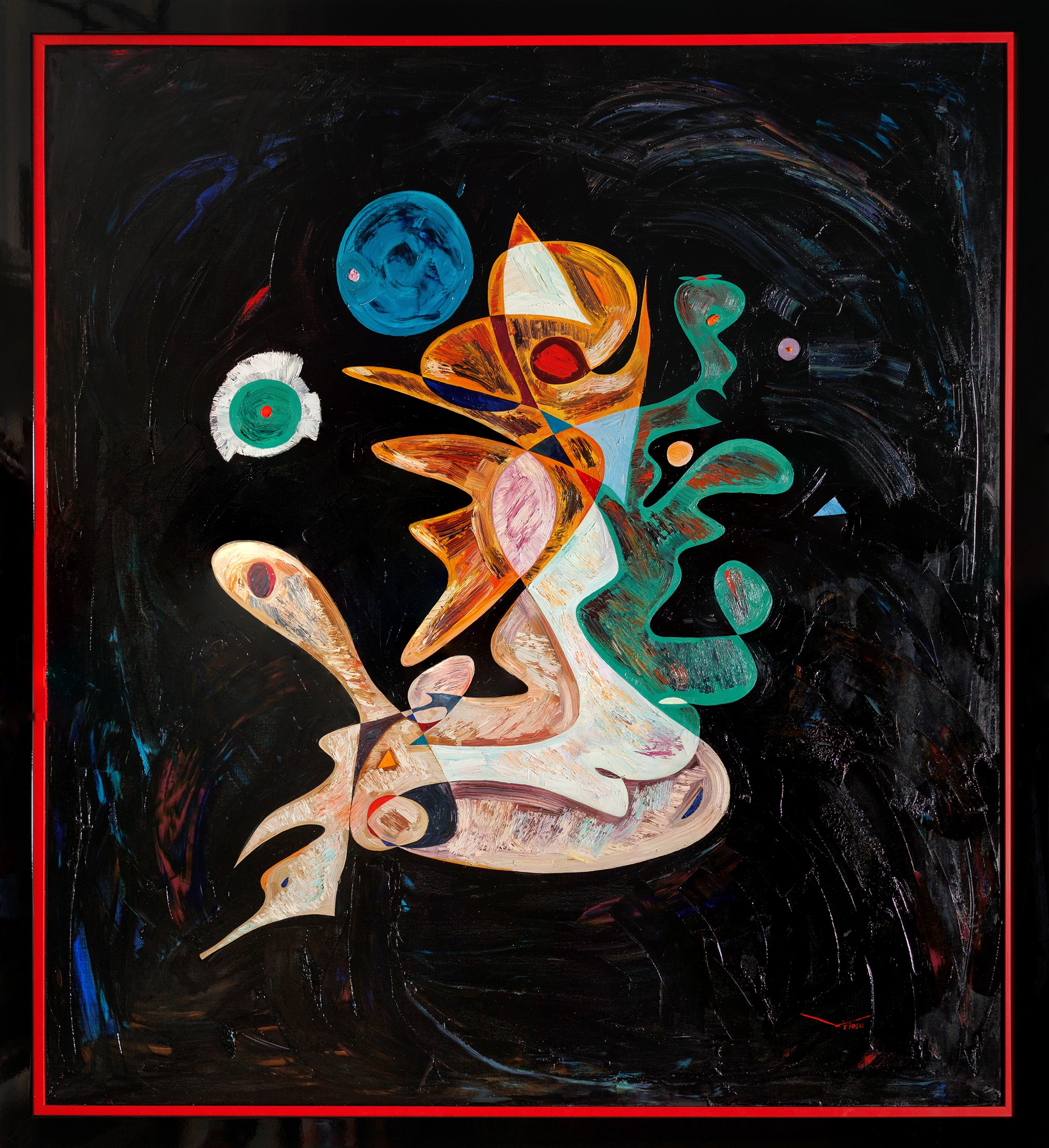
In British Diplomacy (2015), Gheorghe Virtosu approaches diplomacy as an evolving architecture of negotiation, adaptation, and strategic continuity. Rather than illustrating a historical episode or political figure, the painting examines the mechanisms through which influence is cultivated, relationships are maintained, and stability is pursued within an increasingly interconnected world.
Through a dynamic interplay of geometric structures, fluid forms, and spatial tensions, the composition transforms diplomacy into a symbolic system of movement and exchange. Distinct elements remain interconnected while preserving their autonomy, suggesting a model of international engagement founded upon balance, communication, and the management of complexity rather than unilateral control.
Within The Architecture of Power, British Diplomacy represents the strategic dimension of authority. The painting invites reflection on the networks, negotiations, and institutional frameworks through which nations navigate uncertainty, revealing diplomacy as one of the enduring structures through which influence, continuity, and collective stability are sustained across time.
British Diplomacy (2015) presents a vertically organized abstract composition set within a deep black field framed by a vivid red border. A luminous central structure composed of geometric and organic forms rises through the canvas, integrating passages of gold, turquoise, blue, white, green, and red into a dynamic system of interconnected relationships. Floating circular motifs and directional elements reinforce a sense of movement, exchange, and spatial complexity.
The painting is structured around balance rather than symmetry. Intersecting planes, curved contours, and ascending forms interact across the composition, creating a visual architecture that appears simultaneously stable and adaptive. The central configuration functions as a focal point of negotiation between contrasting forces, while the surrounding space amplifies its symbolic presence and directional energy.
Through abstraction and symbolic synthesis, Virtosu transforms diplomacy into a visual model of strategic engagement and international connectivity. Rather than depicting a specific historical narrative, the work explores the mechanisms through which relationships are established, maintained, and adjusted within complex systems of influence, revealing diplomacy as an enduring architecture of communication and continuity.
British Diplomacy (2015) examines diplomacy as a strategic practice through which influence is negotiated, relationships are maintained, and stability is pursued within complex international environments. Rather than presenting power as an act of domination, Gheorghe Virtosu explores authority as a process of communication, adaptation, and calculated engagement. The work suggests that enduring influence depends not only upon strength, but upon the capacity to navigate uncertainty through dialogue and cooperation.
The composition is structured as a network of interconnected forces rather than a hierarchy of fixed positions. Distinct forms interact within a shared visual system, generating meaning through balance, movement, and exchange. This relational organization reflects the nature of diplomacy itself, where outcomes emerge through negotiation between multiple actors whose interests remain interconnected despite their differences.
The expansive black field functions as a symbolic environment of uncertainty and possibility. Against this indeterminate space, the luminous central structure appears as a navigational framework capable of organizing complexity. The painting therefore presents diplomacy as an instrument for establishing orientation and continuity within circumstances that resist permanence or predictability.
Colour operates as a language of strategic differentiation. Gold, turquoise, blue, white, green, and red create a system of visual relationships that guide movement across the composition. These chromatic interactions reinforce the circulation of influence between distinct elements, suggesting the dynamic exchanges through which political, cultural, and economic relationships are sustained.
The interplay between geometric precision and organic transformation reflects the dual nature of diplomatic practice. Structured forms evoke institutions, policy frameworks, and strategic planning, while fluid contours introduce adaptability, responsiveness, and negotiation. The painting therefore avoids static conceptions of authority, presenting influence as a condition sustained through continual adjustment rather than fixed control.
Within The Architecture of Power, British Diplomacy represents the international dimension of authority. If power originates through instinct in Hunter, acquires legitimacy in The Crown Holder, circulates through invisible systems in Illuminati, and is mediated through dialogue in The Diplomatic Jew, here it operates across networks of exchange that connect institutions, cultures, and geopolitical interests within a broader global framework.
Ultimately, the painting presents diplomacy as an architecture of navigation. Through abstraction and symbolic complexity, Virtosu reveals how communication, strategic balance, and international engagement function as mechanisms through which societies manage uncertainty and sustain continuity. The work becomes a meditation on the structures that allow cooperation, influence, and stability to emerge within an interconnected world.
Gheorghe Virtosu | Artist Biography
Gheorghe Virtosu is a contemporary painter whose work investigates the relationships between power, diplomacy, historical memory, and collective consciousness. Through large-scale abstract compositions, he examines the cultural, political, and symbolic structures that shape human experience, transforming complex historical and philosophical questions into dynamic visual architectures.
Working primarily in oil on canvas, Virtosu has developed a distinctive visual language that combines geometric organization, biomorphic forms, symbolic archetypes, and layered chromatic systems. His paintings explore themes including sovereignty, diplomacy, migration, ideology, cultural identity, and the evolving mechanisms through which authority and influence are established, negotiated, and maintained across societies.
Drawing upon art history, political theory, anthropology, and philosophy, Virtosu creates research-driven bodies of work that invite critical reflection on the forces shaping contemporary civilization. Through abstraction, he reveals the interconnected networks of memory, power, communication, and collective belief that underpin social and historical reality, positioning painting as a space for intellectual inquiry as well as visual experience.
Medium: Oil on canvas
Dimensions: 150 × 138 cm (59.1 × 54.3 in)
The composition is structured around a vertically ascending central configuration positioned within a deep black field enclosed by a vivid red border. Interlocking geometric planes, biomorphic forms, circular motifs, and directional elements are organized into a complex visual network that balances stability with movement. The arrangement creates a strong sense of upward progression, reinforcing the painting’s emphasis on navigation, connectivity, and strategic coordination.
Layered oil applications generate depth, texture, and spatial complexity throughout the surface. Variations in brushwork, paint density, and chromatic intensity establish distinct zones of visual activity while maintaining compositional coherence. The interaction between precisely organized structures and fluid painterly transitions contributes to the work’s dynamic equilibrium and architectural character.
A palette dominated by gold, turquoise, blue, white, green, and red operates within the surrounding black field as a system of visual orientation and symbolic emphasis. Colour functions structurally rather than descriptively, guiding perception through interconnected forms and reinforcing the painting’s exploration of diplomacy, negotiation, international exchange, and the maintenance of balance within complex systems of influence.
Artist: Gheorghe Virtosu
Medium: Oil on canvas
Dimensions: H 1.50 m × W 1.38 m
The composition is organized around a vertically ascending central structure that functions as the painting’s primary axis of movement and coherence. Geometric planes, curved contours, and circular motifs converge within this luminous configuration, creating a dynamic balance between concentration and expansion. Rather than relying on symmetry, the work achieves equilibrium through the careful distribution of visual weight across the canvas, directing the viewer’s attention upward through successive layers of interconnected forms.
Intersecting organic and geometric elements generate a network of relationships that encourages continuous visual movement. Floating circular forms surrounding the central structure extend the composition beyond its immediate boundaries, suggesting interaction between multiple centers of influence. This interplay between containment and openness produces a sense of navigation and exchange, reinforcing the painting’s thematic engagement with diplomacy and international connectivity.
The expansive black field amplifies the presence of the central image while creating a spatial environment of depth and uncertainty. Accents of gold, turquoise, blue, white, green, and red establish rhythm and directional movement throughout the composition, linking individual forms into a unified visual system. Through the integration of colour, structure, and spatial tension, Virtosu constructs an abstract architecture in which stability emerges through relationships, adaptation, and strategic balance.
Colour functions as a primary structural element within British Diplomacy. The dominant black field establishes a space of depth, uncertainty, and possibility, while passages of gold, turquoise, blue, white, green, and red emerge with heightened clarity and intensity. These chromatic contrasts create a visual hierarchy that guides movement through the composition and reinforces the painting’s atmosphere of strategic navigation and interconnected exchange.
The formal language combines geometric organization with organic transformation. Angular planes suggest institutional order, structure, and strategic planning, while curved contours and floating circular motifs introduce adaptability, movement, and continuity. The interaction of these contrasting forms creates a dynamic equilibrium in which stability is achieved through balance rather than rigidity.
Colour and form operate as an integrated system of relationships. Chromatic accents emphasize key structural connections, while variations in scale, contour, and orientation establish rhythm across the pictorial space. Through this synthesis, Virtosu transforms abstraction into a visual architecture of diplomacy, where influence, communication, and strategic coordination emerge through the interaction of interconnected elements.
British Diplomacy employs a symbolic vocabulary centered on navigation, connectivity, and strategic balance. The ascending central structure may be interpreted as a metaphor for diplomatic institutions and the evolving frameworks through which influence is organized and sustained. Its layered construction suggests a system built through negotiation, adaptation, and the coordination of multiple interests rather than through singular authority.
Circular motifs and floating forms surrounding the central configuration evoke networks of interaction extending beyond fixed boundaries. These elements suggest spheres of influence, international relationships, and the interconnected nature of global affairs. The recurring intersections between forms reinforce themes of communication, alliance, and exchange, emphasizing diplomacy as a process of building relationships across political and cultural distances.
The contrast between the luminous central image and the expansive black field introduces a dialogue between order and uncertainty. While the dark environment evokes the complexity of geopolitical realities, the structured forms provide orientation and continuity within that space. Through this symbolic architecture, Virtosu presents diplomacy as an enduring mechanism through which societies navigate change, maintain stability, and pursue cooperation within an interconnected world.
British Diplomacy explores diplomacy as a strategic system through which influence is exercised, relationships are maintained, and stability is negotiated within an interconnected world. Gheorghe Virtosu presents authority not as a fixed possession but as a dynamic process dependent upon communication, adaptation, and the continuous management of complex political realities.
The painting proposes that enduring power emerges through networks rather than isolation. Distinct forms remain interconnected within a shared structure, reflecting the ways nations, institutions, and cultures interact through cooperation, negotiation, and mutual dependency. Diplomacy appears as an architecture of relationships capable of transforming competing interests into frameworks of coexistence and strategic balance.
Within The Architecture of Power, the work represents the international dimension of authority. Through abstraction and symbolic complexity, Virtosu reveals how dialogue, coordination, and long-term engagement function as instruments through which societies navigate uncertainty, sustain influence, and shape collective futures beyond the limits of direct force.
British Diplomacy evokes a sense of confidence, vigilance, and strategic awareness. The ascending central structure emerging from the expansive black field conveys resilience and purpose, suggesting the steady navigation of complex circumstances through intelligence, patience, and calculated action. The work encourages contemplation of influence as something achieved through foresight rather than force.
The composition balances stability with movement, generating an atmosphere of controlled tension. Intersecting forms and shifting directional elements create the sensation of continuous adjustment and negotiation, reflecting the uncertainties inherent in international relationships. This dynamic equilibrium produces an emotional experience characterized by attentiveness, adaptability, and measured resolve.
Beneath its structural complexity lies a deeper sense of continuity and connection. The painting conveys diplomacy as a constructive force capable of linking diverse interests within a shared framework, inspiring reflection on cooperation, mutual understanding, and the enduring pursuit of balance within an interconnected world.
- The title British Diplomacy is approached as a symbolic exploration of negotiation, strategic continuity, international engagement, and statecraft rather than as a representation of a specific diplomatic event or historical policy.
- Within The Architecture of Power, the work examines diplomacy as a mechanism through which influence is coordinated, alliances are maintained, and stability is pursued within complex geopolitical environments.
- The painting transforms concepts of communication, navigation, and international exchange into an interconnected visual structure in which meaning emerges through relationships rather than narrative representation.
- The ascending central configuration and surrounding orbital forms may be interpreted as a symbolic model of global networks, emphasizing adaptation, dialogue, and strategic balance as essential components of enduring influence.
Selected Bibliography
- Arendt, Hannah. The Human Condition. Chicago: University of Chicago Press, 1958.
- Bull, Hedley. The Anarchical Society: A Study of Order in World Politics. New York: Columbia University Press, 1977.
- Cassirer, Ernst. An Essay on Man: An Introduction to a Philosophy of Human Culture. New Haven: Yale University Press, 1944.
- Foster, Hal, Rosalind Krauss, Yve-Alain Bois, Benjamin H. D. Buchloh, and David Joselit. Art Since 1900: Modernism, Antimodernism, Postmodernism. London: Thames & Hudson, 2016.
- Kissinger, Henry. Diplomacy. New York: Simon & Schuster, 1994.
- Nicolson, Harold. Diplomacy. Oxford: Oxford University Press, 1963.
- Panofsky, Erwin. Meaning in the Visual Arts. Chicago: University of Chicago Press, 1982.
Curatorial Team: Daniel Varzari
Photography: El Arte Monumental
Special Thanks: Daniel Varzari, Gheorghe Virtosu
El Arte Monumental
08007 Barcelona
Phone: +34 934 439 470/ +01 312 358 8023