The Architecture of Power
El Arte Monumental | Catalogue: The Architecture of Power
Catalogue Entry: Hunter (2017) | Art Curator: Daniel Varzari
Hunter (2017) stands at the threshold of The Architecture of Power, introducing authority before it becomes institution, ideology, or statecraft. Gheorghe Virtosu treats the hunter not as a narrative figure, but as an archetype of orientation, pursuit, and possession—the first symbolic structure from which systems of power begin to form.
The painting’s dense central configuration, set against a textured grey-white field, transforms instinct into architecture. Fragmented forms, animal references, and chromatic intensities are organised into a visual system where power appears as emergence: unstable, adaptive, and continuously constructed.
As the opening work of the exhibition, Hunter establishes the psychological ground for the paintings that follow. It proposes that civilization’s political architectures are rooted not only in institutions, but in deeper impulses of survival, desire, strategy, and symbolic recognition.
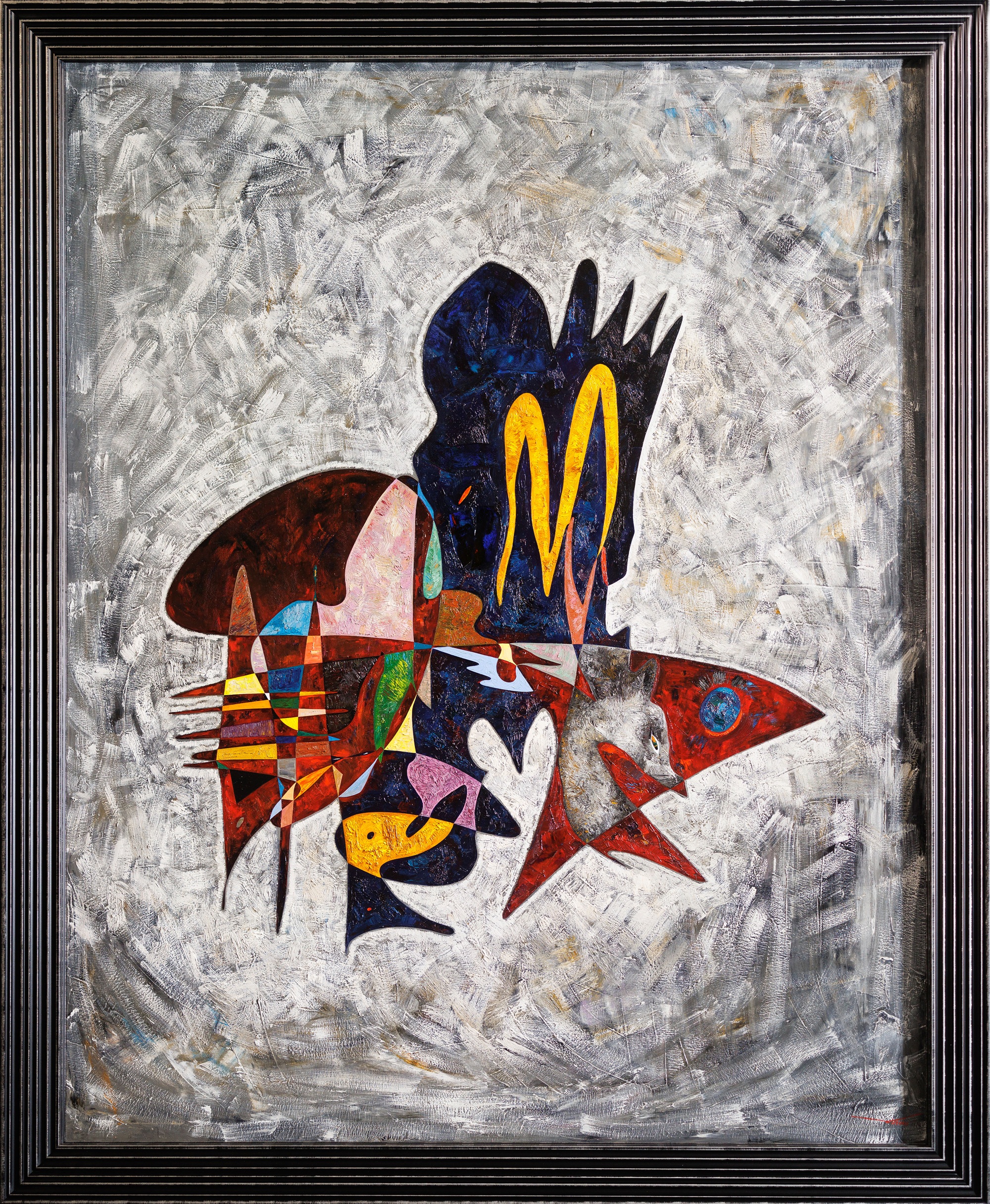
Hunter (2017) presents a complex abstract figure constructed from interlocking geometric and biomorphic forms suspended within a textured grey-white field. Deep blues, saturated reds, luminous yellows, and fragmented passages of colour converge into a dynamic central structure that suggests both organism and system, resisting fixed identification while maintaining strong visual cohesion.
The composition is organised through a balance of fragmentation and unity. Animal-like references, including a prominent fish-shaped element, emerge from the layered configuration, introducing associations with pursuit, survival, transformation, and desire. Rather than depicting a specific narrative, the painting assembles symbolic components into a broader visual language through which instinct and authority become intertwined.
Through its monumental scale and structural complexity, Hunter examines power in its earliest form: not as political control, but as a fundamental human impulse toward orientation, acquisition, and organisation. The work transforms the archetype of the hunter into a symbolic system, positioning it as a precursor to the social, political, and cultural architectures that shape civilization.
Hunter (2017) investigates power at its most fundamental level. Rather than addressing political authority directly, Gheorghe Virtosu examines the psychological and symbolic conditions that precede organized systems of governance. The hunter functions as an archetype through which questions of pursuit, survival, ambition, and control are explored.
The central figure is deliberately unstable. Constructed from interlocking geometric and organic forms, it exists between human, animal, and symbolic identities. This ambiguity allows the work to move beyond representation, presenting power as a condition of becoming rather than a fixed state. Authority appears here as something assembled through perception, action, and adaptation.
Animal references embedded throughout the composition introduce themes of instinct and transformation. The prominent fish-like form may be understood as an object of pursuit, a symbol of sustenance, or a manifestation of desire itself. These elements operate within a broader symbolic system that connects human agency to deeper biological and cultural impulses.
The textured grey-white field surrounding the figure functions as a space of emergence. Neither landscape nor architectural setting, it creates an indeterminate environment from which the central structure appears to materialize. This spatial ambiguity reinforces the idea that power originates within unstable conditions before acquiring social and institutional form.
Colour serves a structural purpose throughout the painting. Concentrated areas of blue, red, yellow, and green establish rhythm, direction, and hierarchy within the composition. Rather than describing objects, colour acts as a system of energy, organising relationships between forms and guiding the viewer through the visual field.
Within The Architecture of Power, Hunter functions as a conceptual point of departure. Before diplomacy, ideology, revolution, or democracy, there exists the impulse to pursue, acquire, and organise. The painting therefore examines the pre-political origins of authority, locating power within the fundamental structures of human experience.
Ultimately, Hunter presents power not as domination but as a dynamic process of orientation and construction. Through abstraction and symbolic synthesis, Virtosu transforms an ancient archetype into a contemporary reflection on the forces that shape individual agency, collective behaviour, and the foundations of civilization.
Gheorghe Virtosu | Artist Biography
Gheorghe Virtosu is a contemporary painter whose work investigates the relationships between abstraction, power, historical memory, and collective consciousness. Working primarily in large-scale oil painting, he has developed a distinctive visual language that combines geometric segmentation, biomorphic structures, and symbolic complexity to examine the systems that shape human civilization.
Central to Virtosu’s practice is the concept of New Perfection in Systemic Abstraction, a framework in which paintings operate as interconnected structures rather than representations of isolated subjects. Through this approach, authority, conflict, identity, and cultural transformation are translated into dynamic visual systems that emphasize process, tension, and continuous reconfiguration.
His works have been exhibited internationally and form part of several long-term research-based projects exploring themes including political power, warfare, mythology, diplomacy, migration, and the evolution of social structures. Across these bodies of work, abstraction functions as a means of revealing the underlying architectures that govern historical and contemporary experience.
Through layered oil techniques, monumental compositions, and an interdisciplinary engagement with philosophy, anthropology, and political thought, Virtosu constructs immersive environments that challenge fixed interpretation while inviting critical reflection on the forces that shape human perception and collective reality.
Medium: Oil on canvas
Dimensions: 184 × 147 cm (72.4 × 57.9 in)
The composition is constructed through a layered combination of geometric segmentation and biomorphic abstraction. A dense central configuration is articulated through interlocking colour fields and structural contours, while the surrounding surface is developed through textured applications of paint that generate depth, movement, and atmospheric complexity.
The painting employs a restrained monochromatic ground contrasted by concentrated zones of saturated blue, red, yellow, green, and white. This chromatic strategy establishes visual hierarchy and directional flow, allowing colour to function as an organisational system rather than a descriptive device.
Surface variation plays a significant role in the work’s spatial condition. Controlled brushwork, layered oil applications, and textured passages create a dynamic relationship between material density and structural clarity, reinforcing the painting’s exploration of emergence, transformation, and symbolic construction.
Artist: Gheorghe Virtosu
Medium: Oil on canvas
Dimensions: H 1.84 m × W 1.47 m
The composition is structured around a dominant vertical configuration positioned within an expansive textured field. Intersecting geometric planes and biomorphic elements converge to form a complex central presence that appears simultaneously constructed and evolving. The asymmetrical arrangement generates visual movement while maintaining overall compositional balance, directing the viewer’s attention through multiple layers of symbolic information.
A dynamic interplay of horizontal and vertical forces organizes the pictorial space. The prominent fish-like element extends laterally across the composition, counterbalancing the upward movement of the central structure and establishing a tension between stability and motion. Fragmented forms overlap and interconnect, creating a network of relationships that encourages continuous visual exploration rather than a singular focal reading.
Chromatic intensity is concentrated within the central configuration, where deep blues, reds, yellows, greens, and white contrasts activate the surface against the restrained grey-white background. This contrast enhances spatial depth and reinforces the distinction between the symbolic figure and its surrounding environment. The result is a composition that operates as a self-contained visual system, balancing structure, energy, and ambiguity within a unified architectural framework.
Color functions as a structural force throughout Hunter, organizing movement, hierarchy, and visual intensity rather than describing natural appearances. Deep blues establish areas of stability and concentration, while saturated reds introduce energy, urgency, and directional momentum. Yellow passages operate as points of activation, creating connections between disparate forms and guiding the viewer through the composition. Against the subdued grey-white field, these chromatic concentrations acquire heightened symbolic and spatial significance.
Form emerges through the interaction of geometric segmentation and organic transformation. Angular planes intersect with curved contours, producing a visual language that oscillates between constructed order and natural growth. The central configuration resists fixed identification, appearing at once architectural, anatomical, and symbolic. This ambiguity allows the painting to operate as a dynamic system rather than a representational image.
The relationship between color and form generates the work’s internal equilibrium. Chromatic contrasts reinforce structural divisions, while recurring shapes create continuity across the composition. Through this integration, Virtosu transforms abstraction into an active field of relationships where perception, symbolism, and spatial organization converge into a unified visual structure.
Hunter employs a symbolic vocabulary that operates through suggestion rather than direct representation. The central figure is assembled from fragmented geometric and organic forms that evoke both human and animal characteristics, transforming the hunter into an archetype rather than an identifiable individual. This ambiguity allows the image to function as a universal symbol of pursuit, agency, and the desire to impose order upon an uncertain environment.
Animal references appear throughout the composition, most notably in the prominent fish-like form extending across the structure. Traditionally associated with sustenance, survival, transformation, and movement, the fish introduces the idea of an objective toward which action is directed. Other concealed organic forms emerge through layers of abstraction, suggesting instinctual forces operating beneath conscious systems of control. Together, these elements connect the act of hunting to broader questions of ambition, adaptation, and human development.
The imagery ultimately functions as a meditation on the origins of authority. Rather than illustrating a specific event, the painting presents symbolic conditions from which structures of power emerge. The hunter becomes a metaphor for orientation and acquisition, while the surrounding field represents a space of possibility and uncertainty. Through this network of symbols, Virtosu explores the relationship between instinct, perception, and the formation of cultural and political systems.
Hunter (2017) examines power before its institutional manifestation. Gheorghe Virtosu approaches the hunter as a foundational archetype through which the earliest forms of agency, intention, and authority emerge. Rather than depicting a narrative event, the painting investigates the psychological conditions that precede organized systems of governance, presenting pursuit and survival as fundamental structures of human experience.
The fragmented yet interconnected forms suggest a state of continuous formation. Human, animal, and symbolic elements coexist within a dynamic visual system, reflecting the tension between instinct and order. Authority is not represented as a fixed possession but as an evolving process shaped by perception, adaptation, and the capacity to transform uncertainty into direction.
Within The Architecture of Power, Hunter functions as the conceptual point of origin from which later explorations of diplomacy, ideology, revolution, and governance unfold. The work proposes that all architectures of power are ultimately rooted in more elemental impulses: the desire to pursue, organise, secure, and define one’s place within the world.
Hunter generates a psychological atmosphere of vigilance, concentration, and latent energy. The central figure appears suspended between emergence and action, creating a sense of anticipation rather than resolution. This condition of becoming invites viewers into a space where instinct and intention remain in dynamic balance.
The contrast between the expansive monochromatic field and the intensely colored central structure produces emotional tension. Areas of visual stability coexist with moments of fragmentation and movement, evoking both confidence and uncertainty. The composition suggests a state of heightened awareness in which perception, desire, and strategic thinking converge.
Despite its complexity, the painting avoids aggression or narrative conflict. Instead, it conveys a contemplative intensity rooted in the experience of pursuit itself. The emotional resonance emerges from the continual negotiation between order and instability, transforming the archetype of the hunter into a reflection on ambition, purpose, and human agency.
- The figure of the hunter is among the oldest recurring archetypes in human culture, frequently associated with survival, territorial awareness, pursuit, and the formation of social structures.
- Within The Architecture of Power, Hunter functions as a conceptual point of origin, examining the pre-political conditions from which systems of authority and governance emerge.
- The painting exemplifies Gheorghe Virtosu’s framework of New Perfection in Systemic Abstraction, in which visual elements operate as interconnected structures rather than representational narratives.
- Animal motifs, including the fish-like form, are employed as symbolic components within a broader system of associations relating to pursuit, transformation, desire, and adaptation.
Selected Bibliography
- Arnheim, Rudolf. Art and Visual Perception: A Psychology of the Creative Eye. Berkeley: University of California Press, 1974.
- Cassirer, Ernst. An Essay on Man: An Introduction to a Philosophy of Human Culture. New Haven: Yale University Press, 1944.
- Eliade, Mircea. Myth and Reality. New York: Harper & Row, 1963.
- Foster, Hal, Rosalind Krauss, Yve-Alain Bois, Benjamin H. D. Buchloh, and David Joselit. Art Since 1900: Modernism, Antimodernism, Postmodernism. London: Thames & Hudson, 2016.
- Lévi-Strauss, Claude. The Savage Mind. Chicago: University of Chicago Press, 1966.
- Gombrich, E. H. The Story of Art. London: Phaidon Press, 1995.
- Jung, C. G. The Archetypes and the Collective Unconscious. Princeton: Princeton University Press, 1981.
Curatorial Team: Daniel Varzari
Photography: El Arte Monumental
Special Thanks: Daniel Varzari, Gheorghe Virtosu
El Arte Monumental
08007 Barcelona
Phone: +34 934 439 470/ +01 312 358 8023