The Architecture of Power
El Arte Monumental | Catalogue: The Architecture of Power
Catalogue Entry: Illuminati (2015) | Art Curator: Daniel Varzari
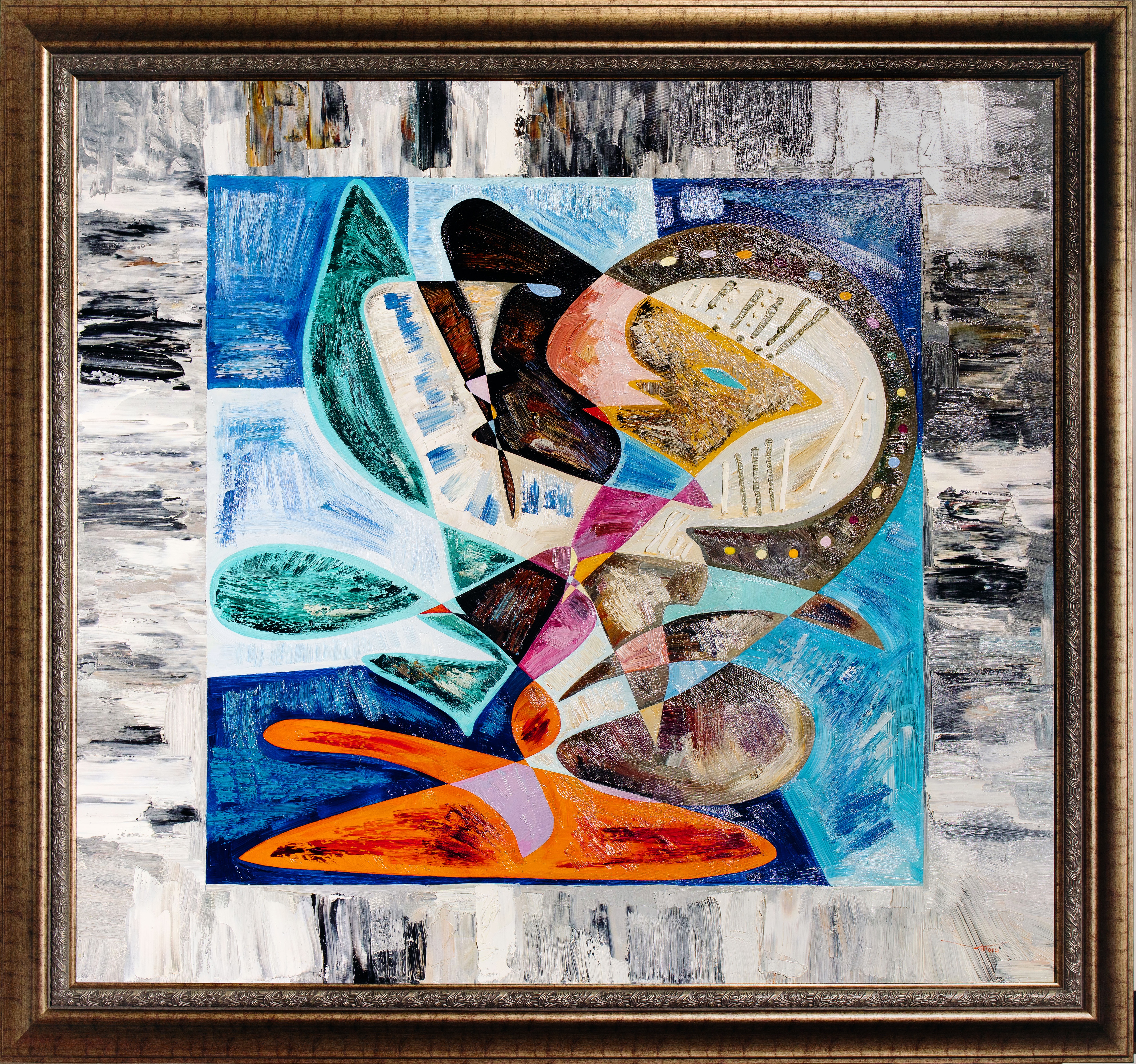
Illuminati (2015) examines the invisible dimensions of power. Rather than focusing on rulers, institutions, or political events, Gheorghe Virtosu investigates the systems of knowledge, perception, and symbolic influence that shape human understanding while often remaining beyond immediate visibility.
Constructed as a dense network of interrelated forms, the painting transforms abstraction into a visual model of interconnected forces. Geometric structures, organic elements, and chromatic relationships suggest a reality organized through layers of information and meaning, where influence operates through connection rather than direct display.
Within The Architecture of Power, Illuminati marks a shift from visible authority toward hidden systems. The work invites viewers to reflect on the structures that guide perception itself, revealing power not only as an institutional phenomenon but also as an architecture of knowledge and collective consciousness.
Illuminati (2015) presents a complex abstract composition structured within a defined rectangular field surrounded by a textured monochromatic border. Interlocking geometric and organic forms rendered in blue, turquoise, black, white, gold, pink, and orange create a dense visual network that appears simultaneously ordered and elusive, inviting sustained observation and interpretation.
The composition is organized through layered relationships between angular segmentation and fluid contours. Forms intersect, overlap, and transform across the pictorial space, generating a dynamic system in which no single element dominates. The enclosed structure establishes a sense of coherence while preserving ambiguity, allowing the painting to function as both image and conceptual framework.
Through abstraction and symbolic complexity, Virtosu explores the invisible architectures through which knowledge, perception, and authority are organized. Rather than depicting a specific narrative, the work visualizes systems of connection and influence, revealing how meaning emerges through relationships that remain only partially visible to the observer.
Illuminati (2015) investigates the relationship between visibility and influence. Rather than addressing power through rulers, institutions, or political events, Gheorghe Virtosu examines the systems that operate beneath the surface of collective experience. The painting proposes that authority often functions through networks of knowledge, symbols, and perception that remain only partially visible to those who inhabit them.
The title is employed as a conceptual metaphor rather than a historical reference. Within the work, “Illuminati” signifies the enduring human fascination with hidden structures that shape reality from behind the visible world. The painting transforms this idea into an abstract visual language, suggesting that influence emerges through relationships, connections, and exchanges rather than through direct representation.
The composition’s enclosed rectangular field reinforces the notion of an internal system governed by its own logic. Intersecting geometric and organic forms create a network of pathways, interruptions, and points of convergence that encourage viewers to navigate the image as they would a complex map. Meaning is not delivered immediately but unfolds through sustained observation and interpretation.
Colour contributes to this process by establishing zones of emphasis and movement. Blues and turquoise tones generate continuity across the composition, while passages of gold, orange, pink, black, and white introduce moments of contrast and disruption. These chromatic relationships function as channels through which visual information circulates, mirroring the transmission of knowledge within larger social and cultural systems.
The interplay between geometric precision and organic transformation suggests that systems of influence are never entirely fixed. Structures emerge, adapt, and reorganize themselves in response to changing conditions. The painting therefore rejects simple distinctions between order and disorder, presenting complexity as an essential characteristic of both knowledge and power.
Within The Architecture of Power, Illuminati expands the exhibition’s investigation beyond sovereignty and legitimacy toward the mechanisms through which authority is communicated and maintained. If power can be recognized through symbols such as the crown, it can also operate through invisible frameworks of information, belief, and perception that shape collective understanding.
Ultimately, the work presents power as an architecture of awareness. Through abstraction and systemic complexity, Virtosu visualizes the hidden relationships that connect individuals, institutions, and ideas, revealing influence not as a singular force but as a dynamic network through which reality itself is interpreted and organized.
Gheorghe Virtosu | Artist Biography
Gheorghe Virtosu is a contemporary painter whose work explores the intersections of abstraction, power, symbolic systems, and collective consciousness. Through large-scale oil paintings and conceptually driven series, he investigates the cultural, political, and psychological structures that shape human experience, transforming complex ideas into dynamic visual architectures.
Central to Virtosu’s practice is the development of New Perfection in Systemic Abstraction, a framework in which paintings function as interconnected systems rather than representational images. Geometric segmentation, biomorphic transformation, and symbolic complexity are employed to examine themes including sovereignty, diplomacy, ideology, historical memory, migration, and the invisible mechanisms through which societies organize meaning and authority.
Working across long-term research-based projects, Virtosu combines painterly experimentation with interdisciplinary engagement in philosophy, anthropology, political theory, and visual culture. His works invite viewers to navigate layered networks of form and interpretation, revealing the hidden structures that influence perception, collective belief, and the evolving architectures of civilization.
Medium: Oil on canvas
Dimensions: 138 × 150 cm (54.3 × 59.1 in)
The painting is organized within a structured rectangular field enclosed by a textured monochromatic border, establishing a clear distinction between the internal composition and its surrounding environment. Interlocking geometric planes and biomorphic forms are arranged into a dense network of relationships, creating a visually complex system that balances containment, movement, and structural coherence.
Layered oil applications generate depth, texture, and spatial complexity across the surface. Variations in paint density and directional brushwork contribute to the work’s dynamic visual rhythm, while controlled segmentation reinforces the interconnected organization of the composition. The interaction between precise structural elements and fluid painterly passages produces a continuous tension between order and transformation.
A chromatic palette dominated by blue, turquoise, black, white, gold, pink, and orange establishes hierarchy and visual circulation throughout the image. Colour functions as an organizational mechanism rather than descriptive representation, guiding perception through the composition and reinforcing the painting’s exploration of interconnected systems, symbolic relationships, and hidden structures of influence.
Artist: Gheorghe Virtosu
Medium: Oil on canvas
Dimensions: H 1.38 m × W 1.50 m
The composition is structured within a clearly defined rectangular field that establishes order while containing a highly dynamic internal system. Intersecting geometric planes, curved contours, and layered forms generate a dense network of visual relationships, encouraging the eye to move continuously across the surface rather than settle upon a single focal point. This balance between containment and complexity creates a sense of organized instability.
Spatial depth emerges through the interaction of overlapping forms, chromatic contrasts, and shifting directional movements. Angular elements introduce structural precision, while organic passages soften the composition and suggest processes of adaptation and transformation. The resulting visual architecture appears simultaneously constructed and evolving, reinforcing the painting’s exploration of interconnected systems rather than isolated objects.
The surrounding monochromatic border functions as both frame and conceptual threshold, separating the internal network from external space while emphasizing its autonomy. Within this contained environment, colour, form, and movement operate as interdependent components of a unified structure. The composition ultimately achieves coherence through relational complexity, transforming abstraction into a visual model of connection, perception, and influence.
Color functions as a primary organizational force within Illuminati. Dominant passages of blue and turquoise establish continuity across the composition, creating visual pathways that connect otherwise disparate elements. Contrasting interventions of gold, orange, pink, black, and white introduce emphasis, disruption, and rhythm, generating a dynamic balance between coherence and complexity. Rather than describing objects, colour operates as a system of relationships through which meaning and movement are structured.
Form emerges through the interaction of geometric precision and organic transformation. Angular planes intersect with curved contours, producing a visual language that oscillates between architectural order and biological growth. The composition resists a singular focal point, encouraging the eye to navigate an interconnected network of shapes whose significance depends upon their relationship to the whole rather than their individual identity.
The integration of colour and form transforms the painting into a self-regulating visual system. Chromatic contrasts reinforce structural divisions while recurring shapes establish continuity across the pictorial field. Through this interplay, Virtosu constructs an architecture of perception in which order, complexity, visibility, and concealment coexist within a unified abstract framework.
Illuminati employs a symbolic language built upon concealment, connection, and revelation. Rather than presenting identifiable figures or narrative events, the painting constructs an intricate network of interdependent forms that suggests systems operating beyond immediate visibility. Geometric structures imply organization and encoded knowledge, while organic elements introduce movement, adaptation, and transformation. The imagery functions less as representation than as a visual model of hidden relationships.
The defined rectangular field serves as a symbolic threshold separating visible reality from underlying structures of influence. Within this contained space, forms intersect, overlap, and fragment into a complex architecture of information. The absence of a dominant central figure shifts attention toward the network itself, suggesting that authority may emerge through systems of exchange, perception, and symbolic interaction rather than through singular sources of control.
Recurring chromatic contrasts and layered spatial relationships reinforce themes of knowledge, interpretation, and collective consciousness. Gold accents evoke value and significance, while dominant blue and turquoise forms suggest continuity, communication, and intellectual order. Through this interplay of symbols, the painting becomes a meditation on the invisible frameworks through which meaning is organized, revealing power as a condition embedded within structures of perception rather than solely within institutions or individuals.
Illuminati (2015) explores the invisible structures through which knowledge, influence, and authority shape collective understanding. Rather than depicting power directly, Gheorghe Virtosu investigates the systems that organize perception itself, suggesting that the most consequential forms of influence often operate beyond immediate visibility. The painting transforms hidden relationships into a symbolic architecture of interconnected forms.
The composition functions as a visual network in which meaning emerges through interaction rather than hierarchy. Geometric and organic elements coexist within a contained field, reflecting the dynamic relationship between order and adaptation. This systemic organization proposes that authority is not merely exercised through institutions, but through the circulation of information, symbols, and cultural narratives that structure how reality is interpreted.
Within The Architecture of Power, Illuminati examines the perceptual dimension of power. If authority originates through instinct and acquires legitimacy through symbolic recognition, it ultimately extends into the invisible frameworks through which societies construct knowledge and meaning. The work presents power as an architecture of perception, revealing the hidden systems that continuously shape collective consciousness.
Illuminati evokes a sense of curiosity, intellectual tension, and perceptual uncertainty. The intricate network of forms invites sustained observation, encouraging viewers to search for patterns, connections, and hidden relationships within the composition. Rather than offering immediate clarity, the painting rewards contemplation and gradual discovery.
The balance between order and complexity generates an atmosphere of controlled mystery. Structured geometries suggest coherence and intention, while overlapping forms and layered spatial relationships introduce ambiguity and openness. This tension creates a psychological experience in which certainty and speculation coexist, reflecting the challenges of interpreting systems that extend beyond direct visibility.
Beneath its visual complexity lies a quieter sense of reflection. The work encourages awareness of the unseen frameworks that shape perception, knowledge, and collective understanding, transforming the act of viewing into an exploration of how meaning is constructed, transmitted, and ultimately understood.
- The title Illuminati is employed as a symbolic concept referring to hidden systems of knowledge, influence, and perception rather than to any specific historical organization or contemporary group.
- Within The Architecture of Power, Illuminati examines the invisible dimensions of authority, exploring how information, symbols, and cultural narratives contribute to the formation of collective understanding.
- The painting exemplifies Gheorghe Virtosu’s framework of New Perfection in Systemic Abstraction, in which visual elements operate as interconnected structures that generate meaning through relationships rather than direct representation.
- The enclosed rectangular field may be interpreted as a symbolic threshold separating visible reality from the hidden frameworks through which perception, knowledge, and influence are organized.
Selected Bibliography
- Arnheim, Rudolf. Art and Visual Perception: A Psychology of the Creative Eye. Berkeley: University of California Press, 1974.
- Cassirer, Ernst. The Philosophy of Symbolic Forms. New Haven: Yale University Press, 1953–1957.
- Debord, Guy. The Society of the Spectacle. New York: Zone Books, 1994.
- Deleuze, Gilles, and Félix Guattari. A Thousand Plateaus: Capitalism and Schizophrenia. Minneapolis: University of Minnesota Press, 1987.
- Foster, Hal, Rosalind Krauss, Yve-Alain Bois, Benjamin H. D. Buchloh, and David Joselit. Art Since 1900: Modernism, Antimodernism, Postmodernism. London: Thames & Hudson, 2016.
- Foucault, Michel. Power/Knowledge: Selected Interviews and Other Writings, 1972–1977. New York: Pantheon Books, 1980.
- Panofsky, Erwin. Meaning in the Visual Arts. Chicago: University of Chicago Press, 1982.
Curatorial Team: Daniel Varzari
Photography: El Arte Monumental
Special Thanks: Daniel Varzari, Gheorghe Virtosu
El Arte Monumental
08007 Barcelona
Phone: +34 934 439 470/ +01 312 358 8023