The Architecture of Power
El Arte Monumental | Catalogue: The Architecture of Power
Catalogue Entry: New and Old World Order (2016) | Art Curator: Daniel Varzari
In New and Old World Order (2016), Gheorghe Virtosu examines one of the defining questions of political history: how systems of authority evolve as established structures encounter emerging forces of change. Rather than depicting a specific geopolitical event, the painting explores the continuous interaction between continuity and transformation, presenting world order as a dynamic process shaped by negotiation, adaptation, conflict, and renewal.
Through an intricate architecture of interlocking forms suspended within a threshold-like environment, the composition visualizes the coexistence of inherited institutions and emerging networks of influence. Fragmented foundations, ascending structures, and intersecting chromatic relationships create a symbolic landscape in which historical memory remains present even as new configurations of power begin to take shape. The work reveals transition not as rupture alone, but as a complex process of reorganization across political, cultural, and social dimensions.
Within The Architecture of Power, New and Old World Order represents the systemic dimension of authority. The painting invites reflection on the forces that shape geopolitical transformation and collective destiny, revealing power as a continually evolving architecture through which societies negotiate the relationship between inherited realities and future possibilities.
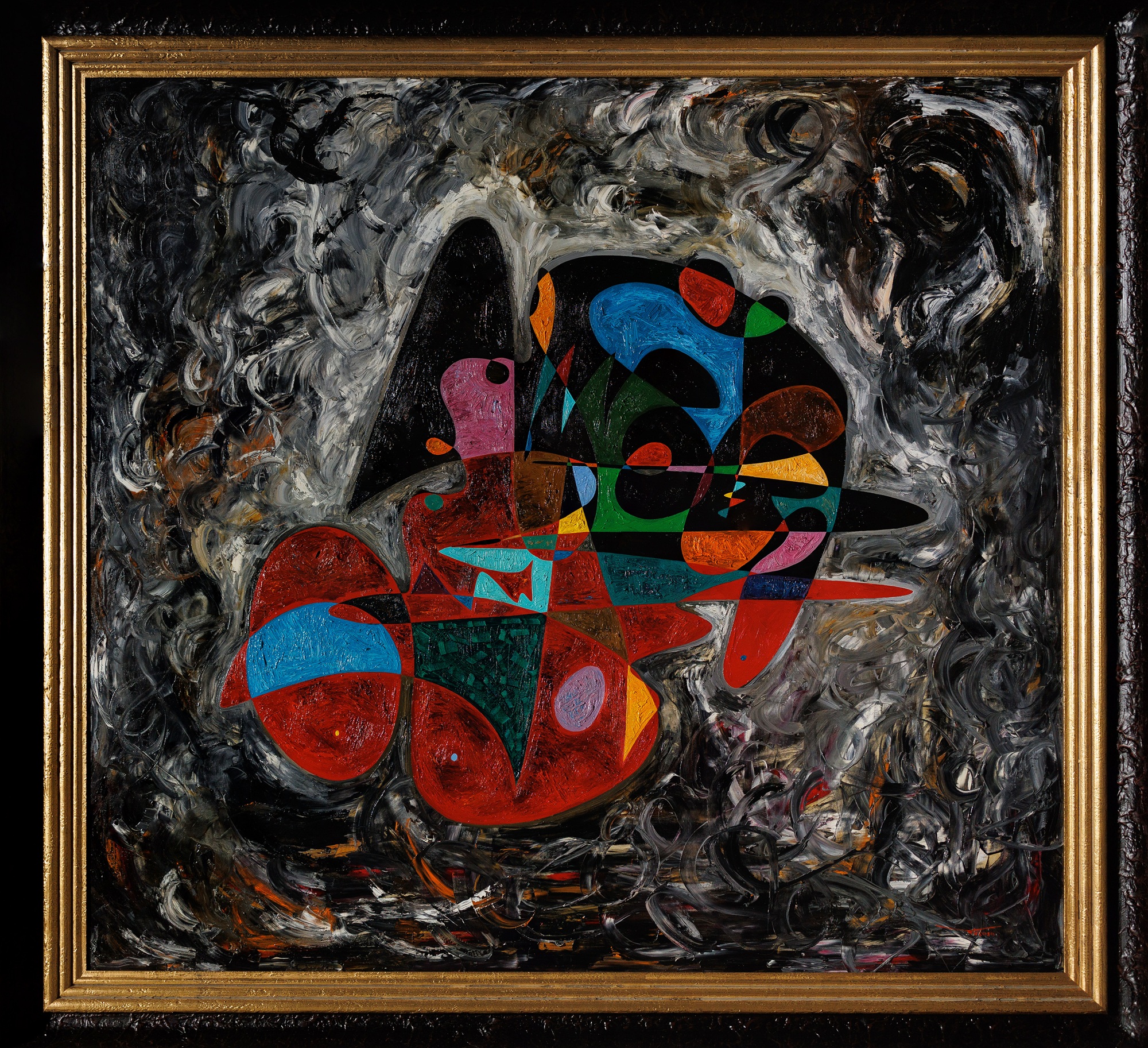
New and Old World Order (2016) presents a complex abstract composition structured around an interconnected central architecture composed of geometric planes, circular motifs, and biomorphic forms. Vibrant passages of red, blue, green, turquoise, orange, pink, black, and gold emerge from layered foundations and converge within a dark portal-like space, creating a dense network of visual relationships characterized by balance, tension, and transformation.
The composition is organized through the interaction of contrasting spatial environments. A highly structured internal system occupies the center of the painting, while energetic monochromatic brushwork surrounds it with an atmosphere of instability and movement. Intersecting forms, directional pathways, and overlapping elements generate a sense of continual negotiation between continuity and change, suggesting the coexistence of established structures and emerging forces within a shared historical landscape.
Through abstraction and symbolic construction, Virtosu transforms geopolitical transition into a visual architecture of historical succession and evolving influence. Rather than illustrating specific events, the painting explores how systems of authority adapt, interact, and reorganize across time, presenting world order as a dynamic process shaped by continuity, transformation, conflict, and renewal.
New and Old World Order explores the relationship between continuity and transformation within the evolution of political, cultural, and economic systems. Gheorghe Virtosu presents history not as a sequence of isolated eras but as an interconnected process in which established structures coexist with emerging forces that challenge, adapt, and redefine existing frameworks of authority. The painting suggests that world order is constantly reconstructed through interaction between memory, innovation, stability, and change.
The composition proposes that power functions through networks of relationships rather than through singular centers of control. Interconnected forms, layered structures, and intersecting pathways evoke the complexity of global systems in which states, institutions, cultures, and economic forces operate simultaneously. Authority appears distributed across multiple actors whose interactions generate both cooperation and competition, continuity and disruption.
The threshold-like architectural space occupying the center of the composition symbolizes transition between historical conditions. Positioned between a structured internal environment and a turbulent external field, the central configuration suggests moments when inherited institutions encounter new realities and must adapt to changing circumstances. The image therefore reflects the uncertainty and possibility that accompany periods of geopolitical transformation.
The work also examines historical memory as an active force within political development. Foundations remain visible beneath emerging structures, indicating that new systems rarely arise independently of what precedes them. Traditions, institutions, and collective experiences continue to shape future arrangements even when societies pursue innovation, reform, or realignment. Transformation is therefore presented as a process of reinterpretation rather than complete replacement.
Through its interaction of geometric organization and organic evolution, the painting reveals the tension between institutional permanence and adaptive change. Structured forms evoke governance, administration, and established frameworks of power, while fluid contours suggest cultural exchange, technological development, and the unpredictable forces that reshape historical trajectories. The coexistence of these visual languages reflects the complexity of contemporary global systems.
Within The Architecture of Power, New and Old World Order represents the systemic dimension of authority. Rather than focusing on individual leaders, ideologies, or events, the work investigates the broader processes through which entire political and social structures evolve across generations. The painting reveals world order as an ongoing negotiation between inherited realities and emerging possibilities.
Ultimately, the work presents history as an architecture of continual transformation. Through abstraction and symbolic complexity, Virtosu reveals how societies reconstruct meaning, authority, and collective identity through the interaction of competing forces and shared experiences. The painting becomes a meditation on humanity’s capacity to adapt to changing circumstances while remaining connected to the historical foundations from which future realities emerge.
Gheorghe Virtosu | Artist Biography
Gheorghe Virtosu is a contemporary painter whose work investigates the relationships between power, historical memory, geopolitical transformation, and collective consciousness. Through large-scale abstract compositions, he examines the political, cultural, and symbolic structures that shape civilizations across periods of continuity and change, translating complex historical processes into dynamic visual architectures.
Working primarily in oil on canvas, Virtosu has developed a distinctive visual language that combines geometric organization, biomorphic forms, symbolic archetypes, and layered chromatic systems. His paintings explore themes including sovereignty, diplomacy, revolution, migration, global influence, cultural identity, and the evolving mechanisms through which authority is established, transmitted, challenged, and reconfigured across societies and generations.
Drawing upon art history, political theory, anthropology, systems thinking, and philosophy, Virtosu creates research-driven bodies of work that invite critical reflection on the forces shaping historical development and contemporary civilization. Through abstraction, he reveals the interconnected relationships between memory, power, institutions, and collective belief, positioning painting as a space for intellectual inquiry into the structures through which societies organize, transform, and understand their place within an evolving world order.
Medium: Oil on canvas
Dimensions: 138 × 150 cm (54.3 × 59.1 in)
The composition is organized around a complex central architecture composed of interlocking geometric planes, circular motifs, and biomorphic forms positioned within a dark portal-like structure. Layered red foundations support ascending configurations of blue, green, turquoise, orange, pink, black, and gold elements, creating a dense network of visual relationships that balances stability, transition, and structural interdependence. Directional pathways, overlapping forms, and contrasting spatial zones generate movement while maintaining overall compositional coherence.
Executed through successive applications of oil paint, the surface combines textured passages with smoother transitions and areas of concentrated chromatic density. Variations in brushwork, pigment thickness, and tonal contrast establish depth and spatial complexity, allowing forms to emerge, intersect, and recede throughout the composition. The surrounding monochromatic field amplifies the visual prominence of the central structure while reinforcing the sensation of historical movement and systemic change.
A palette dominated by red, blue, green, turquoise, orange, pink, black, grey, white, and gold functions as both a structural and symbolic framework. Colour organizes relationships between interconnected forms, directs visual movement across the surface, and reinforces themes of continuity, adaptation, negotiation, and transformation. Through the integration of chromatic contrast, spatial layering, and formal complexity, the painting constructs a symbolic architecture of geopolitical transition and evolving systems of global influence.
Artist: Gheorghe Virtosu
Medium: Oil on canvas
Dimensions: H 1.38 m × W 1.50 m
The composition is organized around a densely structured central architecture positioned within a dark threshold-like space that functions as both frame and transitional zone. Interlocking geometric planes, circular motifs, and biomorphic forms converge into a highly interconnected visual system that immediately concentrates attention toward the center of the painting. Rather than relying on a single dominant figure, the work distributes significance across multiple interacting elements, creating a network of relationships that emphasizes complexity, balance, and continual transformation.
Spatially, the painting establishes a dialogue between order and instability. The central configuration appears carefully organized, while the surrounding monochromatic field of gestural brushwork introduces movement, uncertainty, and atmospheric tension. Layered red foundations anchor the lower portion of the composition, while ascending blue, green, turquoise, orange, and pink forms generate upward movement and visual expansion. This vertical progression reinforces the sensation of emergence and transition, suggesting the development of new structures from existing foundations.
The interaction of colour, form, and directional movement creates a dynamic equilibrium throughout the pictorial field. Circular elements establish points of connection, intersecting planes create structural continuity, and contrasting chromatic passages guide the viewer through successive layers of visual information. Through this integration of geometric organization and organic transformation, Virtosu constructs an abstract architecture in which continuity and change operate simultaneously, revealing historical evolution as a process of negotiation between inherited systems and emerging realities.
Colour functions as a visual language of continuity, interaction, and transformation within New and Old World Order. Dominant passages of red, blue, green, turquoise, orange, pink, black, and gold establish a complex network of chromatic relationships that simultaneously suggest stability and change. The vibrant central palette contrasts sharply with the surrounding monochromatic environment, creating a dynamic tension between established structures and the uncertainties that accompany historical transition.
The formal structure combines geometric organization with organic evolution. Angular planes, circular motifs, and linear frameworks evoke institutions, systems, and mechanisms of governance, while biomorphic contours introduce movement, adaptation, and the unpredictable forces that reshape political and cultural realities. The coexistence of these contrasting formal languages generates a composition that remains both structured and fluid, reflecting the evolving nature of global systems and historical development.
Colour and form operate as an integrated architecture of relationships rather than as isolated compositional elements. Chromatic contrasts emphasize points of intersection and exchange, while overlapping forms establish pathways of visual movement throughout the composition. Through this synthesis, Virtosu transforms abstraction into a symbolic model of geopolitical transformation, revealing how continuity and innovation interact within the ongoing reconstruction of world order.
New and Old World Order employs a symbolic vocabulary centered on transition, continuity, and the evolution of collective systems. The interconnected central architecture functions as the painting’s primary symbolic structure, evoking the coexistence of multiple centers of influence operating within a shared geopolitical environment. Rather than representing a single authority, the composition presents power as a network of relationships through which institutions, cultures, and historical forces interact, compete, and adapt over time.
The portal-like spatial configuration surrounding the central forms may be interpreted as a threshold between historical conditions. Geometric planes suggest institutional frameworks and established structures of governance, while biomorphic elements introduce adaptation, innovation, and the unpredictable dynamics of social change. Circular motifs and intersecting pathways reinforce themes of connectivity, exchange, and interdependence, symbolizing the mechanisms through which influence circulates across political, economic, and cultural systems.
The layered red foundations beneath the ascending composition evoke historical memory and inherited structures upon which emerging realities are constructed. Above them, vibrant blue, green, turquoise, orange, and pink forms suggest renewal, negotiation, and evolving networks of influence. Through this symbolic architecture, Virtosu presents world order as a continually transforming system in which continuity and change remain inseparable, revealing history as an ongoing process of reconstruction rather than a sequence of isolated eras.
New and Old World Order explores the continual transformation of global systems and the complex relationship between historical inheritance and emerging realities. Gheorghe Virtosu presents world order not as a fixed geopolitical arrangement but as a dynamic process through which institutions, cultures, economies, and centers of influence are continuously redefined. The painting suggests that stability and change are not opposing conditions but interconnected forces that shape the evolution of societies across time.
The work proposes that authority operates through networks of interaction rather than isolated structures of control. Established institutions remain present within the foundations of collective life even as new forms of organization, communication, and influence emerge. Through overlapping forms and interconnected relationships, the composition reveals how continuity, adaptation, competition, and cooperation collectively contribute to the reconfiguration of political and cultural realities. Historical change therefore appears as a process of negotiation rather than abrupt replacement.
Within The Architecture of Power, the painting represents the systemic dimension of historical evolution. Through abstraction and symbolic complexity, Virtosu reveals how societies reconstruct meaning, legitimacy, and collective identity while responding to changing circumstances. The work ultimately presents world order as an evolving architecture shaped by memory, innovation, and human agency, emphasizing the enduring capacity of civilizations to adapt while remaining connected to their historical foundations.
New and Old World Order evokes a complex emotional atmosphere characterized by anticipation, uncertainty, and cautious optimism. The interaction between the structured central architecture and the surrounding turbulent environment creates the sensation of a world undergoing transition, where established certainties encounter emerging possibilities. The painting encourages reflection on the emotional realities that accompany periods of profound historical and geopolitical change.
Beneath its structural coherence lies a persistent tension between stability and transformation. Intersecting forms, layered foundations, and contrasting spatial environments generate a feeling of movement without resolution, suggesting a state in which multiple futures remain possible. The composition captures the psychological experience of navigating change, where continuity provides orientation even as new realities challenge familiar frameworks of understanding.
At the same time, the work conveys resilience and adaptability. The interconnected nature of the composition suggests that transformation is not solely a process of disruption but also one of renewal, negotiation, and reconstruction. The emotional register therefore balances uncertainty with possibility, presenting historical transition as an opportunity for societies to redefine relationships, reimagine institutions, and construct new forms of collective meaning within an evolving global landscape.
- Within The Architecture of Power, the work examines how inherited institutions, cultural traditions, and emerging networks of influence interact during periods of systemic transition, adaptation, and historical realignment.
- The painting transforms themes of continuity, change, diplomacy, conflict, innovation, and collective memory into an interconnected visual architecture in which meaning emerges through relationships between forms rather than through narrative illustration.
- The portal-like structure, layered foundations, circular motifs, and ascending configurations may be interpreted as symbols of historical passage, institutional memory, evolving geopolitical networks, and the continual reconstruction of authority across generations.
Selected Bibliography
- Arrighi, Giovanni. Adam Smith in Beijing: Lineages of the Twenty-First Century. London: Verso, 2007.
- Fukuyama, Francis. Political Order and Political Decay: From the Industrial Revolution to the Globalization of Democracy. New York: Farrar, Straus and Giroux, 2014.
- Huntington, Samuel P. The Clash of Civilizations and the Remaking of World Order. New York: Simon & Schuster, 1996.
- Kissinger, Henry. World Order. New York: Penguin Press, 2014.
- Panofsky, Erwin. Meaning in the Visual Arts. Chicago: University of Chicago Press, 1982.
- Foster, Hal, Rosalind Krauss, Yve-Alain Bois, Benjamin H. D. Buchloh, and David Joselit. Art Since 1900: Modernism, Antimodernism, Postmodernism. London: Thames & Hudson, 2016.
- Wallerstein, Immanuel. World-Systems Analysis: An Introduction. Durham: Duke University Press, 2004.
Curatorial Team: Daniel Varzari
Photography: El Arte Monumental
Special Thanks: Daniel Varzari, Gheorghe Virtosu
El Arte Monumental
08007 Barcelona
Phone: +34 934 439 470/ +01 312 358 8023