The Architecture of Power
El Arte Monumental | Catalogue: The Architecture of Power
Catalogue Entry: The Beast of Nazism (2015) | Art Curator: Daniel Varzari
In The Beast of Nazism (2015), Gheorghe Virtosu confronts one of the most destructive ideological forces of the twentieth century through the language of symbolic abstraction. Rather than depicting specific historical events, the painting explores the psychological and cultural conditions that enable systems of extremism, intolerance, and political domination to emerge and endure.
Through an intricate network of organic and geometric forms, Virtosu transforms history into a visual meditation on power, perception, and collective belief. The work invites reflection on the mechanisms through which ideology can influence human behavior, reshape social realities, and challenge the ethical foundations of civil society.
As part of The Architecture of Power, The Beast of Nazism examines the consequences of authority detached from moral responsibility. Both historical reflection and contemporary warning, the painting encourages vigilance against the forces that seek to subordinate individual freedom, human dignity, and critical thought to absolute systems of belief.
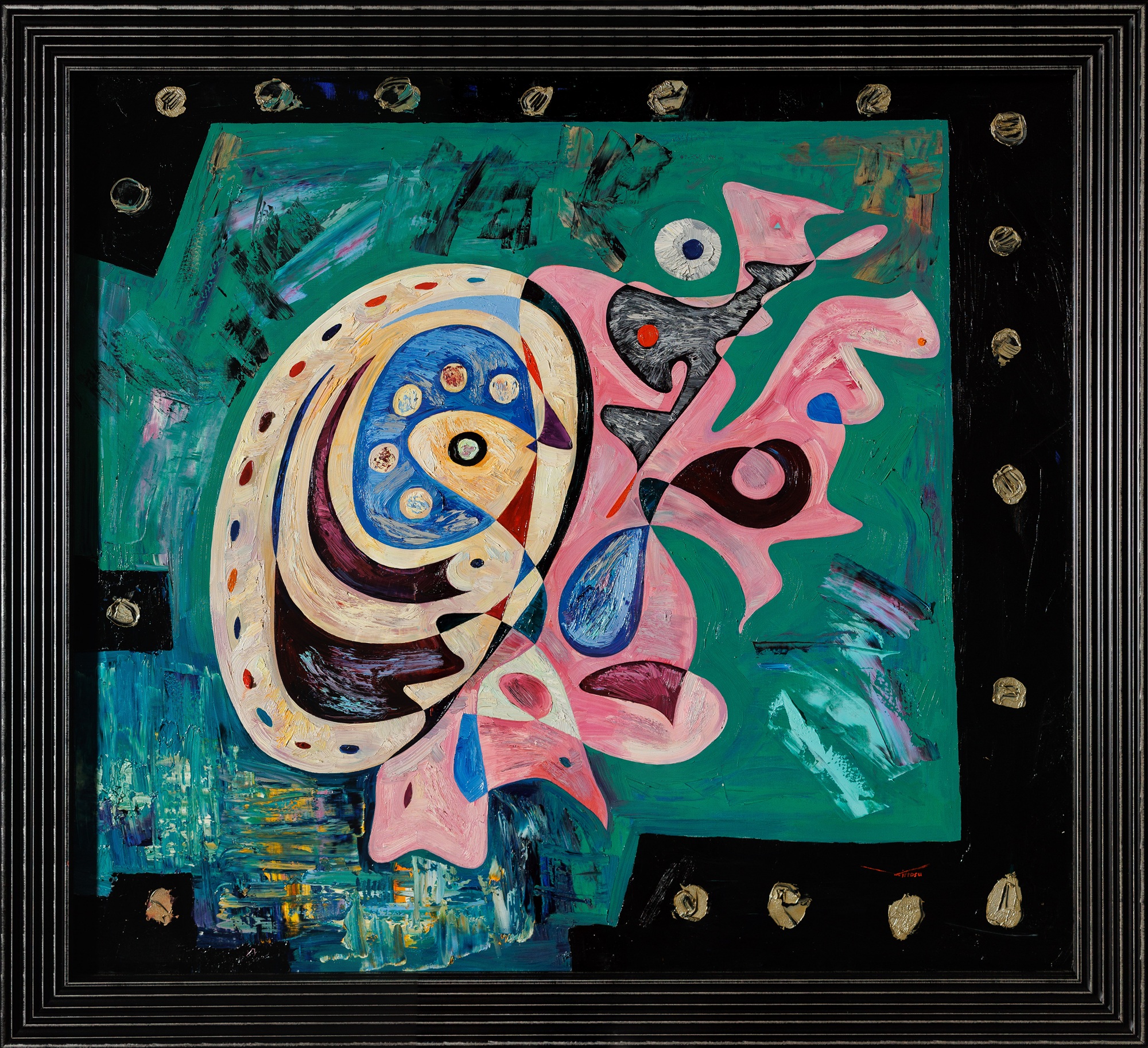
The Beast of Nazism (2015) presents a complex abstract composition organized around a large concentric eye-like structure positioned within a geometric turquoise-green field enclosed by a black border. Fragmented biomorphic forms, circular motifs, angular divisions, and intersecting planes rendered in turquoise, blue, pink, black, white, red, and gold interact across the surface, creating a dense and visually dynamic arrangement.
The composition is structured through enclosure, layering, and fragmentation. Organic forms overlap with geometric frameworks, while recurring circular elements establish visual rhythm throughout the image. A large pink organism-like structure extends from the central eye motif and incorporates smaller eye-like forms, curved appendages, and irregular cavities. Contrasting colour zones and intersecting shapes create areas of compression and expansion that guide movement across the composition.
Surrounding the central structure, a black peripheral field contains numerous small circular gold forms distributed around the edges of the canvas. Broad painterly passages, textured surfaces, and abrupt chromatic transitions contribute to the work’s visual complexity. The interaction between the dominant eye motif, the surrounding biomorphic structures, and the enclosing geometric field produces an image characterized by tension, contrast, and continuous transformation.
The Beast of Nazism (2015) examines the transformation of political authority into a system of ideological domination. Gheorghe Virtosu presents Nazism not simply as a historical regime but as a totalizing worldview capable of reshaping perception, behavior, and collective identity. The painting suggests that authoritarian power achieves its greatest influence when political doctrine extends beyond institutions and becomes embedded within the cultural, psychological, and moral frameworks through which reality itself is interpreted and understood.
Central to the work is the idea that totalitarianism depends upon the gradual subordination of individual judgment to collective ideology. Rather than relying solely upon coercion, such systems seek to redefine truth, reshape memory, and establish new standards of belonging and exclusion. The painting reflects this process through a visual environment in which distinct forms become absorbed into a larger organizational structure, suggesting the tension between individual identity and ideological conformity.
The composition proposes that authoritarian ideology operates through repetition, enclosure, and the simplification of complexity. Fragmented elements are drawn into increasingly controlled relationships, while recurring circular structures create a sense of continuity and self-reinforcement. Alternative perspectives appear compressed within a unified visual field, reflecting the manner in which totalitarian doctrines attempt to replace plurality with uniformity and critical thought with predetermined belief.
The painting also investigates the relationship between fear and authority. Dark forms, enclosed structures, and compressed spatial relationships generate an atmosphere of psychological pressure that reflects the conditions through which oppressive political systems sustain influence. Fear appears not only as an instrument of coercion but as a force capable of reshaping social behavior, narrowing public discourse, and encouraging conformity in place of independent judgment.
At a deeper level, the work addresses the process of dehumanization. Organic forms appear fragmented, distorted, and absorbed into larger structural configurations, suggesting the reduction of individual identity within collective ideological frameworks. Human complexity gives way to symbolic function, reflecting the manner in which extremist political doctrines transform persons into instruments serving abstract objectives rather than autonomous participants in society.
Within The Architecture of Power, The Beast of Nazism represents the destructive extreme of political organization. While other works in the series examine legitimacy, diplomacy, leadership, and transformation, this painting focuses on the consequences that emerge when authority becomes detached from ethical restraint and pluralistic values. The composition reveals how systems initially established to create order can evolve into structures of exclusion, conformity, and persecution.
Ultimately, the painting presents Nazism as an architecture of distortion. Through abstraction and symbolic complexity, Virtosu explores the ways ideological narratives reshape perception, regulate behavior, and redefine reality according to absolute doctrines. The work functions simultaneously as historical reflection and enduring warning, emphasizing the importance of critical thought, moral responsibility, and vigilance in confronting forces that threaten individual freedom and human dignity.
Gheorghe Virtosu | Artist Biography
Gheorghe Virtosu is a contemporary painter whose work explores the relationships between power, historical memory, ideology, and collective consciousness. Through large-scale abstract compositions, he investigates the political, cultural, and symbolic forces that shape societies, translating complex historical experiences into visual structures that examine authority, belief, identity, and human behavior.
Working primarily in oil on canvas, Virtosu has developed a distinctive visual language that combines geometric organization, biomorphic forms, symbolic archetypes, and layered chromatic systems. His paintings address themes including sovereignty, totalitarianism, diplomacy, revolution, migration, cultural identity, and the mechanisms through which political narratives influence collective perception and social reality.
Drawing upon art history, political theory, anthropology, psychology, and philosophy, Virtosu creates research-driven bodies of work that encourage critical reflection on the structures shaping modern civilization. Through abstraction, he reveals the interconnected relationships between memory, ideology, power, and collective belief, positioning painting as a space for intellectual inquiry into the forces capable of shaping, transforming, and at times distorting human experience across history.
Medium: Oil on canvas
Dimensions: 138 × 150 cm (54.3 × 59.1 in)
The composition is structured around a dominant concentric eye-like configuration positioned within a geometric green field and enclosed by a surrounding black border. Intersecting biomorphic forms, fragmented elements, circular motifs, and angular planes are organized into a dense visual network that emphasizes enclosure, repetition, and structural interconnection. The arrangement establishes a strong focal hierarchy while generating continuous movement across the pictorial surface.
Executed through layered applications of oil paint, the surface combines areas of dense pigment with fluid transitions and textured passages. Variations in brushwork, chromatic saturation, and paint density create depth and spatial complexity, allowing forms to emerge, overlap, and dissolve throughout the composition. These material relationships contribute to the painting’s visual density and dynamic surface character.
A palette dominated by turquoise, blue, pink, black, white, red, green, and gold establishes strong chromatic contrasts across the composition. Colour is used to define spatial relationships, distinguish major structural elements, and reinforce visual rhythm through recurring forms and concentric arrangements. The interaction of luminous and dark passages enhances depth, movement, and compositional cohesion throughout the work.
Artist: Gheorghe Virtosu
Medium: Oil on canvas
Dimensions: H 1.38 m × W 1.50 m
The composition is organized around a dominant concentric eye-like structure that serves as the primary focal point and organizing axis of the painting. Surrounding biomorphic forms, circular motifs, and intersecting geometric elements radiate outward from this center, creating a visual system characterized by both cohesion and tension. The arrangement establishes a strong hierarchy of attention while guiding the viewer through successive layers of interconnected forms and recurring visual relationships.
Spatially, the painting balances enclosure and movement. The geometric green field contains the principal forms within a clearly defined internal environment, while the surrounding black border reinforces the distinction between the central structure and the outer pictorial space. Fragmented organic elements appear compressed within this framework, generating visual density and directional tension. Repetition of circular forms and curvilinear contours creates rhythmic movement throughout the composition, encouraging the eye to circulate continuously across the surface.
Contrasts between curved and angular forms, dense and open areas, and luminous and dark passages establish a dynamic equilibrium throughout the work. Turquoise, blue, pink, white, black, red, and gold accents generate chromatic rhythms that connect disparate elements into a coherent visual structure. Through the integration of form, colour, scale, and spatial organization, Virtosu constructs a composition characterized by complexity, balance, and continuous visual transformation.
Colour functions as a primary structural element within The Beast of Nazism. Dominant passages of turquoise, blue, pink, black, white, red, green, and gold establish a system of strong chromatic contrasts that organize the composition and direct visual attention. Luminous areas emerge against darker passages, creating depth, emphasis, and a dynamic relationship between central and peripheral forms. The interaction of saturated and muted tones contributes to the painting’s visual intensity and atmospheric complexity.
The formal structure combines geometric containment with organic transformation. Circular motifs, concentric formations, angular planes, and linear divisions establish a framework of order and repetition, while biomorphic contours, irregular silhouettes, and fragmented forms introduce fluidity and variation. The coexistence of these contrasting formal languages generates visual tension while maintaining overall compositional coherence.
Colour and form operate together to create rhythm and movement throughout the painting. Chromatic accents emphasize focal areas, while recurring circular structures and fragmented shapes establish patterns that guide the viewer’s eye across the surface. Through the interaction of contrast, repetition, scale, and transformation, Virtosu constructs a visually complex composition characterized by balance, density, and continuous formal evolution.
The symbolic language of The Beast of Nazism is organized around a dominant concentric eye-like structure positioned at the center of the composition. As one of the most enduring symbols of observation and awareness, the eye functions as the painting’s principal iconographic element. Its enlarged scale and central placement establish it as the focal point of the visual system, while the surrounding concentric formations amplify its presence throughout the composition.
Surrounding the central eye is a network of fragmented biomorphic forms that merge organic and abstract characteristics. These shifting structures resist stable identification, appearing simultaneously creature-like, anatomical, and symbolic. Their interconnected arrangement creates the impression of a larger organism whose individual components remain inseparable from the whole. The recurring circular motifs distributed throughout the painting reinforce this visual continuity, linking disparate elements into a unified symbolic environment.
The geometric green field enclosing the principal forms functions as a symbolic space of containment and separation. Its clearly defined boundaries distinguish the internal structure from the surrounding black perimeter, establishing a visual relationship between enclosure and exteriority. Numerous gold circular markers positioned along the border further emphasize this distinction while contributing to the painting’s repetitive iconographic rhythm.
Through the interaction of ocular imagery, biomorphic forms, concentric structures, enclosing geometries, and recurring circular motifs, Virtosu constructs a symbolic system in which observation, repetition, containment, and transformation become the dominant visual themes. The painting’s imagery remains intentionally ambiguous, allowing individual symbols to operate simultaneously on biological, psychological, political, and historical levels of interpretation.
The Beast of Nazism reflects upon the vulnerability of human societies to systems that promise certainty, order, and collective purpose at the expense of freedom and moral complexity. The painting suggests that the greatest danger of extremist ideologies lies not only in their political ambitions but in their capacity to reduce the richness of human experience to rigid and unquestionable frameworks. Through abstraction, Virtosu examines the tension between individuality and collective doctrine, revealing how easily complexity can be replaced by absolute conviction.
The work proposes that destructive forms of authority emerge when plurality, ambiguity, and critical reflection are displaced by singular visions of truth. In such environments, difference becomes a threat rather than a source of dialogue, and social life becomes organized around exclusion rather than coexistence. The painting therefore addresses a broader historical and philosophical question: how societies negotiate the balance between collective organization and individual autonomy.
Within The Architecture of Power, The Beast of Nazism serves as a meditation on the consequences of ideological absolutism. Rather than focusing solely on a specific historical regime, the work considers a recurring tendency within human history—the desire to transform political belief into unquestionable certainty. The painting ultimately affirms the enduring importance of intellectual freedom, ethical responsibility, and human dignity in resisting forces that seek to subordinate the individual to an all-encompassing system of thought.
The Beast of Nazism evokes a profound sense of unease, vigilance, and psychological pressure. The dominant eye-like structure, enclosed spatial organization, and dense concentration of forms generate the impression of a world in which observation is inescapable and movement is constrained. The viewer is confronted with an atmosphere of tension that remains unresolved, producing a persistent feeling of discomfort and alertness.
Beneath the composition’s apparent order lies a current of instability. Fragmented forms, compressed spatial relationships, and abrupt visual contrasts create an environment marked by uncertainty and latent threat. The painting oscillates between attraction and disturbance, drawing the viewer into its intricate structures while simultaneously reinforcing a sense of confinement and disquiet.
Yet the work does not communicate despair alone. The act of confronting the image encourages reflection, awareness, and critical engagement. Through its balance of tension and clarity, complexity and structure, the painting transforms anxiety into contemplation, inviting viewers to consider the conditions that shape human experience and the values that sustain individual dignity in times of crisis.
- The title The Beast of Nazism is interpreted as a symbolic exploration of totalitarian ideology and its psychological, cultural, and political consequences rather than as a depiction of a specific historical event or individual.
- The work forms part of The Architecture of Power, a series investigating authority, ideology, collective belief, historical transformation, and the symbolic structures through which power is organized and represented.
Selected Bibliography
- Arendt, Hannah. The Origins of Totalitarianism. New York: Harcourt, Brace & Company, 1951.
- Adorno, Theodor W., and Max Horkheimer. Dialectic of Enlightenment. Stanford: Stanford University Press, 2002.
- Cassirer, Ernst. The Myth of the State. New Haven: Yale University Press, 1946.
- Kershaw, Ian. The Nazi Dictatorship: Problems and Perspectives of Interpretation. London: Bloomsbury Academic, 2015.
- Orwell, George. Nineteen Eighty-Four. London: Secker & Warburg, 1949.
- Panofsky, Erwin. Meaning in the Visual Arts. Chicago: University of Chicago Press, 1982.
- Foster, Hal, Rosalind Krauss, Yve-Alain Bois, Benjamin H. D. Buchloh, and David Joselit. Art Since 1900: Modernism, Antimodernism, Postmodernism. London: Thames & Hudson, 2016.
Curatorial Team: Daniel Varzari
Photography: El Arte Monumental
Special Thanks: Daniel Varzari, Gheorghe Virtosu
El Arte Monumental
08007 Barcelona
Phone: +34 934 439 470/ +01 312 358 8023