The Architecture of Power
El Arte Monumental | Catalogue: The Architecture of Power
Catalogue Entry: The Crown Holder (2017) | Art Curator: Daniel Varzari
The Crown Holder (2017) marks a decisive moment within Gheorghe Virtosu’s exploration of power, shifting attention from the emergence of authority to the structures that sustain its legitimacy. The painting investigates the crown not as a historical object, but as a symbolic mechanism through which sovereignty becomes visible, recognizable, and culturally enduring.
Suspended within a dark and indeterminate field, the monumental crown serves as the foundation for an intricate architecture of forms. Through abstraction, Virtosu transforms one of civilization’s oldest emblems of rule into a dynamic system of relationships, revealing authority as a process of construction rather than a fixed condition.
Positioned within The Architecture of Power, the work examines how collective belief, institutional continuity, and symbolic representation converge to produce legitimacy. Rather than depicting power itself, The Crown Holder investigates the structures through which power acquires meaning and historical permanence.
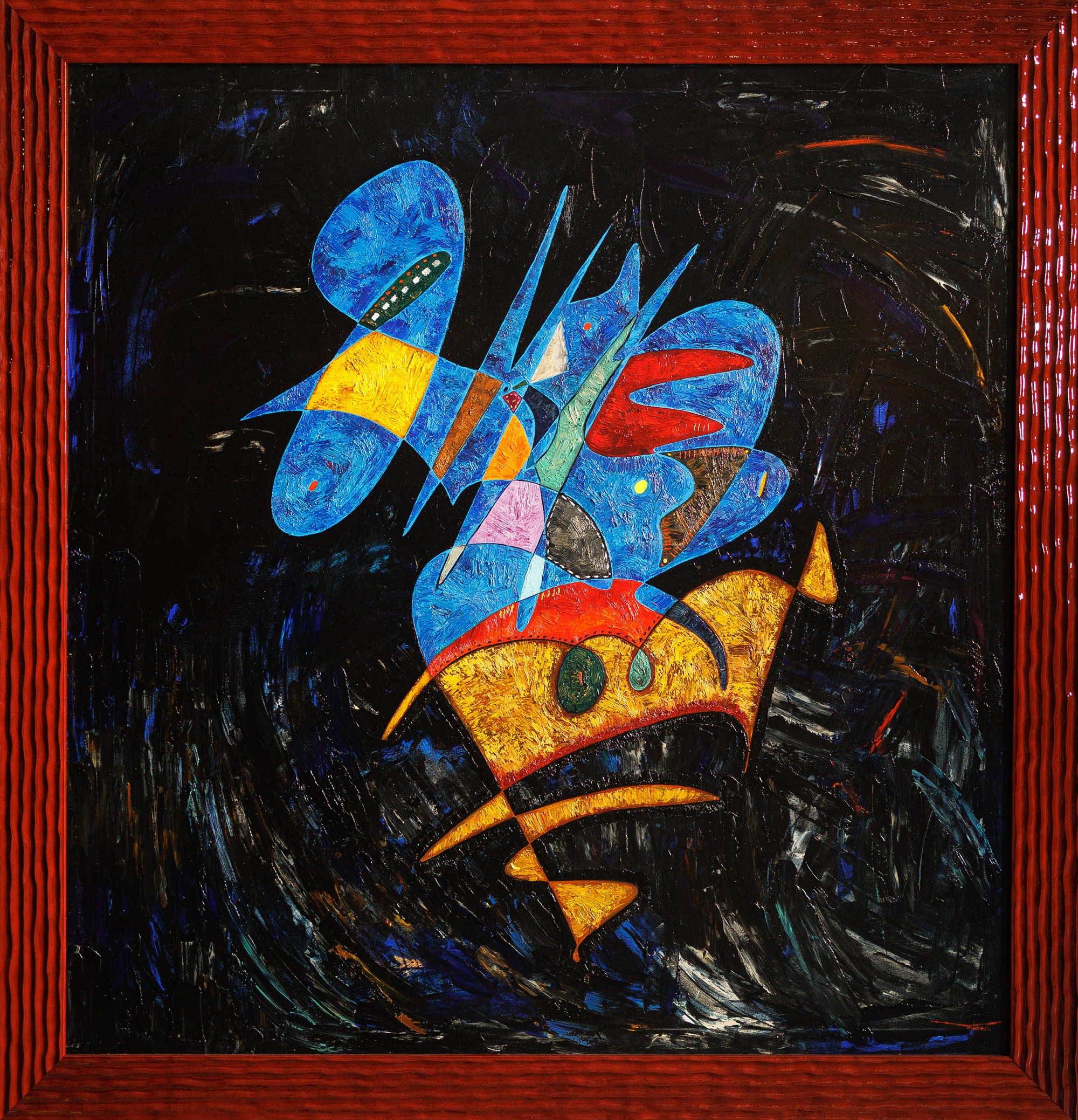
The Crown Holder (2017) presents a monumental golden crown positioned at the foundation of a complex abstract structure composed of blue geometric and organic forms. Suspended against a textured black field, the composition combines architectural stability with dynamic movement, transforming a familiar emblem of sovereignty into an intricate system of symbolic relationships.
The painting is organized around a clear vertical progression in which the crown functions as both anchor and source. Angular planes, curved contours, and vivid accents of red, yellow, green, and white rise from this foundation, creating a layered visual network that suggests authority, continuity, and institutional formation. The image balances precision and fluidity, stability and transformation, within a unified compositional framework.
Through abstraction and symbolic synthesis, Virtosu reinterprets the crown as more than an object of rule. It becomes a visual architecture through which legitimacy, governance, and collective recognition are explored, inviting reflection on the cultural structures that sustain power across time.
The Crown Holder investigates the symbolic foundations of authority through one of history’s most enduring political emblems: the crown. Rather than portraying a sovereign, Gheorghe Virtosu focuses on the mechanism of legitimacy itself, examining how power becomes visible, recognizable, and culturally accepted through symbolic representation.
The crown functions as both object and idea. Throughout human history, crowns have signified continuity, hierarchy, inheritance, and institutional authority. In this work, the emblem is removed from historical specificity and transformed into an abstract structure, allowing it to operate as a universal symbol of sovereignty rather than as a reference to any particular ruler or political system.
The dynamic configuration rising above the crown suggests that authority extends beyond the symbol that represents it. Institutions, traditions, collective memory, ideology, and governance emerge as interconnected forces sustained by legitimacy. The painting proposes that power is never contained within a single object or individual, but exists within broader systems of cultural recognition and social organization.
The surrounding black field reinforces this interpretation by functioning as a space of uncertainty and indeterminacy. Against this expansive darkness, the crown appears illuminated and stable, emphasizing the role of symbolic structures in creating order within conditions of instability. Authority emerges not as a natural condition but as a constructed response to uncertainty.
Colour contributes to the painting’s conceptual framework. Gold evokes sovereignty, value, and continuity, while blue introduces associations with permanence, institutional structure, and intellectual order. Red, yellow, green, and white accents activate the composition, suggesting the tensions, negotiations, and transformations through which legitimacy is maintained.
Within The Architecture of Power, The Crown Holder represents a crucial transition from instinctual power to symbolic authority. If power originates through pursuit and survival, it achieves durability through systems of recognition capable of transforming force into legitimacy. The painting therefore examines the cultural processes through which authority becomes sustainable across generations.
Ultimately, The Crown Holder presents sovereignty as an architecture of belief. Through abstraction and symbolic synthesis, Virtosu reveals legitimacy as a continuously constructed system sustained by representation, memory, and collective acceptance. The work transforms the crown from an object of rule into a meditation on the structures that make rule conceivable.
Gheorghe Virtosu | Artist Biography
Gheorghe Virtosu is a contemporary painter whose work explores the intersections of abstraction, power, historical memory, and collective consciousness. Through large-scale oil paintings, he has developed a distinctive visual language that combines geometric structures, symbolic forms, and complex spatial systems to examine the forces that shape civilizations and cultural identities.
Central to Virtosu’s practice is the concept of New Perfection in Systemic Abstraction, a framework in which paintings function as interconnected systems rather than representational images. His work investigates themes including sovereignty, conflict, diplomacy, mythology, migration, and the evolution of social and political structures, transforming historical and philosophical questions into dynamic visual architectures.
Through layered painterly techniques and an interdisciplinary engagement with art history, anthropology, political theory, and philosophy, Virtosu constructs immersive compositions that invite critical reflection on the symbolic mechanisms through which societies organize power, memory, and collective experience.
Medium: Oil on canvas
Dimensions: 136 × 131 cm (53.5 × 51.6 in)
The composition is constructed around a vertically organized symbolic structure anchored by a monumental crown rendered in luminous gold. Above this foundation, interlocking geometric planes and biomorphic forms are arranged into a dense architectural configuration, creating a visual system that balances stability, movement, and hierarchical order.
A heavily textured black ground provides spatial depth and contrast, allowing the central forms to emerge with heightened clarity and visual intensity. Layered oil applications, controlled brushwork, and segmented colour fields contribute to the painting’s material richness while reinforcing its structural coherence.
Chromatic relationships play a central role in the composition. Gold, blue, red, yellow, green, and white are employed as organizational elements rather than descriptive colours, establishing visual hierarchy, directional movement, and symbolic emphasis. The integration of texture, colour, and form transforms the painting into a unified system in which materiality and meaning remain inseparable.
Artist: Gheorghe Virtosu
Medium: Oil on canvas
Dimensions: H 1.36 m × W 1.31 m
The composition is organized around a strong vertical axis that rises from the monumental crown at the base toward an intricate arrangement of abstract forms above. This upward movement establishes a clear sense of hierarchy and elevation, reinforcing the painting’s engagement with sovereignty, legitimacy, and institutional authority. The crown functions as both visual anchor and conceptual foundation, stabilizing the composition while directing attention toward the structures it supports.
Geometric segmentation interacts with curved organic contours to create a dynamic network of interdependent forms. Angular planes generate structural clarity, while fluid transitions introduce movement and transformation. The composition balances concentration and expansion, allowing individual elements to maintain autonomy while contributing to a coherent architectural system.
The textured black field surrounding the central structure intensifies spatial contrast and isolates the symbolic configuration from any fixed environment. This relationship enhances the monumentality of the image and focuses attention on the internal organization of forms. Through the integration of hierarchy, rhythm, and visual tension, the painting transforms a traditional emblem of sovereignty into a complex architecture of power.
Color functions as a system of hierarchy and symbolic emphasis throughout The Crown Holder. The luminous gold crown establishes the visual foundation of the composition, signifying legitimacy, continuity, and authority, while dominant blue forms create a sense of elevation, stability, and institutional presence. Accents of red, yellow, green, and white introduce rhythm and contrast, activating the surface and directing movement through the image.
Form emerges through the interaction of geometric precision and organic transformation. Angular planes intersect with curved contours to create a structure that appears simultaneously architectural and fluid. The crown anchors the composition, while the forms above generate complexity and expansion, producing a dynamic relationship between permanence and change.
The integration of color and form establishes the painting’s internal equilibrium. Chromatic contrasts reinforce structural divisions, while recurring shapes create continuity across the composition. Together, these elements transform the image into a coherent visual architecture in which authority is expressed not through representation alone, but through the organization of relationships, movement, and symbolic order.
At the centre of the painting stands the crown, one of the most enduring symbols of sovereignty and legitimacy in human history. Rather than functioning as a decorative object, it operates as the conceptual foundation of the composition, representing the authority through which political, cultural, and institutional structures become recognized and sustained. The title, The Crown Holder, shifts emphasis from rulership itself to the mechanisms that support and preserve power.
The complex arrangement of blue geometric and organic forms rising above the crown suggests the systems generated by authority: governance, law, memory, ideology, and collective belief. These elements appear interconnected and continuously evolving, indicating that sovereignty is not a fixed condition but a dynamic structure maintained through relationships, adaptation, and social recognition. The image therefore transforms power from a singular symbol into an active architecture.
The surrounding black field reinforces the symbolic isolation of the central structure, positioning authority against a space of uncertainty and potential instability. Accents of red, yellow, green, and white introduce associations with conflict, transformation, continuity, and renewal, enriching the painting’s symbolic complexity. Through this network of forms and colours, Virtosu presents legitimacy as a cultural construction—an evolving system of meanings through which societies organize power, identity, and historical continuity.
The Crown Holder examines authority as a symbolic construct rather than a personal possession. By isolating the crown from any identifiable ruler, Gheorghe Virtosu shifts attention toward the mechanisms through which legitimacy is established, recognized, and sustained. The work proposes that sovereignty exists not in individuals alone, but in the cultural systems that authorize and preserve power.
The crown functions as both object and idea. Positioned at the foundation of the composition, it serves as a visual metaphor for the structures upon which institutions, traditions, and political orders are built. The dynamic forms rising above it suggest that authority is never static; it is continuously shaped by historical memory, collective belief, and social transformation.
Within The Architecture of Power, The Crown Holder represents the emergence of legitimacy as a defining condition of governance. The painting transforms a familiar emblem of sovereignty into an abstract architecture of recognition, revealing power as a system maintained through symbolism, continuity, and collective acceptance rather than force alone.
The Crown Holder evokes a sense of solemn authority and ceremonial presence. The luminous crown emerging from the darkness conveys stability, permanence, and symbolic weight, while the intricate structure above introduces an atmosphere of complexity and latent tension. The work balances reassurance and uncertainty, suggesting that authority is both enduring and continuously contested.
The contrast between the radiant central forms and the expansive black field generates a psychological experience of isolation and elevation. Viewers may encounter feelings of reverence, contemplation, or critical distance as the painting transforms a familiar emblem of sovereignty into an abstract system whose meaning remains open to interpretation.
Beneath its visual grandeur lies a quieter reflection on legitimacy and belief. The painting invites consideration of the emotional foundations of power—trust, recognition, loyalty, and doubt—revealing authority not only as a political structure but also as a deeply human and collective experience.
- The crown has served throughout history as a primary symbol of sovereignty, embodying legitimacy, continuity, and the transfer of authority across generations and political systems.
- Within The Architecture of Power, The Crown Holder investigates the transformation of power from instinctual force into recognized authority, examining the symbolic structures that sustain governance and collective belief.
- The painting exemplifies Gheorghe Virtosu’s concept of New Perfection in Systemic Abstraction, in which symbolic subjects are reconfigured into interconnected visual systems that privilege structure, process, and relational meaning over direct representation.
- The relationship between the crown and the abstract configuration above may be interpreted as a distinction between legitimacy as symbol and legitimacy as institution, revealing sovereignty as a continuously maintained cultural construct.
Selected Bibliography
- Arnheim, Rudolf. Art and Visual Perception: A Psychology of the Creative Eye. Berkeley: University of California Press, 1974.
- Cassirer, Ernst. The Myth of the State. New Haven: Yale University Press, 1946.
- Foster, Hal, Rosalind Krauss, Yve-Alain Bois, Benjamin H. D. Buchloh, and David Joselit. Art Since 1900: Modernism, Antimodernism, Postmodernism. London: Thames & Hudson, 2016.
- Gombrich, E. H. Symbolic Images: Studies in the Art of the Renaissance. London: Phaidon Press, 1972.
- Kantorowicz, Ernst H. The King’s Two Bodies: A Study in Medieval Political Theology. Princeton: Princeton University Press, 1957.
- Lefort, Claude. Democracy and Political Theory. Minneapolis: University of Minnesota Press, 1988.
- Panofsky, Erwin. Meaning in the Visual Arts. Chicago: University of Chicago Press, 1982.
Curatorial Team: Daniel Varzari
Photography: El Arte Monumental
Special Thanks: Daniel Varzari, Gheorghe Virtosu
El Arte Monumental
08007 Barcelona
Phone: +34 934 439 470/ +01 312 358 8023