The Architecture of Power
El Arte Monumental | Catalogue: The Architecture of Power
Catalogue Entry: The Diplomatic Jew (2015) | Art Curator: Daniel Varzari
In The Diplomatic Jew (2015), Gheorghe Virtosu approaches diplomacy not as a political event but as a cultural condition. Through a sophisticated language of abstraction, the painting explores how dialogue, memory, and negotiation shape relationships between individuals, communities, and historical traditions. The work examines the structures that allow continuity to persist amid social and political transformation.
Suspended within a luminous field of gold and intersecting networks of form, the composition transforms mediation into a symbolic architecture. Distinct visual elements remain interconnected without losing their individuality, suggesting a model of coexistence in which difference becomes the foundation of exchange rather than division. Authority emerges through communication, reciprocity, and mutual recognition rather than domination.
Within The Architecture of Power, The Diplomatic Jew represents the relational dimension of power itself. The painting invites reflection on the intellectual, cultural, and historical processes through which societies sustain dialogue across boundaries, revealing diplomacy as one of the enduring mechanisms through which collective continuity is achieved and preserved.
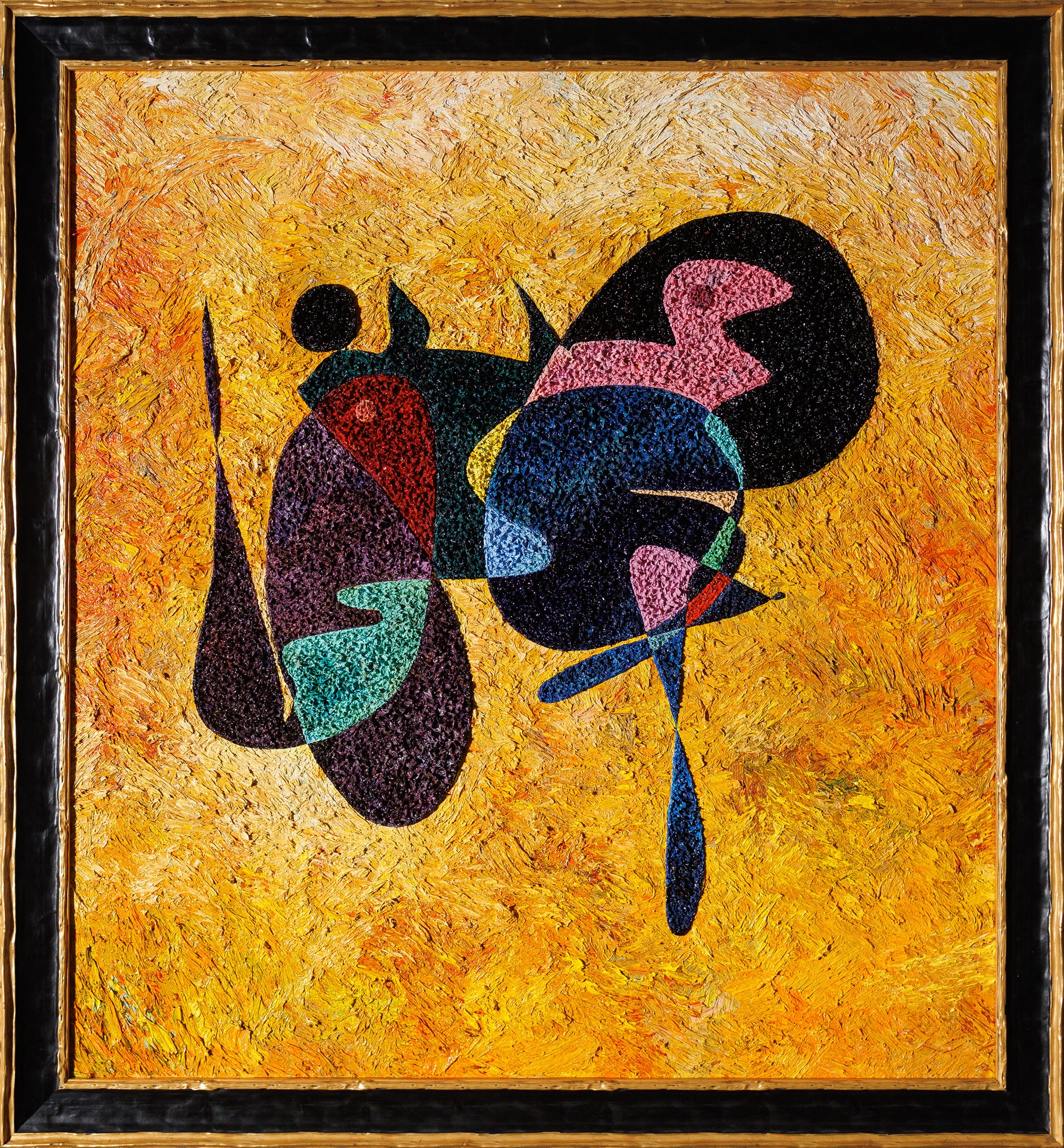
The Diplomatic Jew (2015) presents a complex abstract composition set against a luminous gold and ochre field. Interconnected geometric and organic forms converge around two dominant visual centers, creating a dynamic structure of balance, exchange, and symbolic interaction. Layers of blue, turquoise, violet, red, and black animate the composition, generating a sense of movement within an otherwise carefully ordered system.
The painting is organized through overlapping relationships rather than singular focal points. Circular motifs, elongated forms, intersecting axes, and segmented planes interact across the pictorial surface, producing a visual network that suggests communication, continuity, and negotiation. The composition remains simultaneously stable and fluid, revealing coherence through the interaction of diverse elements.
Through abstraction and symbolic synthesis, Virtosu transforms diplomacy into a visual architecture of cultural memory and mediation. Rather than illustrating a specific historical narrative, the work explores the relationships through which identities, traditions, and systems of knowledge are preserved, exchanged, and reinterpreted across time.
The Diplomatic Jew (2015) examines diplomacy as a cultural and intellectual process through which continuity is preserved across changing historical circumstances. Rather than depicting political authority directly, Gheorghe Virtosu explores the mechanisms of mediation that enable communication between different traditions, interests, and systems of belief. The work suggests that enduring influence is often achieved through negotiation and exchange rather than through force alone.
The composition is structured around relationships rather than hierarchy. Distinct forms maintain their individuality while remaining connected within a larger visual system, reflecting the dynamics of dialogue itself. Meaning emerges through interaction, reciprocity, and balance, emphasizing the capacity of diverse perspectives to coexist within a shared framework without dissolving their differences.
The luminous gold field functions as more than a background; it establishes a symbolic environment associated with memory, value, and historical continuity. Against this expansive space, the darker forms acquire increased significance, appearing as active participants within a broader cultural landscape. The painting therefore situates diplomacy within the long duration of collective experience rather than within a single historical moment.
Colour operates as a language of connection and transformation. Gold, blue, turquoise, violet, red, and black create a network of visual relationships that guide movement across the composition. These chromatic interactions suggest the circulation of ideas, traditions, and cultural influences, reinforcing the painting’s exploration of communication as a dynamic and evolving process.
The interplay between circular forms, crossing axes, and segmented geometries introduces a dialogue between continuity and adaptation. Circular structures evoke endurance and shared memory, while angular elements imply organization, strategy, and negotiation. The composition therefore presents diplomacy not as a fixed institution but as an ongoing process through which stability is achieved amid complexity and change.
Within The Architecture of Power, The Diplomatic Jew investigates the relational dimension of authority. If power originates through instinct in Hunter, acquires legitimacy in The Crown Holder, and circulates through hidden systems in Illuminati, here it becomes a force of mediation capable of sustaining dialogue across cultural, political, and historical boundaries.
Ultimately, the painting presents diplomacy as an architecture of continuity. Through abstraction and symbolic synthesis, Virtosu reveals how societies preserve identity, transmit knowledge, and negotiate difference through networks of exchange that extend beyond individual actors. The work becomes a meditation on the enduring structures that allow cultures to remain connected while continuously transforming over time.
Gheorghe Virtosu | Artist Biography
Gheorghe Virtosu is a contemporary painter whose work investigates the relationships between power, historical memory, cultural identity, and collective consciousness. Through a distinctive language of systemic abstraction, he transforms political, philosophical, and social themes into complex visual structures that explore the forces shaping human civilization.
Central to Virtosu’s practice is the concept of New Perfection in Systemic Abstraction, a theoretical and artistic framework in which paintings function as interconnected systems rather than representational images. Working primarily in oil on canvas, he combines geometric segmentation, biomorphic forms, symbolic archetypes, and layered chromatic relationships to examine sovereignty, diplomacy, migration, mythology, ideology, and the evolving architectures of power.
Through research-driven series and monumentally conceived compositions, Virtosu engages with art history, anthropology, political theory, and philosophy to construct works that invite critical reflection on the structures governing perception and social reality. His paintings reveal how authority, memory, and cultural continuity emerge through networks of relationships, transforming abstraction into a vehicle for intellectual inquiry and contemporary visual thought.
Medium: Oil on canvas
Dimensions: 138 × 150 cm (54.3 × 59.1 in)
The composition is organized around two interconnected centers of visual gravity situated within a luminous gold and ochre field. Geometric segmentation and biomorphic forms interact through overlapping contours, circular structures, and directional axes, creating a balanced yet dynamic system of visual relationships. The arrangement emphasizes dialogue, reciprocity, and structural interdependence rather than singular focal dominance.
Layered oil applications generate depth, texture, and spatial complexity throughout the surface. Dense passages of pigment contrast with translucent transitions and textured grounds, producing a rich material environment that enhances the painting’s architectural coherence. Variations in brushwork and paint density contribute to a sense of accumulated history and continuous transformation.
A chromatic palette dominated by gold, ochre, black, blue, turquoise, violet, red, and pink establishes visual hierarchy and movement across the composition. Colour functions as an organizational and symbolic device rather than descriptive representation, guiding perception through interconnected forms and reinforcing the painting’s exploration of diplomacy, cultural continuity, and systems of exchange.
Artist: Gheorghe Virtosu
Medium: Oil on canvas
Dimensions: H 1.38 m × W 1.50 m
The composition is structured around two interconnected centers of visual gravity that establish a dynamic balance across the horizontal format. A dominant circular form on the right interacts with elongated and segmented elements extending from the left, creating a visual dialogue that directs movement throughout the painting. Rather than relying on symmetry, the work achieves equilibrium through the careful distribution of mass, colour, and spatial tension.
Geometric planes intersect with biomorphic contours to produce a layered network of relationships. Circular motifs, crossing axes, and overlapping forms generate multiple pathways through the composition, encouraging the viewer’s gaze to move continuously between areas of concentration and release. This interplay of structure and fluidity creates a sense of negotiation and exchange, reinforcing the painting’s underlying thematic concern with mediation and connection.
The luminous gold field unifies the composition while simultaneously amplifying the presence of the darker central forms. Chromatic accents of blue, turquoise, violet, red, and pink punctuate the surface, establishing rhythm and directional movement across the pictorial space. Through the integration of colour, form, and spatial organization, Virtosu constructs a coherent visual architecture in which meaning emerges through relationships rather than isolated symbols.
Colour functions as a primary organizing principle within The Diplomatic Jew. A luminous field of gold and ochre establishes the painting’s dominant atmosphere, evoking continuity, value, and historical depth. Against this radiant ground, passages of black, blue, turquoise, violet, red, and pink emerge with heightened intensity, creating a network of visual contrasts that guide movement throughout the composition.
The formal structure is built through the interaction of geometric segmentation and biomorphic transformation. Circular motifs suggest continuity and exchange, while angular planes introduce order, direction, and strategic organization. These contrasting formal languages coexist within a unified system, producing a visual equilibrium that balances stability with adaptability.
Colour and form operate interdependently rather than as separate compositional elements. Chromatic relationships reinforce structural connections between shapes, while variations in scale, contour, and orientation create rhythm across the pictorial surface. Through this synthesis, Virtosu transforms abstraction into a dynamic architecture of dialogue, mediation, and cultural continuity.
The Diplomatic Jew employs a symbolic vocabulary centered on connection, mediation, and continuity. The composition is organized around two interconnected visual centers whose relationship suggests dialogue rather than opposition. Circular forms evoke endurance, memory, and cultural transmission, while intersecting axes and bridging structures imply communication, negotiation, and the movement of ideas between distinct spheres of experience.
The luminous gold field functions as a symbolic space of historical depth and collective memory. Against this expansive environment, darker forms appear as active agents of exchange, navigating a landscape shaped by accumulated knowledge and tradition. The coexistence of geometric precision and organic transformation reflects the balance between institutional structures and the adaptive processes through which cultures preserve identity while responding to change.
Rather than illustrating a specific historical narrative, the imagery operates through abstraction and association. Overlapping forms, enclosed spaces, and interconnected pathways suggest networks of influence, intellectual exchange, and cultural resilience. Through this symbolic architecture, Virtosu presents diplomacy as a process of sustaining relationships across difference, revealing dialogue itself as a formative force within the construction of collective history.
The Diplomatic Jew explores diplomacy as a mechanism of cultural continuity rather than merely a political practice. Gheorghe Virtosu examines how identities, traditions, and systems of knowledge are preserved through dialogue, adaptation, and exchange, suggesting that enduring influence often depends upon the capacity to build connections across social, historical, and ideological boundaries.
The painting presents power as a relational phenomenon. Distinct forms remain interconnected without losing their individuality, creating a visual model in which coexistence is achieved through negotiation rather than assimilation. Authority emerges through communication, reciprocity, and mutual recognition, transforming diplomacy into an active force that sustains stability amid difference and change.
Within The Architecture of Power, the work represents the mediating dimension of authority. Through abstraction and symbolic complexity, Virtosu reveals how collective memory, cultural resilience, and intellectual exchange contribute to the formation of shared realities. The painting ultimately proposes that dialogue itself functions as an enduring architecture through which societies maintain continuity while continually redefining their future.
The Diplomatic Jew evokes a sense of contemplation, balance, and intellectual engagement. The interplay of interconnected forms within the luminous gold field creates an atmosphere of thoughtful exchange, encouraging viewers to reflect on the relationships that unite distinct perspectives rather than divide them.
The composition generates a quiet tension between stability and movement. Structured geometries suggest order and continuity, while fluid contours and chromatic variations introduce adaptability and transformation. This balance produces an emotional experience characterized by curiosity, attentiveness, and an awareness of the complexities inherent in communication and coexistence.
Beneath its visual dynamism lies a deeper sense of resilience and continuity. The painting conveys the emotional dimensions of diplomacy—patience, negotiation, trust, and perseverance—revealing dialogue not as a momentary act but as an enduring process through which cultures, memories, and identities remain connected across time.
- The title The Diplomatic Jew is approached as a symbolic exploration of diplomacy, cultural continuity, negotiation, and mediation rather than as a representation of a specific historical individual or event.
- Within The Architecture of Power, the work examines authority as a relational process sustained through communication, reciprocity, and the preservation of cultural memory across historical transitions.
- The painting exemplifies Gheorghe Virtosu’s framework of New Perfection in Systemic Abstraction, in which symbolic themes are transformed into interconnected visual systems whose meaning emerges through structural relationships rather than narrative representation.
- The dual compositional structure may be interpreted as a metaphor for dialogue itself, emphasizing balance, exchange, and the coexistence of multiple perspectives within a shared symbolic field.
Selected Bibliography
- Arendt, Hannah. The Human Condition. Chicago: University of Chicago Press, 1958.
- Buber, Martin. I and Thou. New York: Charles Scribner’s Sons, 1970.
- Cassirer, Ernst. An Essay on Man: An Introduction to a Philosophy of Human Culture. New Haven: Yale University Press, 1944.
- Foster, Hal, Rosalind Krauss, Yve-Alain Bois, Benjamin H. D. Buchloh, and David Joselit. Art Since 1900: Modernism, Antimodernism, Postmodernism. London: Thames & Hudson, 2016.
- Gadamer, Hans-Georg. Truth and Method. New York: Continuum, 2004.
- Panofsky, Erwin. Meaning in the Visual Arts. Chicago: University of Chicago Press, 1982.
- Ricoeur, Paul. Memory, History, Forgetting. Chicago: University of Chicago Press, 2004.
Curatorial Team: Daniel Varzari
Photography: El Arte Monumental
Special Thanks: Daniel Varzari, Gheorghe Virtosu
El Arte Monumental
08007 Barcelona
Phone: +34 934 439 470/ +01 312 358 8023