The Architecture of Power
“The Architecture of Power” explores authority and ideology in contemporary society through abstract and symbolic forms. Rather than depicting events literally, the series transforms power, social tensions, and governance into layered, visually complex compositions, inviting reflection on the fragility and resilience of the structures that shape our world.
El Arte Monumental | Catalogue: The Architecture of Power
Catalogue Entry: The King of Democracy (2018) | Art Curator: Daniel Varzari
El Arte Monumental | Catalogue: The Architecture of Power
Catalogue Entry: The King of Democracy (2018) | Art Curator: Daniel Varzari
Curator’s Foreword
In a moment marked by political polarization, ideological volatility, and the erosion of institutional trust, The King of Democracy (2018) positions itself as a critical inquiry into the condition of contemporary governance. Rather than stabilizing democracy as an ideal form, the work exposes its internal contradictions, foregrounding tensions between representation, power, and control.
Gheorghe Virtosu constructs a visual language that resists immediate legibility, privileging complexity over resolution. Through abstraction and symbolic compression, the painting withholds clarity, requiring sustained engagement from the viewer. Meaning does not present itself fully formed, but emerges through a process of negotiation, implicating the viewer within the same instability the work articulates.
Presented by our foundation, this work enters a broader discourse on the transformation of democratic systems under contemporary pressures. It shifts the focus from how democracy is defined to how it operates—and how it may be shaped, mediated, or distorted. In this context, the artwork functions not as illustration, but as a critical site in which the structures of governance are examined, unsettled, and reconfigured.
Gheorghe Virtosu constructs a visual language that resists immediate legibility, privileging complexity over resolution. Through abstraction and symbolic compression, the painting withholds clarity, requiring sustained engagement from the viewer. Meaning does not present itself fully formed, but emerges through a process of negotiation, implicating the viewer within the same instability the work articulates.
Presented by our foundation, this work enters a broader discourse on the transformation of democratic systems under contemporary pressures. It shifts the focus from how democracy is defined to how it operates—and how it may be shaped, mediated, or distorted. In this context, the artwork functions not as illustration, but as a critical site in which the structures of governance are examined, unsettled, and reconfigured.
2
Artwork Description
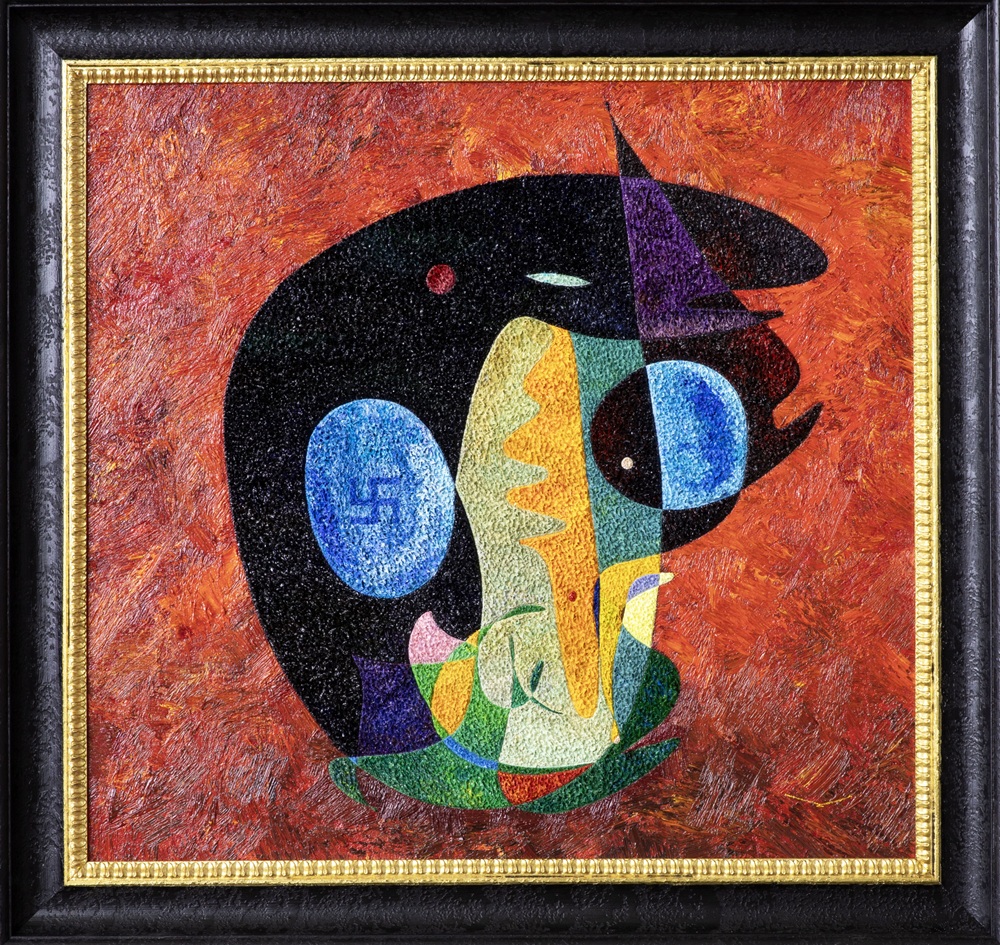
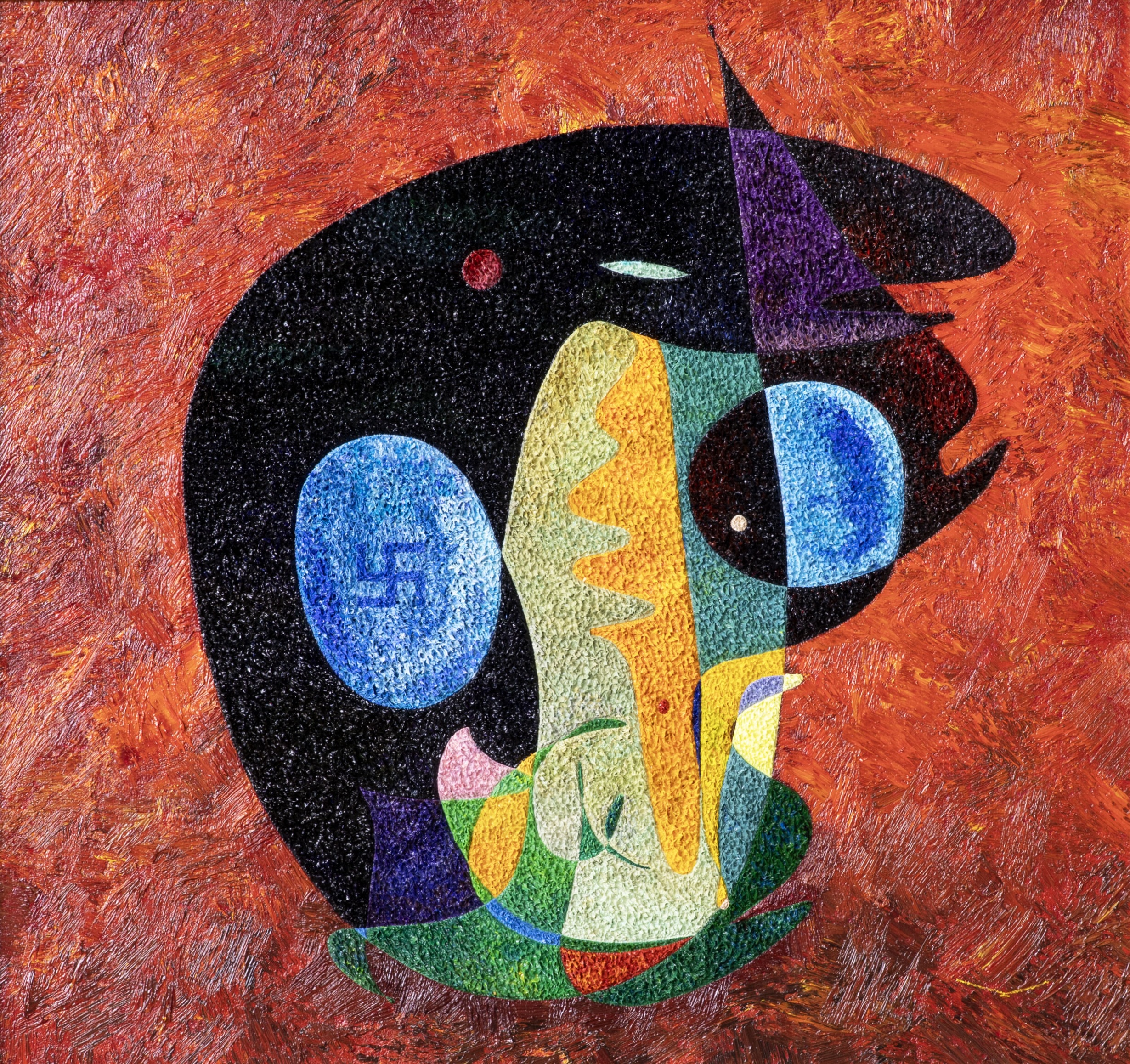
The King of Democracy presents a complex, multi-layered composition in which an abstract central figure emerges from a saturated red background. Executed in oil and acrylic on linen canvas, the work combines expressive texture, color contrasts, and subtle figurative cues to construct a dense visual and conceptual field.
The central figure is divided into two coexisting “epostasys.” The first resembles a pig, with two distinct eyes and a faintly indicated snout; one eye contains a swastika, symbolizing internalized ideological corruption. The second is a profile with a stylized contemporary coiffure, referencing the personalization of power and the performative aspect of modern leadership. These dual forms are partially enveloped by a black mass, representing the concealed mechanisms of authority.
The red background functions as an active societal field. Hidden within it are a shouting human silhouette and a wolf’s head, indicating social tension, protest, and primal aggression. A small red mark ambiguously reads as either an ear or a wound, linking the central figure to the societal environment in a dynamic interplay of communication and conflict.
Above the pig’s snout, a zigzag motif forms two facing profiles, evoking a dialogue that is present but unstable, reflecting the performative nature of democratic discourse. The layering of abstract and figurative elements creates a sense of visual tension, reinforcing the conceptual narrative of democracy as fragmented, contested, and internally conflicted.
The central figure is divided into two coexisting “epostasys.” The first resembles a pig, with two distinct eyes and a faintly indicated snout; one eye contains a swastika, symbolizing internalized ideological corruption. The second is a profile with a stylized contemporary coiffure, referencing the personalization of power and the performative aspect of modern leadership. These dual forms are partially enveloped by a black mass, representing the concealed mechanisms of authority.
The red background functions as an active societal field. Hidden within it are a shouting human silhouette and a wolf’s head, indicating social tension, protest, and primal aggression. A small red mark ambiguously reads as either an ear or a wound, linking the central figure to the societal environment in a dynamic interplay of communication and conflict.
Above the pig’s snout, a zigzag motif forms two facing profiles, evoking a dialogue that is present but unstable, reflecting the performative nature of democratic discourse. The layering of abstract and figurative elements creates a sense of visual tension, reinforcing the conceptual narrative of democracy as fragmented, contested, and internally conflicted.
3
Concept and Interpretation
At the conceptual core of The King of Democracy lies a dualistic exploration of democratic identity and its inherent contradictions. The central figure embodies two coexisting states, or “epostasys,” through which democracy is presented as unstable and internally divided.
The first state manifests as a pig-like visage, a form historically associated with excess, corruption, and moral decay. The inclusion of a swastika within one eye suggests that ideological extremism is not external, but internalized within the system itself. This reflects Louis Althusser’s concept of ideology as something embedded within structures of perception and experience¹.
The second state appears as a contemporary profile marked by a distinctive hairstyle, evoking modern political leadership shaped by image and spectacle. This aligns with Guy Debord’s notion of the “society of the spectacle,” where political authority is increasingly mediated through visual representation rather than substantive governance².
The first state manifests as a pig-like visage, a form historically associated with excess, corruption, and moral decay. The inclusion of a swastika within one eye suggests that ideological extremism is not external, but internalized within the system itself. This reflects Louis Althusser’s concept of ideology as something embedded within structures of perception and experience¹.
The second state appears as a contemporary profile marked by a distinctive hairstyle, evoking modern political leadership shaped by image and spectacle. This aligns with Guy Debord’s notion of the “society of the spectacle,” where political authority is increasingly mediated through visual representation rather than substantive governance².
4
These dual identities are bound by a dominant black form, which can be understood as a concealed force operating beneath the surface. This element recalls Michel Foucault’s theory of power as diffuse and embedded, suggesting that control is exercised through hidden structures rather than overt authority³.
The red background, representing society, is charged with tension. The embedded shouting figure signals resistance or protest, while the wolf’s head introduces a layer of instinctual aggression. Together, they reflect Hannah Arendt’s concerns regarding the fragility of the public sphere and the volatility of collective political behavior⁴.
A small red mark functions ambiguously as both ear and wound, symbolizing the fragile and often violent relationship between authority and society. Above, the zigzag motif forming two opposing profiles suggests dialogue; however, its instability implies a breakdown or distortion of communication. This resonates with Carl Schmitt’s critique of liberal democracy as inherently conflicted and vulnerable to internal antagonism⁵.
Through these layered visual and conceptual elements, Virtosu presents democracy not as a unified or stable system, but as a fragmented structure shaped by ideology, spectacle, and concealed power. The work ultimately invites the viewer to critically reconsider the nature and future of democratic governance.
A small red mark functions ambiguously as both ear and wound, symbolizing the fragile and often violent relationship between authority and society. Above, the zigzag motif forming two opposing profiles suggests dialogue; however, its instability implies a breakdown or distortion of communication. This resonates with Carl Schmitt’s critique of liberal democracy as inherently conflicted and vulnerable to internal antagonism⁵.
Through these layered visual and conceptual elements, Virtosu presents democracy not as a unified or stable system, but as a fragmented structure shaped by ideology, spectacle, and concealed power. The work ultimately invites the viewer to critically reconsider the nature and future of democratic governance.
5

Gheorghe Virtosu | Artist Biography
Gheorghe Virtosu is a contemporary artist whose work explores the intersection of political ideology, identity, and systems of power. Working primarily in painting, he combines abstraction with symbolic figuration to create compositions that are both visually complex and conceptually driven.
His practice is characterized by layered surfaces, dynamic contrasts, and the integration of subtle figurative elements within abstract fields. Through this approach, Virtosu invites viewers to engage actively with his work, constructing meaning through close observation and critical reflection.
Gheorghe Virtosu is a contemporary artist whose work explores the intersection of political ideology, identity, and systems of power. Working primarily in painting, he combines abstraction with symbolic figuration to create compositions that are both visually complex and conceptually driven.
His practice is characterized by layered surfaces, dynamic contrasts, and the integration of subtle figurative elements within abstract fields. Through this approach, Virtosu invites viewers to engage actively with his work, constructing meaning through close observation and critical reflection.
6
Technical Notes
The painting is executed using a combination of oil and acrylic on linen canvas, allowing for both depth of texture and precision of form. The layered application of paint contributes to the physical and visual intensity of the surface, reinforcing the conceptual tension of the composition.
7
Title: The King of Democracy (2018)
Artist: Gheorghe Virtosu
Medium: Oil and acrylic on linen canvas
Dimensions: 77 × 82 cm
Artist: Gheorghe Virtosu
Medium: Oil and acrylic on linen canvas
Dimensions: 77 × 82 cm
8
Visual Composition | Artwork Analysis
The composition is structured around a central abstract form set against a saturated red ground, creating an immediate visual tension between figure and field. The background operates as an active spatial environment rather than a passive backdrop, with layered brushwork generating depth and movement.
Within this red field, concealed imagery gradually emerges: the silhouette of a human face in the act of shouting and, below it, the form of a wolf’s head. These embedded elements are not immediately legible, requiring sustained viewing, and contribute to a sense of instability and latent conflict within the pictorial space.
The central figure is divided into contrasting zones. On one side, a dense black mass dominates, creating a visual weight that suggests opacity and control. On the other, fragmented planes of color—yellow, blue, and green—introduce disruption and multiplicity. This asymmetrical balance prevents visual resolution, reinforcing a condition of internal tension.
Subtle figurative cues are interwoven into the abstract structure. The suggestion of a pig-like face, a secondary profile, and a zigzag motif forming two confronting silhouettes all contribute to a layered composition in which meaning is constructed through accumulation rather than clarity. The result is a dynamic visual system that resists singular interpretation and instead operates through fragmentation, overlap, and perceptual ambiguity.
Within this red field, concealed imagery gradually emerges: the silhouette of a human face in the act of shouting and, below it, the form of a wolf’s head. These embedded elements are not immediately legible, requiring sustained viewing, and contribute to a sense of instability and latent conflict within the pictorial space.
The central figure is divided into contrasting zones. On one side, a dense black mass dominates, creating a visual weight that suggests opacity and control. On the other, fragmented planes of color—yellow, blue, and green—introduce disruption and multiplicity. This asymmetrical balance prevents visual resolution, reinforcing a condition of internal tension.
Subtle figurative cues are interwoven into the abstract structure. The suggestion of a pig-like face, a secondary profile, and a zigzag motif forming two confronting silhouettes all contribute to a layered composition in which meaning is constructed through accumulation rather than clarity. The result is a dynamic visual system that resists singular interpretation and instead operates through fragmentation, overlap, and perceptual ambiguity.
9
Color and Form
The composition is structured around a central abstract form set against a saturated red ground, creating an immediate visual tension between figure and field. The background operates as an active spatial environment rather than a passive backdrop, with layered brushwork generating depth and movement.
Within this red field, concealed imagery gradually emerges: the silhouette of a human face in the act of shouting and, below it, the form of a wolf’s head. These embedded elements are not immediately legible, requiring sustained viewing, and contribute to a sense of instability and latent conflict within the pictorial space.
The central figure is divided into contrasting zones. On one side, a dense black mass dominates, creating a visual weight that suggests opacity and control. On the other, fragmented planes of color—yellow, blue, and green—introduce disruption and multiplicity. This asymmetrical balance prevents visual resolution, reinforcing a condition of internal tension.
Subtle figurative cues are interwoven into the abstract structure. The suggestion of a pig-like face, a secondary profile, and a zigzag motif forming two confronting silhouettes all contribute to a layered composition in which meaning is constructed through accumulation rather than clarity. The result is a dynamic visual system that resists singular interpretation and instead operates through fragmentation, overlap, and perceptual ambiguity.
Within this red field, concealed imagery gradually emerges: the silhouette of a human face in the act of shouting and, below it, the form of a wolf’s head. These embedded elements are not immediately legible, requiring sustained viewing, and contribute to a sense of instability and latent conflict within the pictorial space.
The central figure is divided into contrasting zones. On one side, a dense black mass dominates, creating a visual weight that suggests opacity and control. On the other, fragmented planes of color—yellow, blue, and green—introduce disruption and multiplicity. This asymmetrical balance prevents visual resolution, reinforcing a condition of internal tension.
Subtle figurative cues are interwoven into the abstract structure. The suggestion of a pig-like face, a secondary profile, and a zigzag motif forming two confronting silhouettes all contribute to a layered composition in which meaning is constructed through accumulation rather than clarity. The result is a dynamic visual system that resists singular interpretation and instead operates through fragmentation, overlap, and perceptual ambiguity.
10
Symbolism and Imagery
The pig-like figure draws on a long-standing tradition in political satire, where the animal signifies greed, corruption, and moral decay. Its distorted and abstracted form intensifies these associations, presenting a figure that is simultaneously grotesque and authoritative.
The inclusion of the swastika is deliberately provocative.
Within this context, it functions as a critical device—evoking authoritarianism, extremism, and the historical persistence of oppressive ideologies within modern systems of power.
The inclusion of the swastika is deliberately provocative.
Within this context, it functions as a critical device—evoking authoritarianism, extremism, and the historical persistence of oppressive ideologies within modern systems of power.
11
Conceptual Interpretation
The King of Democracy operates as a critical reflection on contemporary democratic structures rather than an affirmation of them.
The title itself introduces a central paradox: democracy implies collective governance, while the notion of a “king” suggests concentrated authority. This contradiction points toward a system in which democratic ideals may be undermined by centralized or self-serving power.
The fragmented form of the figure reinforces the idea of a destabilized or manipulated system, while the pig imagery underscores themes of corruption and excess. The embedded swastika further suggests that historical patterns of authoritarianism remain latent, capable of re-emerging within modern political frameworks.
The title itself introduces a central paradox: democracy implies collective governance, while the notion of a “king” suggests concentrated authority. This contradiction points toward a system in which democratic ideals may be undermined by centralized or self-serving power.
The fragmented form of the figure reinforces the idea of a destabilized or manipulated system, while the pig imagery underscores themes of corruption and excess. The embedded swastika further suggests that historical patterns of authoritarianism remain latent, capable of re-emerging within modern political frameworks.
12
Emotional Register
The painting evokes a sustained sense of discomfort, tension, and unease. Its aggressive textures, dissonant composition, and charged symbolism work together to confront the viewer, prompting reflection on the fragility and contradictions of contemporary political systems.
13
Notes
- Michel Foucault, Discipline and Punish: The Birth of the Prison (New York: Pantheon Books, 1977).
- Hannah Arendt, The Origins of Totalitarianism (New York: Harcourt, Brace & Company, 1951).
- Guy Debord, The Society of the Spectacle (New York: Zone Books, 1994).
- Carl Schmitt, The Concept of the Political (Chicago: University of Chicago Press, 2007).
- Louis Althusser, “Ideology and Ideological State Apparatuses,” in Lenin and Philosophy and Other Essays (New York: Monthly Review Press, 1971).
Selected Bibliography
- Althusser, Louis. Lenin and Philosophy and Other Essays. New York: Monthly Review Press, 1971.
- Arendt, Hannah. The Origins of Totalitarianism. New York: Harcourt, Brace & Company, 1951.
- Debord, Guy. The Society of the Spectacle. New York: Zone Books, 1994.
- Foucault, Michel. Discipline and Punish: The Birth of the Prison. New York: Pantheon Books, 1977.
- Schmitt, Carl. The Concept of the Political. Chicago: University of Chicago Press, 2007.
14
Acknowledgments
Presented by El Arte Monumental
Curatorial Team: Daniel Varzari
Photography: El Arte Monumental
Special Thanks: Daniel Varzari, Gheorghe Virtosu
Curatorial Team: Daniel Varzari
Photography: El Arte Monumental
Special Thanks: Daniel Varzari, Gheorghe Virtosu
15
El Arte Monumental
Rambla de Catalunya, 18, Eixample
08007 Barcelona
Phone: +34 934 439 470/ +01 312 358 8023
08007 Barcelona
Phone: +34 934 439 470/ +01 312 358 8023