The Architecture of Power
El Arte Monumental | Catalogue: The Architecture of Power
Catalogue Entry: The King of Revolution (2021) | Art Curator: Daniel Varzari
In The King of Revolution (2021), Gheorghe Virtosu examines revolution as a force of historical transformation through which established systems are challenged, dismantled, and reimagined. Rather than portraying a specific event or political figure, the painting investigates the conditions under which societies redefine authority, legitimacy, and collective identity. Revolution appears not as a singular moment of rupture, but as an ongoing process of reconstruction and renewal.
Through a powerful interplay of anthropomorphic forms, geometric structures, and chromatic intensity, the composition transforms political change into a symbolic architecture. Fragmented elements converge into a monumental presence that embodies both disruption and creation, suggesting that new forms of order emerge through the negotiation of competing visions, aspirations, and historical forces.
Within The Architecture of Power, The King of Revolution represents the transformative dimension of authority. The work invites reflection on the human capacity to challenge inherited realities and imagine alternative futures, revealing revolution as one of the fundamental mechanisms through which societies continually reshape the structures that govern collective life.
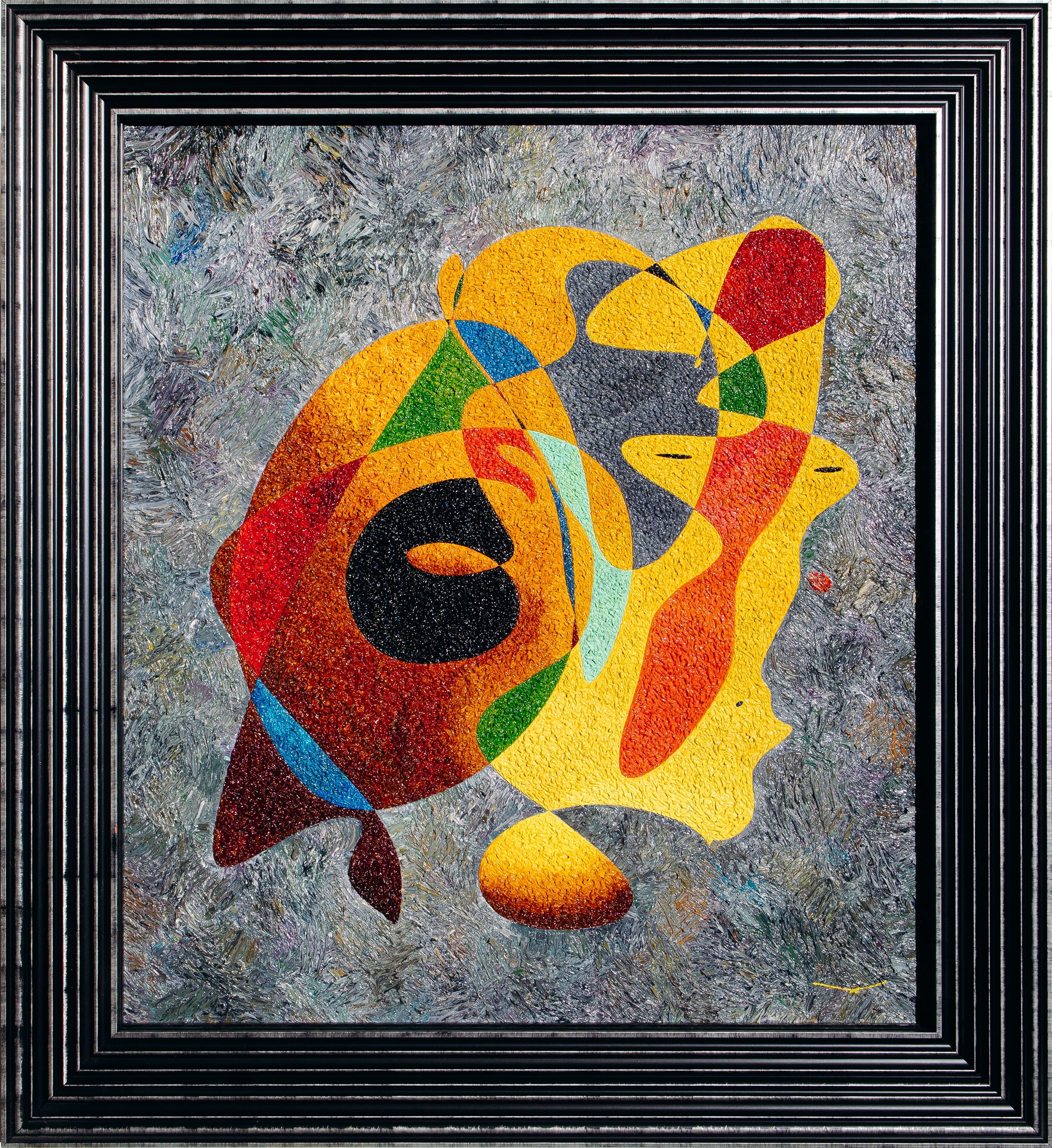
The King of Revolution (2021) presents a monumental abstract figure emerging from a luminous textured field through a complex arrangement of geometric planes, biomorphic contours, and symbolic forms. Gold, yellow, orange, blue, turquoise, red, black, and white elements converge within a dynamic composition that suggests movement, transformation, and the continual restructuring of relationships. Layered profiles, circular motifs, and ascending forms create a powerful sense of energy concentrated around a central presence.
The painting is organized through processes of fragmentation and reconstruction. Distinct visual elements overlap, intersect, and merge, generating a network of tensions that balances instability with coherence. The composition appears simultaneously unified and in transition, reflecting the conditions through which established structures are challenged and new configurations begin to emerge.
Through abstraction and symbolic synthesis, Virtosu transforms revolution into a visual architecture of political renewal and collective change. Rather than illustrating a specific historical narrative, the work explores the forces that reshape authority, identity, and social order, presenting transformation as an enduring process through which societies continuously redefine their future.
The King of Revolution (2021) explores revolution as a transformative force through which societies challenge inherited structures and imagine alternative futures. Gheorghe Virtosu presents political change not as a singular event but as a continuous process of reconfiguration in which authority, identity, and collective values are subjected to critical examination and renewal. The painting suggests that periods of upheaval emerge when existing systems can no longer adequately respond to evolving social realities.
The composition proposes that transformation is inseparable from contradiction. Fragmented forms coexist with emerging structures, while opposing visual forces remain interconnected within a shared symbolic field. Rather than presenting revolution as purely destructive or constructive, the work reveals change as a complex negotiation between dissolution and creation, instability and order, memory and possibility.
The overlapping profiles and interconnected forms evoke the presence of multiple actors participating in historical transformation. Individual agency, collective action, ideology, and social aspiration intersect throughout the composition, suggesting that revolutionary movements are shaped not by singular leadership alone but by the interaction of diverse forces operating within a broader historical environment.
Colour functions as a symbolic language of emergence and intensity. Vibrant passages of gold, yellow, orange, red, blue, and turquoise generate a sense of momentum that moves across the composition, reinforcing themes of awakening, mobilization, and transformation. These chromatic relationships establish visual energy while emphasizing the dynamic processes through which new realities take form.
The painting also examines legitimacy as a condition subject to continual reinvention. Structures of authority appear fragmented yet persistent, suggesting that power survives periods of upheaval by adapting to changing circumstances. Revolution therefore becomes not simply a rejection of the past, but a process through which societies renegotiate the principles upon which authority is established and maintained.
Within The Architecture of Power, The King of Revolution represents the moment when existing systems encounter transformative pressure and alternative forms of organization begin to emerge. The work investigates the mechanisms through which collective imagination challenges established realities, revealing revolution as one of the fundamental processes through which political and cultural structures evolve.
Ultimately, the painting presents revolution as an architecture of becoming. Through abstraction and symbolic complexity, Virtosu reveals change as a creative force capable of reshaping institutions, identities, and historical trajectories. The work becomes a meditation on humanity’s enduring capacity to reconstruct meaning, redefine authority, and envision new possibilities within the evolving landscape of collective life.
Gheorghe Virtosu | Artist Biography
Gheorghe Virtosu is a contemporary painter whose work investigates the relationships between power, historical transformation, collective memory, and cultural identity. Through large-scale abstract compositions, he examines the forces that shape societies across periods of stability, conflict, and change, translating complex political and philosophical questions into dynamic visual structures.
Working primarily in oil on canvas, Virtosu has developed a distinctive visual language that combines geometric organization, biomorphic forms, symbolic archetypes, and layered chromatic systems. His paintings explore themes including sovereignty, revolution, diplomacy, ideology, migration, leadership, and the evolving processes through which authority is established, challenged, and reconfigured within collective life.
Drawing upon art history, political theory, anthropology, and philosophy, Virtosu creates research-driven bodies of work that invite critical reflection on the mechanisms underlying social transformation. Through abstraction, he reveals the interconnected relationships between memory, power, belief, and collective action, positioning painting as a space for intellectual inquiry into the forces that continuously reshape historical reality.
Medium: Oil on canvas
Dimensions: 136 × 131 cm (53.5 × 51.6 in)
The composition is organized around a dense central configuration constructed from interlocking geometric planes, biomorphic contours, and anthropomorphic suggestions. Layered profiles, circular motifs, and ascending structural elements interact within a luminous textured field, generating a complex network of visual relationships that balances fragmentation with cohesion. The arrangement creates a strong sense of movement and transformation while maintaining overall compositional stability.
Executed through successive applications of oil paint, the surface combines areas of dense pigment with more fluid transitions and textured passages. Variations in brushwork, paint density, and chromatic intensity establish depth and spatial complexity, allowing forms to emerge, overlap, and dissolve across the pictorial field. The material structure contributes directly to the work’s atmosphere of change, reconstruction, and continual evolution.
A palette dominated by gold, yellow, orange, black, blue, turquoise, red, and white creates a dynamic system of visual contrasts and directional movement. Colour functions as a structural and symbolic element rather than descriptive representation, guiding perception through interconnected forms while reinforcing themes of revolution, transformation, collective action, and the emergence of new configurations of power.
Artist: Gheorghe Virtosu
Medium: Oil on canvas
Dimensions: H 1.36 m × W 1.31 m
The composition is organized around a concentrated central structure that dominates the pictorial field through its density, complexity, and internal movement. Interlocking geometric planes, curved contours, and overlapping profile-like forms converge within a vertically oriented framework, creating a visual axis that guides the viewer’s attention upward through successive layers of transformation. The composition achieves equilibrium not through symmetry but through the careful distribution of visual weight, tension, and chromatic intensity.
Fragmentation functions as a fundamental compositional principle. Distinct elements intersect, overlap, and partially dissolve into one another, producing a network of relationships that appears simultaneously coherent and unstable. Circular motifs, angular structures, and biomorphic forms establish multiple pathways of visual movement, encouraging continuous engagement with the image while reinforcing themes of conflict, adaptation, and reconstruction.
The luminous textured background provides a unifying spatial environment that amplifies the presence of the central configuration. Accents of gold, yellow, orange, blue, turquoise, red, black, and white create rhythm, contrast, and directional energy throughout the composition. Through the integration of colour, form, and spatial tension, Virtosu constructs an abstract architecture in which transformation emerges as the primary organizing force, revealing change as a process of continuous negotiation between dissolution and renewal.
Colour functions as a primary vehicle of energy and transformation within The King of Revolution. Dominant passages of gold, yellow, and orange establish an atmosphere of emergence, intensity, and renewal, while accents of blue, turquoise, red, black, and white introduce contrast, tension, and directional movement. These chromatic relationships generate a dynamic visual field in which change appears both disruptive and constructive, reinforcing the painting’s exploration of revolutionary transition.
The formal structure combines geometric organization with biomorphic transformation. Angular planes suggest systems of authority, ideology, and institutional order, while curved contours and fluid transitions evoke adaptation, collective agency, and the unpredictability of historical change. The coexistence of these contrasting formal languages creates a composition that remains simultaneously structured and unstable, reflecting the conditions through which new realities emerge from existing frameworks.
Colour and form operate as an integrated network of relationships rather than independent compositional elements. Chromatic contrasts emphasize structural intersections, while variations in scale, contour, and orientation establish rhythm and movement across the surface. Through this synthesis, Virtosu transforms abstraction into a symbolic architecture of revolution in which fragmentation, renewal, and transformation become visible through the interaction of interconnected forms.
The King of Revolution employs a symbolic vocabulary centered on transformation, emergence, and the reconfiguration of authority. The composition’s interconnected profile-like forms suggest the coexistence of multiple voices, identities, and historical forces within a shared field of change. Rather than representing a singular ruler, the image proposes leadership as a collective and evolving phenomenon shaped through interaction, conflict, and social transformation.
Circular motifs, ascending structures, and intersecting geometric planes evoke cycles of disruption and renewal. The recurring movement upward through the composition suggests aspiration, political awakening, and the formation of new possibilities, while fragmented elements reflect the dismantling of inherited systems. Together, these forms create a symbolic environment in which destruction and creation operate simultaneously as complementary aspects of revolutionary change.
The luminous field surrounding the central configuration functions as a space of historical transition and uncertainty. Within this environment, contrasting colours and interconnected forms establish a visual narrative of emergence, adaptation, and collective action. Through this symbolic architecture, Virtosu presents revolution as a process through which societies renegotiate legitimacy, redefine identity, and construct new frameworks of meaning capable of shaping future realities.
The King of Revolution explores revolution as a process through which existing structures of authority are questioned, transformed, and reimagined. Gheorghe Virtosu presents power not as a permanent condition but as a dynamic force subject to continual renegotiation. The painting suggests that moments of profound change emerge when established systems can no longer accommodate evolving social, political, or cultural realities.
The work proposes that transformation is generated through the interaction of opposing forces rather than their elimination. Fragmentation and cohesion, continuity and disruption, memory and innovation coexist within the composition, reflecting the complex mechanisms through which societies reconstruct collective identities and redefine legitimacy. Revolution therefore appears not as an endpoint but as an ongoing process of adaptation and renewal.
Within The Architecture of Power, the painting represents the transformative dimension of authority. Through abstraction and symbolic complexity, Virtosu reveals how collective action, political imagination, and historical change contribute to the emergence of new social realities. The work ultimately presents revolution as an architecture of becoming through which communities continuously reshape their relationship to power, identity, and the future.
The King of Revolution evokes a powerful sense of momentum, tension, and awakening. The convergence of fragmented forms and ascending structures creates an atmosphere charged with anticipation, suggesting a moment in which established realities are being challenged and alternative possibilities begin to emerge. The painting encourages viewers to experience transformation as both disruptive and energizing.
Beneath its visual intensity lies a complex emotional balance between uncertainty and determination. Intersecting forms, shifting relationships, and contrasting colours generate a sensation of instability, while the coherence of the overall structure conveys resilience and purpose. This interplay reflects the emotional conditions often associated with periods of profound social and political change, where risk and hope coexist within the same historical moment.
The work ultimately conveys a sense of renewal and collective agency. Rather than dwelling on conflict alone, the composition emphasizes humanity’s capacity to imagine new futures and reconstruct meaning from disruption. The emotional register therefore moves beyond upheaval toward possibility, presenting revolution as a transformative force capable of generating new forms of identity, belonging, and shared purpose.
- The title The King of Revolution is approached as a symbolic exploration of political transformation, collective agency, and the emergence of new forms of authority rather than as a representation of a specific historical leader or revolutionary movement.
- Within The Architecture of Power, the work examines revolution as a process through which existing systems of legitimacy are challenged, reconfigured, and renewed, revealing power as a dynamic and evolving condition rather than a fixed structure.
- The painting transforms themes of upheaval, ideological conflict, and social change into an interconnected visual architecture in which meaning emerges through relationships between forms, colours, and spatial tensions rather than through narrative illustration.
- The profile-like forms, ascending structures, and fragmented geometries may be interpreted as symbols of political awakening, collective imagination, and the continual reconstruction of identity during periods of historical transition and transformation.
Selected Bibliography
- Arendt, Hannah. On Revolution. New York: Viking Press, 1963.
- Camus, Albert. The Rebel: An Essay on Man in Revolt. New York: Vintage International, 1991.
- Cassirer, Ernst. An Essay on Man: An Introduction to a Philosophy of Human Culture. New Haven: Yale University Press, 1944.
- Foster, Hal, Rosalind Krauss, Yve-Alain Bois, Benjamin H. D. Buchloh, and David Joselit. Art Since 1900: Modernism, Antimodernism, Postmodernism. London: Thames & Hudson, 2016.
- Panofsky, Erwin. Meaning in the Visual Arts. Chicago: University of Chicago Press, 1982.
- Skocpol, Theda. States and Social Revolutions: A Comparative Analysis of France, Russia, and China. Cambridge: Cambridge University Press, 1979.
- Tocqueville, Alexis de. The Old Regime and the Revolution. Chicago: University of Chicago Press, 1998.
Curatorial Team: Daniel Varzari
Photography: El Arte Monumental
Special Thanks: Daniel Varzari, Gheorghe Virtosu
El Arte Monumental
08007 Barcelona
Phone: +34 934 439 470/ +01 312 358 8023