
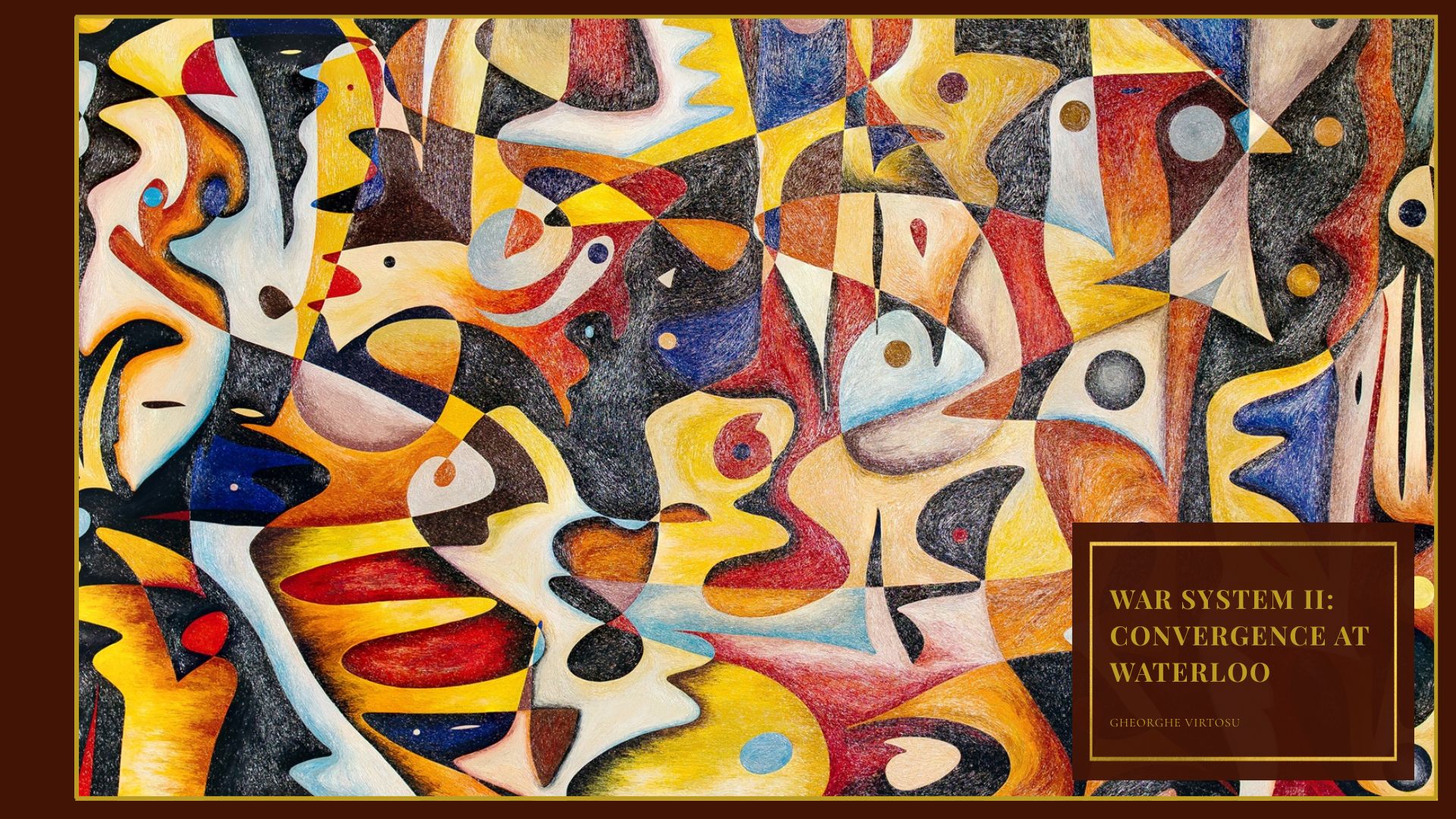
War System II: Convergence at Waterloo
Solo System-Based Exhibition (Collection-Based)
01 Jun 2026War System II: Convergence at Waterloo presents a collection-based exhibition that examines conflict through the relationships between five paintings. Rather than reconstructing a historical battle, the exhibition investigates the forces through which political ambition, military strategy, confrontation, instability, and historical transformation emerge and interact.
At the centre of the installation is Battle of Waterloo (2001–2003), a monumental painting that functions as the exhibition’s principal field of interaction. Through a complex arrangement of abstract forms, shifting trajectories, and intersecting structures, the work transforms conflict into a dynamic condition of competing energies rather than a representation of a specific military event.
Positioned around the central painting, Dreams Rider (2008), Horatio Nelson (2021), Napoleon’s Adviser (2003), and Napoleon Bonaparte (2003) establish a network of complementary and opposing relationships. Together, the works generate a spatial structure in which strategy and action, ambition and resistance, authority and uncertainty coexist within a unified visual framework.
The exhibition is organized as a single architectural configuration. Meaning emerges through the placement of the works, their scale, and their visual dialogue across the gallery space. The paintings are experienced not as isolated objects but as interdependent components within a larger system of historical and symbolic relationships.
While rooted in the historical context of Waterloo, the exhibition does not seek to illustrate history. Instead, it examines the conditions through which historical change becomes possible. Conflict appears as a process of negotiation between competing forces, where structures of power are formed, challenged, transformed, and ultimately reconfigured.
Part of the broader 6 WARS project, War System II operates as a complete exhibition in its own right, presenting a self-contained investigation into the architecture of conflict, leadership, and historical transformation through the language of systemic abstraction.