
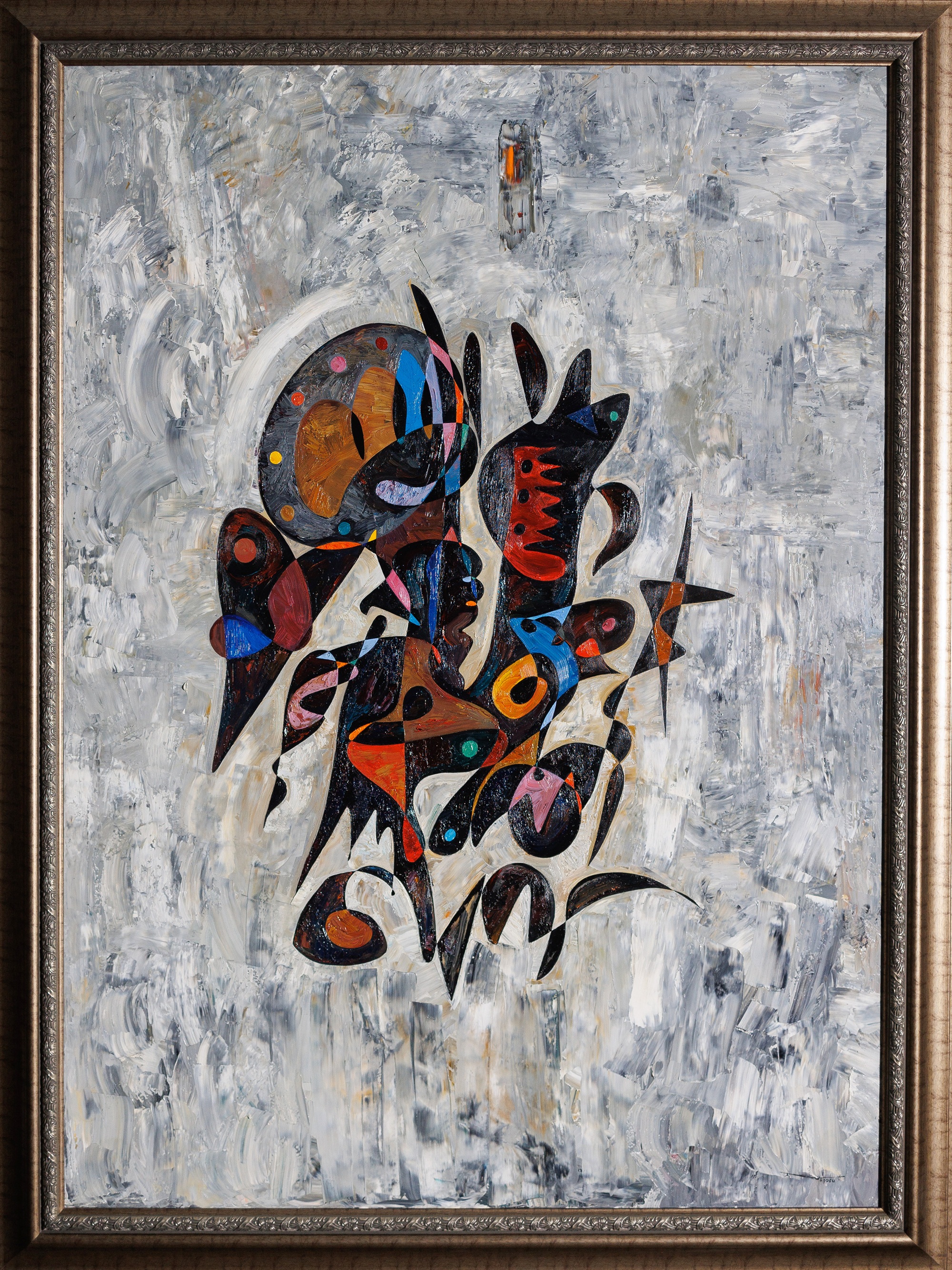
Babylonian Human (2008)
Curatorial Essay
29 Apr 2026Babylonian Human (2008) by Gheorghe Virtosu presents a striking encounter between abstraction and historical reference. A dense cluster of forms occupies the centre of the canvas, set against a wide, heavily worked grey field. While the image resists immediate recognition, the title offers a point of entry, linking the work to the ancient city of Babylon and to the idea of the human figure. Rather than clarifying the image, however, the title introduces a productive tension between what is seen and what is suggested.
The background plays a key role in shaping this tension. Built up through layered, textured brushwork, the grey surface suggests both construction and erosion. It evokes a sense of time passing—of surfaces worn down, altered, or uncovered. In this way, the painting hints at archaeology without depicting a specific place. The reference to “Babylonian” can be understood less as a literal setting and more as an atmosphere of historical depth and cultural memory¹.
At the centre, the clustered forms suggest a figure, but one that is fragmented and unstable. Composed of interlocking shapes—curved, angular, and sharply outlined—the figure resists a single, fixed reading. Elements resembling eyes, limbs, or internal structures appear and dissolve across the surface. The result is a sense of a body in flux, assembled from parts rather than presented as a whole.
Colour contributes to this effect. Bright areas of red, blue, yellow, and pink punctuate the darker structure, drawing the viewer’s attention across the composition. These colours do not describe light or volume; instead, they act as accents or signals within the image. Set against the muted background, they create a contrast between energy and stillness, suggesting moments of intensity within a broader, quieter field.
The title’s reference to Babylon introduces further layers of meaning. Historically associated with early writing systems and complex urban life, Babylon also carries associations of fragmentation and multiplicity. In this context, the painting’s central form can be read as a kind of visual language—made up of signs that do not fully resolve into a single meaning². The “human” of the title is therefore not a clearly defined figure but something more open: a presence constructed through shifting forms and relationships.
The spatial arrangement reinforces this sense of uncertainty. The central cluster appears isolated within the large grey field, almost as if suspended or set apart for examination. At the same time, the textured background suggests that the figure is not entirely separate from its surroundings. It seems to emerge from the surface while also at risk of dissolving back into it.
Babylonian Human ultimately invites the viewer to consider how identity and meaning are formed. By bringing together a historically charged title and an abstract image, Virtosu creates a work that resists straightforward interpretation. The painting does not present a fixed idea of the human; instead, it offers a shifting, fragmented vision shaped by history, perception, and the act of looking itself³.
Artist Biography
Gheorghe Virtosu is a contemporary painter whose work explores abstraction as a vehicle for articulating complex psychological, social, and systemic conditions. His practice is characterized by large-scale compositions that integrate geometric segmentation with biomorphic fluidity.
Emerging from a background shaped by political upheaval and personal adversity, Virtosu channels lived experience into a visual language defined by intensity, transformation, and structural experimentation.
His work from the mid-2010s marks a critical transition toward what would later be formalized as New Perfectionism, a framework in which abstraction operates as a system of interrelated forces rather than a representational mode.
Through layered oil techniques and complex compositional strategies, Virtosu constructs immersive environments that require active perceptual engagement and resist fixed interpretation.
Technical Notes
Medium: Oil on canvas
Dimensions: 215 × 171 cm
The painting combines a heavily textured ground with more controlled applications of paint in the central forms. This contrast enhances the sense of depth and separation between figure and field, while also allowing for moments where the two appear to merge.
Notes
- On historical memory and surface in painting, see discussions of materiality in postwar European art.
- Roland Barthes, Image–Music–Text (1977), on the instability of meaning in visual signs.
- Michel Foucault, The Order of Things (1966), on changing systems of representation.
Selected Bibliography
- Barthes, Roland. Image–Music–Text. London: Fontana, 1977.
- Foucault, Michel. The Order of Things. New York: Pantheon, 1970.
- Foster, Hal et al. Art Since 1900. London: Thames & Hudson, 2016.
- Krauss, Rosalind. The Originality of the Avant-Garde. Cambridge, MA: MIT Press, 1985.