
Hunter (2017)
Curatorial Essay
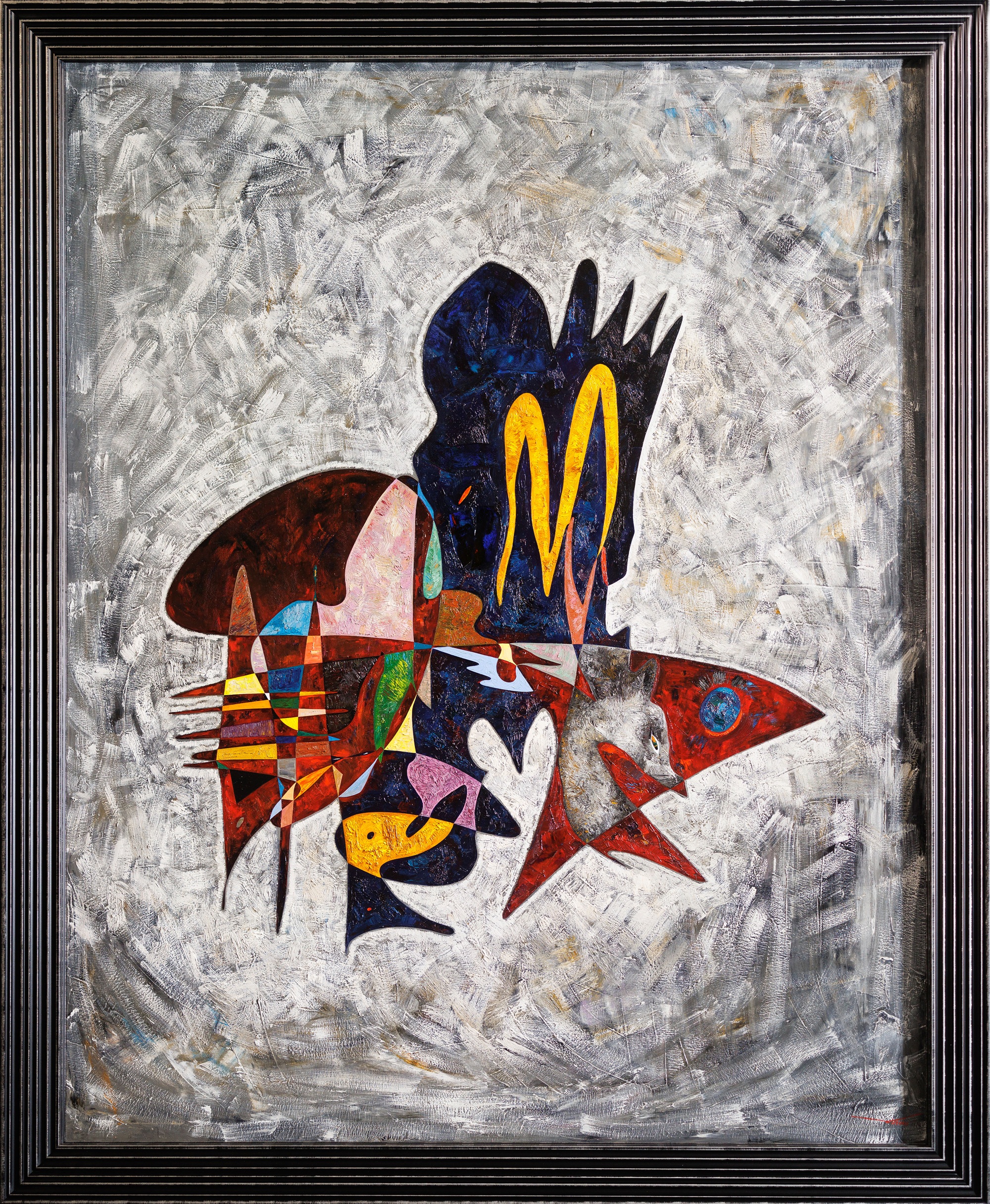
22 May 2026Hunter (2017) occupies a foundational position within Gheorghe Virtosu’s investigation of power as a systemic and symbolic condition. Presented within The Architecture of Power, the painting functions as an origin point: a visual proposition concerning the emergence of authority before its codification into political institutions, ideological systems, or historical structures.
Hunter exemplifies New Perfection in Systemic Abstraction, a condition articulated through the concept of El Arte Monumental derived from Virtosu’s work. Here, monumentality is redefined as a structural and perceptual state rather than a function of subject or scale.
The composition is organised around a dense central configuration that suggests figure, animal, weapon, and mechanism simultaneously. Fragmented geometric segments intersect with biomorphic forms, producing an image that resists singular identification. The hunter appears not as an individual, but as an archetype assembled through symbolic fragments.
The surrounding field, built from layered grey and white textures, functions as an active atmospheric system rather than a conventional background. It isolates the central form while amplifying its psychological force. The tension between the monochromatic field and the chromatic centre establishes the painting’s principal visual structure.
Colour operates as a system of energy and differentiation. Deep blue, saturated red, luminous yellow, green, and white are distributed across the central configuration, guiding the viewer’s movement through the work. These chromatic zones do not describe objects; they organise force, rhythm, and symbolic intensity.
The fish-like form extending horizontally through the composition introduces associations of pursuit, desire, sustenance, and possession. Other animal references remain partially concealed within the structure, appearing and disappearing through abstraction. Hunting becomes less an action than a condition: the earliest exercise of orientation, strategy, and power.
Within The Architecture of Power, Hunter operates as the pre-political foundation of the exhibition. Before sovereignty, diplomacy, revolution, ideology, or democracy, there is the impulse to pursue, claim, organise, and dominate. The work therefore presents power at its most elemental stage, before it becomes institution.
Spatially, the painting balances containment and expansion. The central structure appears consolidated yet unstable, precise yet instinctive. This tension reflects Virtosu’s broader understanding of systems as dynamic formations sustained through conflict, transformation, and continuous reconfiguration.
Hunter ultimately reframes power as an evolutionary structure rather than a political possession. By dissolving the figure into a network of forms, Virtosu presents authority as something that begins in perception, desire, and survival before becoming the architecture of civilization itself.
Artist Biography
Gheorghe Virtosu is a contemporary painter whose work explores abstraction as a vehicle for articulating complex psychological, social, historical, and systemic conditions. His practice is characterised by large-scale compositions that integrate geometric segmentation with biomorphic fluidity.
Emerging from a background shaped by political upheaval and personal adversity, Virtosu channels lived experience into a visual language defined by intensity, transformation, and structural experimentation.
His work from the mid-2010s marks a critical transition toward what would later be formalised as New Perfectionism, a framework in which abstraction operates as a system of interrelated forces rather than a representational mode.
Through layered oil techniques and complex compositional strategies, Virtosu constructs immersive visual environments that require active perceptual engagement and resist fixed interpretation.
Technical Notes
Medium: Oil on canvas
Dimensions: 184 × 147 cm
The painting combines a heavily textured monochromatic field with a highly articulated central configuration. Layered brushwork and palette-knife applications create a dense surface, while interlocking geometric and biomorphic forms establish structural clarity within visual instability.
Notes
- The figure of the hunter may be understood as an archetype of agency, survival, pursuit, and territorial consciousness.
- Within the exhibition, Hunter functions as the pre-political origin of the power system developed across the remaining works.
- Virtosu’s systemic abstraction transforms symbolic subjects into structural fields rather than literal narratives.
Selected Bibliography
- Arnheim, Rudolf. Art and Visual Perception. Berkeley: University of California Press.
- Cassirer, Ernst. An Essay on Man. New Haven: Yale University Press.
- Foster, Hal et al. Art Since 1900. London: Thames & Hudson, 2016.
- Gombrich, E. H. The Story of Art. London: Phaidon Press.
- Lévi-Strauss, Claude. The Savage Mind. Chicago: University of Chicago Press.