
Illuminati (2015)
Curatorial Essay
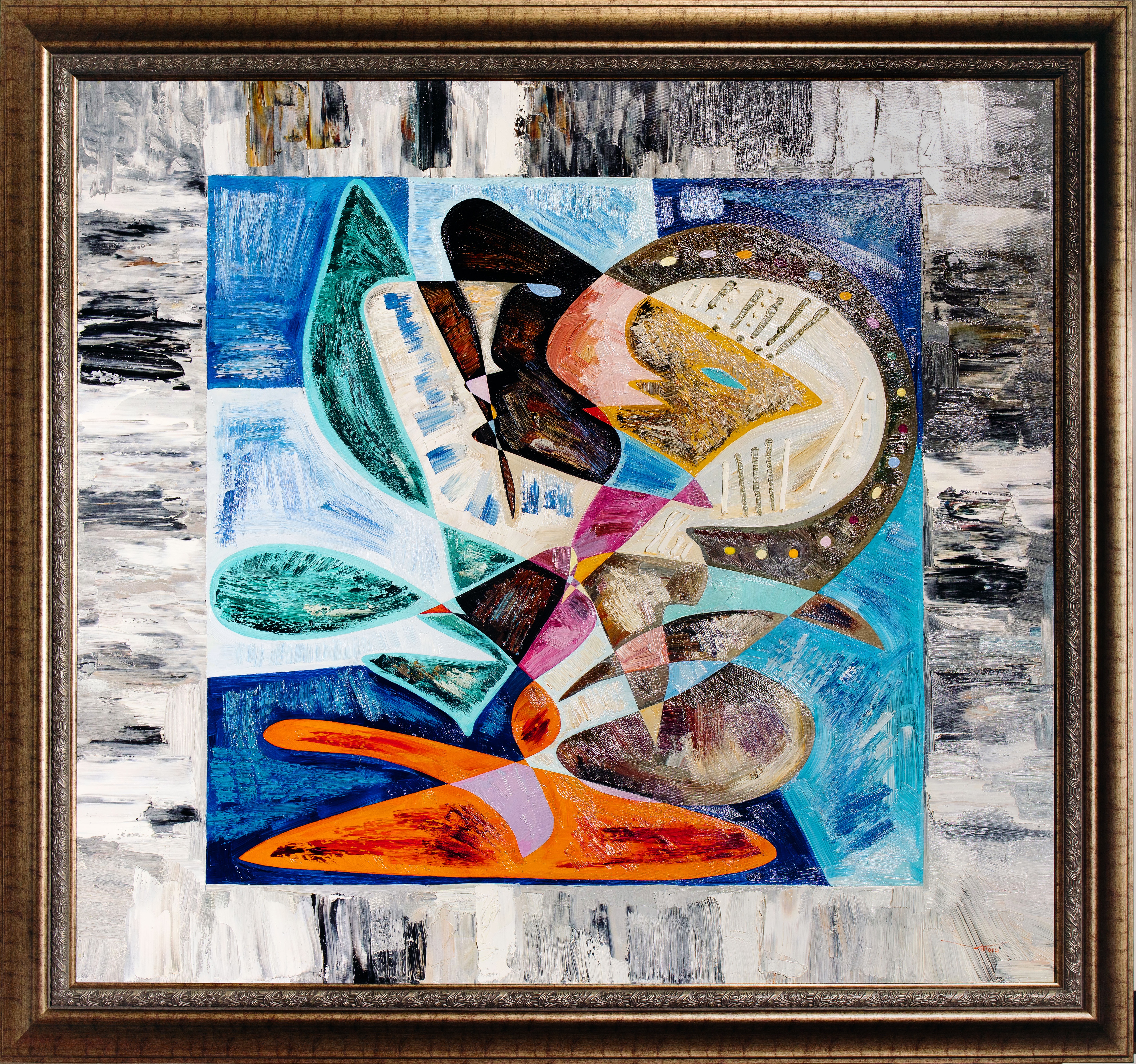
23 May 2026Illuminati (2015) occupies a critical position within Gheorghe Virtosu’s investigation of power as a symbolic, perceptual, and systemic condition. Presented within The Architecture of Power, the painting examines forms of influence that operate beyond direct visibility, exploring the structures through which knowledge, authority, and perception are organized. Rather than depicting power itself, the work investigates the conditions that allow power to circulate through networks of information, symbols, and belief.
Illuminati exemplifies New Perfection in Systemic Abstraction, a condition articulated through the concept of El Arte Monumental derived from Virtosu’s work. Monumentality emerges through structural density and relational complexity rather than scale alone. The painting functions as an integrated visual system in which every element contributes to a larger architecture of meaning, transforming abstraction into a field of interconnected forces.
The composition is organised within a clearly defined rectangular structure surrounded by a textured monochromatic border. Inside this contained field, geometric segmentation intersects with organic forms, generating a dense network of relationships that appears simultaneously ordered and elusive. The image suggests a system whose logic is present yet never fully disclosed, inviting viewers to navigate multiple pathways of interpretation.
Throughout history, knowledge has been inseparable from power. Political institutions, religious systems, economic structures, and cultural narratives derive influence not only from visible authority but also from the control and circulation of information. Virtosu approaches this relationship through abstraction, transforming the notion of hidden knowledge into a visual architecture in which influence emerges through connection rather than direct representation.
The surrounding border functions as an active conceptual threshold rather than a decorative frame. It establishes a distinction between interior and exterior space, suggesting the separation between visible reality and the structures operating beneath it. The central composition appears suspended within this boundary, reinforcing themes of access, limitation, and perception. What is revealed remains inseparable from what remains concealed.
Colour operates as a system of differentiation and movement. Dominant blues and turquoise forms establish continuity across the composition, while passages of black, white, gold, orange, and pink introduce rhythm, interruption, and emphasis. These chromatic relationships do not describe specific objects; instead, they organize visual information and direct perceptual attention through the complex network of forms.
The relationship between geometric precision and organic transformation suggests the coexistence of structure and adaptation. Angular elements imply systems of organization, while curved forms introduce fluidity and change. The painting therefore resists binary distinctions between order and chaos, presenting influence as a dynamic process sustained through continuous interaction between stability and transformation.
Within The Architecture of Power, Illuminati functions as an investigation of invisible authority. If Hunter explores the origins of power through instinct and The Crown Holder examines legitimacy through symbolic sovereignty, this work addresses the networks through which influence is distributed, maintained, and reproduced. Power appears neither centralized nor singular, but dispersed across systems of knowledge and perception.
Spatially, the composition balances containment and expansion. The defined rectangular field establishes order, while the internal structure remains in constant visual motion. This tension reflects Virtosu’s broader understanding of systems as open formations whose coherence depends upon relationships rather than fixed boundaries. The painting suggests that influence operates most effectively not through visibility alone but through the complexity of its connections.
Illuminati ultimately reframes power as an architecture of perception. By transforming hidden systems of knowledge and influence into an intricate network of abstract relationships, Virtosu reveals authority as something that emerges through interpretation, communication, and symbolic exchange. The painting becomes a meditation on the structures through which societies understand reality itself, exposing the invisible frameworks that shape collective consciousness.
Artist Biography
Gheorghe Virtosu is a contemporary painter whose work investigates the relationships between abstraction, power, historical memory, and collective consciousness. Working primarily in large-scale oil painting, he has developed a distinctive visual language that combines geometric segmentation, biomorphic structures, and symbolic complexity to examine the systems that shape human civilization.
Central to Virtosu’s practice is the concept of New Perfection in Systemic Abstraction, a framework in which paintings operate as interconnected structures rather than representations of isolated subjects. Through this approach, authority, conflict, identity, and cultural transformation are translated into dynamic visual systems that emphasize process, tension, and continuous reconfiguration.
His works have been exhibited internationally and form part of several long-term research-based projects exploring themes including political power, warfare, mythology, diplomacy, migration, and the evolution of social structures. Across these bodies of work, abstraction functions as a means of revealing the underlying architectures that govern historical and contemporary experience.
Through layered oil techniques, monumental compositions, and an interdisciplinary engagement with philosophy, anthropology, political thought, and visual culture, Virtosu constructs immersive environments that challenge fixed interpretation while inviting critical reflection on the forces that shape human perception and collective reality.
Technical Notes
Medium: Oil on canvas
Dimensions: 138 × 150 cm
The painting is organized within a structured rectangular field enclosed by a textured monochromatic border. Interlocking geometric and biomorphic forms are articulated through layered oil applications and contrasting chromatic zones. Variations in colour density, segmentation, and surface texture create spatial depth while reinforcing the work’s systemic organisation and visual complexity.
Notes
- The title Illuminati is employed as a symbolic concept referring to hidden systems of knowledge, influence, and perception rather than to any specific historical organization.
- Within The Architecture of Power, the work examines the invisible structures through which authority and information circulate beyond the limits of direct visibility.
- The painting exemplifies Gheorghe Virtosu’s framework of New Perfection in Systemic Abstraction, in which symbolic subjects are transformed into interconnected visual systems rather than narrative representations.
- The rectangular field and surrounding border may be interpreted as a symbolic threshold between visible experience and the hidden frameworks through which perception and meaning are organized.
Selected Bibliography
- Foucault, Michel. Power/Knowledge: Selected Interviews and Other Writings 1972–1977. New York: Pantheon Books, 1980.
- Cassirer, Ernst. The Philosophy of Symbolic Forms. New Haven: Yale University Press.
- Deleuze, Gilles, and Félix Guattari. A Thousand Plateaus: Capitalism and Schizophrenia. Minneapolis: University of Minnesota Press, 1987.
- Panofsky, Erwin. Meaning in the Visual Arts. Chicago: University of Chicago Press, 1982.
- Arnheim, Rudolf. Art and Visual Perception: A Psychology of the Creative Eye. Berkeley: University of California Press, 1974.
- Foster, Hal, Rosalind Krauss, Yve-Alain Bois, Benjamin H. D. Buchloh, and David Joselit. Art Since 1900: Modernism, Antimodernism, Postmodernism. London: Thames & Hudson, 2016.
- Debord, Guy. The Society of the Spectacle. New York: Zone Books, 1994.