
New and Old World Order (2016)
Curatorial Essay
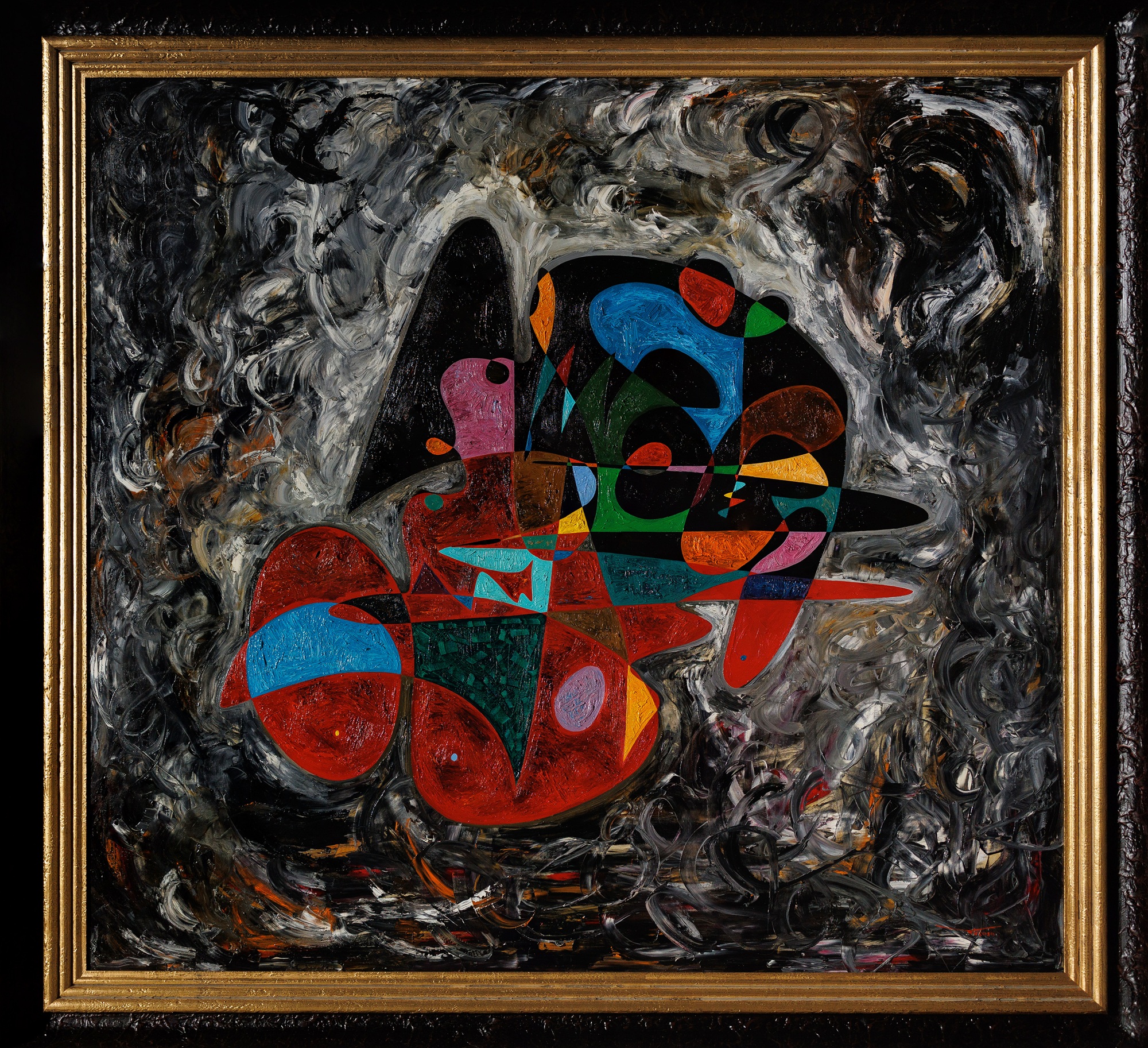
27 May 2026New and Old World Order (2016) occupies a significant position within Gheorghe Virtosu’s investigation of power as a historical, adaptive, and systemic phenomenon. Presented within The Architecture of Power, the painting examines the transition between inherited structures of authority and emerging configurations of global influence. Rather than depicting a specific geopolitical event, the work explores how societies navigate periods of transformation in which established institutions encounter new forces capable of reshaping political, economic, and cultural realities.
Monumentality within New and Old World Order emerges through structural integration and symbolic complexity rather than physical scale alone. The composition functions as an interconnected visual architecture in which colour, form, and spatial relationships operate together to represent the continuous evolution of historical systems. Power appears neither static nor absolute, but as a dynamic process shaped by negotiation, continuity, adaptation, and change.
The composition is organized around a dense central structure composed of interlocking geometric and biomorphic forms positioned within a dark portal-like environment. Red, blue, green, turquoise, orange, pink, black, and gold elements intersect through multiple directional pathways, creating a network of relationships that appears simultaneously coherent and unstable. The image evokes a threshold between historical conditions, suggesting a moment in which competing systems coexist within a shared field of transformation.
Throughout history, world orders have emerged through the interaction of continuity and disruption. Empires, states, institutions, economic systems, and cultural networks evolve through processes of adaptation rather than simple replacement. Virtosu approaches this historical condition through abstraction, transforming geopolitical transition into a symbolic architecture in which inherited structures remain present even as new forms of organization begin to take shape.
The surrounding monochromatic field functions as an active conceptual environment rather than a neutral background. Vigorous gestures of grey, black, and white brushwork create an atmosphere of uncertainty, instability, and movement that surrounds the central architecture. Against this turbulent environment, the internal structure acquires heightened clarity, suggesting the continual effort of political systems to establish coherence within changing historical circumstances.
Colour operates as a language of interaction and emergence. Vibrant reds, blues, greens, turquoise, oranges, and pinks establish zones of activity and connection throughout the composition while maintaining overall structural balance. These chromatic relationships generate pathways of movement that guide perception through the image, emphasizing the interdependence of competing yet interconnected centers of influence. Rather than describing objects, colour functions as a structural instrument through which historical transformation becomes visible.
The interaction between geometric organization and organic transformation reflects the dual character of political evolution itself. Angular forms suggest institutions, systems, and frameworks of governance, while fluid contours introduce adaptation, innovation, and cultural change. The painting therefore avoids presenting history as a linear progression, instead revealing world order as a continuously negotiated condition shaped by multiple interacting forces.
Within The Architecture of Power, New and Old World Order functions as an investigation of systemic transition. If Hunter explores instinct, The Crown Holder examines legitimacy, Illuminati investigates invisible influence, The Diplomatic Jew addresses mediation, British Diplomacy considers negotiation, The Beast of Nazism examines ideological domination, and The King of Revolution explores transformative change, this work investigates the broader historical processes through which entire systems of authority evolve across time.
Spatially, the composition balances containment and expansion. The portal-like structure suggests passage between different historical realities, while the interconnected forms simultaneously resist fixed interpretation. No single element achieves complete dominance; meaning emerges through relationships, interactions, and structural dependencies. This equilibrium reflects Virtosu’s broader understanding of global systems as interconnected networks whose stability depends upon adaptation rather than permanence.
New and Old World Order ultimately reframes geopolitical transformation as an architecture of continuity and emergence. By translating historical succession, institutional evolution, and global realignment into an intricate system of abstract relationships, Virtosu reveals power as a process sustained through negotiation between inherited structures and future possibilities. The painting becomes a meditation on how societies continually reconstruct the frameworks through which collective reality is organized and understood.
Artist Biography
Gheorghe Virtosu is a contemporary painter whose work investigates the relationships between power, historical memory, cultural identity, and collective consciousness. Through large-scale abstract compositions, he examines the political, social, and symbolic structures that shape human experience, transforming complex historical and philosophical questions into dynamic visual architectures.
Working primarily in oil on canvas, Virtosu has developed a distinctive visual language that combines geometric organization, biomorphic forms, symbolic archetypes, and layered chromatic systems. His paintings explore themes including sovereignty, ideology, diplomacy, revolution, migration, cultural identity, and the evolving mechanisms through which authority is established, exercised, challenged, and transformed across societies.
Drawing upon art history, political theory, anthropology, philosophy, and systems thinking, Virtosu creates research-driven bodies of work that invite critical reflection on the forces shaping contemporary civilization. Through abstraction, he reveals the interconnected relationships between memory, power, belief, and collective behavior, positioning painting as a space for intellectual inquiry into the structures that govern historical and social reality.
Technical Notes
Medium: Oil on canvas
Dimensions: 138 × 150 cm
The painting is organized around a complex central architecture composed of interlocking geometric planes, circular motifs, and biomorphic forms positioned within a dark portal-like structure. Layered oil applications, contrasting chromatic passages, and varied surface treatments generate spatial depth and visual complexity. The surrounding monochromatic field reinforces the composition’s emphasis on transition, continuity, and the interaction between established and emerging systems of influence.
Notes
- The title New and Old World Order is approached as a symbolic investigation of geopolitical transformation, historical continuity, and evolving systems of authority rather than as a representation of a specific political doctrine.
- Within The Architecture of Power, the work examines how inherited institutions and emerging structures interact during periods of systemic transition, adaptation, and global realignment.
- The painting transforms themes of continuity, innovation, diplomacy, conflict, and historical succession into an interconnected visual architecture in which meaning emerges through relationships rather than narrative representation.
- The portal-like structure, layered foundations, and interconnected forms may be interpreted as symbols of historical passage, institutional memory, evolving networks of influence, and the continual reconstruction of world order across generations.
Selected Bibliography
- Arrighi, Giovanni. Adam Smith in Beijing: Lineages of the Twenty-First Century. London: Verso, 2007.
- Fukuyama, Francis. Political Order and Political Decay. New York: Farrar, Straus and Giroux, 2014.
- Huntington, Samuel P. The Clash of Civilizations and the Remaking of World Order. New York: Simon & Schuster, 1996.
- Kissinger, Henry. World Order. New York: Penguin Press, 2014.
- Panofsky, Erwin. Meaning in the Visual Arts. Chicago: University of Chicago Press, 1982.
- Foster, Hal, Rosalind Krauss, Yve-Alain Bois, Benjamin H. D. Buchloh, and David Joselit. Art Since 1900: Modernism, Antimodernism, Postmodernism. London: Thames & Hudson, 2016.
- Wallerstein, Immanuel. World-Systems Analysis: An Introduction. Durham: Duke University Press, 2004.