
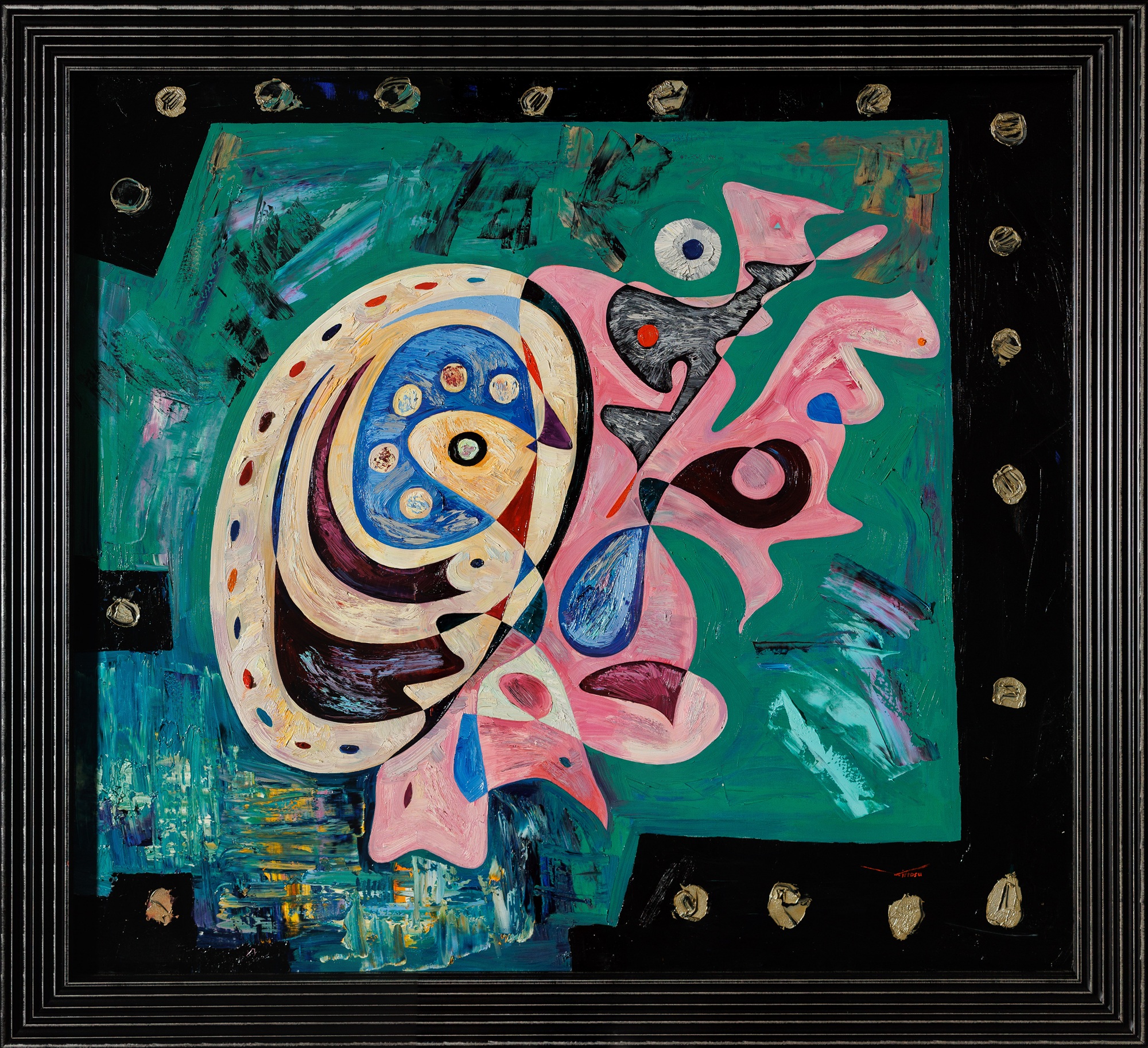
The Beast of Nazism (2015)
Curatorial Essay
26 May 2026The Beast of Nazism (2015) occupies a critical position within Gheorghe Virtosu’s investigation of power as a force capable of both organizing and distorting human society. Presented within The Architecture of Power, the painting examines the transformation of political authority into ideological absolutism. Rather than illustrating historical events directly, the work explores the psychological and cultural conditions through which totalitarian systems emerge, expand, and reshape collective life.
At its core, the painting addresses the relationship between belief and authority. Totalitarian ideologies seek influence not only through institutions and laws but through the construction of alternative realities capable of redefining truth, memory, and identity. Virtosu presents this process as a gradual absorption of complexity into increasingly rigid structures of thought, where certainty replaces ambiguity and obedience displaces independent judgment.
The composition functions as a self-contained symbolic organism whose internal relationships suggest concentration, repetition, and enclosure. Forms appear bound together within a controlled environment that limits openness and exchange. This visual compression reflects the tendency of extremist political systems to reduce plurality, narrowing the space available for dissent, difference, and critical reflection.
Throughout modern history, authoritarian movements have relied upon simplified narratives capable of transforming social anxiety into ideological conviction. By offering absolute explanations for complex realities, such systems cultivate collective identities founded upon exclusion and division. The painting translates this historical process into an abstract visual language in which interconnected forms become increasingly dependent upon a singular organizing logic.
Enclosure emerges as one of the work’s central themes. The distinction between the contained internal environment and the surrounding space suggests a worldview defined by separation and self-reinforcement. Repetition becomes both a visual and conceptual principle, evoking the mechanisms through which doctrines acquire permanence, legitimacy, and the appearance of inevitability.
Colour contributes significantly to the painting’s psychological intensity. Turquoise, blue, pink, white, black, red, and gold establish a system of contrasts that oscillates between attraction and discomfort. Rather than describing recognizable objects, colour operates structurally, directing attention, creating tension, and reinforcing the unstable equilibrium that characterizes the composition as a whole.
The interaction between organic and geometric forms introduces a second level of meaning. Fluid contours suggest the unpredictability of lived experience, while rigid structures imply processes of regulation, classification, and standardization. Their coexistence reflects the persistent tension between human complexity and systems that seek to impose uniformity upon social reality.
Within The Architecture of Power, The Beast of Nazism represents the destructive extreme of ideological certainty. While other works in the series examine legitimacy, diplomacy, influence, or political transformation, this painting investigates the consequences that arise when power becomes detached from ethical responsibility and pluralistic values. The result is a visual meditation on the fragility of freedom when confronted by uncompromising systems of belief.
Ultimately, The Beast of Nazism examines the recurring human temptation to exchange complexity for certainty and freedom for ideological security. Through abstraction and symbolic construction, Virtosu transforms one of history’s most destructive political phenomena into a broader reflection on intolerance, exclusion, and the dangers of absolutist thinking. The painting serves simultaneously as historical reflection and contemporary warning, affirming the enduring importance of critical thought, moral responsibility, and human dignity in the preservation of open society.
Notes
- The title The Beast of Nazism is approached as a symbolic investigation of totalitarian ideology, propaganda, surveillance, and authoritarian power rather than as a depiction of a specific historical event.
- Within The Architecture of Power, the work examines how political authority can evolve into systems of ideological domination that seek control over perception, identity, and collective behavior.
- The painting transforms themes of conformity, manipulation, and dehumanization into an interconnected visual architecture in which meaning emerges through structural relationships rather than narrative representation.
- The concentric eye-like form, enclosing border, and recurring circular elements may be interpreted as symbols of surveillance, ideological repetition, institutional control, and the self-reinforcing mechanisms of totalitarian systems.
Selected Bibliography
- Arendt, Hannah. The Origins of Totalitarianism. New York: Harcourt, Brace & Company, 1951.
- Adorno, Theodor W., and Max Horkheimer. Dialectic of Enlightenment. Stanford: Stanford University Press, 2002.
- Cassirer, Ernst. The Myth of the State. New Haven: Yale University Press, 1946.
- Orwell, George. Nineteen Eighty-Four. London: Secker & Warburg, 1949.
- Panofsky, Erwin. Meaning in the Visual Arts. Chicago: University of Chicago Press, 1982.
- Foster, Hal, Rosalind Krauss, Yve-Alain Bois, Benjamin H. D. Buchloh, and David Joselit. Art Since 1900: Modernism, Antimodernism, Postmodernism. London: Thames & Hudson, 2016.
- Kershaw, Ian. The Nazi Dictatorship: Problems and Perspectives of Interpretation. London: Bloomsbury Academic, 2015.