
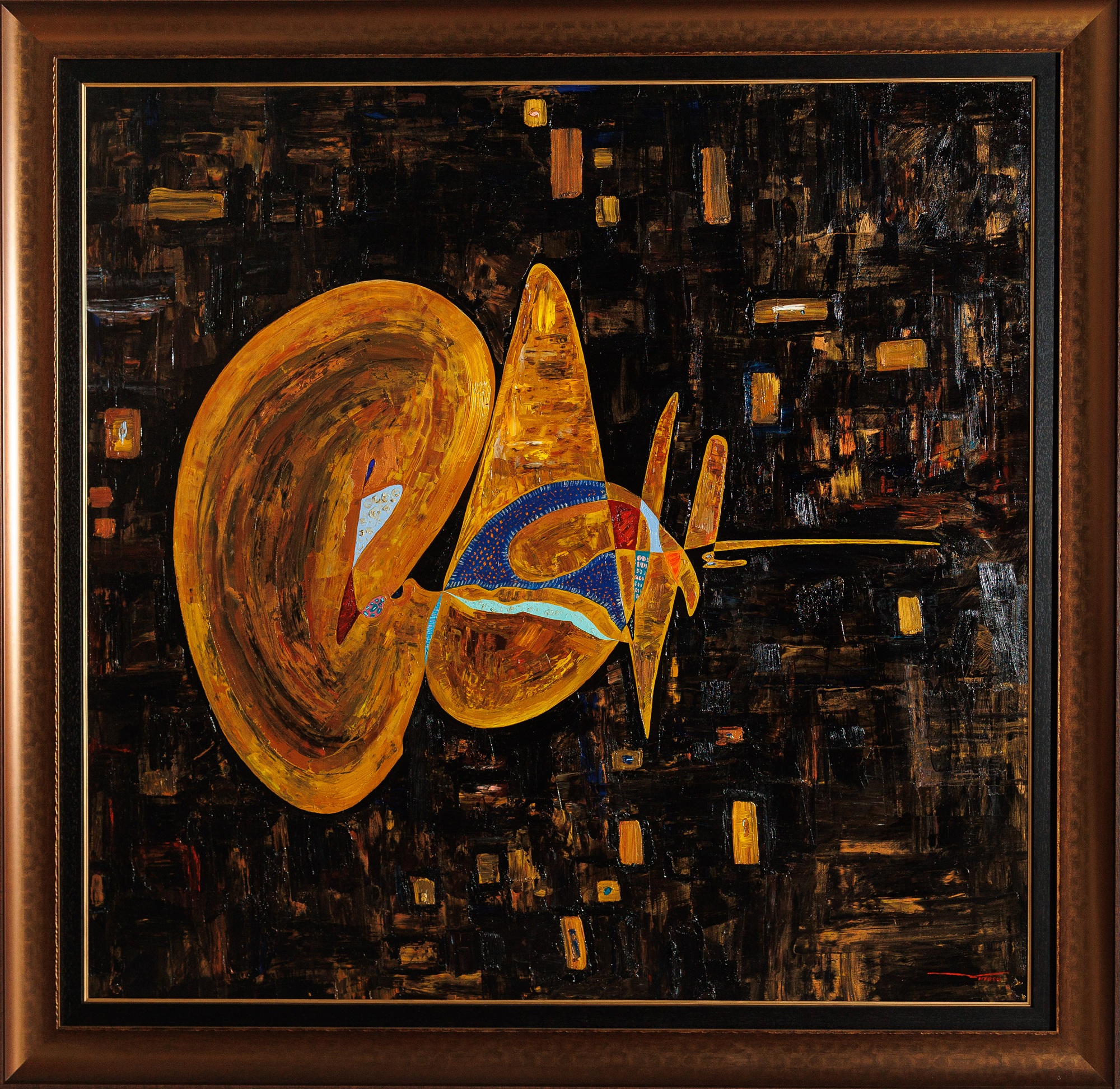
The source of life (2007)
Curatorial Essay
26 Apr 2026In The Source of Life (2007), Gheorghe Virtosu constructs a cosmogenic field in which origination is not depicted as a singular event but articulated as a continuous process of emergence, transformation, and energetic circulation. The composition is dominated by a luminous, biomorphic configuration that appears simultaneously embryonic, mechanical, and celestial. Suspended within a dense, nocturnal ground, this central form resists categorical stability, functioning instead as a generative node through which life is imagined as both material and metaphysical phenomenon. The painting does not illustrate biological genesis in a literal sense; rather, it proposes a speculative ontology in which life unfolds through dynamic relations between structure, motion, and force.1
A defining characteristic of the work is its spatial duality. The background operates as a compressed, nearly impenetrable field of layered darkness, punctuated by dispersed, rectilinear flickers that evoke distant signals or proto-architectural fragments. Against this dense matrix, the central form expands with heightened chromatic intensity, asserting itself as both figure and field. Spatial hierarchies collapse as the luminous organism-like structure simultaneously emerges from and integrates into the surrounding environment. This oscillation destabilizes the distinction between interior and exterior, suggesting that life is not contained but continuously negotiated across permeable boundaries.2
The central configuration is composed of interlocking, curvilinear volumes that evoke anatomical, technological, and cosmic associations. A spiral-like mass on the left suggests gestational enclosure, while elongated, fin-like extensions on the right imply propulsion, transmission, or directional flow. These elements are neither fully organic nor strictly mechanical; instead, they occupy a liminal zone in which biological growth and engineered form converge. The painting thereby situates life within a hybridized framework, challenging the binary opposition between natural and artificial systems. Form becomes a site of synthesis, where evolution is understood as a process of continuous recombination rather than linear progression.3
Temporality within the composition is non-linear and distributed. The painting does not narrate a beginning, middle, and end; instead, it condenses multiple phases of emergence into a single, simultaneous field. The spiral mass may be read as a zone of incubation, the central core as a site of activation, and the projecting extensions as vectors of dissemination. Yet these phases do not unfold sequentially; they coexist, overlapping and interpenetrating one another. This temporal compression aligns with philosophical models that conceive of life as an ongoing event rather than a completed origin, emphasizing process over fixed identity.1
Chromatically, Virtosu employs a restricted yet highly saturated palette dominated by ochres, golds, and deep blacks, punctuated by accents of blue and red. The golden tonality of the central form suggests both vitality and value, invoking associations with illumination, energy, and primordial matter. In contrast, the surrounding darkness functions not merely as absence but as a generative void, a space from which form emerges and into which it may dissolve. The interplay between luminosity and obscurity establishes a rhythmic alternation between revelation and concealment, reinforcing the idea that life is constituted through cycles of appearance and withdrawal.2
The surface treatment further intensifies this dynamic. Layered brushstrokes create a textured field in which traces of gesture remain visible, emphasizing the materiality of the painting process. These accumulated marks generate a sense of depth without relying on illusionistic perspective, maintaining the primacy of the pictorial surface while suggesting internal complexity. The viewer’s perception is continually redirected across the canvas, following the curvature of forms and the dispersal of luminous fragments. This mode of engagement transforms viewing into a temporal act, mirroring the unfolding processes that the painting seeks to evoke.3
At the level of interpretation, The Source of Life resists reduction to symbolic equivalence. While the central form may evoke embryonic, cosmic, or technological imagery, it ultimately operates as a relational construct rather than a fixed sign. Life is not represented as a stable entity but as a condition arising from the interaction of heterogeneous elements. In this sense, the painting aligns with contemporary philosophical conceptions of emergence, in which complex systems arise from the interplay of simpler components without a predetermined blueprint. Virtosu’s work thus situates itself within a broader discourse on the nature of life, emphasizing contingency, interdependence, and transformation.1
The scale of the painting reinforces its immersive quality. At over one and a half meters in both height and width, the canvas envelops the viewer’s field of vision, encouraging a mode of engagement that is both perceptual and corporeal. The absence of a fixed focal point necessitates continuous visual movement, drawing the viewer into a dynamic interaction with the surface. This experiential dimension underscores the work’s conceptual framework, positioning life not as an object to be observed but as a process in which the viewer is implicitly participant.
Ultimately, The Source of Life proposes that origin is not a singular moment located in the past but an ongoing condition that permeates the present. By dissolving the boundaries between organism and environment, structure and flux, Virtosu constructs a visual system in which life emerges as a continuous negotiation of forces. The painting invites sustained contemplation, not to decode a hidden meaning, but to engage with the complexity of becoming itself.
Artist Biography
Gheorghe Virtosu is a contemporary painter whose work investigates the intersection of metaphysics, biological systems, and abstract visual language. His practice is characterized by large-scale compositions in which biomorphic and geometric forms interact within densely structured fields.
Drawing on philosophical concepts related to emergence, temporality, and relational systems, Virtosu constructs paintings that resist fixed interpretation while maintaining internal coherence. His works often explore themes of origin, transformation, and the dynamic interplay between organic and artificial forms.
Working primarily in oil on canvas, he employs layered techniques that allow forms to evolve across multiple perceptual planes. His approach emphasizes process, materiality, and the viewer’s active engagement with the pictorial field.
Technical Notes
Executed in oil on canvas (1.62 × 1.57 meters), the painting establishes a dense, layered surface in which depth is generated through accumulation rather than linear perspective. The absence of a single focal point encourages continuous visual navigation across the composition.
The interplay between luminous, biomorphic forms and a dark, textured ground creates a tension between emergence and concealment. Thick applications of pigment and visible brushwork contribute to the tactile quality of the surface, reinforcing the material presence of the work.
Chromatic contrasts between warm ochres and deep blacks structure the composition, while selective accents of blue and red introduce localized points of intensity. These elements function as visual vectors, guiding the viewer’s movement across the canvas.
Notes
- Gilles Deleuze, Difference and Repetition. Columbia University Press, 1994.
- Henri Bergson, Creative Evolution. Dover Publications, 1998.
- Manuel DeLanda, A New Philosophy of Society. Continuum, 2006.
Selected Bibliography
- Deleuze, Gilles. Difference and Repetition.
- Bergson, Henri. Creative Evolution.
- DeLanda, Manuel. A New Philosophy of Society.
- Simondon, Gilbert. Individuation in Light of Notions of Form and Information.
- Krauss, Rosalind. The Originality of the Avant-Garde and Other Modernist Myths.