
Alexander the Great (2009)
Curatorial Essay
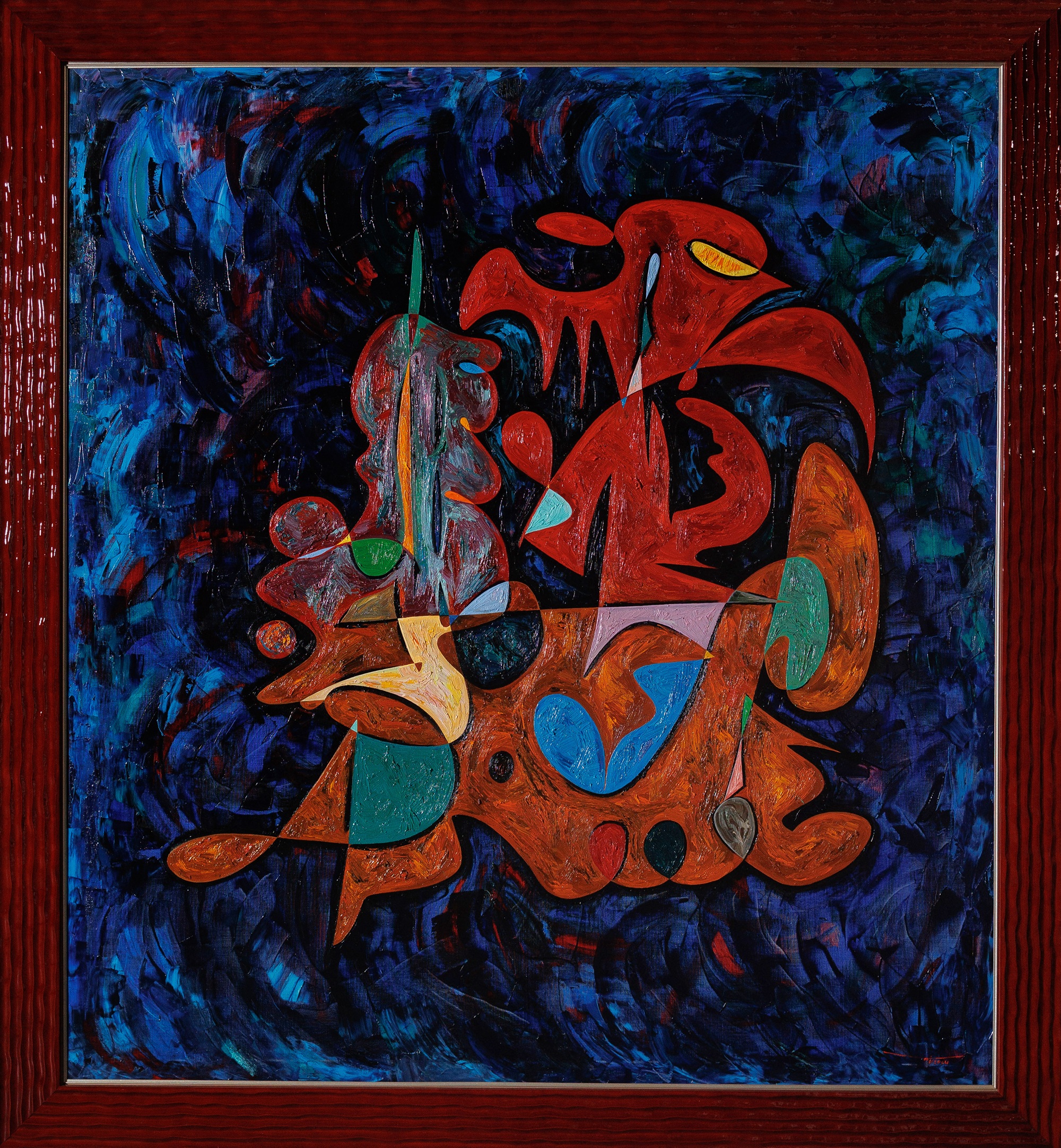
30 May 2026Alexander the Great (2009) investigates the relationship between conquest, myth, and historical permanence through a language of abstraction. Rather than depicting the Macedonian ruler as a recognizable historical figure, Gheorghe Virtosu reconstructs Alexander as a symbolic architecture composed of fragmented forms, chromatic tensions, and shifting spatial structures. The painting moves beyond biography to examine how power expands beyond the individual and becomes embedded within collective memory.
The composition is organized around a dominant red configuration that occupies the upper register of the canvas. Suspended within a deep atmospheric field, this structure functions simultaneously as figure, emblem, and force. Its contours suggest a presence without resolving into a stable identity. Fragments resembling eyes, wings, armour, banners, and territorial markers emerge momentarily before dissolving back into abstraction. Alexander is therefore not represented directly but appears as a system of relationships through which ambition, authority, and expansion are visualized.
The surrounding field is constructed from layered passages of blue, black, and muted green. This dark environment creates a sense of immeasurable depth, evoking both geographical distance and historical duration. Rather than functioning as a neutral backdrop, the space operates as an active arena in which forms collide, merge, and transform. The painting’s atmosphere recalls the uncertainty that accompanies all moments of imperial expansion, where established boundaries become unstable and new structures emerge from conflict.
Colour performs a structural role throughout the composition. Intense reds and oranges dominate the central formation, generating visual momentum and psychological force. These chromatic passages suggest energy, ambition, violence, and transformation. In contrast, areas of turquoise, yellow, and white introduce intervals of balance and reflection. Rather than describing physical volume, colour acts as a system of visual signals that organize the painting's internal dynamics. The resulting tensions create a field of continual negotiation between order and disruption¹.
Geometric and biomorphic elements intersect throughout the lower half of the canvas, producing a fragmented cartography of integration and expansion. Shapes appear to migrate across the surface, absorbing and reorganizing surrounding structures. The composition evokes a map in the process of formation, reflecting the historical reality of Alexander's empire, which united vast and culturally diverse territories under a single political vision². Conquest is therefore understood not as a military event but as a process of transformation that continually reshapes the systems it encounters.
The near-square format reinforces the painting's conceptual concerns. While the central structure appears dominant, it never fully controls the surrounding space. The field resists complete unification, maintaining a state of productive instability. This tension mirrors the paradox of empire itself: the greater its reach, the more fragile its coherence becomes. Authority emerges not as a fixed condition but as a temporary equilibrium sustained through constant negotiation.
Virtosu's treatment of Alexander ultimately transforms the historical ruler into an archetype. The painting examines the enduring human desire to transcend limitation through expansion, achievement, and legacy. Alexander becomes less a historical individual than a symbolic embodiment of civilizational ambition. The work therefore belongs to a broader discourse concerning the construction of political mythology and the mechanisms through which history becomes collective imagination.
Alexander the Great presents power as an evolving structure rather than a permanent possession. Through abstraction, the work dissolves distinctions between individual, empire, and myth, revealing each as part of a larger system of historical production. What remains is not a portrait of a conqueror, but an examination of the forces through which conquest itself is imagined, remembered, and transformed into cultural memory³.
Artist Biography
Gheorghe Virtosu is a contemporary artist whose practice explores the intersections of power, historical memory, mythology, and collective consciousness through abstraction. His work investigates the structures through which civilizations construct meaning, authority, and identity.
Working primarily in large-scale oil paintings, Virtosu develops complex visual systems that combine geometric organization with organic transformation. Rather than depicting historical events directly, his paintings translate social, political, and psychological conditions into networks of symbolic relationships.
Central to his methodology is the concept of systemic abstraction, a framework in which forms operate as interconnected structures rather than isolated images. This approach has contributed to the development of his broader theory of New Perfectionism, where artworks function as dynamic environments of continual transformation.
Through layered surfaces, intense chromatic relationships, and architectonic compositions, Virtosu creates works that challenge viewers to reconsider how history, memory, and power are constructed and perceived.
Technical Notes
Medium: Oil on canvas
Dimensions: 168 × 167 cm
The painting combines layered applications of oil paint with sharply articulated abstract structures. Dense atmospheric passages establish depth and movement, while the central forms are constructed through controlled contours and contrasting chromatic relationships. The interaction between geometric fragmentation and gestural fluidity reinforces the work's exploration of expansion, instability, and transformation.
Notes
- Hannah Arendt, On Violence (1970), on the distinction between authority, power, and force.
- Pierre Briant, Alexander the Great and His Empire (2010), on the political and cultural structures of Alexander's imperial project.
- Joseph Campbell, The Hero with a Thousand Faces (1949), on the transformation of historical figures into mythic archetypes.
Selected Bibliography
- Arendt, Hannah. On Violence. New York: Harcourt, 1970.
- Briant, Pierre. Alexander the Great and His Empire: A Short Introduction. Princeton: Princeton University Press, 2010.
- Campbell, Joseph. The Hero with a Thousand Faces. Princeton: Princeton University Press, 2004.
- Foster, Hal et al. Art Since 1900. London: Thames & Hudson, 2016.
- Clark, T. J. Farewell to an Idea. New Haven: Yale University Press, 1999.