
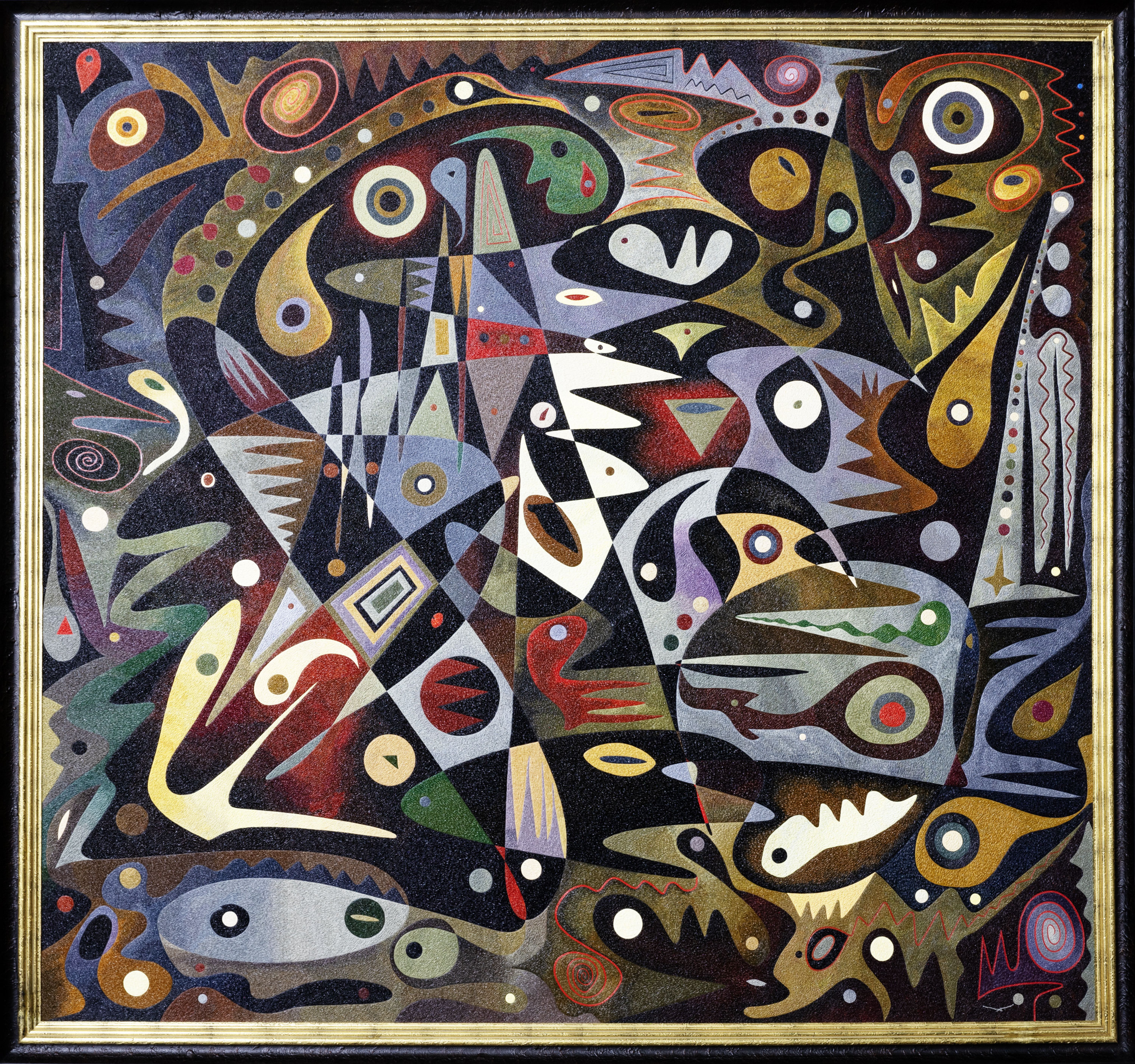
Battle of Gaugamela (2002)
Curatorial Essay
18 Apr 2026In Battle of Gaugamela (2000–2002), Gheorghe Virtosu constructs a pictorial field that reconfigures the Battle of Gaugamela as a system of forces rather than a representational scene. Extending across a monumental horizontal format, the composition rejects linear narration and figural hierarchy, instead organizing visual experience through a dense network of geometric and biomorphic forms. The painting does not depict historical actors or terrain; rather, it translates tactical movement, spatial tension, and the dynamics of command into an abstract visual language in which meaning emerges relationally.
A defining structural feature of the work is the presence of an oblique, diagonal axis that traverses the central field. This diagonal introduces asymmetry and destabilization, redistributing visual weight across the composition. It may be understood as an analogue to the maneuver associated with Alexander the Great, whose angled advance disrupted the opposing line.1 Yet the painting does not illustrate this tactic; it performs its logic. The surrounding forms bend, compress, and fragment in response, producing a visual field structured by pressure and displacement rather than static arrangement.
Across the upper register, a continuous yet internally unstable sequence of forms suggests an extended structural line. Looped shapes, circular motifs, and ornamental rhythms generate a sense of cohesion that is simultaneously undermined by internal discontinuities. This tension may be read in relation to the forces under Darius III, whose numerical scale required spatial extension but introduced vulnerability to rupture.2 The painting encodes this condition not through representation, but through the instability of its own formal continuity.
Within the central and rightward zones, forms converge in areas of heightened density, where angular geometries intersect with curved biomorphic shapes. These regions produce a sense of compression and collision, suggesting moments of tactical convergence and breakthrough. Spatial planes overlap and penetrate one another, generating a visual logic of impact rather than depth. The painting thus transforms the decisive moment of engagement into a condition of structural intensity, where no single form dominates but all participate in a dynamic field of interaction.3
Biomorphic elements—eyes, beak-like protrusions, and ambiguous organic forms—circulate throughout the composition, introducing a layer of perceptual and psychological complexity. These motifs resist stabilization into identifiable figures, instead functioning as dispersed nodes of vision and awareness. Their distribution undermines any singular vantage point, producing a multiplicity of perspectives that aligns with the fragmented experience of conflict.
The principle of fragmentation operates across both form and surface. From a distance, the composition resolves into a coherent system of movement; at close range, it dissolves into granular pigment and discontinuous edges. This oscillation between legibility and disintegration produces a dual perceptual condition in which strategy and chaos coexist.
Chromatically, the work reinforces this instability through the juxtaposition of deep blacks, metallic golds, muted reds, and pale greys. Gold elements punctuate the surface as markers of intensity and value, while darker fields generate zones of compression and resistance. Color does not unify the composition but differentiates and destabilizes it.
Ultimately, Battle of Gaugamela constructs a visual system in which history is no longer presented as a resolved narrative but as a field of interacting forces. By dispersing agency and refusing figural centrality, Virtosu challenges the conventions of history painting, replacing monumental clarity with immersive complexity.
Artist Biography
Gheorghe Virtosu is a contemporary painter whose work explores the intersection of philosophy, historical systems, and visual abstraction. His practice is defined by large-scale compositions that integrate biomorphic forms, geometric structures, and fragmented spatial logics.
Engaging with historical events and conceptual frameworks, Virtosu translates complex systems into abstract visual languages that resist fixed interpretation while maintaining internal coherence.
Central to his practice is an ongoing investigation of large-scale historical and ideological subjects, reconfigured through abstraction into dynamic visual fields.
Working primarily in oil on canvas, Virtosu employs layered techniques that allow forms to emerge, dissolve, and reconfigure across multiple perceptual planes.
Technical Notes
Executed in oil on canvas at a monumental scale (3.23 × 4.03 meters), the painting establishes an immersive horizontal field that necessitates bodily movement for full perception. Layered pigment applications produce a granular texture that shifts between cohesion and fragmentation depending on viewing distance.
The interplay between biomorphic forms and angular geometric structures generates a tension between fluidity and directional force, while overlapping planes emphasize interaction over illusionistic depth.
Chromatic contrasts produce zones of visual intensity and optical vibration, guiding the viewer’s movement across the canvas.
Notes
- Arrian, Anabasis of Alexander.
- Plutarch, Life of Alexander.
- Robin Lane Fox, Alexander the Great. Penguin Books, 1973.
Selected Bibliography
- Arrian. Anabasis of Alexander.
- Plutarch. Life of Alexander.
- Fox, Robin Lane. Alexander the Great.
- Krauss, Rosalind. The Originality of the Avant-Garde and Other Modernist Myths.
- Deleuze, Gilles. Difference and Repetition.
- El Arte Monumental, “New Perfection and Systemic Abstraction in Contemporary Painting.” 2026.