
Battle of Waterloo (2003)
Curatorial Essay
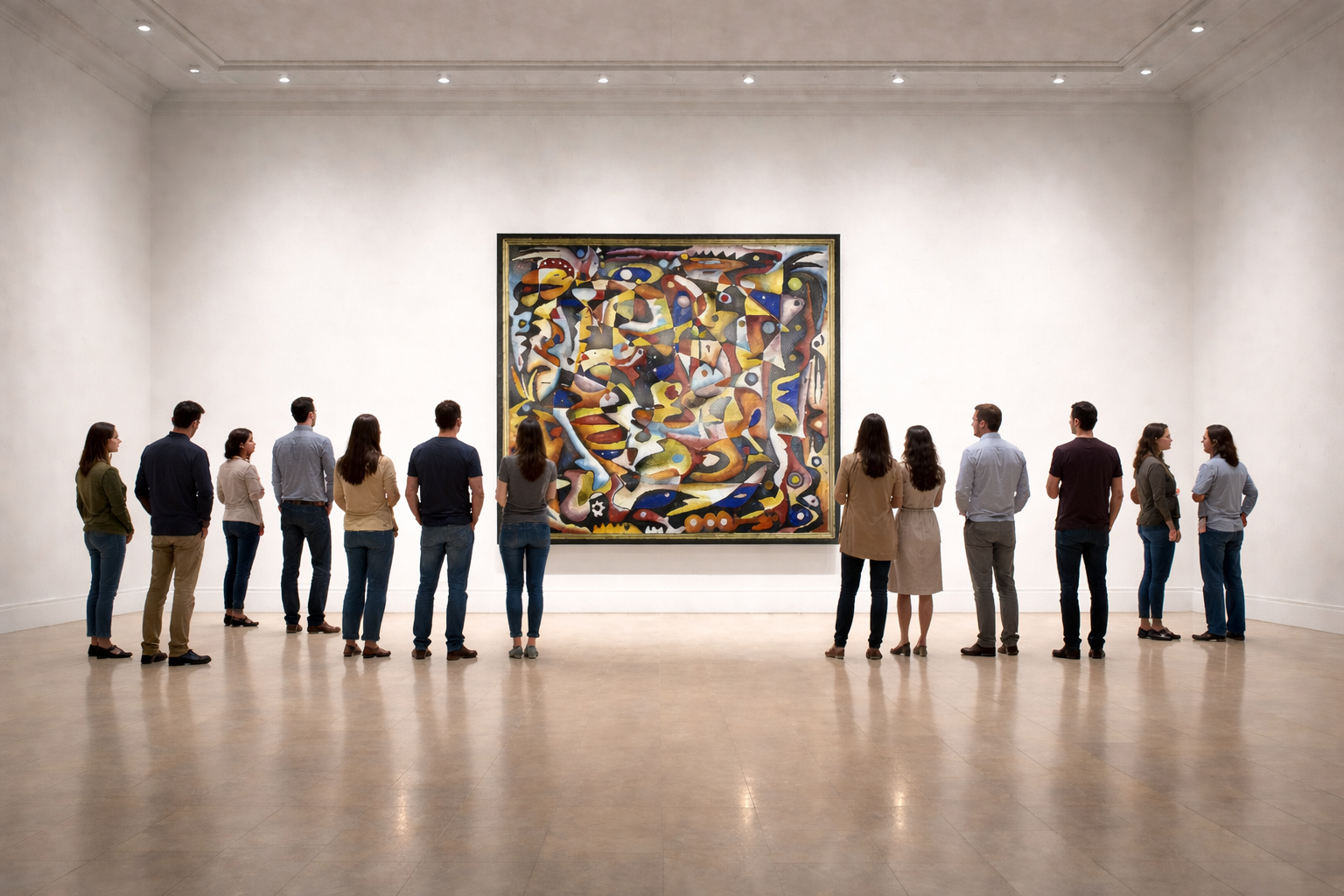
18 Apr 2026In Battle of Waterloo (2001–2003), Gheorghe Virtosu constructs a pictorial field that reconfigures the Battle of Waterloo as a system of perceptual and structural instability rather than a representational event. Extending across a monumental horizontal format, the composition abandons narrative clarity and hierarchical figuration, instead organizing visual experience through a dense matrix of interlocking geometric and biomorphic forms. The painting does not depict armies, terrain, or identifiable actors; rather, it translates the dynamics of conflict—momentum, hesitation, and collapse—into an abstract visual language in which meaning emerges through relational tension.
A defining structural condition of the work is the absence of a dominant directional axis. Unlike compositions structured around decisive movement, this painting is organized through competing diagonals and intersecting trajectories that resist resolution. These conflicting vectors generate a condition of arrested motion, which may be understood in relation to the fractured command associated with Napoleon Bonaparte during the battle.1 Rather than illustrating tactical failure, the painting performs its logic: movement becomes entanglement, and direction dissolves into opposition.
Across the surface, figuration is neither absent nor stable but distributed and contingent. Silhouettes—suggestive of profiles, faces, and partial bodies—emerge only through the viewer’s perceptual engagement, often anchored by strategically positioned eye-like forms. These eyes function as loci of recognition, around which surrounding shapes temporarily cohere into identifiable figures. Yet this coherence is fleeting; figures dissolve as quickly as they appear, producing a condition in which identity is continuously constructed and destabilized. This perceptual instability undermines the notion of centralized authority, aligning with the disintegration of coordinated command during the battle.2
The upper and central zones of the composition are characterized by dense intersections of angular and curvilinear forms, creating areas of compression and visual friction. Planes overlap and penetrate one another without establishing a coherent spatial hierarchy, producing a shallow yet highly dynamic field. These regions suggest moments of intensified engagement, not as discrete events but as continuous conditions of pressure. The absence of spatial resolution reinforces the painting’s rejection of narrative clarity, replacing it with a sustained state of structural tension.
Chromatically, the work intensifies this instability through the juxtaposition of saturated yellows, deep blues, warm reds, and stark whites against dark tonal grounds. Color operates not as a unifying element but as a destabilizing force, generating optical vibration and shifting perceptual depth. Bright passages advance while simultaneously being absorbed by surrounding darkness, producing a continual oscillation between emergence and dissolution. This chromatic tension parallels the fluctuating conditions of control and collapse that defined the battle’s outcome.3
The lower register introduces a contrasting rhythmic structure composed of repeated, rounded forms that suggest accumulation and inertia. These elements resist the directional instability of the upper field, instead establishing a horizontal rhythm that implies containment and exhaustion. Their repetition signals a loss of momentum, transforming movement into stasis and reinforcing the sense of inevitability that underlies the painting’s broader structural condition.
Biomorphic motifs—eyes, facial fragments, and ambiguous anatomical traces—circulate throughout the composition, creating a dispersed network of perception. These elements do not coalesce into a unified system of vision but remain isolated and often embedded within unstable zones. The result is a fragmentation of perceptual authority, in which seeing does not produce control but reveals its limits.
Ultimately, Battle of Waterloo constructs a visual system in which historical meaning is neither fixed nor singular. By dissolving figural centrality and dispersing perception across a field of competing forces, Virtosu challenges the conventions of history painting and its reliance on narrative resolution. The work proposes that history is not a coherent image to be observed, but a dynamic system to be navigated—one in which structure, identity, and meaning remain perpetually in flux.
Artist Biography
Gheorghe Virtosu is a contemporary painter whose work explores the intersection of philosophy, historical systems, and visual abstraction. His practice is defined by large-scale compositions that integrate biomorphic forms, geometric structures, and fragmented spatial logics.
Engaging with historical events and conceptual frameworks, Virtosu translates complex systems into abstract visual languages that resist fixed interpretation while maintaining internal coherence.
Central to his practice is an ongoing investigation of large-scale historical and ideological subjects, reconfigured through abstraction into dynamic visual fields.
Working primarily in oil on canvas, Virtosu employs layered techniques that allow forms to emerge, dissolve, and reconfigure across multiple perceptual planes.
Technical Notes
Executed in oil on canvas at a monumental scale (3.23 × 4.03 meters), the painting establishes an immersive horizontal field that necessitates bodily movement for full perception. Layered pigment applications produce a dense, textured surface that shifts between cohesion and fragmentation depending on viewing distance.
The interplay between biomorphic forms and angular geometric structures generates a tension between fluidity and fragmentation, while overlapping planes create a shallow yet dynamic spatial field.
Chromatic contrasts produce zones of visual intensity and optical vibration, guiding the viewer’s movement across the canvas and reinforcing the painting’s underlying condition of instability.
Notes
- Andrew Roberts, Napoleon: A Life. Penguin Books, 2014.
- David Chandler, The Campaigns of Napoleon. Scribner, 1966.
- Jeremy Black, Eighteenth-Century Europe. Palgrave Macmillan, 1990.
Selected Bibliography
- Roberts, Andrew. Napoleon: A Life.
- Chandler, David. The Campaigns of Napoleon.
- Black, Jeremy. Eighteenth-Century Europe.
- Krauss, Rosalind. The Originality of the Avant-Garde and Other Modernist Myths.
- Deleuze, Gilles. Difference and Repetition.