
British Diplomacy (2015)
Curatorial Essay
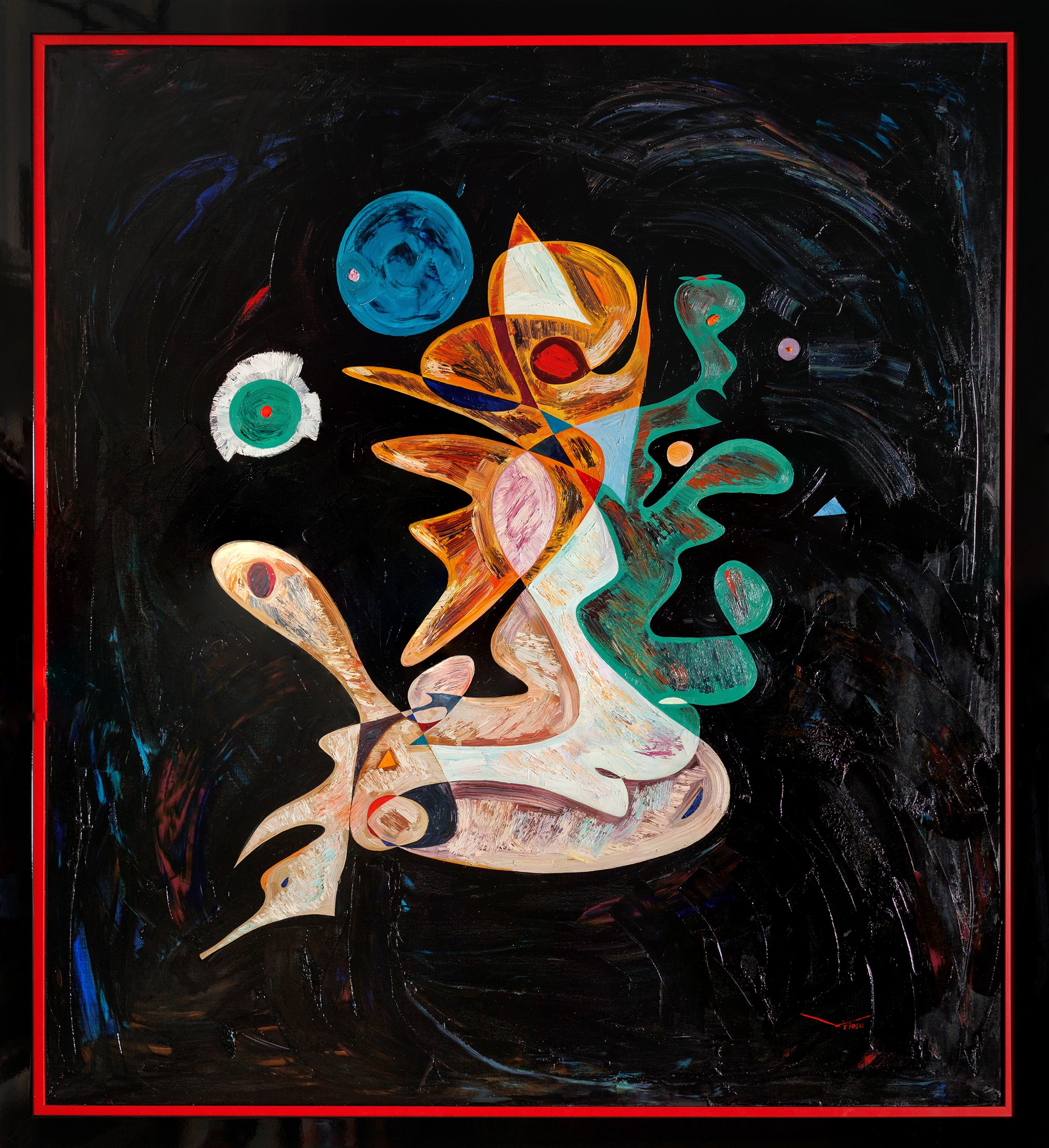
24 May 2026British Diplomacy (2015) occupies a significant position within Gheorghe Virtosu’s investigation of power as a strategic, adaptive, and relational phenomenon. Presented within The Architecture of Power, the painting explores diplomacy as an instrument through which influence is negotiated, alliances are maintained, and stability is pursued amid uncertainty. Rather than representing a specific political event or historical figure, the work examines the structures that enable dialogue, coordination, and international engagement across shifting geopolitical realities.
British Diplomacy exemplifies New Perfection in Systemic Abstraction, a condition articulated through the concept of El Arte Monumental derived from Virtosu’s work. Monumentality emerges through structural complexity and symbolic integration rather than scale alone. The painting functions as an interconnected visual system in which colour, form, and spatial organization contribute to a broader architecture of negotiation and strategic balance.
The composition is organized around a vertically ascending central structure positioned within an expansive black field. Intersecting geometric planes, fluid contours, circular motifs, and directional forms generate a network of relationships that appears simultaneously stable and in motion. The image evokes navigation rather than confrontation, suggesting a process of continuous adjustment within an environment characterized by uncertainty and change.
Throughout history, diplomacy has served as a mechanism through which nations extend influence beyond the limits of direct force. Trade, negotiation, alliance-building, cultural exchange, and strategic communication have shaped international relations as profoundly as military power. Virtosu approaches this historical condition through abstraction, transforming diplomacy into a visual architecture in which relationships and connections become the primary agents of action.
The surrounding black field functions as an active conceptual space rather than a neutral background. It evokes the uncertainty of international affairs, the complexity of geopolitical environments, and the unpredictable conditions within which diplomacy operates. Against this expansive field, the central structure acquires heightened clarity and significance, suggesting the role of strategic institutions in navigating unstable circumstances.
Colour operates as a system of orientation and emphasis. Gold, turquoise, blue, white, red, and green establish distinct zones of visual activity while maintaining overall compositional coherence. The chromatic relationships create pathways through the image, directing attention between areas of concentration and release. Rather than describing objects, colour functions as a structural language through which relationships are organized and maintained.
The interplay between geometric precision and organic transformation reflects the dual character of diplomacy itself. Angular elements suggest institutional frameworks, policy structures, and strategic planning, while fluid contours introduce flexibility, adaptation, and responsiveness. The painting therefore presents diplomacy not as a fixed doctrine but as a dynamic process requiring continuous negotiation between principle and circumstance.
Within The Architecture of Power, British Diplomacy functions as an investigation of strategic authority. If Hunter explores the origins of power through instinct, The Crown Holder examines legitimacy through sovereignty, Illuminati investigates invisible systems of influence, and The Diplomatic Jew addresses mediation between cultures, this work considers diplomacy as the mechanism through which power operates within international networks and global relationships.
Spatially, the composition balances containment and expansion. The central structure appears anchored yet constantly evolving, while surrounding orbital forms suggest the presence of multiple actors operating within a shared environment. This equilibrium reflects Virtosu’s broader understanding of political systems as interconnected formations whose stability depends upon communication, adaptation, and strategic coordination rather than unilateral control.
British Diplomacy ultimately reframes diplomacy as an architecture of navigation. By transforming negotiation, strategic continuity, and international engagement into an intricate system of abstract relationships, Virtosu reveals influence as a process sustained through movement, adjustment, and connection. The painting becomes a meditation on the structures through which societies pursue stability within a constantly changing world.
Artist Biography
Gheorghe Virtosu is a contemporary painter whose work investigates the relationships between abstraction, power, historical memory, and collective consciousness. Working primarily in large-scale oil painting, he has developed a distinctive visual language that combines geometric segmentation, biomorphic structures, and symbolic complexity to examine the systems that shape human civilization.
Central to Virtosu’s practice is the concept of New Perfection in Systemic Abstraction, a framework in which paintings operate as interconnected structures rather than representations of isolated subjects. Through this approach, authority, conflict, diplomacy, identity, and cultural transformation are translated into dynamic visual systems that emphasize process, tension, and continuous reconfiguration.
His works have been exhibited internationally and form part of several long-term research-based projects exploring themes including political power, diplomacy, mythology, migration, collective memory, and the evolution of social structures. Across these bodies of work, abstraction functions as a means of revealing the underlying architectures that govern historical and contemporary experience.
Through layered oil techniques, monumental compositions, and an interdisciplinary engagement with philosophy, anthropology, political thought, and visual culture, Virtosu constructs immersive environments that challenge fixed interpretation while inviting critical reflection on the forces that shape human perception and collective reality.
Technical Notes
Medium: Oil on canvas
Dimensions: 150 × 138 cm
The painting is organized around a vertically structured central configuration positioned within a dark surrounding field. Intersecting geometric and biomorphic forms are articulated through layered oil applications, contrasting chromatic passages, and varied brushwork. Circular motifs, directional axes, and fluid contours generate spatial depth and visual movement while reinforcing the composition’s emphasis on negotiation, connectivity, and strategic balance.
Notes
- The title British Diplomacy is approached as a symbolic investigation of negotiation, strategic continuity, international engagement, and statecraft rather than as a representation of a specific diplomatic event.
- Within The Architecture of Power, the work examines diplomacy as a mechanism through which influence is coordinated, relationships are maintained, and stability is pursued across complex geopolitical environments.
- The painting exemplifies Gheorghe Virtosu’s framework of New Perfection in Systemic Abstraction, in which political and historical themes are transformed into interconnected visual systems rather than narrative illustrations.
- The ascending central structure and surrounding orbital forms may be interpreted as a symbolic model of international networks, emphasizing adaptation, communication, and strategic navigation within conditions of uncertainty.
Selected Bibliography
- Kissinger, Henry. Diplomacy. New York: Simon & Schuster, 1994.
- Nicolson, Harold. Diplomacy. Oxford: Oxford University Press, 1963.
- Arendt, Hannah. The Human Condition. Chicago: University of Chicago Press, 1958.
- Cassirer, Ernst. An Essay on Man. New Haven: Yale University Press, 1944.
- Panofsky, Erwin. Meaning in the Visual Arts. Chicago: University of Chicago Press, 1982.
- Foster, Hal, Rosalind Krauss, Yve-Alain Bois, Benjamin H. D. Buchloh, and David Joselit. Art Since 1900: Modernism, Antimodernism, Postmodernism. London: Thames & Hudson, 2016.
- Wight, Martin. Power Politics. Leicester: Leicester University Press, 1978.