
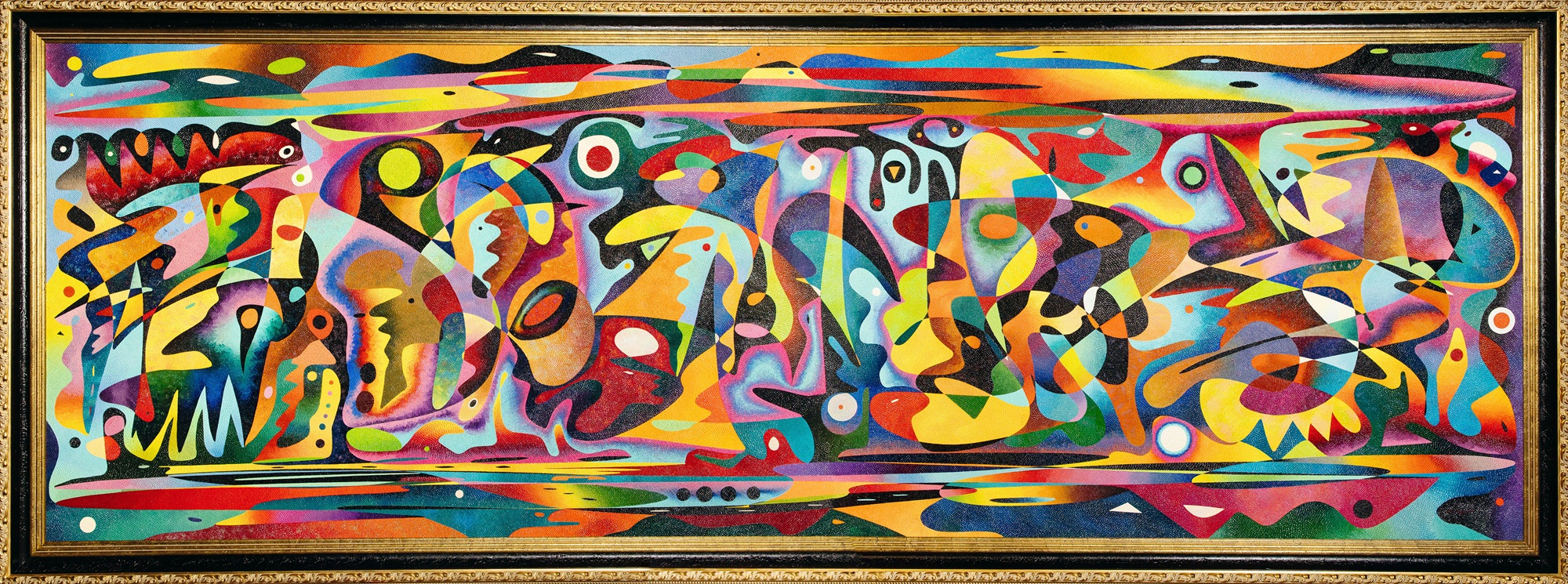
Buddhism (2018)
Curatorial Essay
07 Apr 2026In Buddhism (2016–2018), Gheorghe Virtosu constructs a panoramic visual field that displaces representation in favor of processual emergence. The painting does not depict a religious system through fixed iconography; rather, it stages a continuous field in which forms arise, stabilize momentarily, and dissolve without resolution. Meaning is neither contained nor transmitted but generated relationally, positioning the work as a site of perpetual becoming.
This condition of instability may be understood through Roland Barthes’ conception of the sign as inherently unfixed and perpetually deferred¹. Visual motifs—faces, ocular structures, and biomorphic clusters—function as unstable signifiers that resist closure. A face may briefly cohere into recognizable identity only to fragment into adjacent forms, while an “eye” oscillates between perception, structure, and abstraction. The painting thus exposes signification as process: meaning is continuously produced and undone, never fully present.
Jacques Derrida’s notion of différance further deepens this reading². Meaning within the painting is not only unstable but structurally deferred; each form refers beyond itself to other forms from which it differs and upon which it depends. No element achieves self-presence. Instead, the entire composition operates as a chain of relational differences in which identity is constituted through absence, displacement, and temporal delay. The image becomes a field of traces rather than fixed entities.
The compositional structure resonates with the rhizomatic model proposed by Gilles Deleuze and Félix Guattari³. The painting unfolds as a non-hierarchical multiplicity without origin or endpoint, in which any point may connect to any other. Faces proliferate across the central register, yet they do not function as stable subjects; they are transient intensities within a distributed network. The work resists both unity and fragmentation, sustaining instead a condition of continuous variation.
This multiplicity destabilizes identity at its core. Faces of varying ages—youthful, mature, and aged—emerge and dissolve within the same field, their features migrating and overlapping. No figure retains coherence; each is constituted through relations that immediately exceed it. In this sense, the painting enacts both the Buddhist doctrine of non-self and Deleuze’s concept of becoming⁴. Identity is not an essence but a provisional effect within an ongoing process of transformation.
The vertical articulation of the composition introduces a non-linear field of emergence and dissolution. The lower zone presents dense, pre-figurative accumulations; the central band allows for the temporary stabilization of faces; and the upper register disperses these formations into attenuated chromatic fields. These zones coexist rather than unfold sequentially, producing a continuous present in which formation and dissolution are simultaneous. Temporality is spatialized, dissolving linear progression into a field of coexisting states.
This structure finds a precise philosophical parallel in the work of Nāgārjuna, whose articulation of emptiness (Śūnyatā) emerges through dependent origination⁵. As interpreted by Jay L. Garfield, phenomena are empty not because they do not exist, but because they lack independent, intrinsic essence⁶. In Virtosu’s painting, no form exists autonomously; each arises only through its relations to others. The visual field thus enacts emptiness not as void, but as relationality.
The interaction between curvilinear continuity and angular interruption may be understood through Deleuze’s distinction between smooth and striated space⁷. Smooth space manifests as flow and continuity, while striated space introduces segmentation and structure. In Buddhism, these spatial regimes are inseparable: structure emerges from flow only to dissolve back into it. The painting sustains a dynamic oscillation in which no spatial logic achieves dominance.
Chromatically, the work intensifies this condition of flux. Virtosu employs a highly saturated and heterogeneous palette that detaches color from descriptive function. Color traverses forms, disregards boundaries, and reappears across disparate structures, preventing the consolidation of identity. Through gradients and blending, edges dissolve, and chromatic transitions enact impermanence at the level of perception.
This chromatic mobility aligns with Barthes’ free play of the signifier and Deleuze’s conception of difference as productive⁸. Color does not represent form; it generates and destabilizes it. At the same time, the intensity of chromatic presence resists any interpretation of emptiness as absence. Instead, the painting embodies fullness without essence: a condition in which phenomena are vividly present yet lack intrinsic identity, directly paralleling Nāgārjuna’s logic of emptiness.
The question of perception is further destabilized through a Lacanian framework. The recurring eye-like motifs suggest the presence of a gaze, yet this gaze cannot be localized within a stable subject. As Jacques Lacan argues, the gaze precedes and constitutes the subject rather than emanating from it⁹. In Virtosu’s painting, perception is decentered: the viewer is no longer the origin of vision but becomes implicated within a field in which seeing and being seen are indistinguishable.
This condition finds resonance in Maurice Merleau-Ponty’s phenomenology, in which perception is understood as an embodied and reciprocal relation between seer and seen¹⁰. In Buddhism, this reciprocity is intensified: forms appear to perceive as much as they are perceived, and the viewer becomes entangled within the same network of relations that constitutes the image. Perception is thus revealed as distributed, unstable, and co-constitutive.
Crucially, the painting maintains a rigorously non-hierarchical structure. No figure, form, or chromatic zone asserts dominance; all elements exist within a distributed field of relations. The viewer’s gaze moves continuously, generating and dissolving meaning in real time, without access to a privileged interpretive position.
Ultimately, Buddhism operates as a metasystem of becoming and deferral. It does not represent Buddhist philosophy but enacts its structural principles through visual means. Impermanence, non-self, interdependence, and emptiness are embedded within the painting’s formal, spatial, and chromatic logic. The work becomes a field of différance and dependent origination, in which meaning, identity, and perception are continuously produced and undone.
Artist Biography
Gheorghe Virtosu is a contemporary painter whose work explores the intersection of symbolic systems, philosophy, and visual abstraction. His practice engages with global belief structures and theoretical frameworks, translating them into complex compositions that emphasize transformation, interconnection, and the instability of meaning. Through his 10 Religions series, Virtosu investigates shared conceptual foundations across cultures, inviting viewers into an active and reflexive process of interpretation.
Technical Notes
Executed in oil on canvas at a large scale (2 × 6 meters), the work creates an immersive perceptual environment. Layered applications of paint generate depth and translucency, enabling forms to emerge and dissolve across multiple visual planes. The interplay between fluid chromatic transitions and intermittent structural articulations reinforces the tension between continuity and differentiation.
Acknowledgments
Presented by El Arte Monumental
Curatorial Team: Daniel Varzari
Photography: Courtesy of El Arte Monumental
Special Thanks: Daniel Varzari
Notes
- Roland Barthes, Mythologies (1957).
- Jacques Derrida, Of Grammatology (1967).
- Deleuze and Guattari, A Thousand Plateaus (1987).
- Deleuze, Difference and Repetition (1994).
- Nāgārjuna, Mūlamadhyamakakārikā.
- Jay L. Garfield, The Fundamental Wisdom of the Middle Way (1995).
- Deleuze, ibid.
- Barthes, Image–Music–Text (1977).
- Lacan, The Four Fundamental Concepts of Psychoanalysis (1978).
- Merleau-Ponty, Phenomenology of Perception (1962).
Selected Bibliography
- Barthes, Roland. Mythologies. 1957.
- Derrida, Jacques. Of Grammatology. 1967.
- Deleuze, Gilles. Difference and Repetition. 1994.
- Deleuze, Gilles, and Félix Guattari. A Thousand Plateaus. 1987.
- Garfield, Jay L. The Fundamental Wisdom of the Middle Way. 1995.
- Lacan, Jacques. The Four Fundamental Concepts of Psychoanalysis. 1978.
- Merleau-Ponty, Maurice. Phenomenology of Perception. 1962.