
Caodaism (2021)
Curatorial Essay
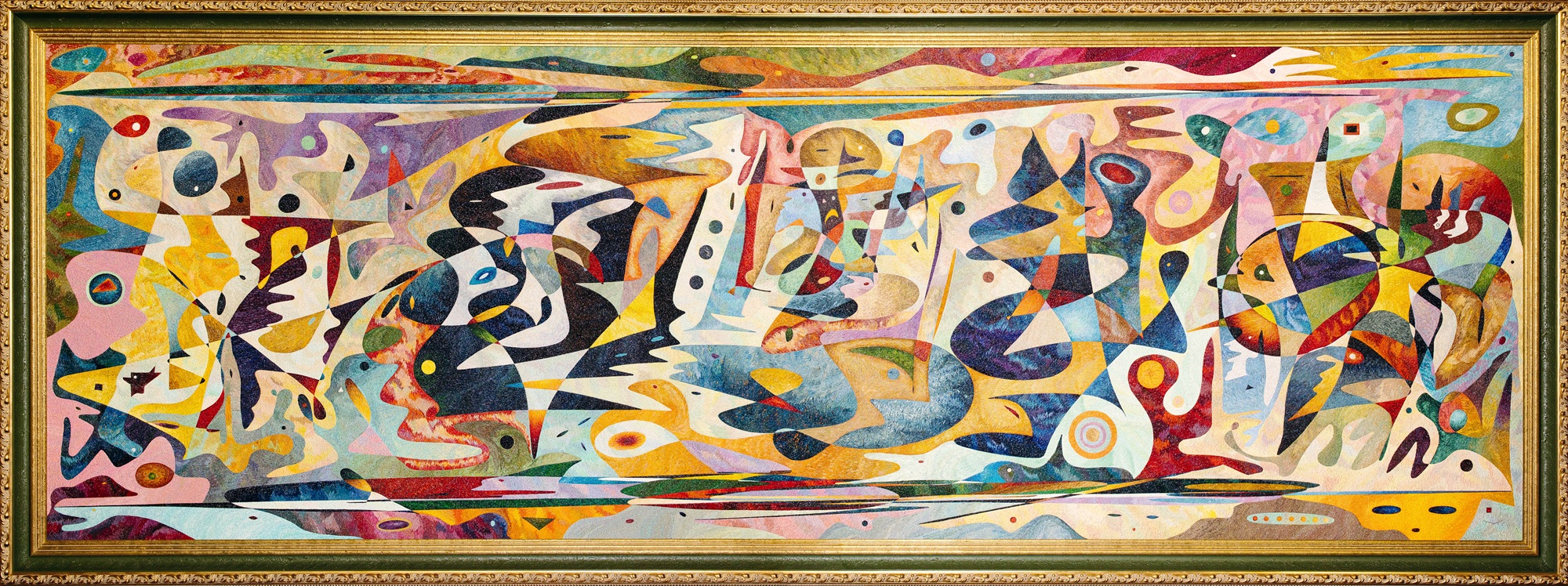
11 Apr 2026In Caodaism (2019–2021), Gheorghe Virtosu constructs a panoramic visual field that operates as a speculative cosmology rather than a direct representation of doctrine. The composition unfolds laterally, inviting a left-to-right movement that suggests progression, yet resists fixed narrative closure. Within this extended field, the painting encodes a system of relations that can be read in dialogue with the syncretic philosophy of Caodaism, in which multiple religious traditions converge without hierarchical dominance. Meaning is not presented as stable or singular, but emerges through the viewer’s sustained engagement with shifting visual correspondences, aligning with Umberto Eco’s concept of the “open work”¹.
The left region of the composition is marked by a predominance of yellow tonalities and relatively diffuse, emergent forms. This zone may be interpreted as resonating with Buddhism, particularly through its chromatic association with illumination and spiritual awakening. However, such a reading remains provisional; rather than functioning as a fixed symbolic code, color operates within a broader field of cultural associations. Forms in this region appear less stabilized, suggesting conditions of origin, multiplicity, or initial emergence.
As the composition advances toward the center, cooler blue tonalities become more prominent, and the density of faces and semi-figurative forms increases. This central zone may be aligned with Taoism, particularly in its emphasis on flow and relational balance. The proliferation of eyes and fragmented visages constructs a distributed field of perception, destabilizing the singular viewing subject and introducing a condition of omnidirectional awareness, consistent with Michel Foucault’s decentering of the observing subject².
Near the compositional center, three small circular forms appear, accompanied by an anthropomorphic silhouette that evokes a meditative or enlightened presence. While it is tempting to identify this figure directly as the Buddha, its abstraction resists definitive iconographic classification. Instead, it functions structurally as a point of convergence. The three dots may be interpreted as an abstract condensation of the “Three Teachings” (Tam Giáo), though this remains interpretive rather than conclusive. Their central placement reinforces the notion of synthesis.
Moving toward the right, red tonalities intensify, and forms appear increasingly structured yet simultaneously fragmented. This region may be read in relation to Confucianism, particularly in its association with order and ethical structure. Yet rather than stabilizing the composition, this apparent order gives way to perceptual ambiguity. Faces dissolve, boundaries blur, and identity becomes dispersed across unstable configurations, enacting a process akin to deterritorialization as articulated by Gilles Deleuze and Félix Guattari³.
The upper and lower horizontal bands introduce an additional layer of complexity. While they function compositionally as framing devices, they also evoke, by analogy, the borders of photographic or cinematic film. This introduces a temporal dimension, suggesting segmentation and sequence. However, this reading remains speculative; the bands establish a logic of containment and progression without explicitly determining it.
The repetition of eyes throughout the composition further reinforces perceptual instability. These motifs may be connected to the Caodaist Divine Eye, yet here they are multiplied and dispersed, transforming a centralized symbol into an omnipresent condition. Meaning, therefore, is not fixed but continually deferred across the surface, aligning with Jacques Derrida’s concept of différance⁴.
The overall structure of the painting can thus be understood as a visual analogue to syncretism itself. Rather than illustrating Caodaist theology, the work enacts it through formal organization. Chromatic progression, symbolic condensation, and distributed figuration produce a system in which multiple meanings coexist without resolution. This resonates with the rhizomatic model proposed by Deleuze and Guattari, where meaning emerges through non-hierarchical connections³.
Ultimately, Caodaism operates as a visual philosophy of synthesis without closure. It does not resolve multiplicity into unity but sustains their coexistence within an open system. The viewer is implicated in this process, navigating a field in which meaning is continuously produced, negotiated, and transformed.
Artist Biography
Gheorghe Virtosu is a contemporary painter whose work explores the intersection of symbolic systems, philosophy, and visual abstraction. His practice engages with global belief structures and theoretical frameworks, translating them into complex compositions that emphasize transformation, interconnection, and the instability of meaning. Through his 10 Religions series, Virtosu investigates shared conceptual foundations across cultures, inviting viewers into an active and reflexive process of interpretation.
Technical Notes
Executed in oil on canvas at a monumental scale (2 × 6 meters), the work creates an immersive visual environment. Layered applications of paint generate depth and stratification, allowing forms to emerge, overlap, and dissolve across multiple perceptual planes. The interplay between biomorphic figuration and geometric structuring reinforces the conceptual tension between multiplicity and unity.
Acknowledgments
Presented by El Arte Monumental
Curatorial Team: Daniel Varzari
Photography: Courtesy of El Arte Monumental
Special Thanks: Daniel Varzari
Notes
- Umberto Eco, The Open Work. Cambridge, MA: Harvard University Press, 1989.
- Michel Foucault, Discipline and Punish: The Birth of the Prison. New York: Pantheon Books, 1977.
- Gilles Deleuze and Félix Guattari, A Thousand Plateaus. Minneapolis: University of Minnesota Press, 1987.
- Jacques Derrida, Of Grammatology. Baltimore: Johns Hopkins University Press, 1976.
Selected Bibliography
- Eco, Umberto. The Open Work.
- Derrida, Jacques. Of Grammatology.
- Deleuze, Gilles, and Guattari, Félix. A Thousand Plateaus.
- Foucault, Michel. Discipline and Punish.
- Merleau-Ponty, Maurice. Phenomenology of Perception.
- Bergson, Henri. Time and Free Will.