
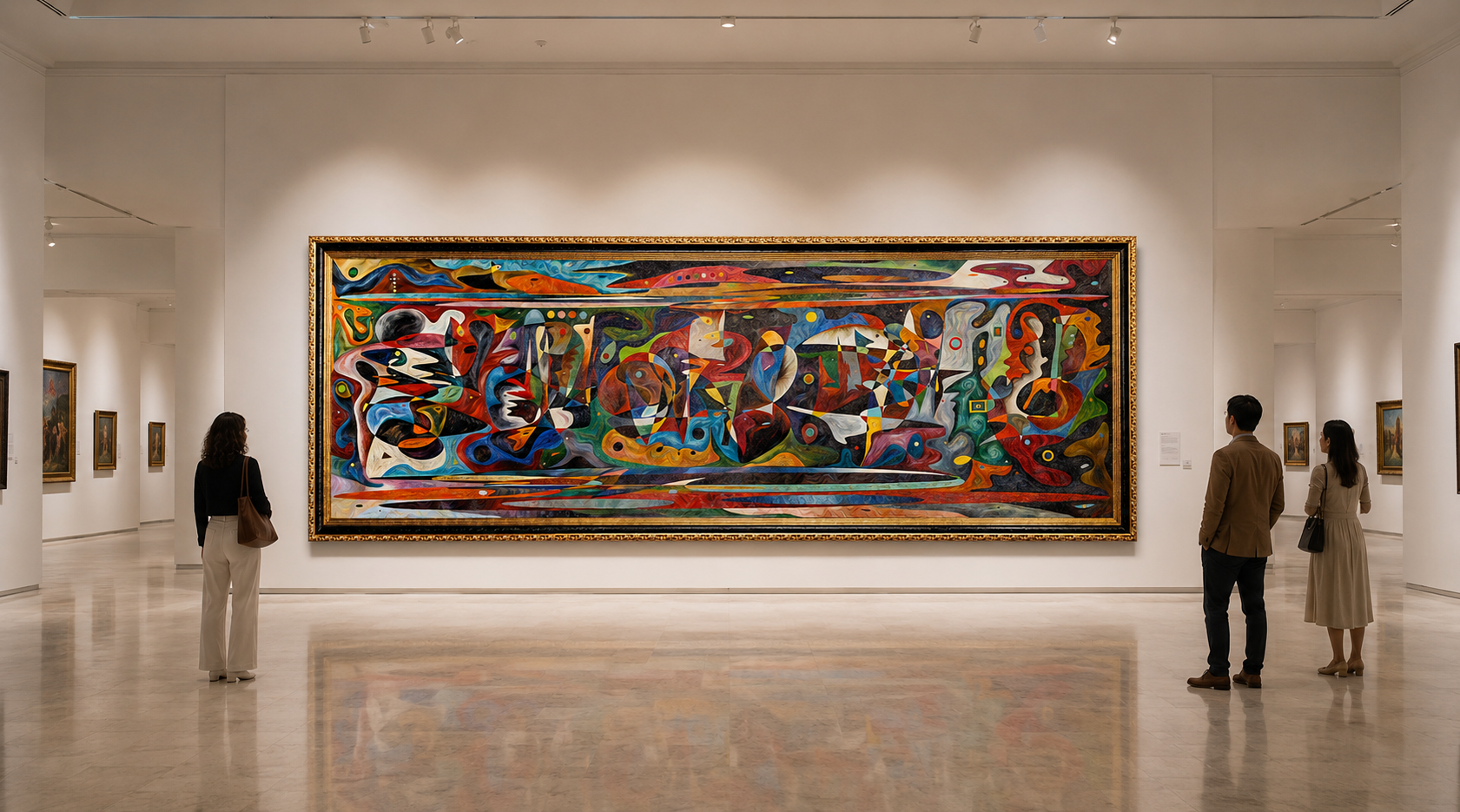
Christianity (2010)
Curatorial Essay
09 Apr 2026In Christianity (2008–2010), Gheorghe Virtosu constructs a directional visual field that unfolds from left to right as a movement across sacred history. Unlike works in the 10 Religions series that emphasize cyclical continuity or structural unity, this painting articulates a progressive transformation in which meaning, identity, and form emerge, destabilize, and ultimately become estranged from their origin. The composition does not present a linear narrative but encodes multiple theological moments—creation, fall, preservation, sacrifice, and contemporary condition—within a continuous yet shifting system of relations.
The left section establishes a zone of relative coherence, where symbolic clusters corresponding to origin narratives are most legible. Interwoven forms evoke Adam and Eve, bound within a serpentine motion that signals relational rupture from the outset. Nearby, a vessel-like structure suggests the Ark, while fish-like forms circulate as distributed markers of early belief. A cross, constructed from dispersed chromatic points rather than a unified form, emerges within this field. Its fragmentation is critical: rather than functioning as a fixed symbol, it appears as an event assembled from multiplicity, aligning with Roland Barthes’ conception of the sign as inherently unstable and perpetually deferred¹.
As the composition advances toward the center, layers of mediation begin to interrupt the immediacy of these symbolic forms. The surface becomes stratified, recalling systems of inscription, transmission, and codification. Meaning is no longer directly accessible but filtered through structures that organize and reinterpret it. This middle register operates as an interface in which presence and absence coexist, transforming lived relation into structured articulation. The painting thus stages the passage from event to system, from experience to doctrine.
The right side marks a decisive transformation in which coherence gives way to fragmentation. Forms darken, faces dissolve, and boundaries lose stability, producing a field of increasing perceptual uncertainty. Identity no longer holds as a coherent structure but becomes dispersed across overlapping and incomplete configurations. This progression enacts a process of deterritorialization in the sense articulated by Gilles Deleuze and Félix Guattari², where established forms lose their coordinates and drift into new, unstable arrangements.
This trajectory culminates in the upper right region, where a figure emerges that appears distinctly estranged—elongated, simplified, and detached from the human field below. Rather than representing an external entity, this form can be understood as the endpoint of a transformation in which the human image becomes unrecognizable. In contrast to the theological premise of a stable imago, identity here persists only as a trace, no longer anchored to its origin. The painting thus articulates a condition in which resemblance collapses, and subjectivity becomes alien to itself.
The composition as a whole resists cyclical resolution. Instead, it proposes a directional unfolding characterized by irreversibility, where meaning originates in structure, is reorganized through mediation, and gradually disperses into fragmentation. This movement aligns with Jacques Derrida’s notion of différance³, in which meaning is continually deferred and constituted through difference. No symbol within the painting achieves final stability; each remains contingent upon its position within an evolving network.
The symbolic density of the work further reinforces this condition. The cross, the ark, the serpent, and the fish do not function as isolated signs but as relational nodes within a metasymbolic system. Their meanings shift as they move across the compositional field, resisting singular interpretation. The viewer is thus implicated in the production of meaning, navigating a space where symbols are continuously reconfigured through perception.
A deeper philosophical resonance emerges in relation to Michel Foucault’s concept of historical epistemes⁴, in which systems of knowledge transform over time, producing discontinuities in meaning and representation. Virtosu’s painting can be understood as a visual analogue to this process, staging a transition from coherence to fragmentation without offering reconciliation. The field becomes a site of historical drift, where structures persist but no longer guarantee stability.
Chromatically, the work reinforces this trajectory. The left side maintains greater clarity and saturation, while the right side darkens and compresses into more ambiguous tonalities. Color thus operates not only as a formal device but as a temporal indicator, marking the movement from legibility toward obscurity. The gradual dominance of darker tones underscores the painting’s progression toward instability and estrangement.
Ultimately, Christianity operates as a visual philosophy of transformation through rupture. It does not resolve the tensions it presents but sustains them within an open, evolving system. By collapsing sacred history into a continuous yet directional field, Virtosu reveals the conditions under which meaning is generated, mediated, and destabilized. What remains is not a fixed system of belief, but a dynamic structure in which identity, perception, and representation persist through their continual transformation.
Artist Biography
Gheorghe Virtosu is a contemporary painter whose work explores the intersection of symbolic systems, philosophy, and visual abstraction. His practice engages with global belief structures and theoretical frameworks, translating them into complex compositions that emphasize transformation, interconnection, and the instability of meaning. Through his 10 Religions series, Virtosu investigates shared conceptual foundations across cultures, inviting viewers into an active and reflexive process of interpretation.
Technical Notes
Executed in oil on canvas at a monumental scale (2 × 6 meters), the work creates an immersive visual environment. Layered applications of paint generate depth and stratification, allowing forms to emerge, overlap, and dissolve across multiple perceptual planes. The interplay between biomorphic figuration and structural fragmentation reinforces the conceptual tension between coherence and disintegration, while the chromatic shift from clarity to darkness supports the painting’s directional progression.
Acknowledgments
Presented by El Arte Monumental
Curatorial Team: Daniel Varzari
Photography: Courtesy of El Arte Monumental
Special Thanks: Daniel Varzari
Notes
- Roland Barthes, Mythologies.
- Gilles Deleuze and Félix Guattari, A Thousand Plateaus.
- Jacques Derrida, Of Grammatology.
- Michel Foucault, The Archaeology of Knowledge.
Selected Bibliography
- Barthes, Roland. Mythologies.
- Derrida, Jacques. Of Grammatology.
- Deleuze, Gilles, and Félix Guattari. A Thousand Plateaus.
- Foucault, Michel. The Archaeology of Knowledge.
- Agamben, Giorgio. The Time That Remains.
- Auerbach, Erich. Mimesis.