
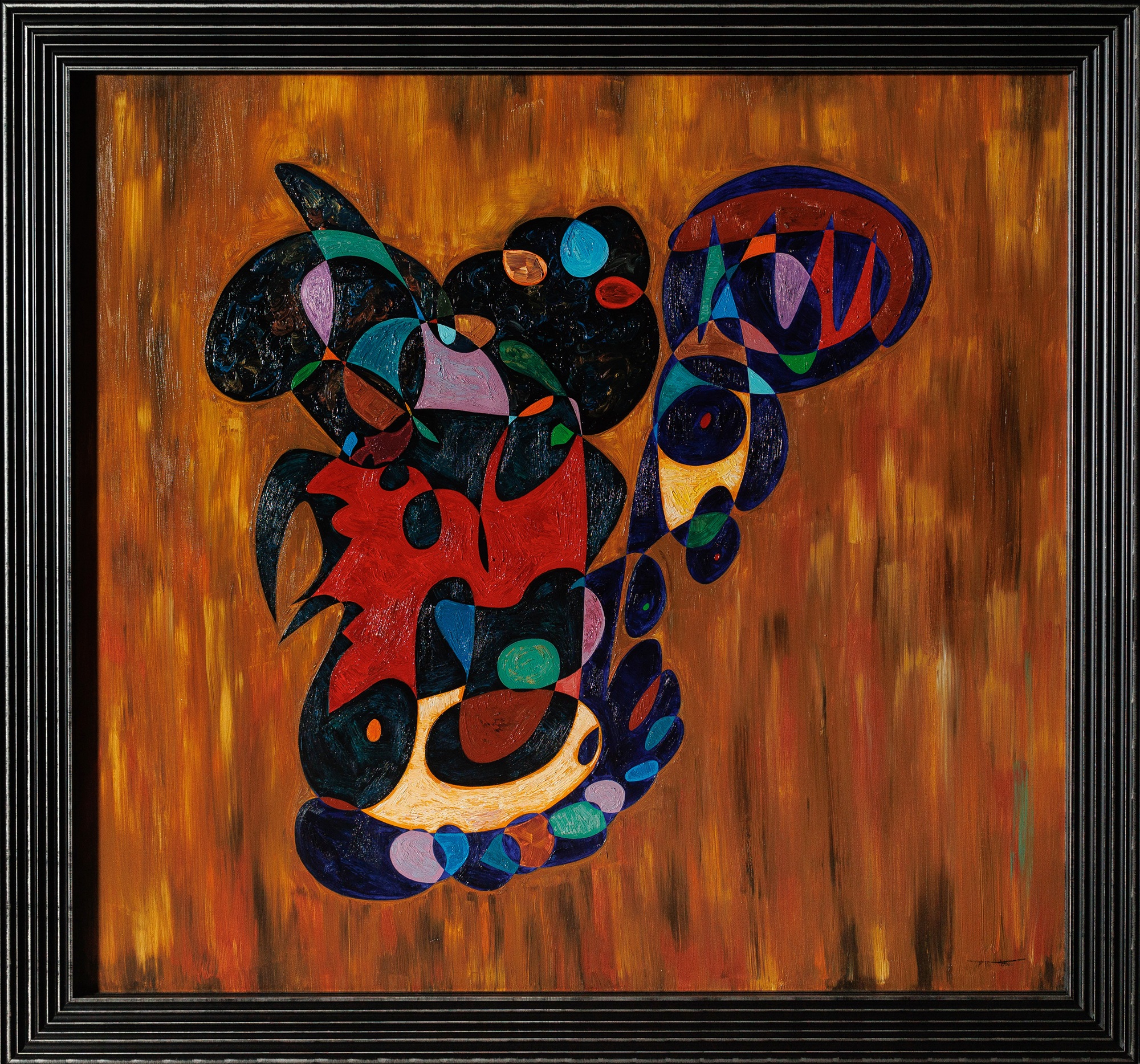
Darius III (2005)
Curatorial Essay
30 Apr 2026Darius III (2005) presents a meditation on power, fragmentation, and historical memory. Developed as part of Gheorghe Virtosu’s Six Wars System, the work functions as Codex II of the larger composition Battle of Gaugamela (2000–2002). Rather than depicting the battle itself, the painting isolates its symbolic aftermath, focusing on the instability of imperial authority at the moment of collapse.
The figure of Darius III is not represented directly but emerges as a fragmented configuration suspended within a luminous ochre field. Interlocking forms suggest a body—eyes, limbs, armour-like structures—yet refuse to resolve into a unified figure. The composition presents sovereignty as something constructed and unstable, held together through tension rather than coherence¹.
The background plays a critical role in shaping this reading. Built from layered tones of ochre, rust, and gold, the surface suggests both atmosphere and erosion. Vertical striations evoke heat, residue, and the afterimage of conflict, transforming the field into an active environment rather than a passive backdrop. The sense of place is indirect, registering not as geography but as a condition of intensity.
Colour functions structurally across the composition. Dense black forms anchor the central cluster, while vivid accents of red, blue, green, and violet punctuate the surface. These elements do not describe volume but operate as visual signals, interrupting continuity and directing attention. The sharp red passages introduce a sense of rupture, reinforcing the instability of the figure and its internal tensions.
The designation of the work as “Codex II” frames it as part of a system of visual recording. Rather than offering a readable narrative, however, the painting constructs an archive of fragments—marks that preserve the trace of an event without resolving into a fixed meaning². In this sense, the work aligns historical memory with abstraction: what remains is not the event itself, but its dispersed and unstable aftereffects.
The scale and near-square format create a contained yet expansive field in which the central form appears both dominant and precarious. It occupies the space without fully controlling it, while the surrounding surface presses inward, suggesting the possibility of dissolution. This spatial tension mirrors the broader conceptual framework of the work, where authority and identity remain unresolved.
As part of the Six Wars System, Darius III contributes to a wider investigation of conflict as structure rather than event. War is not depicted directly; it is encoded within form, colour, and surface. The painting situates the historical figure within a field of abstraction, transforming sovereignty into a condition that is contingent, fragmented, and continually in flux³.
Darius III ultimately reframes history as a problem of interpretation. By dissolving the figure into a system of visual relations, the work challenges the viewer to consider how power, identity, and memory are constructed. The result is not an image of authority, but its afterimage—unstable, dispersed, and resistant to resolution.
Artist Biography
Gheorghe Virtosu is a contemporary painter whose work explores abstraction as a vehicle for articulating complex psychological, social, and systemic conditions. His practice is characterized by large-scale compositions that integrate geometric segmentation with biomorphic fluidity.
Emerging from a background shaped by political upheaval and personal adversity, Virtosu channels lived experience into a visual language defined by intensity, transformation, and structural experimentation.
His work from the mid-2010s marks a critical transition toward what would later be formalized as New Perfectionism, a framework in which abstraction operates as a system of interrelated forces rather than a representational mode.
Through layered oil techniques and complex compositional strategies, Virtosu constructs immersive environments that require active perceptual engagement and resist fixed interpretation.
Technical Notes
Medium: Oil on canvas
Dimensions: 171 × 169 cm
The painting combines a layered, textured background with more controlled applications of paint in the central forms. Thick vertical brushwork creates a sense of depth and movement, while the sharply defined shapes of the figure introduce structural clarity within an otherwise unstable field.
Notes
- Pierre Briant, From Cyrus to Alexander (2002), on the structure and collapse of the Achaemenid Empire.
- Michel Foucault, The Archaeology of Knowledge (1969), on archives and discontinuity.
- Paul Virilio, War and Cinema (1984), on the structuring logic of war and perception.
Selected Bibliography
- Briant, Pierre. From Cyrus to Alexander: A History of the Persian Empire. Winona Lake: Eisenbrauns, 2002.
- Foucault, Michel. The Archaeology of Knowledge. London: Routledge, 1972.
- Virilio, Paul. War and Cinema: The Logistics of Perception. London: Verso, 1989.
- Foster, Hal et al. Art Since 1900. London: Thames & Hudson, 2016.
- Clark, T. J. Farewell to an Idea. New Haven: Yale University Press, 1999.